
Most Affordable HVAC Technician Schools & Training in Salisbury for 2027
Audited and Verified:
Our Editorial and Data Verification Process
Research.com uses government datasets, official education statistics and primary institutional information to support its career and degree guides. Our review process checks factual accuracy, occupational definitions, source dates and the requirements associated with the credentials discussed.
How This Article Was Fact-Checked
Our editorial team verifies salary estimates, employment projections, education requirements and program information against original data providers and official organizations. Salary figures are checked against the relevant occupational definitions and reporting periods. Information about licensure, accreditation and required in-person training is reviewed separately.
Fact-checked and verified on:

Co-Founder and Chief Data Scientist

Reviewed by Karolina Broda
Fact-Checker and Data Verification
Choosing an affordable HVAC training program in Salisbury, North Carolina, means looking beyond tuition: you need enough hands-on practice to get hired without paying for training that misses your goal. The U.S. Bureau of Labor Statistics projects 10.9% national growth for HVAC mechanics and installers from 2025 to 2035. This guide compares costs, credentials, work-based routes, and North Carolina requirements. It also accompanies the Research.com team of data scientists' Most Affordable HVAC Technician Trade Schools in Salisbury for 2027 ranking, created to help students identify programs worth considering.
Key findings about HVAC technician degrees in Salisbury
- Compare routes, not just schools: Salisbury-area students can investigate a community-college HVAC credential, employer training, or a registered apprenticeship. Ask each provider how much supervised equipment work is included.
- Plan for refrigerant work: The U.S. Environmental Protection Agency requires Section 608 technician certification for covered work involving regulated refrigerants; finishing a school program does not itself award that certification.
- Use wages as context, not a starting-pay quote: The national median for HVAC mechanics and installers was $61,010 in May 2025, according to the U.S. Bureau of Labor Statistics. Local entry-level offers and the total cost of getting job-ready matter more to an individual investment decision.
Table of Contents
- Most Affordable HVAC Technician Schools & Training in Salisbury for 2027
- What can I expect from an HVAC technician trade school program in Salisbury?
- Where can I work with an HVAC technician trade school training in Salisbury?
What can I expect from an HVAC technician trade school program in Salisbury?
Expect training in heating, ventilation, air conditioning, and refrigeration systems - not just classroom instruction. A suitable entry-level program should let you handle tools and meters, interpret wiring diagrams, diagnose faults, and practice safe service procedures on equipment. The U.S. Bureau of Labor Statistics describes installation, maintenance, and repair as core HVAC duties; ask how the program divides time among those tasks.
For a Salisbury resident, Rowan-Cabarrus Community College is a public-college option to investigate, but verify the current HVAC credential, class site, schedule, fees, and available lab sections directly before enrolling. A nearby employer or registered apprenticeship may fit better if you need to earn while learning. The comparison is practical: school can provide structured preparation before a job search, while work-based training ties instruction to paid field experience but depends on finding a sponsor or employer.
The table distinguishes the routes by what you receive and what you still need to verify.
| Route | Typical credential or outcome | Best fit and main limitation |
| Community-college HVAC program | Certificate, diploma, or associate degree, depending on the program | Structured labs and a documented credential; confirm field experience and total cost. |
| Employer-sponsored training | Job experience and employer-provided instruction; any external credential varies | Earlier earnings; instruction may be narrower than a full HVAC curriculum. |
| Registered apprenticeship | Paid, supervised work plus related instruction and an apprenticeship completion credential | Extensive work-based learning; entry depends on sponsor openings and selection rules. |
A short program is worth considering when its labs and employer connections match the work you want. It is a weaker investment if it advertises a credential but cannot show where you will practice diagnosing real equipment.
Where can I work with an HVAC technician trade school training in Salisbury?
Potential workplaces include residential service companies, commercial building contractors, facilities-maintenance departments, and refrigeration service employers. These settings call for different preparation: residential service emphasizes varied customer calls, while commercial and refrigeration work may involve larger controls, different equipment, and more travel between sites. The U.S. Bureau of Labor Statistics identifies contractors and other employers across building-service settings as HVAC employers.
Salisbury applicants should ask prospective employers where crews actually report and which counties they serve. A job described as local may involve driving to worksites throughout the surrounding area. That changes transportation costs and makes a valid driver's license or driving record important for some roles, even when those are employer requirements rather than school admission requirements.
A verified Salisbury-specific wage figure is not available here, so the national figure is a benchmark rather than a local pay estimate. The U.S. Bureau of Labor Statistics reports a $61,010 national median annual wage for heating, air conditioning, and refrigeration mechanics and installers in May 2025. A median describes workers across experience levels and specialties; a newly trained technician should not treat it as an expected first offer.
When evaluating an offer, compare the base rate with paid travel, overtime terms, benefits, tool allowances, and whether training time is paid. Also ask whether the role is primarily maintenance, installation, or service. Those differences can affect both earnings and the experience you build toward more independent work.
There is no single Salisbury-wide duration or required number of school contact hours for entry-level HVAC employment. A short certificate concentrates on core skills; a diploma or associate-degree program generally covers a broader curriculum and takes longer. Apprenticeship combines related instruction with supervised work over a sponsor-defined period. Request each program's current calendar, total contact hours, lab hours, and expected time to completion for your intended schedule.
Speed is useful only if the training still fits the job. If an accelerated associate degree program appeals to you, check whether its pace leaves enough scheduled HVAC lab time and whether you can attend every required session while working. Part-time study may protect current earnings but delay entry into a technician role.
Online coursework can reasonably cover system theory, electrical fundamentals, reading diagrams, and some safety instruction. It cannot replace physically measuring circuits, connecting components, checking airflow, or troubleshooting equipment under supervision. A hybrid program can work well if its in-person labs are accessible from Salisbury and occur often enough to build competence; a fully online course is better viewed as supplemental preparation unless the provider arranges substantial practical training.
Convenient admission is not the same as occupational readiness. If you are comparing an online open enrollment college with a campus HVAC option, ask where hands-on work happens, who evaluates it, and whether attendance requires travel beyond the advertised study location. Confirm separately how the program prepares you for any certification exam; an online completion certificate is not an EPA credential.
There is no defensible single average for all Salisbury HVAC pathways: a college program, a private training provider, and a paid apprenticeship use different pricing and compensation models. Even among schools, published tuition does not necessarily include everything needed to finish. Request a written, program-specific cost estimate rather than treating the lowest advertised tuition as the cheapest route to work.
For a useful comparison, have each provider identify tuition, mandatory fees, books, tools, personal protective equipment, consumables, exam charges, and travel to labs or worksites. Add earnings you may forgo while studying, then subtract aid you are actually eligible to receive or wages paid during training. Federal Student Aid notes that aid eligibility depends on the institution and program; ask the provider whether the specific credential qualifies. Also investigate North Carolina workforce-training assistance and employer tool or tuition support before borrowing.
An affordability ranking can narrow the school search, but it does not calculate your personal return on investment. That depends on completion likelihood, debt, existing earnings, likely post-training pay, how long you expect to work in the trade, and the timing of those costs and earnings.
The award depends on the route: a school may offer a certificate, diploma, or associate degree; a registered apprenticeship awards its own completion credential. An employer may instead document completed training and job experience. Obtain the exact credential name in writing and ask whether courses can stack into a longer program or receive credit toward related training later.
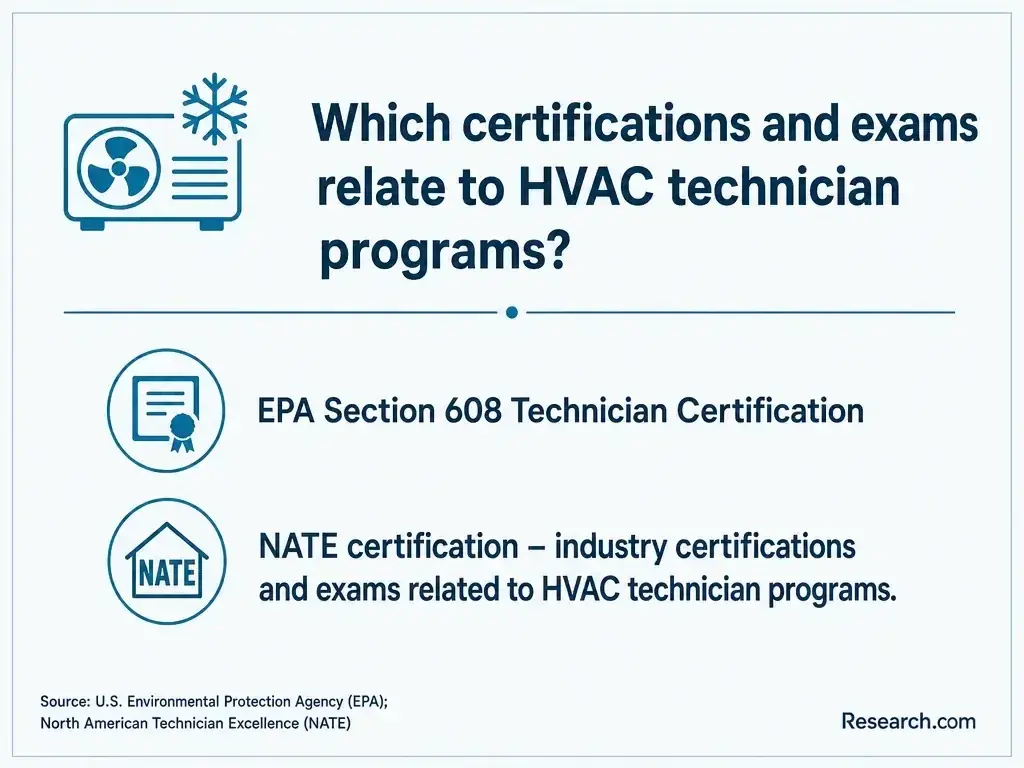
Do not confuse a school award with a certification or license. The U.S. Environmental Protection Agency's Section 608 certification concerns regulated refrigerant handling and requires passing the applicable exam; it is not automatically awarded with an HVAC certificate. Likewise, completing an associate program is not the same as qualifying to operate an independent contracting business in North Carolina.
Search results for a best online associate degree in 6 months may be tempting when you want a fast credential. For HVAC, judge the option by its actual equipment practice, credential, and exam preparation - not the advertised timeline alone.
Requirements vary by provider and route. Ask a college about its application, placement or prerequisite rules, age requirements for particular activities, and whether previous coursework or relevant work qualifies for credit. An employer or apprenticeship sponsor may instead assess work readiness, availability, driving ability, and aptitude; selection is not the same process as school admission.
Before applying, distinguish entry requirements from job requirements. A school may admit you without a driver's license, while a service employer may need technicians to reach customer sites. If you have prior maintenance experience, ask whether it changes course placement or apprenticeship standing - but get any credit or advanced-standing decision confirmed by the provider.
A useful HVAC curriculum connects electrical controls, refrigeration principles, heating systems, airflow, equipment installation, diagnostics, and safety. The U.S. Bureau of Labor Statistics notes that technicians work with mechanical and electrical components and must follow refrigerant-handling rules. Because service calls rarely present faults neatly, supervised troubleshooting is more valuable than watching demonstrations alone.
Ask to see the equipment used in labs and how students' skills are assessed. Practice with meters, wiring, pressure-related procedures, and fault diagnosis should prepare you to explain what you found - not merely replace a part by rote. Customer communication, accurate service notes, and safe work habits also matter when moving from a classroom to occupied homes or buildings.
Not every HVAC employee needs an individual North Carolina contractor license. The North Carolina State Board of Examiners of Plumbing, Heating and Fire Sprinkler Contractors regulates covered heating contracting work; licensing a contracting business or qualifying to perform regulated work independently is different from taking an entry-level job with an appropriately licensed employer. Do not assume school graduation grants contracting authority. Check the board's current classification, experience, and examination rules before choosing training specifically to support a future contracting goal.
Separately, the U.S. Environmental Protection Agency requires Section 608 technician certification for covered work involving regulated refrigerants. Ask whether your program includes exam preparation, whether the exam itself is included, and which certification type fits the work you intend to do. Institutional accreditation, state authorization to offer education, apprenticeship registration, EPA certification, and state contractor licensure serve different purposes; none automatically substitutes for another.
Start with the job you want - residential service, commercial installation, refrigeration, or a longer-term contracting goal - then compare programs against that outcome. The following checks help reveal costs or training gaps that a ranking alone cannot show:
- Ask for the exact credential, schedule, total contact hours, supervised lab hours, and any field-placement arrangements.
- Request an itemized cost estimate, including tools, safety gear, exam fees, and travel from Salisbury to every required site.
- Verify institutional accreditation or applicable school authorization separately from certification preparation and North Carolina contractor-licensing requirements.
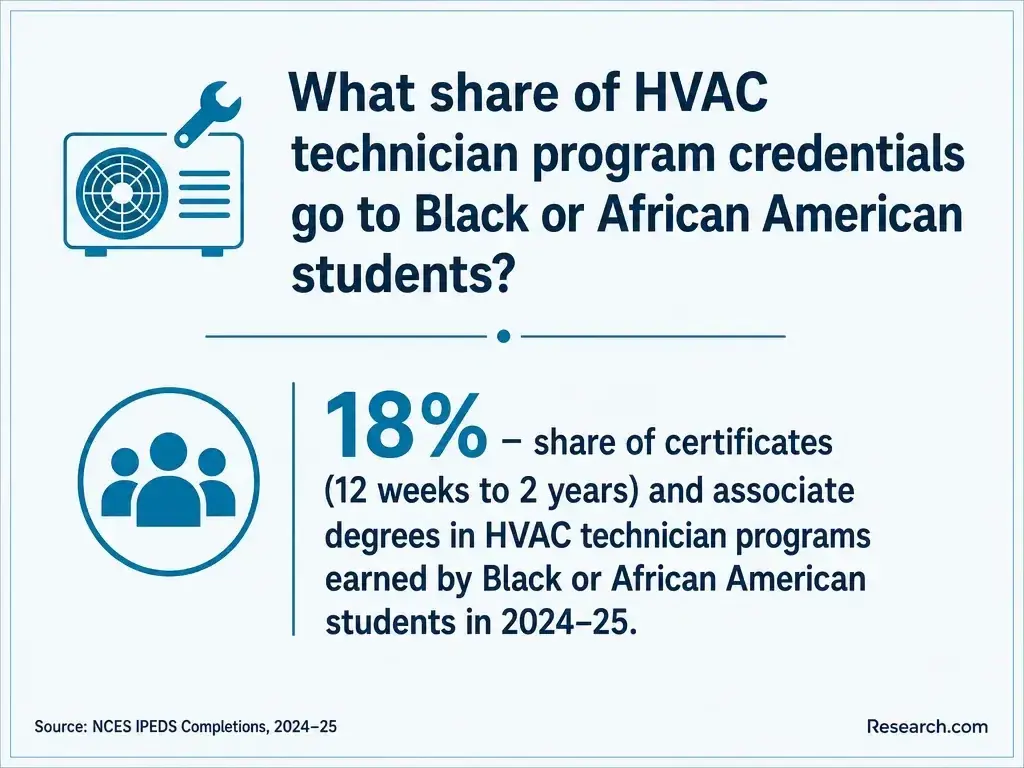
- Ask what evidence the provider has for completion, employer connections, and graduates entering HVAC roles; confirm what population and period any outcomes describe.
- Compare a school offer with available paid apprenticeship or employer-training opportunities before committing to debt.
Be wary of promises of guaranteed jobs or wages, vague claims that a program is "licensed," and online options that cannot identify required practical sessions. If a search leads you to dual degree programs usa, refocus on the narrower HVAC decision: which route gets you the relevant equipment skills, work experience, and required certification at a manageable total cost?
Training can support an application for an installation helper, maintenance, or entry-level service role, depending on demonstrated skills and employer expectations. With field experience, a technician may take on more complex diagnostics, commercial systems, refrigeration, controls, or supervisory responsibilities. Independent contracting is a separate step governed by North Carolina's applicable licensing rules, not an automatic outcome of an entry credential.
If your main question is what is a quick degree that pays well, HVAC deserves a closer look at the work itself. The national occupational median is useful context, but the stronger reason to enroll is a realistic route from training to a job you can perform well. Someone who wants paid, supervised learning may prefer an apprenticeship; someone seeking structured labs before applying for field work may prefer a college program.
The U.S. Bureau of Labor Statistics projects 10.9% growth nationally from 2025 to 2035 for heating, air conditioning, and refrigeration mechanics and installers. That supports considering the trade, but it is not a Salisbury hiring forecast or a promise of a local opening. Before enrolling, review current postings within a commute you can sustain: note whether employers seek helpers, require experience, or specify refrigerant certification.
That check can change your training choice. If accessible openings favor experienced service technicians, a program with employer placements or a paid apprenticeship may bridge the gap better than classroom-only study. If entry-level installation positions are available, a shorter hands-on credential paired with continued employer training may be sufficient.
Most Affordable HVAC Technician Schools & Training in Salisbury for 2027
Investing in HVAC training is a consequential financial decision. To help readers compare local options on consistent terms, the Research.com team evaluates programs against others in the same occupation and location. Only programs with completions reported to the Integrated Postsecondary Education Data System (IPEDS) are eligible for the ranking; an unlisted apprenticeship or employer training program is not necessarily a poor option.
The most affordable ranking scores costs and debt only: tuition, cost of attendance, median student debt, and the federal loan default rate. An entropy-based method gives more weight to measures that differ more across eligible programs. Accreditation, training quality, and employment outcomes are not included in this affordability score. Research.com's separate best-program rankings also consider completion, retention, earnings, student support, and relevant recognition. Readers should therefore use the affordability ranking as a cost comparison, not proof that a program provides the practical training they need.
The ranking process draws on the following data sources. Some are relevant to other trades in Research.com's broader ranking system rather than HVAC specifically:
- IPEDS database - reported institutional costs, enrollment, and completions.
- National Center for Education Statistics - federal education data and definitions.
- College Scorecard database - available cost, debt, and outcome measures.
- Peterson's database - supplementary institution and program information.
- Commission on Accreditation of Allied Health Education Programs - accreditation information for applicable health programs, not HVAC approval.
- Accrediting Bureau of Health Education Schools - accreditation information for applicable health programs, not HVAC approval.
- Commission on Dental Accreditation - accreditation information for applicable dental programs, not HVAC approval.
- Dental Assisting National Board - credential information for applicable dental programs, not HVAC certification.
- National Center for Construction Education and Research - information on applicable construction-trade training and credentials.
- Apprenticeship.gov Partner Finder - information on potential work-based training alternatives.
These sources help make the comparison more consistent, but published institutional data cannot capture every tool purchase, commute, or paid apprenticeship opportunity. See Research.com's methodology for more information about how the ranking is created.
# 2 position
Frequently asked questions about HVAC technician programs in Salisbury
What is the cheapest way to start HVAC training near Salisbury?
Compare the full cost of a public-college credential with paid apprenticeships and employer training. The cheapest advertised tuition may not be the lowest-cost path once tools, travel, forgone wages, and aid are included.
Can I become an HVAC technician without trade school?
Yes. Some people enter through employer training or a registered apprenticeship. Ask how each route provides supervised practice and prepares you for refrigerant work.
Can I complete HVAC training entirely online?
You can study theory online, but equipment setup, measurements, and troubleshooting require hands-on practice. Confirm where and when a hybrid program provides it.
Does an HVAC certificate include EPA Section 608 certification?
Not automatically. Ask whether the program prepares you for the applicable exam and whether testing is included in its price.
Will a school credential let me start my own HVAC contracting business?
No credential alone establishes that authority. Check the North Carolina licensing board's current requirements for the contracting work you intend to perform.
- U.S. Bureau of Labor Statistics - Heating, Air Conditioning, and Refrigeration Mechanics and Installers
Used to verify salary, employment outlook, and typical education requirements.
https://www.bls.gov/ooh/installation-maintenance-and-repair/heating-air-conditioning-and-refrigeration-mechanics-and-installers.htm - NCCER - Accredited Training
Used to verify programmatic accreditation or industry recognition of programs.
https://www.nccer.org/ - NATE - Certification
Professional certification reference for graduates of this occupation.
https://natex.org/ - Rowan-Cabarrus Community College - official website
Official school website (programs, tuition, admissions).
https://www.rccc.edu/