
Best Electrical Technician Training Programs & Trade Schools in Granite Falls for 2027
Audited and Verified:
Our Editorial and Data Verification Process
Research.com uses government datasets, official education statistics and primary institutional information to support its career and degree guides. Our review process checks factual accuracy, occupational definitions, source dates and the requirements associated with the credentials discussed.
How This Article Was Fact-Checked
Our editorial team verifies salary estimates, employment projections, education requirements and program information against original data providers and official organizations. Salary figures are checked against the relevant occupational definitions and reporting periods. Information about licensure, accreditation and required in-person training is reviewed separately.
Fact-checked and verified on:

Co-Founder and Chief Data Scientist

Reviewed by Karolina Broda
Fact-Checker and Data Verification
Choosing electrician training near Granite Falls, Minnesota, means comparing more than tuition: you need supervised work, practical skills, and a path toward state licensure. The U.S. Bureau of Labor Statistics projects electrician employment to grow 9.2% nationally from 2025 to 2035, but that does not guarantee a local opening. This guide helps prospective students and career changers compare trade school with paid apprenticeship, costs, credentials, and career prospects. It also accompanies the Best Electrician Trade Schools in Granite Falls for 2027 ranking, created by the Research.com team of data scientists to help students identify programs worth considering.
Key findings about electrician degrees in Granite Falls
- For Minnesota journeyworker electrician licensure, classroom training alone is not enough: applicants must document qualifying practical experience and pass the state examination under Minnesota Department of Labor and Industry rules.
- The national median annual wage for electricians was $63,190 in May 2025; it is not a Granite Falls starting-pay estimate (U.S. Bureau of Labor Statistics).
- A short certificate may teach fundamentals, but a paid registered apprenticeship combines classroom instruction with supervised work. Compare each option's total cost, work placement, and applicable experience credit before enrolling.
Table of Contents
- Best Electrical Technician Training Programs & Trade Schools in Granite Falls for 2027
- What can I expect from an electrician trade school program in Granite Falls?
- Where can I work with an electrician trade school training in Granite Falls?
What can I expect from an electrician trade school program in Granite Falls?
Expect instruction in electrical theory, the National Electrical Code, blueprint reading, circuits, conduit, testing, and jobsite safety. The decisive question is how much of that instruction you will practice in a lab or on an actual worksite. Wiring a training panel is valuable preparation, but it is not the same as accumulating documented, supervised experience toward a Minnesota journeyworker license.
Granite Falls is a smaller community, so compare the location of both classes and worksites. Ask Minnesota West Community and Technical College which electrical training options, if any, are currently available at a campus you can reach; do not assume every program is offered at every campus. Also compare registered apprenticeships and employer-sponsored routes that place you with contractors across the surrounding area. A longer commute can change the real cost of an otherwise affordable program.
The pathways solve different problems. A pre-apprenticeship or trade-school certificate can help a newcomer build basic skills before applying for work; an apprenticeship is better suited to someone ready to earn wages while completing structured, supervised training. An associate degree may appeal to a student who wants broader technical coursework, but the degree itself does not replace Minnesota's licensing requirements.
Where can I work with an electrician trade school training in Granite Falls?
Electrical work spans residential construction, commercial buildings, industrial maintenance, and utility-related facilities. Near Granite Falls, the practical search area may extend beyond town to contractors and employers elsewhere in southwest and west-central Minnesota. That makes access to a vehicle, early jobsite start times, and the geographic reach of an apprenticeship sponsor worth checking before you commit.
Trade-school training can support applications for supervised entry-level electrical work, but it does not independently authorize licensed electrical work. Ask prospective employers whether they hire and supervise Minnesota-registered unlicensed electrical workers, what tasks beginners perform, and whether they document experience in the form the Minnesota Department of Labor and Industry requires.
The U.S. Bureau of Labor Statistics reports a $63,190 national median annual wage for electricians in May 2025. That figure covers experienced workers as well as newer electricians; it is neither a Granite Falls wage nor an apprentice starting wage. Pay can differ by employer, specialty, overtime, and whether the job is in town or requires travel to a larger market.
For a usable local estimate, request current apprentice wage steps and benefit information from apprenticeship sponsors and compare actual entry-level postings in your commuting area. When judging a program's return, weigh likely starting earnings against tuition, debt, time away from paid work, the chance of completing training, and the years needed to reach your target role - not the national median alone.
Duration depends on the credential and schedule. A short pre-apprenticeship or certificate concentrates on entry skills; a diploma or associate degree generally involves a longer course of study. A registered apprenticeship extends beyond classroom training because it combines instruction with substantial supervised employment. Confirm the current calendar and required contact hours with the provider rather than assuming similarly named programs take the same time.
Minnesota's journeyworker electrician pathway requires 48 months of qualifying experience, with examination and experience rules administered by the Minnesota Department of Labor and Industry. The department determines whether particular education receives experience credit and whether work qualifies. Before paying for a program, obtain its written explanation of any potential credit and verify it with the state; finishing classes does not automatically complete the licensing pathway.
Online coursework can make code reading, calculations, and electrical theory easier to fit around work. It cannot by itself demonstrate safe installation, troubleshooting with instruments, or supervised jobsite performance. A hybrid option makes sense only if its required labs are accessible and its work-based component fits your schedule.
The comparison below separates what a format can teach remotely from what you still need to arrange in person. General lists of most popular online universities cannot establish whether an electrician program provides that practical training.
| Format | Best fit | Practical limitation to verify |
| Online theory | Someone preparing for entry or studying while employed | Where labs and supervised work will occur |
| Hybrid program | Someone who can travel for scheduled labs | Lab frequency, location, and equipment access |
| On-campus program | Someone who benefits from regular instructor-led practice | Whether it also connects students to qualifying work |
| Apprenticeship | Someone ready for paid, supervised work plus instruction | Entry requirements, work availability, and travel area |
For Granite Falls residents, a distant lab may make a nominally flexible hybrid program less convenient than nearby in-person training. Never treat an entirely online completion certificate as proof of Minnesota license eligibility.
There is no defensible single average for Granite Falls electrician training: prices vary by provider, credential, residency status, and whether training is delivered through paid employment. Request a current, itemized estimate for each option. A comparison of online phd cost, for instance, would not capture an electrician trainee's tools, protective equipment, or worksite travel.
Budget for tuition and mandatory fees, books and code materials, tools, meters, protective gear, transportation, and any examination or licensing charges. Also account for earnings you may give up while attending classes. A paid apprenticeship may offset some of these costs with wages, while an eligible college program may offer grants or federal aid; eligibility depends on the program and student, according to Federal Student Aid. Ask providers whether tools are supplied and whether workforce funding or employer reimbursement is available before borrowing.
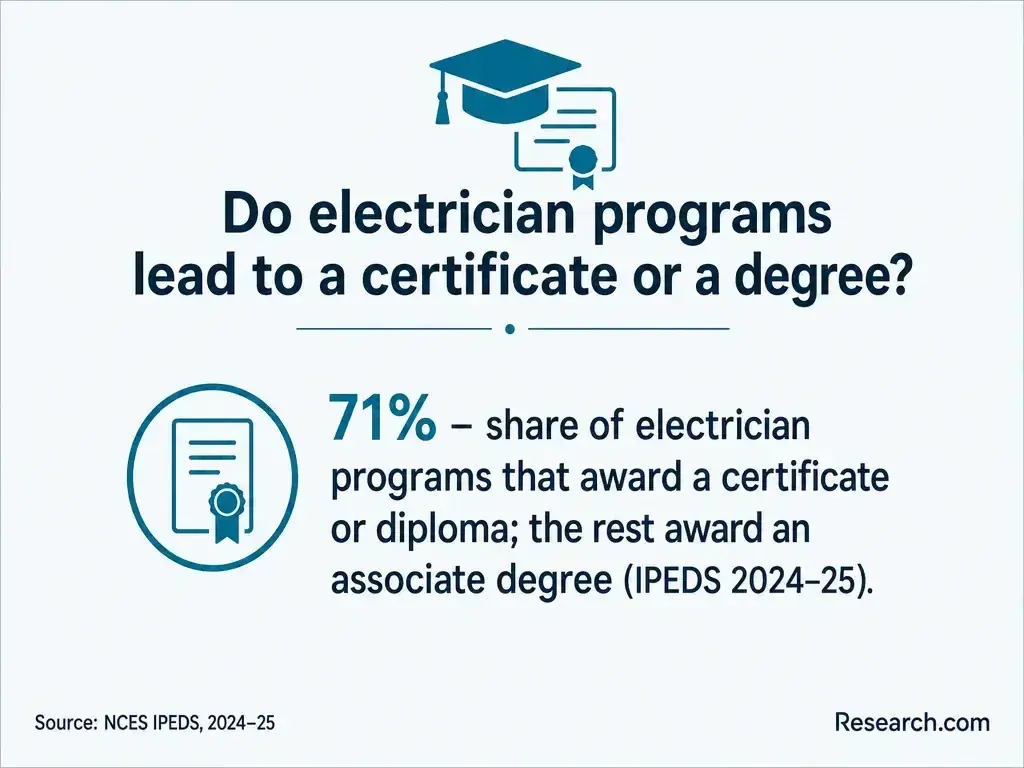
The award may be a pre-apprenticeship completion certificate, a trade certificate or diploma, or an associate degree. A registered apprenticeship instead documents completion of an approved work-and-instruction program. These credentials are not interchangeable: the most useful one is the one employers recognize and that helps you obtain qualifying supervised work.
Minnesota occupational licensure is separate from a school award, institutional accreditation, school authorization, industry training recognition, and apprenticeship registration (Minnesota Department of Labor and Industry; U.S. Department of Labor). When considering college majors that are worth it, keep the electrician decision anchored to its own outcome: whether the credential and practical experience move you toward the electrical work you intend to do.
Requirements vary. A college or career-school program may ask for an application and evidence that you are ready for its math and reading coursework. An apprenticeship sponsor or employer may additionally screen for jobsite readiness, reliable transportation, and the ability to meet its hiring requirements. Request the current criteria directly; admission to classes is not the same as selection for a paid apprenticeship.
If you are looking at open enrollment colleges, check the electrician program's requirements separately. Before accepting electrical work in Minnesota, verify the state's unlicensed-worker registration and supervision rules with the Minnesota Department of Labor and Industry. Ask whether the provider helps students secure supervised positions and how it handles applicants who cannot immediately find one.
A useful curriculum connects calculations and code requirements to installations: reading plans, sizing and assembling circuits, bending conduit, making connections, using test instruments, identifying faults, and working safely around energized systems. The U.S. Bureau of Labor Statistics identifies installation, maintenance, and repair as core electrician duties; practice should prepare you for those tasks, not just for a written test.
Ask to see the lab syllabus and equipment list. Find out which tasks students perform themselves, how instructors assess safe work, and whether the program arranges supervised field experience. Training in newer equipment, such as charging infrastructure, can be useful, but it should build on sound wiring and code fundamentals rather than replace them.
Yes, Minnesota regulates electrical work. A beginner may work under applicable unlicensed-worker registration and supervision rules; independent journeyworker-level work requires meeting state experience requirements and passing the licensing examination (Minnesota Department of Labor and Industry). Operating an electrical contracting business involves separate state requirements. Do not confuse permission to train under supervision with permission to work independently.
Before enrolling, check the Minnesota Department of Labor and Industry's current rules for the license you seek, qualifying experience, any allowable education credit, examination, and worker registration. An NCCER or other industry credential may signal skills to an employer, but it is not a Minnesota electrical license. Likewise, an accredited school does not automatically make its graduates license-eligible.
Start with your intended job: residential installation, commercial construction, or maintenance may lead you to different employers and training opportunities. Then compare each program with a paid apprenticeship on the same terms - practical experience, time to employment, total cost, and a documented path toward Minnesota licensure. A ranking can identify options to investigate, but it cannot tell you whether a lab schedule or worksite commute fits your life.
Use these questions with admissions staff and apprenticeship coordinators; ask for written answers where the claim affects cost or licensing.
- What credential is awarded, and which labs or supervised work placements are required?
- Who helps arrange qualifying electrical employment, and how is experience documented?
- What is the full cost after fees, tools, safety gear, and travel, and what aid or paid training is available?
- What are the current completion and employment outcomes, and what do they measure?
- How does this training relate to Minnesota's current journeyworker eligibility rules?
Verify institutional accreditation through the recognized accreditor and any applicable school authorization through the relevant regulator; verify occupational requirements separately with the Minnesota Department of Labor and Industry. A list of top accredited universities in the us cannot answer the electrician-specific questions above. Red flags include a claim that online coursework alone grants a license, unclear tool charges, or a promise of journeyworker pay immediately after graduation.
A common progression is supervised entry-level work, growing responsibility as experience is documented, and application for journeyworker licensure once state requirements are met. From there, electricians may pursue maintenance, commercial or industrial work, supervisory responsibilities, or contracting, subject to the qualifications that apply to each role (Minnesota Department of Labor and Industry; U.S. Bureau of Labor Statistics).
Choose training around the next step, not a distant job title alone. A beginner needs safe hands-on practice and an employer willing to supervise; an experienced worker changing specialties may benefit more from targeted code or equipment training than from repeating an introductory certificate. Ask whether prior learning or documented experience can reduce coursework, but let the state determine what counts toward licensure.
The U.S. Bureau of Labor Statistics projects 9.2% growth in U.S. electrician employment from 2025 to 2035. That national projection supports investigating the trade, but it does not measure vacancies in Granite Falls. Construction schedules, industrial maintenance needs, and the number of contractors willing to supervise trainees will matter more to your first job search.
Because the local market is smaller than a major metro area, compare openings across a realistic commuting radius before choosing a program. Look for apprentice and registered-worker positions as well as fully licensed roles; counting the latter as entry opportunities would overstate your immediate prospects. Ask sponsors where their apprentices actually work so you can judge whether the travel and schedule are sustainable.
Best Electrical Technician Training Programs & Trade Schools in Granite Falls for 2027
Investing in electrician training is a consequential decision. Research.com's team created the accompanying ranking to compare programs against others in the same occupation and location, using reported outcomes, costs, and quality indicators rather than a school's name alone. Only programs with completions reported to the Integrated Postsecondary Education Data System (IPEDS) are eligible; a registered apprenticeship or employer training program absent from IPEDS may still be a strong option.
For best-program rankings, programmatic accreditation or relevant industry recognition accounts for 20% of the score, institutional accreditation for 10%, and student support for 10%. The remaining 60% covers completion and full- and part-time retention, earnings one year after completion, earnings relative to annual attendance cost, tuition, attendance cost, debt - including debt held by students who withdrew - and federal loan default rates. An entropy-based method gives more weight to indicators that vary more across eligible programs. Most-affordable rankings use only tuition, attendance cost, median debt, and default rates, with entropy-based weights; accreditation and other quality measures are not part of that score.
The ranking methodology draws on the following data sources. Some serve the broader trade-program methodology rather than electrician-specific accreditation; for example, healthcare accrediting bodies do not approve electrician training.
- IPEDS database - program completions and institutional reporting.
- National Center for Education Statistics - education data and institutional context.
- College Scorecard database - available cost, debt, and earnings measures.
- Peterson's database - institutional and program information.
- Commission on Accreditation of Allied Health Education Programs (CAAHEP) - recognition data relevant to covered healthcare occupations.
- Accrediting Bureau of Health Education Schools (ABHES) - recognition data relevant to covered healthcare occupations.
- Commission on Dental Accreditation (CODA) - recognition data relevant to covered dental occupations.
- Dental Assisting National Board (DANB) - credential information relevant to dental assisting.
- National Center for Construction Education and Research (NCCER) - construction-trade training and industry-recognition context.
- Apprenticeship.gov Partner Finder - registered-apprenticeship pathway context.
Use the ranking to narrow your choices, then verify current program availability, hands-on instruction, costs, and Minnesota licensing implications directly with each provider. Research.com explains its approach further on its methodology page.
# 2 position

Frequently asked questions about electrician programs in Granite Falls
Is electrician trade school worth it if I can apply for an apprenticeship?
It can be if you need basic skills, structured lab practice, or help connecting with an employer. If you can enter a suitable paid apprenticeship directly, compare its wages and supervised experience with the school's full cost before enrolling.
Can I become a licensed electrician through online classes alone?
No. Online theory does not replace the qualifying practical experience, examination, and other Minnesota requirements for journeyworker licensure (Minnesota Department of Labor and Industry).
Does a trade-school certificate count toward Minnesota licensing experience?
Do not assume it does. Ask the provider to identify any claimed education credit, then confirm the program and your circumstances with the Minnesota Department of Labor and Industry.
Do I need to attend a program in Granite Falls itself?
No. Compare reachable campuses, apprenticeship sponsors, and employers across your commuting area. Check where labs and worksites are held, not just the address on a program listing.
What should I check before paying an enrollment deposit?
Confirm the credential, total charges, hands-on requirements, employer connections, refund terms, and how the training supports your intended Minnesota licensing pathway. Get those details in writing.
- U.S. Bureau of Labor Statistics - Electricians
Used to verify salary, employment outlook, and typical education requirements.
https://www.bls.gov/ooh/construction-and-extraction/electricians.htm - NCCER - Accredited Training
Used to verify programmatic accreditation or industry recognition of programs.
https://www.nccer.org/ - O*NET OnLine - Electricians
Used to verify common responsibilities, skills, work settings, and education expectations.
https://www.onetonline.org/link/summary/47-2111.00 - Minnesota West Community and Technical College - official website
Official school website (programs, tuition, admissions).
https://www.mnwest.edu/