# 1 position
Western Nevada College - Electrician.
associate

Audited and Verified:
Our Editorial and Data Verification Process
Research.com uses government datasets, official education statistics and primary institutional information to support its career and degree guides. Our review process checks factual accuracy, occupational definitions, source dates and the requirements associated with the credentials discussed.
How This Article Was Fact-Checked
Our editorial team verifies salary estimates, employment projections, education requirements and program information against original data providers and official organizations. Salary figures are checked against the relevant occupational definitions and reporting periods. Information about licensure, accreditation and required in-person training is reviewed separately.
Fact-checked and verified on:

Co-Founder and Chief Data Scientist

Reviewed by Karolina Broda
Fact-Checker and Data Verification
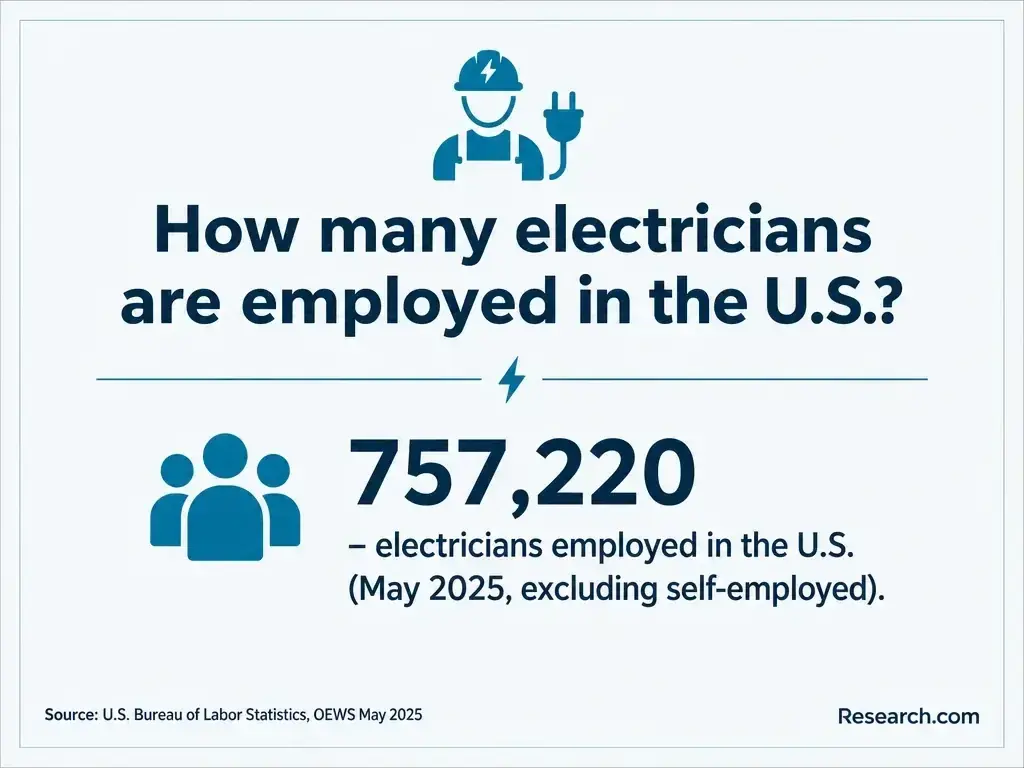
Choosing electrician training in Carson City means deciding whether to pay for classroom preparation, seek a paid apprenticeship, or combine the two. The stakes are real: U.S. electrician employment is projected to grow 9.2% from 2025 to 2035, according to the U.S. Bureau of Labor Statistics. This guide compares credentials, practical training, costs, wages, and Nevada's rules so you can choose a route into the trade. It also features a Best Electrician Trade Schools in Carson City for 2027 ranking created by the Research.com team of data scientists to help students make an informed choice about programs worth considering.
Expect a mix of electrical theory and supervised practice: reading plans, selecting wire and protective devices, making connections, testing circuits, and working safely around energized-equipment hazards. A useful program provides substantial lab access and explains which tasks students actually perform, rather than relying on demonstrations alone.
School training and apprenticeship solve different problems. A certificate can build entry-level skills before a job search; a registered apprenticeship combines paid, supervised work with related instruction over a longer period. Ask Western Nevada College which electrical courses and credentials are currently offered and whether a regional apprenticeship sponsor recognizes any of them. Do not assume similarly named certificates carry the same hands-on experience or apprenticeship credit.
Potential worksites include residential and commercial construction, building maintenance, industrial facilities, and public infrastructure. In and around Carson City, the practical question is whether you can reach a sponsor or employer with enough supervised work to develop your chosen specialty. Compare openings across Carson City and the wider western Nevada labor market before committing to a commute or a narrow training track.
Graduates of a short program may enter as helpers or apprenticeship applicants rather than independently performing the full scope of an experienced electrician's work. Employers set hiring standards, and job duties must comply with applicable supervision and contracting rules. The U.S. Bureau of Labor Statistics distinguishes electricians from electrical and electronics installers and repairers, so match a program's equipment and lab work to the jobs you intend to pursue.
The U.S. median annual wage for electricians was $63,190 in May 2025, according to the U.S. Bureau of Labor Statistics. That national occupation-wide figure is a benchmark, not a Carson City wage quote or a prediction for a new trainee. Before comparing offers, ask employers or apprenticeship sponsors for the applicable starting rate, scheduled raises, benefits, and expected hours; paid training can materially change the value of a pathway.
Compare wages for the same kind of role. An apprentice's rate, an experienced electrician's wage, and a contractor's business revenue are not interchangeable. For a school program, weigh likely entry pay against fees, borrowing, and any time away from paid work - not against the national median alone.
Duration depends on the credential and the amount of supervised work included. A short school certificate can teach fundamentals without completing an apprenticeship; an associate degree includes broader coursework; a registered apprenticeship follows a sponsor-approved schedule of related instruction and work-based learning. The U.S. Department of Labor describes electrical apprenticeships as commonly lasting four or five years, but applicants should obtain the particular sponsor's required hours, progression rules, and completion terms.
The comparison below separates time in school from time developing occupational competence. Verify current schedules with Western Nevada College and individual sponsors.
| Pathway | What completion means | Main scheduling trade-off |
| Pre-apprenticeship or short certificate | Completion of specified introductory instruction | May get you job-ready sooner, but does not itself complete supervised apprenticeship hours |
| Associate degree | Completion of an academic credential with technical coursework | Broader study and a longer school commitment; apprenticeship credit requires sponsor confirmation |
| Registered apprenticeship | Completion of sponsor-required instruction and supervised work | Longer route, generally with wages earned during training |
Online coursework can be useful for electrical calculations, plan reading, and code study. It cannot, by itself, demonstrate safe installation, testing, or troubleshooting on actual equipment. For a hybrid program, ask where labs take place, who supervises them, how many sessions require travel, and whether a prospective apprenticeship sponsor accepts the instruction.
On-campus training is most useful when you need access to tools and feedback before approaching employers. An online-only certificate may suit someone already receiving supervised practice at work, but it is a weak substitute for that practice. Institutional accreditation matters when evaluating a school - including the kinds of institutions discussed in guides to best non profit accredited online universities - but it does not turn remote coursework into electrical field experience.
There is no single reliable Carson City-wide average covering college classes, career schools, and paid apprenticeships: they charge differently and are not all represented in college cost databases. Obtain a current, program-specific estimate from Western Nevada College or another provider rather than treating a general tuition figure as the cost of becoming job-ready.
Ask for a written total covering tuition, mandatory fees, books or code materials, tools, protective equipment, transportation to labs or jobsites, and any examination or application charges. Then subtract confirmed grants, employer support, or apprenticeship wages and account for earnings forgone while attending. Federal Student Aid eligibility depends on the institution and program; workforce assistance should be confirmed with Nevada's workforce agency. A comparison with the cheapest online masters is not a useful electrician-training price benchmark: the credentials, practical requirements, and routes into work differ.
The credential depends on the route: a school may award a course-completion certificate, an occupational certificate, or an associate degree; a registered apprenticeship awards its own completion credential after required instruction and work experience. A course certificate documents learning, but it is not the same as apprenticeship completion or authorization to operate an electrical contracting business. Confirm the exact award and what employers or apprenticeship sponsors recognize before paying a deposit.
Industry credentials can supplement training where an employer values them, but a generic online certificate should not be mistaken for supervised electrical experience. That distinction matters even when considering broader lists of online certifications that pay well without a degree.
Schools and apprenticeship sponsors set different entry rules. Ask about basic math readiness, proof of prior education, age requirements, interviews or assessments, driving and travel expectations, and any employer-imposed screening. An apprenticeship may also require securing a place with a sponsor or employer; admission to a classroom program alone does not secure that position.
Check a provider's current institutional accreditation separately from its Nevada authorization, any industry recognition, and a sponsor's apprenticeship registration. Guides to top schools with national accredited status can help frame accreditation questions, but an accreditation label alone cannot establish that electrical training meets an employer's or sponsor's requirements.
Core instruction commonly covers electrical calculations, circuits, wiring methods, drawings, test instruments, motors or controls, and the National Electrical Code. The U.S. Bureau of Labor Statistics also identifies testing, troubleshooting, and safety as central electrician work. Compare curricula by asking students to show what they build, measure, and diagnose - not merely which subjects appear in a catalog.
Construction-focused students should prioritize installation and code application; someone targeting maintenance should look closely at motors, controls, and fault diagnosis. Code familiarity matters because electricians must work to the requirements applicable to a particular installation. Ask how instructors teach students to locate and apply those requirements, rather than memorize isolated rules.
Do not confuse working under an employer's supervision with holding a license to run an electrical contracting business. The Nevada State Contractors Board regulates contractor licensing, including electrical contracting. A school credential does not itself grant that license; contractor applicants must meet the board's applicable experience, examination, and other requirements. Confirm current rules with the board before choosing training as a step toward self-employment.
For an employee or apprentice position, ask the employer and the Carson City authority having jurisdiction what documentation, supervision, or local requirements apply to the specific work. Also verify that any apprenticeship is registered with the appropriate apprenticeship authority. Institutional accreditation, industry certification, apprenticeship registration, and occupational licensing answer different questions; none should be presented as a substitute for another.
Start with the job you want, then work backward to the training it requires. The most useful comparison is not simply the highest-ranked school: it is the program that offers relevant practice, an affordable route to supervised work, and a credential recognized by your intended employer or sponsor. General guides to accelerated bachelor's programs address a different education decision, not a shortcut into electrical fieldwork.
Before enrolling, put the same questions to Western Nevada College, any other provider you are considering, and regional apprenticeship sponsors:
A red flag is a claim that a short certificate or fully online course automatically makes you an independent electrician. Another is a price quote that omits tools or required travel. Get answers in writing, and use rankings as a shortlist rather than proof of licensing eligibility or a guaranteed return.
Introductory training may support an application for helper work or an apprenticeship. With progressively more supervised experience, workers may move into construction installation, maintenance, controls, troubleshooting, or supervision. Electrical contracting is a separate business path subject to Nevada State Contractors Board requirements; completing school is not enough to establish eligibility.
Choose a starting route that fits your finances and experience. A paid apprenticeship can suit someone ready to learn on jobsites; school-based labs can suit someone who needs foundational practice before applying. Neither pathway guarantees advancement. Ask prospective employers which skills distinguish their entry-level applicants from candidates for higher-responsibility work.
The U.S. Bureau of Labor Statistics projects 9.2% growth in electrician employment from 2025 to 2035. That is a national projection, not a forecast of Carson City openings or an assurance of placement. It supports investigating the trade, but a prospective student should still check current regional vacancies and apprenticeship intake before selecting a start date.
Local demand may differ by specialty and project timing. If your preferred route depends on a particular employer or sponsor, ask when applications open and whether you would need to travel outside Carson City for instruction or work. Those practical constraints can matter more to an entry-level applicant than the national growth rate.
Education is a significant investment, so the Research.com team designed this ranking to compare electrician programs with other programs serving the same occupation and location - not with unrelated schools nationwide. The team checks outcomes, costs, recognition, and student support to make the comparison more useful. Only programs reporting completions to the Integrated Postsecondary Education Data System (IPEDS) are eligible; an apprenticeship absent from IPEDS is not necessarily unapproved or inferior.
For best-program rankings, programmatic accreditation or relevant industry recognition accounts for 20% of the score, institutional accreditation for 10%, and student support for 10%. The remaining 60% covers completion and full-time and part-time retention, earnings one year after completion, earnings relative to annual attendance cost, tuition, attendance cost, median debt - including debt held by students who withdrew - and federal loan default rates. Weights within that 60% use an entropy-based method, giving more weight to indicators that vary more across programs. Separate most-affordable rankings score only tuition, attendance cost, debt, and default rates using that method; accreditation and other quality measures do not enter their scores.
The ranking draws on the following sources. Some cover occupations other than electrical work; their inclusion in the broader source set does not imply that allied-health recognition applies to electrician programs.
Use the ranking to identify programs to investigate, then confirm current schedules, costs, hands-on instruction, and apprenticeship connections directly with each provider. More detail about the approach appears on Research.com's methodology page.
# 1 position
# 2 position
Electrician
Delivery mode: On Campus (May Include Online Courses)
16.87
/ 100
Final score
Accreditation
Institutional accreditation from Northwest Commission on Colleges and Universities.
Western Nevada College received a Research.com Trade Program Score of 16.87/100.
Not necessarily. Registered apprenticeships combine related instruction with supervised work and set their own entry requirements. Ask the sponsor whether prior school coursework helps with admission or earns credit; neither should be assumed.
Online courses can teach theory, but electrical installation and troubleshooting require supervised, hands-on practice. Confirm how a program supplies that experience before enrolling.
No. Compare its current offerings with registered apprenticeships and employer training accessible from Carson City. Availability, entry dates, and travel requirements can change.
No. Nevada electrical contracting is regulated by the Nevada State Contractors Board. Check its current licensing requirements separately from any school's graduation requirements.
Yes, particularly if earning while training is important and you can secure a place. Compare its wages, required travel, schedule, and supervised experience with a school program's cost and lab opportunities.