
2027 Best Accounting Degree Programs Ranking in Tampa

Co-Founder and Chief Data Scientist
Choosing the right accounting degree program in Tampa can be overwhelming. Our 2027 Best Accounting Degree Programs Ranking in Tampa was carefully crafted by the Research.com team of data scientists to help you make a clear, informed decision.
In this article, you'll find a detailed ranking that considers quality, reputation, and career prospects. Whether you're just starting or aiming to advance, finding the best program is key to your success.
Exploring these options can open doors to rewarding opportunities and a promising future in accounting.
Key benefits of getting accounting degree in Tampa
- Salary for accounting degree graduates: Graduates in Tampa can expect competitive wages, with staff accountants earning a mean annual wage of $90,780 and bookkeepers or tax preparers earning around $49,580. These figures reflect strong financial rewards for those with an accounting degree entering the local job market.
- Career paths after graduation: Tampa accounting graduates have diverse opportunities, from roles such as staff accountant to associate auditor or accounts payable clerk, offering flexibility and growth in both corporate and public sectors. Many local employers appreciate graduates from popular universities like the University of South Florida for their practical skills.
- Benefits of an online accounting degree: Earning an accounting degree online in Tampa offers convenience and flexibility, allowing students to study while balancing work or family. Graduates from programs like the University of Tampa's online offerings report feeling confident and well-prepared to enter the job market quickly without sacrificing quality education.
- 2027 Best Accounting Degree Programs Ranking in Tampa
- What can I expect from accounting degree in Tampa?
- Where can I work with accounting degree in Tampa?
What can I expect from accounting degree in Tampa?
The average cost of pursuing an accounting degree in Tampa typically ranges from $6,000 to $15,000 per year for in-state students, depending largely on the institution. Graduates from the University of South Florida's Muma College of Business often reflect on balancing tuition expenses with the value of strong internship programs that connect them directly to Tampa's thriving finance sector. These experiences help justify the investment, as the practical skills gained accelerate entry into well-paying roles.
Many accounting students appreciate how competitive tuition in Tampa makes advanced degrees more accessible without sacrificing quality. At community colleges or regional universities, annual tuition tends to be lower, around $4,000 to $7,000, attracting those who seek affordable pathways before transferring or entering the workforce.
While tuition fees might appear daunting, graduates highlight the importance of considering specialized tracks like forensic accounting that align with personal passions, enhancing long-term career satisfaction. In Tampa's dynamic market, students find the return on investment not only in numbers but in meaningful, confidence-building professional growth.
Where can I work with accounting degree in Tampa?
Graduates with accounting degrees from universities such as the University of South Florida in Tampa often find themselves at diverse crossroads, far beyond the typical accounting firm stereotypes. Many start in public accounting roles at firms like PwC or Deloitte, engaging in auditing and tax preparation, which offer constant challenges and opportunities for growth. These environments require mastering CPA certifications, but the payoff includes a strong sense of accomplishment and career momentum.
Others discover fulfillment in corporate settings with companies like Raymond James Financial, where accounting knowledge translates into financial strategy, budgeting, and internal audits. The thrill here lies in influencing business decisions directly, a chance to see numbers shape real-world outcomes.
Working for the City of Tampa or local nonprofits often appeals to graduates driven by purpose, managing public funds or nonprofit grants. These roles prove that accounting can be about community impact, not just spreadsheets.
Tampa's vibrant tourism and small business sectors also provide unexpectedly rewarding paths, where accountants handle payroll and tax filings, becoming trusted partners in local growth stories. Graduates frequently share how this diversity keeps each day fresh and deeply satisfying.
Graduates from major Tampa institutions like the University of South Florida often find that accounting degrees open doors to positions such as Staff Accountant, where the mean annual wage reaches around $90,780 according to the latest BLS data. This is a compelling figure considering Tampa's growing economy and the hands-on experience students gain through local internships.
Recent graduates quickly realize that roles like Bookkeeper, Tax Preparer, or Associate Auditor start near $49,580 annually, which provides a stable foundation for launching a career. One graduate shared how their tax preparation internship at a Tampa firm not only boosted their confidence but aligned perfectly with the expected earnings, making their academic investment feel worthwhile.
For those balancing studies at institutions like Hillsborough Community College with real-world work experience, these salary benchmarks create a vivid image of financial independence soon after graduation. It challenges the assumption that entry-level accounting jobs pay modestly in Tampa-data clearly shows strong earning potential that grows with expertise.
- Tampa offers accounting degrees at associate, bachelor's, and graduate levels, with the University of South Florida (USF) being a top choice.
- In-state tuition at public universities like USF ranges from $6,000 to $8,000 annually, while private schools may charge over $20,000 per year.
- Starting salaries for accountants in Tampa average between $50,000 and $55,000, increasing to $75,000 or more with experience and CPA certification.
- Accounting employment in Tampa is projected to grow about 10% over the next decade, which is faster than the national average.
- Local industries such as finance, healthcare, technology, and tourism create steady demand for accounting professionals.
- Many Tampa programs support CPA exam preparation and meeting the 150-credit hour requirement to improve job prospects.
In Tampa, completing a bachelor's degree in accounting typically takes four years of full-time study, a reality many graduates from the University of South Florida (USF) can attest to. This timeframe aligns with the 120 to 130 credit hours required, offering a clear path but also prompting reflection on how life's demands might reshape that plan.
Some students at Hillsborough Community College experience a more flexible journey by starting with associate degrees and transferring credits, which can creatively shorten the overall time. Imagine balancing work and studies, choosing part-time options-these decisions can extend completion to five years or beyond, yet leave students feeling empowered by pursuing their goals on their own terms.
Graduates often highlight the positive impact of local programs tailored to Tampa's professional environment, where accelerated options exist but so do opportunities to deeply engage with the material at a comfortable pace. This balance reflects the unique rhythms of Tampa life while preparing students for real-world success.
Accounting is becoming more technology-driven, and Tampa students should choose programs that teach more than traditional bookkeeping, auditing, and tax preparation. Employers increasingly expect graduates to understand accounting software, spreadsheets, data analytics, automation, cybersecurity basics, and how financial systems support business decisions.
Artificial intelligence, blockchain, cloud-based accounting platforms, and automated audit tools are changing how accountants review transactions, detect errors, manage compliance, and identify risk. These tools do not eliminate the need for accountants; they shift the work toward interpretation, controls, analysis, advisory services, and ethical judgment.
Skills that matter for future accounting roles
- Data analytics: The ability to interpret large financial datasets and identify trends, exceptions, and risk indicators.
- Automation literacy: Understanding how recurring accounting tasks are automated and how to review automated outputs for accuracy.
- Accounting systems: Experience with tools used for general ledger, payroll, reporting, tax, and audit workflows.
- Cybersecurity awareness: Familiarity with internal controls, access management, fraud risk, and data privacy.
- Communication: The ability to explain financial findings to managers, clients, auditors, or regulators who may not have accounting backgrounds.
Students considering graduate education should also evaluate whether an advanced credential improves their return on investment. Research.com's discussion of accounting master's degree salary can help prospective students compare the potential value of a specialized degree against the time and cost required. For Tampa students, the strongest programs will connect classroom learning with current technology used by accounting firms, corporate finance teams, and government agencies.
Choosing between an on-campus and online accounting degree in Tampa often reveals more than just differences in location; it challenges how you envision your educational journey. Graduates from the University of South Florida praise the vibrant campus life, where late-night study sessions with classmates and spontaneous networking events create a palpable energy driving motivation. These face-to-face experiences are deeply woven into Tampa's accounting community, offering direct pathways to internships with local firms.
Conversely, online students from institutions like the University of Tampa often celebrate the freedom to juggle family commitments or part-time work while progressing at their own pace. One graduate recalls finishing a tough tax course after bedtime, an unthinkable scenario in a traditional setting. The asynchronous format fosters independence and self-discipline, skills highly valued by employers.
Both paths demand the same academic rigor and unlock CPA eligibility, yet your choice impacts how you connect with Tampa's business world and shape your personal learning rhythm.
The most affordable accounting programs in Tampa are usually those that combine lower tuition with strong transfer pathways, accredited business coursework, and access to internships. For many students, the lowest-cost route is not always a four-year campus program from day one. A community college-to-university transfer plan, an online public university option, or a hybrid schedule can reduce total expenses while still leading to a respected accounting credential.
When comparing affordable accounting programs, look beyond the published tuition rate. Fees, books, technology costs, commuting, lost work hours, and the number of credits accepted in transfer can change the real price of a degree. A program that accepts more prior credits or offers flexible scheduling may be less expensive overall than one with a lower per-credit rate but a longer completion timeline.
- Best for lowest upfront cost: Community college accounting coursework followed by transfer to a four-year institution.
- Best for working adults: Online or hybrid accounting programs with evening, asynchronous, or accelerated courses.
- Best for CPA-focused students: Programs that clearly explain how their curriculum supports the 150 credit hours required by Florida's Board of Accountancy.
- Best for local job access: Programs with internship relationships in public accounting, healthcare, real estate, government, and corporate finance.
Students comparing Tampa options can also review broader statewide affordability through Research.com's guide to the most affordable accounting programs in Florida. This can help you see whether a Tampa-based program, a nearby Florida institution, or an online option offers the better balance of cost, academic quality, and career support.
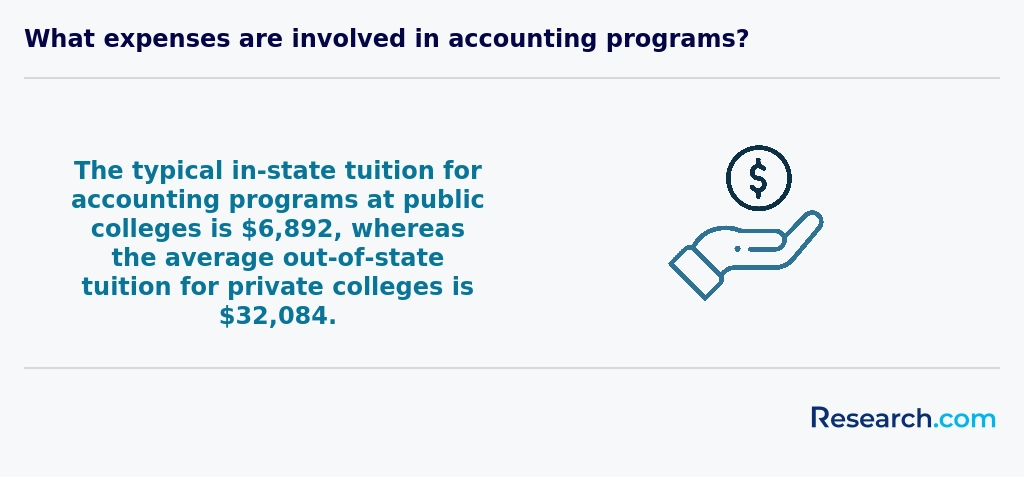
The average accounting degree cost Tampa students face is often a balance between value and investment. Public institutions in the area, like the University of South Florida, generally offer in-state residents a degree for around $13,920 total, which many graduates recall as a smart choice supporting both affordability and quality. Out-of-state students, however, may encounter costs exceeding $30,000, pushing them to carefully weigh financial aid options and long-term career benefits. This median illustrates the tangible difference that residency status can make in the cost of an accounting degree in Tampa.
Several graduates from Tampa's private colleges, known for specialized accounting tracks, recognize that while tuition is higher, reaching between $18,000 and $25,000 annually, their investment included scholarships or unique programs, which made the cost more manageable and personally rewarding. They often describe this choice as an investment in tailored education that enriched their skill set beyond standard curricula.
For those exploring more cost-effective routes, community colleges offer associate degrees or certificates with significantly lower expenses, typically between $3,500 and $5,000 annually, providing a foothold into accounting careers without the heavy financial burden.
When considering the full range of expenses-including fees and textbooks-students find that preparing a financial plan is crucial. Many have benefited from work-study programs or employer tuition assistance, factors that help reduce the actual out-of-pocket costs and make pursuing an accounting degree in Tampa a realistic goal.
Prospective students interested in exploring options should also review the most affordable accounting programs in Florida, which highlight how Tampa stands out for balancing quality and cost. This awareness empowers students to take charge of their educational journey while keeping an eye on both immediate affordability and long-term career gains.
Financial aid for accounting students in Tampa often feels like more than just numbers-it's a lifeline that transforms possibility into reality. Graduates from the University of South Florida often recall how completing the FAFSA unlocked access to federal grants, such as the Pell Grant offering up to $7,395 annually. This direct support made the difference between working multiple jobs and focusing fully on studies. Meanwhile, students at Hillsborough Community College have shared their relief when receiving state-specific aid like the Florida Bright Futures Scholarship, which substantially reduces in-state tuition costs.
Local scholarships from Tampa institutions create a personalized safety net. Many accounting majors have expressed gratitude for merit- and need-based scholarships at the University of Tampa, which helped ease the weight of tuition fees and fostered a stronger connection to their academic community.
Equally impactful are employer tuition reimbursements available through Tampa's financial sectors, enabling working professionals to pursue degrees part-time without sacrificing income. These options illustrate how diverse support systems converge to empower Tampa's accounting students beyond what appears on paper.
Tampa students do not have to follow one fixed route into accounting. The most affordable path depends on your prior credits, work schedule, residency status, transfer plans, and whether you need CPA preparation. Comparing pathways early can prevent wasted credits and reduce total cost.
1. Community college to university transfer
- Students can begin with an associate degree in accounting at Hillsborough Community College or St. Petersburg College, where in-district tuition often falls below $4,000 per year.
- Articulation agreements can help students transfer credits into a bachelor's program, reducing duplication and lowering the total cost of a four-year degree.
- This route works best for students who confirm transfer requirements before enrolling and meet regularly with academic advisors at both institutions.
2. Fully online programs
- Online degrees, such as those from the University of South Florida, can cost as little as $300 per credit hour.
- Online study can reduce relocation and commuting costs while allowing students to keep working.
- Students should confirm whether online programs offer career services, internship support, faculty access, and CPA advising comparable to campus-based options.
3. Accelerated and hybrid formats
- Some universities offer 8-week accelerated courses or hybrid models that combine online study with limited in-person requirements.
- Accelerated formats may help students finish sooner, but they can be demanding for learners working full time.
- Hybrid formats may be a strong compromise for students who want flexibility but still value face-to-face networking and local employer events.
4. Out-of-state low-cost options
- Students open to relocating or attending remotely can compare tuition outside Florida. For example, the Low Cost Accounting Degree Programs Ranking in Arizona highlights institutions where total tuition can be 30–40% lower than Tampa’s private colleges.
- Before choosing an out-of-state or online program, confirm accreditation, transferability, CPA eligibility, and whether the program's career support fits your target job market.
The most cost-effective pathway is usually the one that preserves credits, keeps borrowing manageable, and still gives students access to accounting coursework, advising, internship options, and employer connections.
To enroll in an accounting degree program in Tampa, many students find that meeting academic prerequisites is a crucial first step. Graduates from local institutions often recall how having a strong foundation in math and basic economics gave them confidence during admissions. For example, those aiming for a bachelor's in accounting typically need a high school diploma or GED and some familiarity with quantitative subjects, reflecting Tampa's emphasis on practical skills.
Interestingly, some Tampa colleges, like the University of South Florida, offer flexibility by considering overall academic records instead of fixating solely on SAT or ACT scores. This nuanced approach encourages students who might shine in other ways-such as through a compelling personal statement or strong recommendations-to feel optimistic about their chances.
For graduate accounting programs, demonstrating prior coursework in core accounting subjects often becomes essential. Interviews with local MAcc graduates reveal that submitting transcripts and sometimes GMAT or GRE scores can initially seem daunting but ultimately affirm their preparedness for advanced study.
Balancing these requirements with financial planning also motivates many Tampa students to actively seek scholarships and aid, fueling a sense of accomplishment beyond academics.

An accounting degree can qualify graduates for many entry-level roles, but long-term advancement often depends on professional credentials. The CPA credential is especially important for students who want to work in public accounting, audit, tax, or higher-level advisory roles. Other credentials, including Certified Management Accountant (CMA) and Certified Internal Auditor (CIA), can support careers in corporate finance, internal audit, risk management, and operations-focused accounting.
Each credential has different exam, education, experience, and continuing education requirements. Before choosing a Tampa accounting program, students should ask whether the curriculum aligns with their target credential and whether advisors can explain Florida's CPA education pathway clearly.
Common certification pathways
- CPA: Often preferred for public accounting, audit, tax, and higher-level accounting leadership roles.
- CMA: Useful for management accounting, budgeting, forecasting, performance analysis, and corporate finance roles.
- CIA: Valuable for internal audit, compliance, controls testing, and risk management careers.
- Bookkeeping certificates: Practical for students who want job-ready accounting support skills before or during a degree program.
Students who want to strengthen applied bookkeeping skills before pursuing advanced credentials may benefit from a bookkeeping certificate online. These programs can help build confidence in ledger management, payroll processing, bank reconciliation, financial statement preparation, QuickBooks, and Excel.
Graduate study is another option. An MS in Accounting or Master of Taxation may help students meet advanced education goals, prepare for specialized roles, or move into leadership. The best choice depends on your target role, existing credits, employer expectations, and whether the credential is likely to improve your career mobility enough to justify the cost.
Graduates from popular institutions in Tampa often reflect on how their accounting programs combine rigorous core courses with practical skills that truly prepare them for the real world. Instead of just memorizing rules, students at these universities tackle financial and managerial accounting by working through actual business scenarios-analyzing statements that influence real decisions in local companies. This hands-on approach makes abstract numbers become meaningful.
Taxation classes stand out as particularly relevant here, where students learn the nuances of both state and federal tax codes affecting Tampa's bustling entrepreneurial scene. Many recall moments in class discussing recent tax law changes that directly impact the small businesses thriving in the region, which adds urgency and excitement to their studies.
Auditing courses challenge students to evaluate financial records critically, applying GAAP standards while considering Tampa-specific industry examples. Alongside this, courses in business law, ethics, and accounting software help students develop judgment and technical mastery-key qualities that local employers consistently praise among graduates.
Accounting degree specializations in Tampa challenge the notion that accounting is a one-size-fits-all discipline. Graduates from well-known Tampa universities often highlight how focusing on Financial Accounting has sharpened their skills in managing compliance and financial reporting, making them indispensable in local industries. Meanwhile, others gravitate towards Taxation, driven by direct experiences helping Tampa's diverse businesses navigate complex tax codes with confidence. This hands-on exposure emphasizes why the best accounting concentration options Tampa offers are more nuanced than many realize.
For those who prefer a hands-on investigative approach, Forensic Accounting in Tampa's growing finance sector presents an exciting path, cultivating analytical thinking essential for uncovering fraud. Alternatively, Management Accounting prepares students for vital roles in Tampa's corporate world, turning numbers into strategic decisions. Governmental Accounting also draws in those passionate about public service, reflecting Tampa's unique economic ecosystem. Reflecting on these diverse pathways, many find their studies align closely with objectives like sitting for the CPA, reinforcing the tangible value of a specialized degree. Tampa graduates often note how such focused education enhances not only skills but career satisfaction, supporting ambitions influenced by factors such as the accounting master's degree salary.
Choosing the best accounting degree in Tampa means looking beyond reputation alone. Graduates from top accredited accounting schools in Tampa often share how AACSB accreditation transformed their career prospects by validating the rigor of their education. Yet, one must weigh the cost against quality-local public universities offer some of the best affordable accounting degree programs Tampa can provide, sparing students from overwhelming debt while still delivering solid instruction.
Consider the flexibility of program formats, too. Many students working full-time in Tampa praise their programs' adaptability, enrolling in evening or online classes that respect their busy lives. If you're exploring specialized paths, opt for curricula emphasizing forensic accounting or taxation to better align with your ambitions. Career services that connect you to internships in Tampa's growing financial hub are equally vital for real-world experience.
For those who find balancing studies and work tricky, exploring a bookkeeping certificate online might serve as a useful stepping stone. Real success stories often stem from students who navigate their options with intentional reflection, focusing on how education choices mesh with lifestyle and career goals rather than merely chasing the most prestigious name.

Graduates from popular Tampa institutions often discover that accounting career opportunities in Tampa extend far beyond traditional roles. Many find themselves thriving as Certified Public Accountants, but others use their degrees to become financial analysts, internal auditors, or tax specialists, driven by Tampa's diverse economy. One graduate described how studying at a local college opened doors at a tech firm where accounting expertise blended with innovative financial strategies, creating a unique and rewarding career path.
Jobs with accounting degree Tampa also include niche specialties like forensic accounting or governmental auditing, fields that reflect the city's economic landscape. Graduates frequently remark on how Tampa's dynamic mix of finance, healthcare, and manufacturing sectors offers unmatched professional versatility. Choosing to pursue CPA certification in Tampa often proves pivotal, supported by numerous firms that foster candidate success.
Students weigh costs carefully; those at local public universities benefit from moderate tuition rates and often explore options like the Low Cost Accounting Degree Programs Ranking in Arizona for comparison. For many, this thoughtful investment correlates with career satisfaction and longevity in Tampa's thriving job market.
The accounting job opportunities in Tampa reveal a dynamic industry deeply connected to the city's diverse economy. Graduates from popular universities find themselves stepping into roles within public accounting firms, corporate accounting departments, and government agencies, all eager for professionals skilled in auditing, tax preparation, and financial analysis. These opportunities reflect the market demand for accounting degrees Tampa, driven by the continual presence of financial institutions and regional corporate headquarters.
Real-life experiences of graduates illustrate the edge local education provides. Many report that affordable tuition at Tampa universities, averaging $7,000 to $10,000 annually for in-state students, combined with strong internship networks, significantly boosts their employment chances in the area. This accessibility challenges the assumption that expensive private schooling is necessary for success in accounting. For students uncertain about the best direction for their careers, exploring what are the best college majors for the future helps clarify how accounting fits within a promising professional landscape.
2027 Best Accounting Degree Programs Ranking in Tampa
Investing in your education is a significant decision that can shape your future, and the Research.com team understands the importance of making informed choices. To assist prospective students in Tampa, we have meticulously crafted the "2027 Best Accounting Degree Programs Ranking in Tampa." Our commitment to quality, credibility, and accuracy is reflected in the extensive research and analysis conducted to compile this ranking.
We utilized the following reputable data sources to ensure a comprehensive evaluation of accounting degree programs:
By exploring this ranking, readers will gain valuable insights into the best accounting degree programs available in Tampa, helping them make informed decisions about their educational paths. For more details on our methodology, please visit our Research.com methodology page.


# 5 position
Strayer University-Florida
Master of Science in Accounting

Frequently Asked Questions About accounting
Accounting degree students in Tampa can maximize their learning experience by engaging with local professional organizations such as the Tampa Bay Chapter of the Florida Institute of CPAs. Networking offers valuable connections and insights into regional accounting trends. Tampa's proximity to major industries, including financial services and port-related logistics, provides ample internship and job shadowing opportunities to gain practical skills.
Furthermore, students should take advantage of Tampa's accessible continuing education workshops and seminars offered by universities and community colleges. According to the Bureau of Labor Statistics, Tampa's accounting job market is projected to grow by 7% through 2031, highlighting the importance of relevant, updated coursework.
Active participation in case competitions and using Tampa's accounting software resources can also enhance problem-solving skills important for future professionals.
The accounting field continues to evolve rapidly, creating new opportunities for specialists in emerging niches. In Tampa, areas like forensic accounting are growing due to increased demand for fraud detection and financial investigation, especially with Tampa's expanding financial services sector.
Another significant niche is environmental accounting, driven by businesses focusing on sustainability and regulatory compliance. Tampa's growing green economy supports this trend, offering roles that combine accounting with environmental impact assessments.
Technology also plays a large role in new accounting fields. Roles involving data analytics, blockchain accounting, and cybersecurity are developing quickly, as firms seek professionals skilled in managing complex digital financial information.
According to the Bureau of Labor Statistics, accounting jobs incorporating technology skills are expected to grow faster than traditional roles over the next decade.
After earning an accounting degree in Tampa, preparing for the job market involves several key steps. Start by gaining practical experience through internships or part-time roles, as local firms value hands-on skills. Tampa's growing business sector offers many opportunities, with the Bureau of Labor Statistics reporting a 6% increase in accounting jobs statewide from 2021 to 2024.
Networking is crucial; joining local chapters of professional organizations like the Florida Institute of Certified Public Accountants (FICPA) can open doors. Additionally, consider certifying as a CPA, since Florida requires 150 credit hours for licensure, which many Tampa programs accommodate.
Develop strong proficiency in accounting software such as QuickBooks and Excel, as employers in Tampa seek candidates familiar with digital tools. Attending job fairs at local universities can also connect graduates with employers actively hiring in the Tampa Bay area.
Employers in Tampa highly value accounting graduates who demonstrate strong analytical skills. These skills enable professionals to interpret financial data accurately, which is essential for roles in auditing, tax preparation, and financial reporting. According to the Tampa Bay Workforce report, analytical thinking ranks as a top requirement for over 75% of accounting positions.
Technical proficiency is another critical skill, particularly familiarity with accounting software like QuickBooks and Excel, widely used by Tampa firms. Additionally, employers seek graduates who possess solid communication skills, allowing them to explain complex financial information clearly to clients and colleagues.
Ethical judgment and attention to detail are equally important, reflecting the necessity of compliance with strict regulatory standards in Florida's accounting industry.
Finding internships in Tampa relevant to an accounting degree involves leveraging local resources and networks. Tampa hosts a range of accounting firms, from small practices to large corporations, creating diverse internship opportunities. Students should utilize career services at institutions like the University of South Florida, which often partner with companies for internship placements.
Online platforms such as Handshake and LinkedIn also list internships specifically in accounting within the Tampa area. According to the Tampa Bay Workforce Development Board, internships in accounting offer valuable real-world experience and can increase job placement prospects after graduation.
Joining professional organizations, such as the Florida Institute of CPAs, helps students network and discover openings not widely advertised. Tampa's growing finance sector means accounting internships are regularly available but applying early and tailoring resumes to local industries are key steps to success.
An accounting degree in Tampa significantly enhances career mobility and advancement opportunities. The region's growing economy, driven by finance, healthcare, and tourism sectors, demands skilled accounting professionals. According to the U.S. Bureau of Labor Statistics, Tampa's metropolitan area is projected to grow accounting and auditing jobs by 7% through 2030, slightly above the national average. Earning an accounting degree provides foundational knowledge required for roles such as financial analyst, auditor, or tax consultant.
Employers in Tampa often prefer candidates with a bachelor's degree in accounting or related fields as a minimum qualification. Furthermore, this degree is essential for pursuing certifications like CPA, which can increase earning potential and lead to leadership roles. Locally, Tampa Bay's business community values graduates who combine technical expertise with compliance and regulatory understanding, essential for navigating Florida's tax codes and corporate requirements.
Studying for an accounting degree in Tampa equips students with skills relevant to multiple disciplines, emphasizing both technical and soft skills. Tampa's universities often integrate coursework in finance, business law, and information systems into their accounting programs, reflecting the interconnected nature of modern business environments.
This interdisciplinary training is critical as the Tampa Bay region hosts diverse industries such as healthcare, finance, and technology, which demand versatile accounting professionals. For instance, the Tampa Bay Economic Development Council highlights the area's growth in sectors requiring hybrid expertise, underscoring the need for accountants to collaborate across fields.
Additionally, programs frequently offer practical experiences like internships with local firms, enhancing real-world application of interdisciplinary knowledge. Students develop abilities in data analysis, communication, and ethical decision-making, preparing them for roles that intersect accounting with management, consulting, or compliance.
Choosing between a thesis and a non-thesis accounting degree program in Tampa depends on your career goals and learning preferences. Thesis programs typically focus on research, requiring students to produce an original academic paper. This path is ideal for those interested in pursuing doctoral studies or careers in academia.
Non-thesis programs concentrate on practical skills and coursework, often preferred by professionals aiming for certifications like CPA or entering the workforce immediately. According to the National Association of State Boards of Accountancy, Tampa has a growing demand for CPAs, making practical experience valuable.
Consider the program structure, faculty expertise, and available resources at Tampa institutions to make an informed decision.
Students based in Tampa who wish to study accounting abroad have several pathways to consider. Many universities in Tampa, such as the University of South Florida, offer partnerships with international institutions, allowing students to participate in exchange programs. These programs typically last one semester to one academic year and enable students to earn credits toward their degree while gaining global experience.
Another option is enrolling in study abroad programs during the summer or winter breaks, which often focus on specialized accounting topics or international business practices. According to the Institute of Management Accountants, gaining international exposure helps accounting students enhance skills desired by global firms.
Lastly, Tampa students may pursue online global accounting degrees accredited in the US and abroad, allowing flexibility while studying international accounting standards. These various options provide Tampa students strong opportunities to develop global competencies in accounting.
Students pursuing accounting degrees in Tampa have access to a variety of part-time job opportunities that can enhance their education. Common roles include bookkeeping assistants, tax preparers, and audit clerks. These positions provide practical experience with financial software and regulatory compliance, which are vital for accounting careers. According to the Bureau of Labor Statistics, Tampa's demand for accounting technicians is expected to grow by 7% from 2022 to 2032, reflecting strong local job prospects.
Additionally, many Tampa accounting firms and small businesses offer internships and part-time roles during tax season, allowing students to gain hands-on experience. Working in these roles helps students develop skills in data analysis and client communication, complementing their academic learning.
Accounting students in Tampa have access to diverse networking opportunities that support their professional growth. Local universities such as the University of South Florida offer chapters of national organizations like Beta Alpha Psi and the American Institute of Certified Public Accountants (AICPA). These groups host events, workshops, and guest lectures, connecting students to industry professionals.
The Tampa Bay Chapter of the Florida Institute of CPAs (FICPA) plays an active role in organizing networking mixers and career fairs tailored to accounting students, providing direct links to Tampa's accounting firms and businesses. According to FICPA, its events have helped more than 60% of participants secure internships or job placements locally.
Additionally, Tampa's vibrant business community supports accounting-specific meetups and seminars, offering valuable informal networking opportunities outside campus environments.
Alumni networks offer significant advantages to accounting degree students in Tampa by providing connections within a competitive job market. Tampa hosts numerous accounting firms, including regional offices of top national companies, making networking essential for internships and job placements. According to data from the Tampa Bay Business Journal, accounting graduates with strong alumni links have a 30% higher chance of early career placement.
These networks also foster mentorship opportunities, allowing current students to gain insights from experienced professionals in Tampa's accounting sector. Alumni often share advice on certifications like CPA and CMA that are critical for career advancement.
Additionally, involvement in alumni events enhances students' professional development and community presence, expanding their access to Tampa-area resources and industry events.
Customizing an accounting degree program in Tampa allows students to align their education with specific career goals. Many Tampa institutions offer elective courses in areas such as forensic accounting, taxation, auditing, and financial analysis, enabling a tailored learning path. Students can also engage in internships with local firms, which provide practical experience and networking opportunities in the city's growing finance sector. Additionally, some programs offer accelerated tracks or combined bachelor's and master's degrees to meet the 150-credit-hour requirement for CPA licensure. According to the Florida Department of Education, nearly 40% of Tampa accounting graduates pursue certifications, reflecting this flexible approach.
Accounting students in Tampa often face significant challenges balancing rigorous coursework with practical experience requirements. Many programs emphasize mastering complex topics such as tax regulations, auditing standards, and financial reporting, which can overwhelm newcomers. Additionally, Tampa's competitive job market demands internships or part-time roles, yet securing these opportunities can be difficult for students without strong local networks.
A recurring challenge is passing the CPA examination, with Florida's CPA pass rates averaging around 55% in recent years, reflecting national trends. Limited access to specialized tutoring or mentoring programs locally can also hinder student success. Furthermore, managing financial stress while attending schools adds pressure, as Tampa's cost of living continues to rise.
An accounting degree opens the door to several professional certifications that can enhance your career prospects in Tampa's competitive job market. The most recognized credential is the Certified Public Accountant (CPA) license, which requires passing a rigorous exam and meeting experience requirements set by the Florida Board of Accountancy. Tampa has strong demand for CPAs, especially in auditing, tax preparation, and consulting roles.
Other certifications valuable to accounting graduates include the Certified Management Accountant (CMA), which focuses on financial management and strategic planning, and the Certified Internal Auditor (CIA), ideal for internal audit careers. According to the Florida Institute of CPAs, these certifications often lead to higher salaries and wider job opportunities within Tampa's growing financial sector.
To write a winning application for an accounting program in Tampa, start by highlighting your academic strengths, especially in math and business-related courses. Many Tampa institutions look for a GPA of 3.0 or higher. Including relevant extracurricular activities, such as internships or volunteer bookkeeping, can demonstrate practical experience. Tampa's job market for accountants is growing, so mentioning your career goals aligned with local opportunities can strengthen your case.
Craft a clear, concise personal statement focusing on your passion for accounting and commitment to the profession. Ensure all required documents, like transcripts and letters of recommendation, are submitted on time to Tampa-area schools such as the University of Tampa or USF.
Accounting is a globally recognized profession with strong demand worldwide, including in Tampa. According to the U.S. Bureau of Labor Statistics, employment of accountants and auditors is expected to grow by 7% from 2022 to 2032, reflecting consistent national and regional demand.
Professionals with accounting degrees in Tampa benefit from a diverse job market that connects to international business due to the city's role as a financial hub in Florida. Tampa's growing industries, such as finance, healthcare, and technology, require accountants who understand global financial standards.
Moreover, international credentials like the CPA license are respected worldwide, enhancing mobility for graduates considering work beyond the U.S. This global recognition emphasizes the importance of studying accounting principles aligned with international financial reporting standards (IFRS) and U.S. GAAP.
Gaining practical experience while studying for an accounting degree in Tampa is essential for career readiness. Many Tampa universities, such as the University of South Florida and St. Petersburg College, offer internships with local firms, providing hands-on learning opportunities. According to the Tampa Bay Workforce Alliance, over 30% of accounting students participate in internships, boosting their employability.
Students can also join campus organizations like accounting clubs or Beta Alpha Psi, which connect members with networking events and workshops. Additionally, Tampa's vibrant business community, including numerous accounting firms and corporations, frequently seeks student interns.
Volunteering for tax assistance programs during tax season can similarly help build practical skills and professional connections.
Choosing the right concentration within an accounting degree program in Tampa depends largely on your career goals and interests. Tampa offers diverse opportunities in sectors like corporate finance, government, and public accounting. For example, if you aim to work in auditing or tax preparation, consider concentrations in Auditing or Taxation. According to the Bureau of Labor Statistics, accountants in Florida earn a median wage of around $70,000, which varies with specialization.
Explore concentrations aligned with Tampa's growing industries, such as healthcare and financial services. Additionally, verify if your school's program prepares you for certifications relevant in Tampa, like the CPA or CMA, which enhance job prospects locally.
- 2027 Best Accounting Degree Programs Ranking in Montgomery
- 2027 Best Accounting Degree Programs Ranking in Atlanta
- 2027 Best Accounting Degree Programs Ranking in Birmingham
- 2027 Best Accounting Degree Programs Ranking in New Orleans
- 2027 Best Accounting Degree Programs Ranking in Huntsville
- 2027 Best Accounting Degree Programs Ranking in Jackson
- 2027 Best Accounting Degree Programs Ranking in Greensboro
- 2027 Best Accounting Degree Programs Ranking in Nashville
- 2027 Best Accounting Degree Programs Ranking in Memphis
- 2027 Best Accounting Degree Programs Ranking in Louisville
See What Experts Have To Say About Studying Accounting
Read our interview with Accounting experts

Yaw M. Mensah
Accounting Expert
Professor and Interim Vice Dean for Strategic Partnerships
Rutgers Business School


- Financial Aid Overview for Accounting Degrees https://www.accounting.com/resources/financial-aid/
- M.S. in Accounting Prerequisite Courses https://www.ut.edu/graduate-degrees/graduate-business/master-of-science-in-accounting/ms-in-accounting-prerequisite-courses
- Mastering the Art of Networking: A Guide for Accounting ... https://www.wscpa.org/blog/607cb669-8d98-427e-8c9b-06129d9297e8:mastering-the-art-of-networking-a-guide-for-accounting-students
- Accounting Career: Outlook and Overview | DeVry University https://www.devry.edu/blog/accounting-career-outlook.html
- 6 Tips to Get a Head Start in Your Career during College https://www.thiswaytocpa.com/education/articles/make-the-most-of-your-education/6-tips-get-head-start/
- College Readiness: Connecting with the Alumni Network https://southcoastcf.org/college-readiness-connecting-with-the-alumni-network/
- Guide to Transition into an Accounting Career https://teach.com/online-ed/business-degrees/online-masters-accounting/how-to-transition-to-an-accounting-career/
- Accounting and Business https://www.hcfl.edu/academics/subjects/accounting-and-business
- Are accounting students overloaded and under-supported? https://www.studentvoice.ai/blog/accounting-students-challenges-with-workload-and-support/
- Accountant Cover Letter Example https://www.careertoolbelt.com/professions/accountant/cover-letter-example/


