2027 Online Physics Degrees That Work Well With Employer Sponsorship

Co-Founder and Chief Data Scientist
Working adults who want a physics degree face a practical question: can a rigorous lab-based major fit around a job and employer tuition benefits? The stakes are real. The BLS Occupational Outlook Handbook, updated in 2024, reports a $149,530 median annual wage for physicists and astronomers and 7% projected job growth from 2023 to 2033. This guide explains online physics degree formats, sponsorship rules, admissions, labs, costs, and career outcomes so you can choose a program your employer is more likely to fund.
Key Things You Should Know
- Fully online physics bachelor's programs are uncommon, so employer-sponsored students should prioritize regional accreditation, clear lab delivery, transfer-credit policies, and written employer approval before enrolling.
- Employer education benefits often follow the federal tax-free assistance limit of $5,250 per year, which can reduce out-of-pocket tuition but may not cover fees, books, lab kits, or courses outside an approved degree plan.
- Physics can support careers in research, aerospace, defense, data analysis, engineering support, education, and technical operations, but many physicist roles prefer graduate study while BLS projects 7% growth for physicists and astronomers from 2023 to 2033.
What is an online physics degree and how does it work with employer tuition sponsorship?
An online physics degree is a college program that teaches mechanics, electricity and magnetism, thermodynamics, quantum physics, computational modeling, mathematics, and laboratory reasoning through distance-based coursework. At the bachelor's level, it is usually a Bachelor of Science program, though some schools may offer related degrees in physical science, natural science, applied physics, engineering physics, or astronomy with substantial physics coursework.
Employer tuition sponsorship means your workplace pays for part or all of your education because the degree supports your current role, a future internal role, or the organization's workforce needs. The arrangement may be called tuition assistance, tuition reimbursement, direct billing, education assistance, or workforce development funding. The most important distinction is timing: reimbursement usually requires you to pay first and submit grades later, while direct billing sends approved tuition charges to the employer or a third-party benefits administrator.
For physics students, sponsorship works best when the program has predictable scheduling, documented accreditation, itemized costs, and a curriculum that can be tied to job-relevant skills. Employers are more likely to approve a degree when the connection is clear, such as improving technical modeling, instrumentation, quality control, materials analysis, aerospace support, energy systems, software simulation, or data-heavy problem solving.
The federal tax code allows many employers to provide up to $5,250 per year in tax-free educational assistance to an employee, although employers can set stricter internal limits. This figure matters because an online physics degree may take several years part time; spreading credits across calendar years can make sponsorship dollars go further, especially if transfer credits reduce the number of remaining courses.
Which accredited online physics programs are best suited for employer-sponsored students?
The best employer-sponsored online physics option is not always the cheapest or fastest program. It is the program that your employer will approve, that has recognized institutional accreditation, that can deliver required labs without forcing you to quit your job, and that supports your intended career path.
Because fully online physics majors are rare in the United States, the comparison below focuses on program types that working adults should evaluate rather than assuming every school with online science courses offers a complete online physics degree.
| Program option | Best fit | Employer-sponsorship strengths | Watch-outs |
| Accredited online Bachelor of Science in Physics | Students who want the clearest physics credential for graduate school, research support, technical analysis, or physics-adjacent jobs | Strongest alignment with a physics degree request; usually includes upper-division theory, math, and lab expectations | Few fully online choices; labs, prerequisites, and course sequencing can limit flexibility |
| Online physical science or natural science degree with physics coursework | Working adults who need a science credential but do not require a formal physics major | May be easier to schedule and transfer into; can satisfy some teaching, technical, or internal promotion goals | May not be sufficient for physics graduate admissions or roles specifically requiring a physics major |
| Online engineering, environmental, or applied science degree | Students whose employer wants job-ready technical design, systems, compliance, or operations skills | Often easier to connect to business needs, especially in energy, manufacturing, infrastructure, or environmental operations | Not a substitute for a physics degree if the target role requires physics theory or graduate physics preparation |
| Online data, computational, or analytics-heavy STEM program | Students interested in simulation, modeling, scientific programming, AI, quantitative analysis, or technical data roles | Strong fit for employers that sponsor degrees tied to automation, analytics, forecasting, or software-enabled research | May move you away from laboratory physics and toward applied computing |
If your employer's need is applied systems work rather than physics theory, you may also compare physics with environmental engineering degrees online, especially for roles involving energy, water, compliance, infrastructure, or environmental measurement. The right choice depends on whether your workplace values scientific explanation, engineering design, regulatory application, or computational analysis most.
Before applying, ask the school to confirm whether the degree can be completed online in your state, whether any in-person lab or residency is required, and whether upper-division physics courses are offered frequently enough for part-time students. Then send that information to your employer before you register, not after you receive a tuition bill.
How can you qualify for employer tuition assistance to earn an online physics degree?
To qualify for employer tuition assistance, you usually need to show that the degree is accredited, job-related, cost-approved, and likely to be completed successfully. Physics degrees can be easier to justify when your current or target role involves technical systems, instrumentation, data analysis, engineering support, R&D operations, defense, aerospace, energy, manufacturing, quality assurance, or technical education.
Use the following sequence to reduce the risk of denied reimbursement or surprise out-of-pocket costs.
- Read your employer's education-benefit policy and identify annual caps, grade minimums, eligible schools, required approvals, reimbursement deadlines, and service commitments.
- Ask HR or the benefits administrator whether the program must be regionally accredited, whether online labs are eligible, and whether fees, books, software, lab kits, and proctoring are covered.
- Write a short business case connecting the physics degree to specific job duties, such as modeling, technical troubleshooting, safety analysis, process improvement, laboratory operations, or future internal roles.
- Submit the school name, degree title, accreditation status, course list, estimated tuition, start date, and delivery format before enrolling.
- Keep syllabi, receipts, grade reports, invoices, and employer approvals in one folder because reimbursement systems often require documentation after each term.
A common mistake is assuming that "online" automatically means eligible. Some employers only approve programs from certain institutions, programs tied to a current job family, or courses completed with a minimum grade. Another mistake is enrolling in prerequisite math or science courses before confirming whether the employer will pay for non-degree, remedial, or transfer coursework.
If your employer denies a full physics degree, ask whether it would approve a staged plan: calculus first, then introductory physics, then a formal degree declaration after successful completion. This approach can show academic readiness and may make your request less risky from the employer's point of view.
What admission requirements and prior math or science background do online physics degrees expect?
Online physics degrees are more math-intensive than many other online majors. Even when admission to the university is broad, success in the major usually depends on readiness for calculus, laboratory science, and abstract problem solving. Adult learners who have been away from school for several years should pay close attention to placement testing and prerequisite chains because physics courses often build in a strict order.
The table below summarizes common expectations. Exact requirements vary by institution, but these are the areas most likely to affect admission, transfer evaluation, and first-year course planning.
| Requirement area | What schools commonly expect | Why it matters for working adults |
| High school or transfer record | Official transcripts showing prior coursework and GPA history | Transfer credits can shorten the degree, but old science credits may not always satisfy current major requirements |
| Mathematics placement | Readiness for precalculus or calculus, sometimes verified through placement tests or prior college math | Starting below calculus can add terms and reduce the immediate value of employer funding |
| Science background | Prior physics, chemistry, or lab science is helpful but not always required for freshman admission | Students without recent science coursework may need a slower start to avoid overload |
| Technology access | Reliable computer, internet, webcam, scientific calculator, and sometimes programming or lab software | Employer devices may not allow required software, so personal equipment may be necessary |
| Transfer evaluation | Review of community college credits, military credits, AP or CLEP exams, and previous STEM coursework | A careful evaluation can reduce cost, but physics major courses may need close equivalency review |
Students who are not calculus-ready should not automatically rule out physics. A better decision is to map the prerequisite path first. If the first year would be mostly algebra, trigonometry, and precalculus, ask your employer whether those courses count toward the approved plan and whether they must be taken at the degree-granting school.
Another common mistake is underestimating time. A single upper-level physics course can require problem sets, lab reports, coding assignments, and exams. For a full-time employee, one math or physics course plus one lighter general education course may be more sustainable than a heavy STEM schedule that jeopardizes grades and reimbursement eligibility.
How do online physics programs handle labs, research, and hands-on learning requirements?
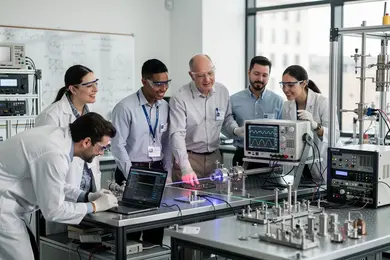
Labs are the biggest difference between choosing online physics and choosing many other online majors. A reputable program should explain exactly how students complete laboratory learning, how experiments are assessed, and whether any campus visits are required. If the answer is vague, treat that as a red flag.
Online physics programs may use several lab-delivery models. Understanding these models helps you estimate cost, schedule disruption, and employer approval risk.
| Lab model | How it works | Best for | Potential concern |
| Home lab kits | Students receive or buy equipment to run experiments at home and submit reports, videos, or data files | Working adults who need maximum schedule flexibility | Kits may add fees and require space, safety awareness, and careful setup |
| Simulation-based labs | Students use software to model experiments, analyze results, and test physical principles | Computational physics, conceptual reinforcement, and data-analysis practice | May not fully replace hands-on measurement for some graduate programs or employers |
| Remote instrumentation | Students control real lab equipment online or analyze data from remote experiments | Students who need authentic data without traveling | Scheduling windows and technology access can be limiting |
| Short campus residency | Students travel for intensive lab sessions over several days or weeks | Students who want stronger hands-on preparation and can take leave from work | Travel, lodging, and missed work may not be covered by tuition benefits |
| Approved local lab or transfer course | Students complete certain labs at a local college and transfer credits back | Students near a community college or partner institution | Requires preapproval from both the home school and employer |
Research and capstone requirements also vary. Some online students complete literature reviews, computational projects, data-analysis studies, instrumentation projects, or faculty-guided independent work. If you plan to apply to graduate physics programs, ask whether online students can access faculty research, recommendation letters, advanced labs, and mathematical preparation comparable to on-campus students.
For employer-sponsored students, the best lab plan is one that can be documented in advance. Ask for a written explanation of lab fees, travel requirements, equipment requirements, safety expectations, and whether any lab component must be completed during business hours.
What does the curriculum in an online physics bachelor's program typically include?
A typical online physics bachelor's curriculum combines a general education core, advanced mathematics, foundational physics sequences, laboratory work, computational tools, and electives. The exact balance matters because a program designed for graduate physics preparation may look different from one designed for applied technical careers.
The table below shows the major curriculum areas and how each one supports career or graduate-school readiness.
| Curriculum area | Common courses or topics | Why it matters |
| Mathematics foundation | Calculus I-III, differential equations, linear algebra, mathematical methods | Physics relies on modeling change, systems, waves, fields, and probability |
| Introductory physics | Mechanics, electricity and magnetism, waves, optics, thermodynamics | Builds the core language used in advanced physics and engineering support roles |
| Advanced physics | Quantum mechanics, statistical mechanics, classical mechanics, electromagnetism, modern physics | Important for graduate study, research support, and deeper technical analysis |
| Laboratory science | Experimental methods, measurement, uncertainty, instrumentation, lab reporting | Shows that students can collect, evaluate, and communicate scientific evidence |
| Computing and data analysis | Programming, numerical methods, simulation, scientific computing, visualization | Increasingly valuable as employers use automation, modeling, and data-driven decision-making |
| Electives and applications | Astronomy, materials, optics, electronics, energy, biophysics, education, engineering-related topics | Lets students align the degree with employer needs or graduate-school interests |
Program fit depends on your goal. If you want research-oriented physics, look for rigorous upper-division theory and faculty access. If you want applied industry mobility, computational physics, electronics, instrumentation, statistics, and project-based courses may be more valuable. If your interest is human movement, rehabilitation technology, or biomechanics rather than physical theory, compare the curriculum with exercise science degrees before committing to physics.
A common curriculum mistake is choosing a program because it has "physics" in the title without checking course depth. Review the catalog for calculus-based physics, upper-division requirements, lab expectations, and elective availability. For employer sponsorship, also check whether courses are offered in predictable terms; a required course offered only once a year can delay graduation and complicate benefit planning.
How much does an online physics degree cost and how can employer funding reduce expenses?
The cost of an online physics degree depends on tuition rate, transfer credits, fees, lab kits, books, proctoring, residency travel, and how many terms you need to finish. Employer funding can make a large difference, but it rarely removes the need to budget carefully.
For context, the College Board's 2024 Trends in College Pricing and Student Aid reported the following average published tuition and fees for four-year institutions in 2024-25. These are broad national benchmarks, not online physics-specific prices, but they help you evaluate whether a program's tuition is relatively low, moderate, or high.
- Public four-year in-state tuition and fees: $11,610 per year
- Public four-year out-of-state tuition and fees: $30,780 per year
- Private nonprofit four-year tuition and fees: $43,350 per year
Employer assistance changes the real price you pay. If your employer offers up to $5,250 per year and you study part time, that benefit may cover a meaningful share of annual tuition. However, if tuition is high or you enroll full time, you may still owe a balance each term. The smartest approach is to calculate net cost across the whole degree, not just the first semester.
Use this checklist before enrolling so you can see the true cost after sponsorship.
- Ask the school for a full program cost estimate that separates tuition, mandatory fees, online fees, lab fees, books, software, proctoring, and travel.
- Confirm how many credits will transfer and whether transferred physics, calculus, or lab courses satisfy major requirements.
- Compare your employer's annual cap with your planned course load and note whether the cap resets by calendar year, fiscal year, or academic year.
- Check whether reimbursement requires a specific grade and whether a failed or withdrawn course becomes your personal expense.
- Ask whether employer-paid tuition affects grants, scholarships, veterans benefits, or federal aid packaging.
Do not choose solely on sticker tuition. A slightly higher-cost program with better transfer acceptance, no travel requirement, and reliable course scheduling may cost less in practice than a cheaper program that delays graduation or requires unpaid leave for labs.
What physics-related careers can you pursue with an online degree and employer support?
An online physics degree can be useful beyond the job title "physicist." Many bachelor's graduates work in applied technical, analytical, operational, or education-related roles, while those aiming for independent research or university faculty positions often continue into graduate study. Employer sponsorship can strengthen outcomes when you choose electives and projects that solve real workplace problems.
The table below connects physics-related career paths with typical responsibilities and the education level commonly expected. Requirements vary by employer, security clearance, state rules, and industry.
| Career path | Typical responsibilities | Common education fit |
| Research or laboratory technician | Operate instruments, collect data, maintain equipment, document experiments, support scientists or engineers | Bachelor's degree in physics or related science; lab experience is important |
| Engineering or systems support specialist | Assist with testing, modeling, troubleshooting, quality control, technical documentation, or field support | Physics bachelor's plus applied electives; some roles prefer engineering coursework |
| Data analyst or scientific computing associate | Build models, analyze technical data, write scripts, create visualizations, support simulation or forecasting work | Physics degree with programming, statistics, and data coursework |
| Aerospace, defense, or energy technical role | Support testing, measurement, safety analysis, instrumentation, materials evaluation, or mission operations | Physics or engineering-related bachelor's; clearance or industry experience may matter |
| Science teacher or educator | Teach physics or physical science, design labs, assess learning, meet state education requirements | Bachelor's degree plus state-approved teacher preparation or alternative certification |
| Graduate physics or applied physics pathway | Prepare for research, advanced instrumentation, medical physics, materials science, optics, or academic roles | Strong physics bachelor's with advanced math, labs, research, and recommendations |
AI and automation are changing how physics graduates demonstrate value. Employers increasingly value people who can connect physical systems with data, simulation, instrumentation, and software. If your long-term goal is analytics, machine learning, modeling, or scientific computing, a physics bachelor's can be paired later with a masters degree in data science online to strengthen applied career options.
Physics is not the right choice for every employer-sponsored student. If your workplace needs licensed engineering design, an engineering degree may be more direct. If your goal is healthcare patient care, a physics degree alone will not replace professional clinical preparation. If your goal is fast entry into a specific technician role, a shorter certificate or associate degree may be more cost-effective.
What are the salary expectations and job outlook for physics graduates in the United States?
Salary outcomes for physics graduates vary widely because the degree can lead to many different roles. A bachelor's degree may support technical, analytical, education, or engineering-support positions, while research physicist roles often require a master's or doctorate. Use salary data as a market signal, not as a promise of individual earnings.
The BLS Occupational Outlook Handbook reports that physicists and astronomers had a median annual wage of $149,530 in May 2023 and projected employment growth of 7% from 2023 to 2033. This is a strong signal for advanced physics roles, but it does not mean every online bachelor's graduate will enter a physicist job immediately; degree level, research experience, location, industry, security clearance, and programming skills all influence opportunities.
The table below shows how to interpret physics-related career outcomes more realistically.
| Outcome category | What to expect | How to improve competitiveness |
| Entry-level bachelor's roles | Often titled technician, analyst, quality specialist, test associate, or engineering support rather than physicist | Build lab, coding, statistics, electronics, and documentation experience |
| Research-focused physics roles | More likely to prefer graduate study, specialized research, publications, or advanced lab experience | Choose a rigorous curriculum, complete a capstone, seek faculty research, and plan for graduate admissions |
| Industry technical roles | May value physics problem-solving but expect applied tools used in aerospace, defense, energy, manufacturing, or software | Align electives with employer systems, simulation tools, instrumentation, or compliance needs |
| Education roles | Public school teaching generally requires state licensure or an approved alternative route | Confirm state teacher-certification requirements before choosing a physics-only degree plan |
| Data and computational roles | Physics training can be relevant, but employers often screen for Python, SQL, statistics, cloud tools, or machine learning exposure | Create a portfolio of technical projects using real data, simulations, and reproducible code |
Location matters, too. Physics-related roles cluster around universities, national labs, aerospace corridors, semiconductor and optics companies, energy employers, medical technology firms, defense contractors, and major research hospitals. Remote work exists for some modeling and data roles, but many laboratory and instrumentation jobs still require onsite work.
A common mistake is using the physicist median salary to justify any physics degree purchase. A better ROI calculation compares your current earnings, employer funding, total remaining cost, likely job titles, required graduate study, and internal promotion opportunities.
How can working adults choose a reputable, accredited online physics program their employer will approve?
Choosing a reputable online physics program requires more than reading rankings. Employer-sponsored students should verify accreditation, lab delivery, degree title, transfer policies, course availability, and the employer's approval process before committing money or time.
Use these practical questions when comparing schools. They are designed to reveal approval risks, completion barriers, and ROI issues before you enroll.
- Is the institution accredited by a recognized accrediting agency, and will my employer accept that accreditation?
- Is the degree title specifically physics, or is it physical science, natural science, astronomy, engineering physics, or another related field?
- Can the entire degree be completed online from my state, including upper-division courses and labs?
- Are any labs, exams, internships, or residencies scheduled during normal work hours?
- How many of my prior credits apply to the major, not just to electives?
- How often are required physics and math courses offered, and what happens if I miss a sequence?
- What are the total estimated costs after tuition assistance, including fees, equipment, books, proctoring, and travel?
- Will online students have access to faculty advising, research opportunities, career services, tutoring, and recommendation letters?
- What graduate programs or employers have accepted graduates from this program, and how does the school document outcomes?
- What is the withdrawal policy if work demands, deployment, shift changes, or family responsibilities interrupt a term?
Red flags include unclear accreditation language, pressure to enroll before employer approval, vague lab explanations, missing upper-division course schedules, unusually broad promises about salary, and refusal to provide a written cost breakdown. Another warning sign is a program that sounds like physics but lacks calculus-based coursework or advanced physics requirements.
Also compare the degree with your real workplace goal. A physics degree is strong for quantitative problem-solving, modeling, instrumentation, and scientific reasoning. But if your employer needs information organization, research archives, data stewardship in libraries, or technical knowledge management, an MLIS degree may be the better sponsored credential. The best program is the one that matches both your career goal and the sponsor's business need.
Before your final decision, get written confirmation from three parties: the school, your employer, and the benefits administrator if one is used. That confirmation should cover eligibility, covered costs, course load, payment timing, and what happens if you change jobs before finishing the degree.
Other Things You Should Know About Physics
Yes, but fully online physics bachelor's programs are uncommon. Some programs use online lectures, home lab kits, simulations, remote labs, or short residencies. Always confirm lab requirements and state authorization before enrolling.
Possibly. Employers are more likely to approve the degree if it is accredited, job-related, submitted for approval before enrollment, and within the company's tuition-assistance rules. Many employers also require a minimum grade for reimbursement.
It can be respected if it comes from an accredited institution and includes rigorous math, lab, and upper-division physics coursework. Employers and graduate programs may still review course quality, lab experience, research exposure, and skills rather than delivery format alone.
In 2027, employer-sponsored online physics degrees typically involve companies covering tuition fees or reimbursing costs to employees as they pursue an online degree. Employers partner with accredited institutions offering flexible, quality programs that align with job requirements, ensuring employees gain relevant skills without needing to leave their jobs.
References
- Five Ways Online Distance Learning Saves You Money | News & Updates https://www.brightonsbm.com/news/five-ways-online-distance-learning-saves-you-money-0/
- Best Online Degree Programs for Working Adults https://www.scholaro.com/db/News/best-online-degree-programs-256
- Physics Employment Facts https://www.compadre.org/careers/facts.cfm
- Sponsorship, scholarships and charitable trusts https://www.eclips-online.co.uk/leaflet/2.31
- Guide to Employers Who Subsidize Online Education https://www.onlineeducation.com/features/employers-who-subsidize-higher-ed
- Paying for a Computer Science Degree | Scholarships, Grants, Loans https://www.computerscience.org/resources/how-to-pay-for-a-degree/
- Offering Physics Lab Courses Online: Status, Methods, Pros, Cons https://www.physicsforums.com/threads/offering-physics-lab-courses-online-status-methods-pros-cons.407956/
- 2025 Best Online Degrees in Physics https://www.onlineu.com/degrees/physics
- Where Can I Find a Physics Online Course for Credit? 5 Great Options - Prereqcourses https://www.prereqcourses.com/physics-online-course-for-credit/
- The Cost of Online Education • Oxford Learning College https://www.oxfordcollege.ac/news/the-cost-of-online-education/