2027 Best Online Bachelor's in Physics for Adults Over 40

Co-Founder and Chief Data Scientist
Choosing an online bachelor's in physics after 40 is usually a career, budget, and time-management decision, not just an academic one. Physics can support paths in engineering support, data analysis, education, research assistance, aerospace, energy, and technology.
The U.S. Bureau of Labor Statistics reports a 2024 median pay of $166,290 for physicists, but many bachelor's-level roles differ by industry and experience. This guide explains program fit, accreditation, admissions, costs, curriculum, online labs, career outcomes, and how to compare schools before enrolling.
Key Things You Should Know
- True fully online bachelor's degrees in physics are limited, so adults over 40 should compare accredited physics programs with closely related online STEM pathways and confirm lab, transfer-credit, and graduation requirements before applying.
- Cost varies widely: College Board's 2024 pricing data shows average published tuition and fees of $11,610 for in-state public four-year students and $43,350 at private nonprofit four-year institutions, before aid, books, technology fees, and transfer credits.
- The strongest ROI usually comes from matching the degree to a specific goal, such as engineering support, graduate study, teaching preparation, data-intensive technical work, or a career pivot into aerospace, energy, software, or analytics.
What makes an online bachelor's in physics a good fit for adults over 40?
An online bachelor's in physics is a good fit for adults over 40 when the program's format, math intensity, lab model, and career outcomes match the student's available time and professional goal. Physics is the study of matter, energy, motion, forces, waves, electricity, magnetism, quantum behavior, and the mathematical models used to describe the physical world.
For adult learners, the value of an online physics degree is usually not limited to becoming a physicist. Many bachelor's-level graduates use physics training to demonstrate quantitative reasoning, problem-solving ability, technical communication, programming exposure, and the capacity to learn complex systems.
Those skills can transfer into engineering-adjacent roles, laboratory work, technical sales, scientific computing, education, analytics, defense contracting, energy, manufacturing, and graduate study.
The best-fit student is not necessarily someone who already works in science. Many adults over 40 consider physics because they want a more rigorous STEM credential, need a bachelor's degree to advance, want to teach science, or plan to combine prior work experience with technical training. A former military electronics technician, for example, may use physics to move toward aerospace testing or systems work.
A mid-career educator may use it to strengthen science-teaching preparation. A business or operations professional may pair physics with programming or statistics to move toward technical analysis.
However, physics is not the easiest online bachelor's degree to complete. It usually requires calculus, differential equations, laboratory science, and abstract problem-solving. Adults who need the fastest credential for an immediate promotion may be better served by a more directly applied program.
Students who are mainly interested in earth systems, environmental consulting, or natural resources may want to compare physics with online geology degrees, which can be more directly aligned with field, environmental, and resource-focused work.
Adults over 40 should think of the degree as a structured investment. It can be worthwhile when it fills a clear gap between your current experience and your target role. It may not be worthwhile if you choose it only because it sounds impressive, without checking whether the program's course sequence, lab format, and employer relevance match your next step.
How does an online physics degree compare to a campus-based bachelor's program?
An online physics degree can cover the same major concepts as a campus-based bachelor's program, but the learning experience is different. The most important differences are lab delivery, scheduling flexibility, access to research, instructor interaction, and how quickly students can move through sequential math and physics courses.
The comparison below shows the decision points that matter most for adults over 40, especially those balancing work, caregiving, military service, or a career transition.
| Decision factor | Online bachelor's in physics | Campus-based bachelor's in physics | Best fit |
| Schedule | Often asynchronous or partly asynchronous, with set due dates | Fixed class and lab meeting times | Online is usually better for working adults with unpredictable schedules |
| Labs | May use at-home kits, simulations, remote instrumentation, short residencies, or approved local lab work | Typically uses campus lab equipment and in-person supervision | Campus may be stronger for students seeking research-heavy or experimental physics pathways |
| Peer interaction | Discussion boards, video meetings, group projects, and virtual office hours | In-person study groups, labs, clubs, and seminars | Campus may feel more immersive; online may be more practical for adult learners |
| Research access | Varies widely; some programs offer remote projects or faculty mentoring | Often easier to access faculty labs and undergraduate research | Campus is often stronger for PhD preparation, though online students can still build research experience intentionally |
| Transfer flexibility | Often designed for transfer and degree-completion students | May be less flexible with upper-division residency rules | Online can be advantageous for adults with prior college credit |
Online physics can be academically legitimate when it is offered by an accredited institution, uses qualified faculty, includes appropriate laboratory learning, and provides transparent course requirements. The key question is not whether online is automatically better or worse.
The better question is whether the program can support your specific outcome: finishing a bachelor's degree, qualifying for graduate school, entering a technical job family, or adding STEM depth to an existing career.
Campus programs may still be better for students who want extensive lab access, undergraduate research, teaching assistant opportunities, or a traditional pre-PhD pathway. Online programs may be better for adults who need flexibility, live far from a university, want to keep working, or already have practical technical experience that can compensate for less campus immersion.
Which accredited schools offer reputable online bachelor's degrees in physics?
There are fewer online bachelor's programs in physics than in business, psychology, computer science, or general studies. That makes accreditation and curriculum verification especially important. A reputable option should come from an institution accredited by an agency recognized by the U.S. Department of Education or the Council for Higher Education Accreditation, and it should clearly publish degree requirements, lab expectations, transfer policies, faculty credentials, and student support services.
Because offerings change, adults should treat any school list as a starting point rather than a final ranking. The programs below are examples of accredited U.S. institutions that have offered online or distance-accessible physics or closely related physics-heavy bachelor's pathways; prospective students should confirm current availability directly with the school before applying.
| School or pathway type | Typical online physics-related option | Why adults over 40 may consider it | What to verify before applying |
| Arizona State University Online | Physics or physics-adjacent online STEM study, depending on current catalog offerings | Large online infrastructure, broad STEM course ecosystem, and transfer-friendly advising | Whether the current degree is a BA, BS, or related major; lab format; graduate-school preparation |
| Liberty University Online | Online bachelor's-level physics option in a flexible distance format | May appeal to students seeking a structured online schedule and broad transfer-credit review | Science lab requirements, total cost after aid, and whether the curriculum fits secular research or industry goals |
| University-based online STEM programs | Physics-heavy astronomy, physical science, applied science, or engineering technology tracks | Useful when a pure physics major is unavailable but the student needs quantitative science training | Whether employers or graduate programs will treat the degree as equivalent to physics |
| Hybrid physics completion pathways | Mostly online general education and math courses with in-person upper-division labs | Can work for adults near a campus who need flexibility for non-lab coursework | Residency rules, commute requirements, and whether labs are offered at convenient times |
A practical way to define "best" is to choose the program that fits your goal with the fewest hidden obstacles. For one adult, that may be the lowest net cost after transfer credits. For another, it may be access to advanced math, modern physics, and faculty recommendations for graduate school. For a third, it may be a program that allows part-time pacing without forcing a long break between sequential courses.
If your end goal is computing, modeling, AI, or analytics rather than physics itself, also compare a physics degree with an affordable online computer science degree. Physics builds deep quantitative reasoning, but computer science may provide a more direct route into software development, cloud systems, machine learning engineering, or cybersecurity roles.
What admission requirements do online physics programs have for adult and nontraditional students?
Online physics programs usually admit adult and nontraditional students through the same undergraduate admissions system used for other applicants, but they may evaluate transfer credits, work history, military training, and prior college performance in ways that matter more for older learners.
The most common requirements include a high school diploma or equivalent, official transcripts, minimum GPA standards, placement readiness in math and English, and sometimes standardized test scores, although many universities now use test-optional policies.
The most important admissions issue for physics is math readiness. A student who has not taken algebra, trigonometry, precalculus, or calculus recently may be admitted to the university but still needs prerequisite coursework before starting the physics major sequence. That can add time and cost, so it should be clarified early.
Before applying, adults over 40 should gather the materials that most directly affect admission, transfer credit, and time to graduation. These items help the school evaluate where you stand academically and what you can skip:
- Official transcripts from every college attended, including community colleges, military colleges, and unfinished programs
- High school transcript or GED documentation if required by the institution
- Descriptions or syllabi for older math, physics, engineering, or computer science courses that may need transfer review
- Military training records, professional certifications, or prior learning documentation if the school evaluates experiential credit
- A current résumé if the program or adult-degree office considers professional background during advising
- Placement test results or recent coursework showing readiness for precalculus, calculus, and college-level writing
Common mistakes include assuming that admission to the university means admission to the physics major, assuming old science credits will automatically transfer, or ignoring prerequisite chains.
Physics courses are highly sequential: calculus-based mechanics often comes before electricity and magnetism, which comes before modern physics or advanced laboratory work. Missing one prerequisite can delay an entire year if courses are offered only once annually.
Adult applicants should ask for a written transfer-credit estimate and a term-by-term degree plan before enrolling. This is especially important if you have credits from more than one institution, attended college many years ago, or need to study part time.
How long does it take to complete an online bachelor's in physics, and how is it structured?
A bachelor's degree in physics typically requires about 120 semester credits, including general education, math, physics major courses, laboratories, electives, and sometimes a capstone. Full-time students often finish in about four years, while adults studying part-time may need five to six years depending on transfer credit, course availability, and math placement.
For adults over 40, the timeline is usually shaped by three factors: how many credits transfer, how recently the student completed math prerequisites, and whether the program offers upper-division physics courses frequently enough for part-time learners. A student with an associate degree and recent calculus may move faster than a student who needs to restart with precalculus.
The following table summarizes common completion scenarios. It is not a guarantee, but it can help you estimate which enrollment pattern fits your life and budget.
| Student profile | Likely structure | Approximate planning horizon | Main risk to watch |
| First-time adult college student | General education, math sequence, introductory physics, upper-division major courses | Four to six years depending on full-time or part-time pace | Underestimating the time needed for calculus and lab science |
| Student with an associate degree | Major prerequisites, upper-division physics, remaining general education, electives | Two to four years depending on transfer fit | Assuming all associate-degree credits apply to the physics major |
| Former STEM major returning after a long break | Refresher math, transfer evaluation, advanced physics sequence | Two to four years depending on course currency rules | Needing to repeat older math or lab courses |
| Working professional taking one course at a time | Slow sequential progress through math and physics | Five or more years | Losing momentum during prerequisite gaps |
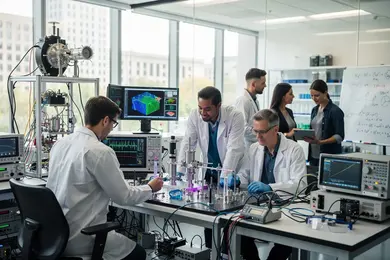
Most online physics programs use a mix of asynchronous lectures, problem sets, virtual recitations, discussion activities, exams, and lab assignments. Some courses may require proctored exams, scheduled live sessions, group projects, or lab kits. Upper-division courses can be more demanding than general education courses because they require sustained problem-solving rather than memorization.
A realistic plan for an adult learner is to take one demanding STEM course at a time during the first term. Calculus and calculus-based physics can require significant weekly study. Once you know your pace, you can decide whether to add a general education course, elective, or programming class in the same term.
What core courses and specializations are typically included in an online physics curriculum?
An online physics curriculum usually combines foundational math, laboratory science, computational methods, and upper-division theory. The exact balance depends on whether the degree is a Bachelor of Arts, Bachelor of Science, physical science major, or physics concentration. A BS typically has more advanced physics, lab, and math requirements, while a BA may provide more elective flexibility.
Students should review the curriculum carefully because course titles alone do not show rigor. A strong program should build from calculus-based fundamentals to more advanced theory and should include opportunities to apply physics through labs, modeling, computation, or a capstone project.
Most reputable physics bachelor's programs include some version of the following academic areas. These subjects matter because they show whether the degree can support graduate study, technical employment, or interdisciplinary STEM work:
- Calculus sequence, often including single-variable calculus, multivariable calculus, and sometimes differential equations
- Introductory calculus-based physics covering mechanics, electricity and magnetism, waves, optics, and thermodynamics
- Modern physics, including relativity, atomic structure, quantum concepts, and nuclear physics foundations
- Upper-division courses such as classical mechanics, electromagnetism, quantum mechanics, statistical mechanics, or thermal physics
- Laboratory courses focused on measurement, uncertainty analysis, instrumentation, experimental design, and scientific reporting
- Computational or programming coursework using tools such as Python, numerical methods, simulation, or data analysis
- Senior capstone, research project, seminar, or portfolio demonstrating applied problem-solving and technical communication
Specializations are less common in online physics than in larger campus programs, but students can often shape the degree through electives. Useful areas include astronomy, materials science, data science, engineering physics, education, applied mathematics, computer science, energy systems, or geophysics.
If a school does not offer a formal specialization, ask whether electives can be selected to support your career target.
Adults who want to move into analytics or AI-related technical work should pay close attention to programming and statistics. Physics provides a strong conceptual base for modeling and problem-solving, but many employers also expect practical data tools.
If your long-term goal is advanced analytics rather than physics research, compare the bachelor's pathway with later graduate options such as data science masters online programs.
How much does an online bachelor's in physics cost, and what financial aid options exist?
The cost of an online bachelor's in physics depends on tuition, fees, transfer credits, residency status, course load, books, lab kits, proctoring, software, and the number of prerequisite courses needed. Published tuition is only the starting point. Adults over 40 should focus on net cost, which is the amount paid after grants, scholarships, employer tuition benefits, military education benefits, and accepted transfer credits.
College Board's 2024 pricing data reported average published tuition and fees of $11,610 for in-state students at public four-year institutions and $43,350 at private nonprofit four-year institutions. This does not mean every online physics program will match those figures, but it shows why transfer credits and institutional aid can change the return on investment significantly.
When comparing programs, use the following cost categories to build a realistic estimate. The goal is to avoid choosing a school based only on the advertised per-credit rate.
- Tuition per credit and whether online students pay in-state, out-of-state, or separate online tuition
- Mandatory online learning, technology, student services, graduation, transcript, and proctoring fees
- Science lab costs, including lab kits, equipment deposits, local lab arrangements, or short residency travel
- Books, access codes, calculator requirements, software, and computer upgrades
- Prerequisite coursework in algebra, precalculus, calculus, chemistry, programming, or writing
- Opportunity cost, including reduced work hours or delayed promotion while enrolled
- Transfer-credit savings from prior college, community college, military training, or approved exams
Financial aid may include Federal Pell Grants, federal student loans, state grants, institutional scholarships, employer tuition assistance, veterans benefits, and payment plans. The maximum Federal Pell Grant for the 2025-26 award year is $7,395, but eligibility depends on financial need, enrollment intensity, degree status, and federal rules.
Adults who already have a bachelor's degree may have fewer grant options, so they should confirm eligibility before assuming aid will apply.
To reduce cost, start with a transfer audit, ask whether lower-division math and general education courses can be completed at a community college, and compare total program cost rather than per-credit tuition. Also ask whether part-time enrollment changes aid eligibility.
The cheapest program is not always the best value if it lacks required courses, has weak advising, or delays graduation because key physics classes are offered too rarely.
What careers can a bachelor's in physics lead to for mid-career and older adults?
A bachelor's in physics can lead to several career directions, but adults over 40 should be realistic about job titles. Many roles with "physicist" in the title require a master's degree or PhD, especially in research. At the bachelor's level, physics is often valued as a quantitative STEM degree that can support technical, analytical, educational, and engineering-adjacent work.
The strongest career outcomes often come when adults combine physics with prior work experience. Someone with manufacturing experience may move toward quality, testing, or process roles. Someone with military electronics or aviation experience may be competitive for aerospace support or systems roles. Someone with teaching experience may use physics coursework to strengthen science instruction, subject to state certification rules.
The table below summarizes common career directions and how a physics bachelor's can support them. Requirements vary by employer, state, and industry, so use this as a planning tool rather than a promise of eligibility.
| Career direction | Typical responsibilities | How physics helps | Additional preparation that may help |
| Engineering technician or technologist | Testing equipment, collecting measurements, troubleshooting systems, supporting engineers | Mechanics, electricity, magnetism, instrumentation, and lab analysis | CAD, electronics, manufacturing systems, or industry certifications |
| Data or quantitative analyst | Analyzing datasets, building models, communicating patterns, supporting decisions | Mathematical modeling, programming, statistics, and problem decomposition | SQL, Python, visualization tools, statistics, and portfolio projects |
| Research assistant or laboratory specialist | Running experiments, maintaining instruments, recording data, preparing reports | Experimental design, uncertainty analysis, and technical writing | Lab safety, instrumentation, coding, and faculty or industry research experience |
| Science teacher or educator | Teaching physics or physical science, developing lessons, assessing students | Subject-matter depth and conceptual understanding | State teacher certification, student teaching, or alternative licensure route |
| Technical sales or applications specialist | Explaining scientific products, supporting customers, translating technical requirements | Ability to understand complex systems and communicate clearly | Industry knowledge, CRM tools, presentation skills, and customer-facing experience |
| Graduate or professional school applicant | Preparing for advanced study in physics, engineering, education, data science, or related fields | Core theoretical and mathematical foundation | Research experience, strong recommendations, advanced math, and competitive GPA |
Adults considering health, biomechanics, sports performance, or rehabilitation-related science may find that physics is useful but not the most direct undergraduate path. In those cases, comparing physics with exercise science degrees online can help clarify whether the intended career requires anatomy, physiology, kinesiology, or clinical prerequisites instead of advanced physics.
Common mistakes include expecting a bachelor's alone to open every research role, ignoring the need for programming skills, or failing to build a portfolio. A physics degree becomes more marketable when paired with evidence of applied ability: coding projects, lab reports, data visualizations, internships, undergraduate research, technical writing samples, or industry experience.
What salary ranges and job outlook can physics graduates expect in different industries?
Physics graduates can work in industries with very different pay structures, including education, government, aerospace, defense, software, energy, finance, manufacturing, and research. Salary depends on role, degree level, location, security clearance, technical tools, and prior experience. Adults over 40 may have an advantage when they can combine the degree with an existing professional background, but salary outcomes are never automatic.
The U.S. Bureau of Labor Statistics reported a 2024 median annual wage of $166,290 for physicists, a category that often includes advanced-degree research and applied science roles. That figure is useful as a labor-market signal, but bachelor's-level graduates should not treat it as a typical starting salary.
Many entry and mid-level roles available with a bachelor's degree fall under different occupational categories with different pay ranges.
The table below explains how to interpret salary context by career direction rather than assuming one universal "physics degree salary."
| Pathway | Salary context | Job outlook considerations | What improves competitiveness |
| Physicist or research scientist | Often associated with higher median wages, but many roles require graduate education | Demand is tied to research funding, federal labs, defense, energy, and specialized industry needs | Master's or PhD, research experience, publications, computational skills |
| Engineering support and testing | Pay varies by industry and technical responsibility | Aerospace, manufacturing, energy, and electronics employers may value applied measurement skills | Instrumentation, CAD, electronics, quality systems, hands-on lab experience |
| Data and computational roles | Compensation depends heavily on software, statistics, and business-domain skills | AI and automation are increasing demand for workers who can model systems and validate outputs | Python, SQL, machine learning basics, statistics, portfolio projects |
| Education | Teacher pay depends on state, district, credentials, and experience | Physics and physical science teachers may be needed in some regions, but licensure rules vary | Teacher certification, classroom experience, subject exams, pedagogy coursework |
| Technical sales and applications | Compensation may combine salary, commission, and bonuses | Scientific equipment, energy, software, and industrial technology companies need technical communicators | Customer experience, product knowledge, communication, industry network |
A major current trend is the growth of AI-assisted modeling, simulation, and data analysis. Physics students who learn programming, numerical methods, and data validation can be well positioned for roles where employers need people who understand both models and real-world constraints. At the same time, AI tools do not remove the need for domain judgment. Employers still need workers who can ask whether a model's output makes physical sense.
For job outlook, the BLS projects employment for physicists and astronomers to grow 7% from 2024 to 2034, which is faster than the average for all occupations. The limitation is that this category does not represent every job a bachelor's-level physics graduate may pursue. Use it as a sign of continued demand for advanced physical science expertise, then research the specific job family you want.
How can adults over 40 evaluate and choose a high-quality online physics program?
Adults over 40 should evaluate online physics programs with a stricter checklist than a traditional first-time student might use. The right program must be academically credible, financially manageable, compatible with adult responsibilities, and aligned with a realistic career or graduate-school goal.
Start by defining your outcome. A program that is excellent for personal enrichment may not be the best path to graduate physics research. A flexible BA may be ideal for a career changer who needs a STEM bachelor's credential, while a more rigorous BS may be better for someone targeting engineering graduate school or research-heavy roles.
Use the following steps to compare programs before submitting an enrollment deposit. These actions help prevent the most expensive mistakes adult learners make.
- Confirm institutional accreditation through the school's official accreditation page and recognized accreditor databases.
- Ask whether the degree is a BA, BS, physical science degree, or physics concentration, and compare the required upper-division physics courses.
- Request a written transfer-credit evaluation before committing, especially if you have older college credits or military training.
- Map prerequisites term by term so you know when calculus, labs, and upper-division physics courses are offered.
- Ask how labs work online, including whether you need kits, simulations, local proctors, remote instruments, or campus visits.
- Compare total net cost after aid, fees, books, lab expenses, and transfer credits rather than relying on advertised tuition.
- Review faculty access, tutoring, advising, disability services, career support, and graduate-school advising for online students.
- Check whether the curriculum supports your goal, such as teaching licensure, engineering graduate prerequisites, data analytics, or laboratory work.
- Ask for outcomes information, but treat salary or placement claims carefully unless the school explains its methodology.
- Speak with an admissions advisor and, if possible, a physics faculty member before enrolling.
Red flags include unclear lab requirements, pressure to enroll before a transfer evaluation, missing course rotations, vague accreditation language, limited math support, or promises of guaranteed employment. Another warning sign is a program that markets physics broadly but does not show enough advanced physics, math, or laboratory work for your goal.
The best choice is the program that you can complete without unnecessary debt and that gives you evidence of skill: rigorous coursework, completed labs, technical writing, programming projects, research exposure, or a portfolio. For many adults, the winning strategy is not chasing the most famous school. It is choosing the accredited program that fits your life, uses your prior credits wisely, and connects directly to your next career move.
Other Things You Should Know About Physics
It can be respected when it comes from an accredited institution and includes rigorous math, physics, and lab work. Employers will also look for applied skills such as programming, data analysis, instrumentation, communication, and relevant work experience.
In 2027, top online bachelor's programs in physics for adults over 40 often emphasize flexibility and robust support systems. Notable programs include The University of Arizona Global Campus and Oregon State University, which offer comprehensive curriculums designed to accommodate adult learners balancing other life commitments.
Online labs can be legitimate if they are well designed and meet the learning outcomes of the course. Ask whether the program uses lab kits, simulations, remote instruments, local lab partners, or short residencies, and confirm that graduate programs or employers in your target field will accept the format.
No, but it requires planning. Adults who refresh algebra, trigonometry, and calculus before upper-level physics usually have a smoother transition. Starting with one demanding STEM course can help you build confidence without overloading your schedule.
References
- How much does it cost to get a bachelor's degree? | edX https://www.edx.org/resources/how-much-does-it-cost-to-get-a-bachelors-degree
- 9 Best Physics Courses for 2025: Learn Physics Online — Class Central https://www.classcentral.com/report/best-physics-courses/
- Physics Core Curriculum https://udallas.edu/academics/programs/physics/core-curriculum.php
- Paying for a Computer Science Degree | Scholarships, Grants, Loans https://www.computerscience.org/resources/how-to-pay-for-a-degree/
- 2025 Most Affordable Online Bachelor's Degrees https://www.onlineu.com/most-affordable-colleges/bachelors-degrees
- Free Online Bachelor Program Opportunities - Swiss School of Business and Management Geneva https://www.ssbm.ch/free-online-bachelor-program-opportunities/
- Physics Degree- Best Schools, Major & Programs https://www.onlinedegree.com/bachelors/physics/