2027 Online PharmD Programs for Students Who Want Community Pharmacist Careers

Co-Founder and Chief Data Scientist
Choosing an online PharmD program is a high-stakes decision because the degree must lead to licensure, not just graduation. The U. S. Bureau of Labor Statistics reports a 2024 median pharmacist wage of $137,480, but outcomes depend on accreditation, clinical placements, state rules, and debt. This guide is for students aiming at community pharmacy roles in retail, grocery, independent, clinic-connected, or ambulatory settings. You will learn how online PharmD programs work, what to verify before enrolling, and how to compare cost, format, licensure fit, and career value.
Key Things You Should Know
- An online PharmD must be ACPE-accredited or in an eligible accreditation status to support pharmacist licensure; students still complete in-person labs, Introductory Pharmacy Practice Experiences, and Advanced Pharmacy Practice Experiences.
- The BLS reported a 2024 median annual wage of $137,480 for pharmacists, with projected employment growth of 5% from 2024 to 2034, so program choice should focus on licensure readiness and practice skills rather than convenience alone.
- Federal graduate/professional loan rates for 2025-2026 are 7.94% for Direct Unsubsidized Loans and 8.94% for Grad PLUS Loans, making total program cost, scholarships, and completion time central to PharmD ROI.
What is an online PharmD program and how does it prepare community pharmacists?
An online Doctor of Pharmacy program, usually called an online PharmD, is a professional doctorate designed to prepare students for pharmacist licensure. "Online" usually means didactic courses are delivered through live or recorded virtual instruction, while skills labs, simulations, assessments, and pharmacy practice rotations still require in-person participation.
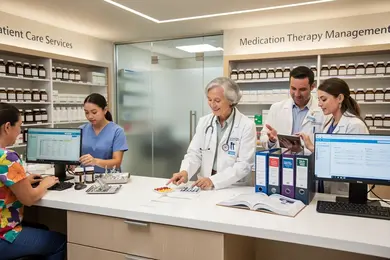
For students who want community pharmacist careers, the best online PharmD programs should build more than medication knowledge. Community pharmacists counsel patients, verify prescriptions, administer immunizations where authorized, manage medication therapy, screen for drug interactions, coordinate with prescribers, supervise technicians, and support adherence for chronic conditions such as diabetes, hypertension, asthma, and mental health disorders.
The online format can be a strong fit for students who need geographic flexibility, but it is not a shortcut. A PharmD is a rigorous clinical degree, and students should expect a full professional workload. If you are still mapping the full education-to-licensure pathway, this overview of the steps to become a pharmacist can help you place the PharmD within the broader career sequence.
The table below summarizes how online PharmD training connects to community pharmacy work. Use it to check whether a program's curriculum matches the everyday responsibilities you want after licensure.
| Program component | What students learn | Why it matters in community pharmacy |
| Pharmacotherapy coursework | Drug selection, dosing, monitoring, contraindications, and treatment guidelines | Supports safe prescription verification and evidence-based patient counseling |
| Patient communication practice | Motivational interviewing, health literacy, cultural humility, and shared decision-making | Helps pharmacists explain complex medication instructions clearly |
| Pharmacy law and ethics | Controlled substances, scope of practice, privacy, dispensing rules, and documentation | Prepares graduates for state-specific legal responsibilities |
| Skills labs and simulations | Immunization technique, compounding basics, dispensing workflows, and error prevention | Builds hands-on competence that cannot be fully learned through lectures |
| Community rotations | Real patient care in chain, independent, grocery, outpatient, or clinic-linked pharmacies | Shows whether the student is ready for front-line practice and workflow pressure |
Are online PharmD programs accredited and do they meet pharmacist licensure requirements?
Online PharmD programs can meet pharmacist licensure requirements, but only if they are properly accredited and structured to satisfy state board expectations. In the United States, the key accreditor for professional pharmacy education is the Accreditation Council for Pharmacy Education, commonly known as ACPE.
Accreditation matters because state boards of pharmacy generally require graduation from an ACPE-accredited PharmD program, followed by passing required licensing exams such as the North American Pharmacist Licensure Examination and, in many states, a pharmacy law exam. Some states also have intern-hour, background check, immunization, or jurisprudence requirements, so students should confirm rules in the state where they plan to practice.
Students should understand the difference between a program that is fully accredited, a program that has candidate status, and a program that merely markets itself as online or flexible. Candidate status may be acceptable in some circumstances, but it carries more uncertainty than full accreditation. A program without the appropriate ACPE status is a major red flag for anyone seeking pharmacist licensure.
Before applying, students should verify several licensure-critical details directly with the school and the relevant state board. These checks are especially important for online students who may live far from the university's home state.
- Confirm the program's current ACPE accreditation status and the date of its next accreditation review.
- Ask whether the program is authorized to enroll students from your state of residence.
- Verify whether the school can place you in IPPE and APPE rotations in or near your preferred region.
- Check whether the curriculum satisfies licensure education requirements in the state where you plan to practice.
- Ask for recent NAPLEX and law exam pass-rate information, and compare it with national context rather than looking at one year in isolation.
A careful licensure check protects you from the most expensive mistake in pharmacy education: completing coursework that does not qualify you to sit for the exams you need.
How do online PharmD programs compare with campus-based options for community pharmacy careers?
For community pharmacy careers, the best choice is not simply "online" or "campus." The better question is which format gives you the strongest combination of accredited coursework, accessible clinical placements, faculty support, affordability, and preparation for fast-paced patient care.
Online PharmD programs may help students remain in their communities, reduce relocation costs, or keep limited work responsibilities while studying. Campus-based programs may offer more immediate access to labs, faculty, classmates, research opportunities, and local pharmacy networks. Because pharmacy is hands-on and licensure-based, an online format is only valuable if the required in-person components are well organized.
If you are comparing health care education paths beyond pharmacy, especially as a licensed nurse, reviewing what is the easiest RN to BSN online program may help clarify whether nursing advancement or pharmacy training better fits your current credentials and career goals.
The table below compares the main trade-offs. It is designed to help students think beyond convenience and evaluate which learning environment supports their long-term community pharmacy readiness.
| Factor | Online PharmD | Campus-based PharmD | Decision takeaway |
| Flexibility | Often allows remote lectures and fewer weekly campus visits | Usually requires regular on-campus attendance | Online may fit students with location constraints, but clinical requirements remain in person |
| Hands-on training | Delivered through scheduled labs, immersion sessions, simulations, and rotations | More frequent access to in-person labs and faculty demonstrations | Ask how often online students must travel and how skills are assessed |
| Peer and faculty connection | Depends heavily on live sessions, advising, cohorts, and virtual office hours | Often easier to build informal networks | Students who need daily structure may prefer campus learning |
| Clinical placements | May be arranged near the student, but availability varies | Often tied to established local employer networks | Rotation quality is a deciding factor for community pharmacy careers |
| Cost profile | May reduce relocation and commuting costs, but tuition can still be high | May involve housing or relocation costs, depending on location | Compare total cost, not just tuition per credit |
An online PharmD is usually a good fit for self-directed learners who can manage a demanding schedule without daily campus structure. A campus-based program may be better for students who learn best through frequent in-person interaction or who want stronger access to local faculty, research, and employer networks.
What admission requirements and prerequisites do online PharmD programs typically have?
Online PharmD admissions requirements vary by school, but most programs look for strong preparation in biology, chemistry, anatomy, physiology, mathematics, communication, and social science. Some programs admit students after completing specific undergraduate prerequisites, while others prefer or require a bachelor's degree.
Many programs use PharmCAS, the centralized application service for pharmacy schools, though applicants should always review each program's direct requirements. The Pharmacy College Admission Test is no longer required by many schools, but some programs may still consider standardized testing, academic history, interviews, or situational judgment tools.
Students changing from another health profession should pay close attention to prerequisite gaps. For example, applicants with nursing experience may already have patient-care exposure but may still need organic chemistry, biochemistry, calculus, microbiology, or physics. Nurses who are deciding whether to stay in nursing or switch to pharmacy may also compare online BSN to MSN programs with PharmD pathways because the time, licensure, scope of practice, and cost are very different.
Most online PharmD applicants should be ready to document academic readiness, communication ability, and exposure to pharmacy practice. The following items commonly appear in admissions review because they help schools assess whether a student can handle professional-level training.
- Completion of required science and general education prerequisites with minimum grade standards set by the program.
- College transcripts from every institution attended, including transfer and dual-enrollment coursework.
- Letters of recommendation from science faculty, pharmacists, supervisors, or health care professionals.
- A personal statement explaining motivation for pharmacy, patient-care goals, and readiness for online learning.
- An interview, often using behavioral questions or multiple mini-interview formats to assess judgment and communication.
- Evidence of pharmacy exposure, such as technician work, shadowing, volunteering, or employment in a patient-care setting.
A common mistake is applying only to the fastest or most convenient program without checking whether your prerequisites are current, transferable, and accepted. Because science prerequisites may expire at some schools, applicants who completed coursework years ago should ask admissions advisors whether retakes are required.
How long do online PharmD programs take and what formats do they use?
Most professional PharmD programs take about four academic years after prerequisite coursework, though some accelerated options can be shorter and some pathways take longer if students enroll part time or need additional prerequisites. Online PharmD programs may use cohort models, block schedules, synchronous classes, asynchronous modules, campus immersion periods, and required experiential rotations.
The fastest route is not always the best route for community pharmacy. Accelerated schedules can reduce time out of the workforce, but they may also compress difficult pharmacotherapy sequences and leave less room for work, caregiving, or remediation. A longer format may be more manageable for students balancing family responsibilities or those who need more time to master clinical material.
The table below outlines common format choices. Use it to understand how a program's calendar can affect learning pace, travel, and readiness for clinical rotations.
| Format | Typical structure | Best fit | Potential drawback |
| Traditional four-year online or hybrid PharmD | Online coursework with scheduled in-person labs and rotations across multiple years | Students who want a structured professional timeline with standard pacing | Longer time before entering licensed practice |
| Accelerated PharmD | Year-round or compressed coursework with fewer long breaks | Students who can study full time and manage intensive workloads | Less flexibility for employment or family responsibilities |
| Hybrid cohort model | Live online classes combined with campus immersion sessions | Students who want peer connection while limiting relocation | Travel costs and required campus dates can add up |
| Distance pathway with local rotations | Remote didactic courses plus experiential placements near the student when available | Students who need to remain in a specific region | Rotation availability may vary by location |
Students should also ask how attendance works. Some online programs require live participation at set times, while others allow more asynchronous viewing. For a licensure-focused degree, programs with regular interaction, timely feedback, and clear competency assessments are usually stronger than programs that rely mainly on recorded lectures.
What core coursework and clinical training do online PharmD students complete?
Online PharmD students complete the same broad professional training expected of future pharmacists: biomedical science, pharmaceutical science, pharmacotherapy, patient assessment, pharmacy law, communication, population health, interprofessional care, and experiential education. The online delivery method changes how students access lectures and activities, not the need to demonstrate clinical competence.
For community pharmacy careers, the most important learning outcomes are safe dispensing, medication therapy decision-making, patient counseling, immunization readiness, workflow management, and collaboration with prescribers. Technology is increasingly part of this work.
Community pharmacists now use e-prescribing systems, drug-interaction alerts, vaccine registries, inventory platforms, adherence dashboards, and sometimes AI-supported decision tools. Students should learn how to use these systems without over-relying on automation.
Experiential education is a defining part of PharmD training. Students typically complete Introductory Pharmacy Practice Experiences early in the curriculum and Advanced Pharmacy Practice Experiences near the end. These rotations are where online students prove they can apply classroom knowledge in real pharmacies and patient-care environments.
The following training areas are especially relevant for students who want to work in community pharmacy after licensure. Together, they show whether a program prepares students for both clinical decision-making and high-volume practice realities.
- Self-care and nonprescription therapy, including when to recommend over-the-counter products and when to refer a patient to a prescriber.
- Medication therapy management, including adherence reviews, therapy duplication checks, and patient-specific medication action plans.
- Immunization training, including vaccine screening, administration technique, storage requirements, and documentation.
- Community pharmacy law and controlled substance procedures, including prescription validity, refills, recordkeeping, and red-flag assessment.
- Patient counseling and health literacy, including how to explain side effects, timing, device use, and missed-dose instructions.
- Practice management, including technician supervision, inventory workflows, quality improvement, and medication safety reporting.
A strong online PharmD program should make clinical readiness visible through skills checkoffs, objective structured clinical examinations, preceptor evaluations, and rotation performance. Students should be cautious if a program cannot clearly explain how it verifies hands-on competencies before APPEs.
How much do online PharmD programs cost and what financial aid is available?
Online PharmD cost varies widely by institution, residency status, tuition model, fees, travel requirements, and length of study. Students should evaluate the full cost of attendance rather than tuition alone because required campus immersions, lab kits, background checks, immunization records, exam fees, rotation travel, technology, and lost work hours can materially change affordability.
Federal loan rates are a key part of the cost equation. For 2025-2026, graduate and professional Direct Unsubsidized Loans carry a 7.94% fixed interest rate, while Grad PLUS Loans carry an 8.94% fixed interest rate. That means borrowing decisions can affect the long-term value of a PharmD even when the program leads to a strong professional career.
PharmD students should look beyond sticker price and ask what they will actually pay over time. Common cost components include the following:
- Tuition charged per credit, term, semester, or professional year
- University fees, distance-learning fees, laboratory fees, and professional program fees
- Required travel and lodging for campus immersions, labs, assessments, or orientation
- Books, drug information resources, software, laptop requirements, and clinical supplies
- Background checks, drug screening, immunizations, CPR certification, and liability coverage
- Licensing exam preparation, NAPLEX registration, state law exam costs, and board application fees
Students planning for leadership roles in pharmacy operations, health system administration, or corporate retail management may eventually consider business education as a separate step. In that case, comparing options such as an affordable online MBA healthcare management program can help separate the cost of becoming a pharmacist from the cost of later moving into management.
Financial aid may include federal Direct Unsubsidized Loans, Grad PLUS Loans, school scholarships, state grants, employer tuition support, military benefits, service-based repayment programs, and private scholarships from pharmacy associations. Students who plan to work in underserved communities or public service settings should ask whether their employment goals may qualify for loan repayment or forgiveness programs, but they should not assume eligibility without reviewing program rules.
Before committing, build a conservative PharmD budget. Include borrowed principal, interest, fees, living expenses, and the income you may give up during rotations. A program with slightly higher tuition may still be reasonable if it offers stronger rotation placement, better completion support, and licensure outcomes; a cheaper program may be risky if it leaves students struggling to secure required clinical experiences.
What community pharmacist roles and practice settings can online PharmD graduates pursue?
Graduates of accredited online PharmD programs can pursue the same pharmacist licensure pathway as campus graduates, assuming they meet state requirements and pass required exams. For community-focused students, the most common destinations include chain pharmacies, independent pharmacies, grocery and mass-merchandise pharmacies, outpatient clinics, specialty pharmacies, long-term care pharmacies, mail-order pharmacies, and health system outpatient pharmacies.
Community pharmacy is changing. Traditional dispensing remains important, but many employers increasingly value pharmacists who can provide immunizations, chronic disease support, medication therapy management, point-of-care testing where allowed, transitions-of-care counseling, and collaborative services with prescribers. Automation may reduce some repetitive dispensing tasks, but it can also increase demand for pharmacists who can interpret therapy issues, counsel patients, and manage clinical services.
The table below compares common community-oriented roles. It can help students identify which practice settings align with their preferred pace, patient interaction style, and advancement goals.
| Role or setting | Typical responsibilities | Good fit for students who want |
| Retail chain pharmacist | Prescription verification, counseling, immunizations, workflow oversight, and technician supervision | High patient volume, structured systems, and broad community access |
| Independent community pharmacist | Dispensing, patient relationships, local provider coordination, business operations, and personalized services | Close community ties and more involvement in business decisions |
| Grocery or mass-merchandise pharmacist | Prescription services, vaccine clinics, patient counseling, and consumer health support | Community-facing practice with retail convenience and preventive care opportunities |
| Ambulatory care or clinic-linked pharmacist | Medication reviews, chronic disease management, transitions of care, and prescriber collaboration | More clinical follow-up and interprofessional teamwork |
| Specialty pharmacy pharmacist | High-cost medication support, prior authorization coordination, adherence counseling, and safety monitoring | Complex therapies and ongoing patient management |
Some students choose PharmD because they want broad medication expertise, while others are deciding between pharmacy and advanced nursing practice. If you are already a nurse and want diagnostic or prescribing-focused patient care, nursing graduate pathways may be a better fit than pharmacy; if your main interest is medication optimization, dispensing safety, and pharmacotherapy, PharmD is the more direct route.
Advancement in community pharmacy can include pharmacist-in-charge, pharmacy manager, district leadership, clinical services coordinator, medication therapy management specialist, specialty pharmacy roles, ownership of an independent pharmacy, or transitions into managed care, informatics, industry, or academia. Additional residencies or certificates may help for some clinical or specialized roles, but they are not always required for entry-level community pharmacist positions.
What is the salary outlook and demand for community pharmacists in the United States?
The U.S. salary outlook for pharmacists is strong compared with many occupations, but it varies by setting, region, employer, experience, and workload. The BLS reported a 2024 median annual wage of $137,480 for pharmacists. This figure includes pharmacists across settings, not only community pharmacy, so students should use it as a national benchmark rather than a guaranteed earnings outcome.
Demand is also more nuanced than a single growth number. BLS projections show pharmacist employment growing 5% from 2024 to 2034, which indicates continued need but not unlimited opportunity in every local market. Community pharmacy demand is shaped by prescription volume, retail consolidation, expanded immunization services, chronic disease prevalence, telehealth integration, and the shift toward pharmacists providing more direct patient care.
The table below gives a practical view of factors that can influence pharmacist compensation and job availability. It is meant to help students interpret salary data realistically before borrowing for a PharmD.
| Factor | How it can affect salary or demand | What students should understand |
| Practice setting | Retail, hospital outpatient, specialty, long-term care, and managed care roles may pay differently | Community pharmacy salaries can be competitive, but role expectations vary widely |
| Geographic market | Rural, urban, and high-cost regions may have different staffing needs and wage ranges | Licensure portability and state law differences can affect mobility |
| Clinical services | Immunization, MTM, testing, and chronic care programs can expand pharmacist responsibilities | Programs with strong patient-care training may improve readiness for evolving roles |
| Automation and central fill | Technology can shift routine dispensing work away from individual stores | Human judgment, counseling, and clinical problem-solving remain important differentiators |
| Management responsibility | Pharmacist-in-charge or manager roles may involve higher responsibility and different compensation | Leadership skills can matter as much as clinical knowledge for advancement |
Students should compare expected local wages with total debt, repayment options, and personal career goals. A PharmD may be worth the investment for students committed to pharmacist licensure and patient-facing medication care, but it may not be the best financial choice for someone who mainly wants a general health care credential or a nonclinical business role.
How can students evaluate and choose a reputable online PharmD program for community practice?
Choosing an online PharmD program should be treated like a licensure and financial due-diligence process. The right program is not simply the one with the most flexible schedule; it is the one that can document accreditation, clinical placement capacity, student support, licensure preparation, transparent cost, and community-practice training.
Use the following steps to compare programs before you apply or enroll. This sequence helps you avoid common red flags and focus on evidence that affects licensure, completion, and career readiness.
- Verify ACPE accreditation status directly and confirm whether the program is approved to enroll students from your state.
- Ask how the school arranges IPPE and APPE rotations for online students, especially if you live outside the university's region.
- Review recent NAPLEX and law exam pass-rate trends, but avoid judging a school by a single year of data.
- Calculate total cost of attendance, including travel, fees, equipment, exam costs, and reduced work hours during rotations.
- Ask how often students must attend campus, how much notice is given, and whether travel costs are predictable.
- Compare faculty access, tutoring, academic warning systems, technical support, and remediation policies.
- Look for community pharmacy training in immunization, MTM, self-care, pharmacy law, technician supervision, and patient communication.
- Speak with current students or alumni when possible, especially those who completed rotations near your region.
Several mistakes can make an otherwise promising PharmD pathway risky. Avoid choosing a program based only on speed, assuming "online" means no travel, overlooking state authorization, ignoring rotation logistics, or borrowing without a repayment plan. Also be cautious of schools that cannot clearly explain accreditation status, experiential placement responsibilities, or licensure outcomes.
A reputable online PharmD program should make its expectations transparent before you enroll. If the admissions team cannot answer practical questions about clinical placements, state eligibility, campus requirements, and student support, keep comparing options.
Other Things You Should Know About PharmD
Working full time is usually difficult and often unrealistic, especially during labs, exams, and rotations. Some students work limited hours early in the program, but APPE rotations typically require full-time availability.
They must pass the NAPLEX, the North American Pharmacist Licensure Examination, and also meet state law requirements, which often include the MPJE. Most states require graduation from an ACPE-accredited PharmD program before licensure, plus any internship hours set by the state board of pharmacy.
Community pharmacists typically do not require a residency to begin their careers. However, completing a residency can provide additional clinical experience and potentially open up more career opportunities. Online PharmD programs often offer practical components that prepare students for the workforce, eliminating the necessity for an initial residency.
References
- Admissions https://pharmacyforme.org/admissions
- Hybrid PharmD Program | WCU https://westcoastuniversity.edu/programs/pharmd
- Pharmacy School Costs in 2025 https://pharmacy.uworld.com/blog/how-much-does-pharmacy-school-cost/
- PharmCAS https://www.pharmcas.org/school-directory/explore-and-compare/post_bs_programs
- International Students and Graduates https://www.aacp.org/resource/international-students-and-graduates
- Elevate Your PharmD Degree with the FlexPharmD: A Flexible Path to Success https://www.unthealth.edu/college-of-pharmacy/doctor-of-pharmacy-pharmd.html
- Start Your Future at the Only Online Pharmacy School in Ohio https://pharmdonline.findlay.edu/
- Non-Traditional Jobs For Pharmacists - Some That Are Outside The Pharmaceutical Industry https://www.freece.com/blog/non-traditional-pharmd-jobs/
- Pharmacy Career Outlook: Is a Career in Pharmacy Worth It? - Roseman University https://www.roseman.edu/student-experience/news/pharmacy-career-outlook-is-a-career-in-pharmacy-worth-it/
- Pharmacy Education Online: Complete Guide for International Students in 2025 https://eliteexpertise.com/blog/pharmacy-education-online/