2027 Online PharmD Programs With the Best Clinical Skills Lab Support

Co-Founder and Chief Data Scientist
Choosing an online PharmD is hard because pharmacy is still a hands-on clinical profession. The U. S. Bureau of Labor Statistics reported a $137,480 median annual wage for pharmacists in May 2024, but reaching that role requires accredited training, licensure, patient-care practice, and lab competency. This guide is for prospective pharmacy students comparing online and hybrid PharmD options. You'll learn what strong clinical skills lab support looks like, how programs handle simulations and in-person intensives, what accreditation means, and how to compare cost, time, admissions, and career outcomes before enrolling.
Key Things You Should Know
- Strong online PharmD lab support usually combines virtual simulations, standardized patient encounters, sterile compounding practice, assessment checkoffs, and required in-person intensives rather than replacing hands-on training entirely.
- ACPE accreditation is essential because it evaluates whether PharmD programs provide sufficient experiential education, patient-care preparation, assessment systems, and practice-readiness support for pharmacist licensure pathways.
- Pharmacist roles remain financially significant, with the BLS reporting a $137,480 median annual wage in May 2024, but total program cost, travel for labs, state licensure rules, and placement access can change ROI substantially.
What defines an online PharmD program with strong clinical skills lab support?
An online PharmD program with strong clinical skills lab support is not simply a set of recorded lectures. It is a professional doctorate pathway that teaches pharmacy science online while giving students structured opportunities to practice the physical, interpersonal, and decision-making skills required in real pharmacy settings.
For students comparing online PharmD programs, the strongest options usually share a few defining features: ACPE accreditation, clearly scheduled campus or regional lab intensives, high-quality simulation technology, faculty feedback on clinical performance, and reliable experiential placement systems.
The table below summarizes the main lab-support features that matter most when comparing online and hybrid PharmD programs. These features help separate a flexible program from one that may leave students underprepared for practice-based assessments, rotations, and licensure expectations.
| Feature | What it should include | Why it matters |
| Skills lab intensives | Required in-person sessions for compounding, immunization practice, patient assessment, device technique, and communication checkoffs | Students need supervised hands-on practice before entering advanced pharmacy practice experiences. |
| Virtual simulation | Interactive patient cases, medication therapy management scenarios, electronic health record practice, and decision-tree exercises | Simulation helps online students rehearse clinical judgment before working with real patients. |
| Standardized patient encounters | Recorded or live counseling sessions with feedback on communication, empathy, accuracy, and documentation | Pharmacists must explain medications clearly and identify safety issues in patient conversations. |
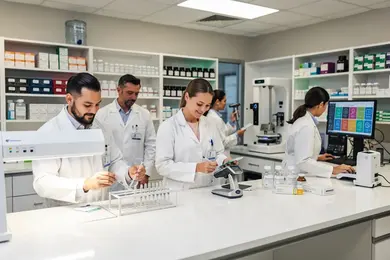
| Compounding and calculations support | Remote preparation modules followed by supervised in-person sterile and nonsterile compounding practice | Medication preparation errors can create major safety risks, so students need verified competency. |
| Experiential education network | Introductory and advanced pharmacy practice rotations arranged through approved sites and preceptors | Even a strong online curriculum depends on real-world practice settings to build competence. |
A common mistake is choosing the program that appears most convenient without checking how often students must travel, where labs are held, and who arranges rotations. Convenience matters, but pharmacy education cannot be fully asynchronous if the goal is licensure-ready clinical preparation.
How do online PharmD clinical skills labs replicate hands-on campus training?
Online PharmD clinical skills labs replicate campus training by splitting skill development into three layers: pre-lab preparation, supervised practice, and competency assessment. Students may learn concepts online, rehearse through simulation, and then demonstrate hands-on skills during scheduled intensives or supervised practice experiences.
This model works best when each lab activity has a clear purpose. A video demonstration alone is not enough; students need practice, feedback, correction, and documentation that they met program standards.
Most strong programs use a sequence like this to move students from theory to practice:
- Students complete online modules covering pharmacotherapy concepts, safety standards, calculations, communication techniques, or device use.
- Students practice with virtual cases, simulated patients, digital drug information tools, or home-based assignments where appropriate.
- Faculty evaluate performance through quizzes, recorded counseling encounters, case write-ups, or remote checkoffs before in-person sessions.
- Students attend campus or regional intensives to practice tasks that require direct supervision, such as compounding, immunization technique, physical assessment, or interprofessional simulations.
- Students receive remediation or additional coaching if they do not meet competency expectations before moving into higher-stakes experiential rotations.
The strongest programs make these expectations visible before enrollment. If a school cannot clearly explain which skills are assessed online, which are assessed in person, and what happens if a student needs remediation, applicants should treat that as a red flag.
Which accredited online PharmD programs offer the most robust lab resources?
No single online PharmD program is automatically "best" for every student because lab support depends on location, travel flexibility, prior academic preparation, preferred learning style, and rotation access. A program with excellent campus intensives may be a poor fit if the student cannot travel when required, while a program with strong regional placement support may be more practical for working adults.
The programs below are examples of ACPE-accredited or ACPE-recognized PharmD pathways that have offered online, distance, or hybrid learning structures with in-person clinical skills components. Applicants should verify current format, accreditation status, campus visit requirements, and state authorization directly with each school before applying.
| Program example | Online or hybrid structure | Clinical skills lab support to examine | Best fit |
| Creighton University School of Pharmacy and Health Professions | Distance pathway with required campus experiences | Campus-based skills labs, patient-care simulations, communication practice, and experiential rotations | Students who want an established distance PharmD model with scheduled in-person learning. |
| Lake Erie College of Osteopathic Medicine School of Pharmacy | Distance education pathway with required on-campus sessions | Structured campus learning sessions, practice labs, and required experiential education | Students who can manage a defined hybrid schedule and want a professional-school environment. |
| St. John Fisher University Wegmans School of Pharmacy | Online pathway with required immersions | Skills immersions, simulation activities, patient-care practice, and placement-based experiential learning | Students looking for an online format that still includes repeated in-person clinical training. |
| Duquesne University School of Pharmacy | Online pathway with on-campus components | Clinical skills development, lab-based assessments, and pharmacy practice experiences | Students who want a private university setting with hybrid professional training. |
| University of Colorado Skaggs School of Pharmacy and Pharmaceutical Sciences | Distance or hybrid professional pharmacy pathways depending on track | Clinical education, experiential learning, and practice-readiness support tied to program pathway | Students comparing established public university pharmacy training with distance-access options. |
When evaluating "best" lab resources, do not rely only on marketing language. Ask for a current skills lab calendar, a list of required campus visits, examples of simulation platforms, remediation policies, and rotation placement support by state.
How does ACPE accreditation impact online PharmD clinical skills lab quality?
ACPE accreditation matters because it is the quality-control framework for U.S. PharmD education. State boards of pharmacy generally require graduation from an ACPE-accredited PharmD program as part of the pharmacist licensure pathway, along with exams and other state-specific requirements.
For online students, accreditation is especially important because it helps ensure the program has not traded clinical preparation for convenience. ACPE standards evaluate whether the curriculum, faculty oversight, experiential education, assessment methods, and patient-care preparation are sufficient for a professional pharmacy degree.
Accreditation affects clinical lab quality in several practical ways:
- It requires programs to document that students develop practice-ready competencies, not just complete didactic coursework.
- It pushes schools to maintain qualified faculty, preceptor systems, assessment plans, and continuous improvement processes.
- It supports consistency across online and campus learners so distance students are not treated as a lesser pathway.
- It gives applicants a way to identify programs that are eligible for pharmacist licensure pathways in most U.S. jurisdictions, subject to state rules.
The key limitation is that accreditation does not mean every program has the same lab design or the same level of convenience. One accredited program may require several campus trips, while another may use different intensive structures. Students should treat ACPE accreditation as the minimum requirement, then compare the actual lab and rotation model.
What clinical lab experiences and simulations are included in online PharmD curricula?
Online PharmD curricula usually combine foundational science, pharmacotherapy, patient care, law and ethics, public health, and experiential education. Clinical labs connect those courses to practice by asking students to perform pharmacist tasks under observation or in simulation.
The most useful lab experiences are those that mirror common pharmacist responsibilities. They should help students become safer, more precise, and more confident before they counsel patients, collaborate with clinicians, or verify medication therapy in rotations.
Students should expect many of the following lab and simulation categories in a well-supported online PharmD pathway:
- Patient counseling labs focused on medication instructions, side effects, adherence barriers, health literacy, and motivational interviewing.
- Medication therapy management simulations involving medication reviews, drug interaction checks, therapeutic recommendations, and documentation.
- Immunization and injection technique practice, often tied to certification requirements and state scope-of-practice rules.
- Sterile and nonsterile compounding practice, including calculations, aseptic technique, labeling, safety procedures, and quality checks.
- Physical assessment and point-of-care testing activities, such as blood pressure measurement or device-based screening where permitted.
- Interprofessional simulations with nursing, medical, physician assistant, or public health students to practice team-based care.
- Pharmacy law, ethics, and controlled substance scenarios that require students to identify compliance and safety issues.
AI-enabled learning tools are also becoming more common in health professions education. In pharmacy, the value is not that AI replaces clinical judgment; it is that adaptive cases, virtual patients, and analytics can help students practice more often and identify weak areas earlier. Programs should be transparent about how these tools are supervised by faculty and how student performance is evaluated.
How do online PharmD programs arrange in-person lab intensives and practicum placements?
Online PharmD programs usually handle hands-on training through two mechanisms: required in-person lab intensives and experiential education placements. Lab intensives are controlled by the school and often occur on campus. Practicum and rotation placements occur in approved pharmacy practice settings under preceptors.
Students should pay close attention to logistics because these requirements can affect work schedules, family responsibilities, travel costs, and state eligibility. A program can be academically strong but still impractical if the required travel or placement geography does not fit the student's life.
Before enrolling, applicants should ask admissions or experiential education staff these questions:
- How many in-person lab intensives are required, and how many days does each session last?
- Are intensives held only on the main campus, or are regional sites available?
- Which skills are assessed in person, and what happens if a student does not pass a checkoff?
- Does the school place students in introductory and advanced pharmacy practice experiences, or must students find their own sites?
- Can the school support placements in the student's state, and does state authorization affect enrollment?
- Are travel, lodging, background checks, immunizations, drug screens, or onboarding fees included in the estimated cost of attendance?
- How far in advance are lab and rotation schedules released?
A major red flag is vague placement language. "Students may identify local sites" sounds flexible, but it can become stressful if the school does not have established preceptor agreements near the student. Strong programs usually have a formal experiential education office that explains responsibilities clearly.
What admission requirements apply to online PharmD programs with advanced lab training?
Admission requirements vary by school, but online PharmD programs with serious clinical lab expectations typically look for evidence that applicants can handle rigorous science coursework, professional communication, and the time demands of hybrid learning. Many applicants enter after completing prerequisite college courses rather than after earning a bachelor's degree, although some programs prefer or reward broader academic preparation.
Applicants comparing pharmacy with nursing or other clinical routes should also consider whether their long-term goal is prescribing, medication therapy management, direct bedside care, or pharmacy leadership. For example, non-nurses exploring advanced clinical training may compare PharmD admissions with direct entry MSN programs online if they are still deciding between pharmacy and nursing.
Common admissions requirements include the following, but students should confirm details directly with each school:
- Completion of prerequisite courses such as general chemistry, organic chemistry, biology, microbiology, anatomy or physiology, calculus or statistics, and humanities or social science courses.
- Minimum GPA standards, often with separate attention to science GPA and prerequisite performance.
- Official transcripts from all colleges attended and evaluation of transfer credit policies.
- PharmCAS application materials where applicable, including essays, recommendations, and activity history.
- Interview participation, often using behavioral questions or multiple mini-interview formats to assess professionalism and communication.
- Technical standards showing the student can participate in lab activities, patient interaction, and experiential education with or without approved accommodations.
- Background check, drug screening, immunization documentation, and other health clearance requirements before rotations.
Students should avoid assuming that online admission means easier admission. Pharmacy schools still need students who can progress into patient-facing environments safely. Applicants with weaker science grades may strengthen their profile by retaking key prerequisites, gaining pharmacy technician or healthcare experience, and preparing carefully for interviews.
How long do these online PharmD programs take, and what do they cost overall?
Most entry-level PharmD programs take about four professional years after prerequisites, though some schools offer accelerated calendars or different pathways for students with prior pharmacy education. Online and hybrid formats may reduce relocation costs, but they do not eliminate lab travel, rotation expenses, technology needs, or professional fees.
Students should compare total cost of attendance rather than tuition alone. Federal graduate loan rates also matter: for loans first disbursed during the 2024-2025 federal aid year, Direct Unsubsidized Loans for graduate and professional students carried an 8.08% fixed interest rate, which makes borrowing strategy an important part of ROI planning.
The table below shows the main cost categories to request from each school. This is more useful than comparing tuition in isolation because online PharmD students often face expenses that are easy to overlook.
| Cost category | What to verify | Why it affects the decision |
| Tuition | Per-credit, per-term, or annual tuition and whether rates differ by residency | Tuition is usually the largest expense, but pricing structures vary widely by institution. |
| Professional fees | Lab, simulation, technology, assessment, graduation, or professional program fees | Fees can materially change the annual cost even when tuition appears competitive. |
| Travel for intensives | Required trips, lodging, meals, transportation, and missed work time | Hybrid programs may require repeated campus visits that are not included in tuition. |
| Experiential education costs | Site onboarding, background checks, drug screens, immunizations, parking, and relocation for rotations | Rotation costs can rise if local placements are limited or schedules require temporary relocation. |
| Licensure preparation | NAPLEX, MPJE or state law exam costs, review materials, and state board fees | Graduation is not the final expense; licensure adds additional required costs. |
If the main career goal is healthcare operations rather than pharmacist licensure, a health care administration masters may offer a more direct and often less clinically intensive route into management. The right comparison is not just "which degree is cheaper," but which credential matches the job you actually want.
When reviewing cost, ask schools for a full written estimate that includes:
- Total tuition for the full program under normal progression.
- All required fees for labs, simulations, assessments, and technology.
- Estimated travel and lodging costs for every required in-person session.
- Typical rotation-related expenses that students pay out of pocket.
- Scholarship availability, assistantships, military benefits, employer support, and payment plan options.
- Borrowing limits, loan interest, and whether the school provides debt counseling for professional students.
What pharmacy career paths rely most on strong clinical skills lab preparation?
Strong clinical skills lab preparation matters most in roles where pharmacists interact directly with patients, evaluate medication therapy, collaborate with clinicians, or manage safety-sensitive medication systems. Retail dispensing still requires accuracy and counseling, but many expanding pharmacy roles involve deeper clinical judgment and interprofessional communication.
The BLS projects pharmacist employment to grow 5% from 2023 to 2033, which is about as fast as the average for all occupations. For students, that means the degree can support stable career access, but the strongest opportunities may favor graduates who can demonstrate patient-care skills, adaptability, and readiness for evolving practice models.
The table below connects career paths with the lab skills that matter most. Use it to decide whether a program's clinical support matches your target role.
| Career path | Typical responsibilities | Lab preparation that matters most |
| Community pharmacist | Medication dispensing, counseling, immunizations, adherence support, and safety screening | Patient counseling, immunization technique, medication safety, and workflow simulation |
| Clinical pharmacist | Medication therapy management, rounding support, therapeutic recommendations, and documentation | Patient case simulations, interprofessional communication, evidence-based pharmacotherapy, and EHR practice |
| Hospital or health-system pharmacist | Order verification, sterile products oversight, transitions of care, and medication-use safety | Sterile compounding, calculations, high-alert medication safety, and acute care simulations |
| Ambulatory care pharmacist | Chronic disease management, medication adjustment support, patient education, and follow-up | Physical assessment, motivational interviewing, medication therapy management, and documentation |
| Managed care or industry pharmacist | Formulary review, medication policy, pharmacoeconomic analysis, safety monitoring, or medical information | Drug information evaluation, evidence review, communication, and population-health simulations |
Students interested mainly in psychiatric medication management should compare pharmacy roles with nursing-based advanced practice routes, including the fastest psych NP program options, because scope of practice, prescribing authority, licensure, and patient-care responsibilities differ substantially by profession and state.
Strong lab preparation is especially valuable for students planning residencies. Postgraduate year one pharmacy residency programs are competitive and practice-heavy, so applicants benefit from repeated simulations, polished patient counseling, strong documentation habits, and confidence in interprofessional settings.
How can students evaluate and compare clinical lab support across online PharmD options?
The best way to compare online PharmD lab support is to move beyond rankings and create a practical checklist. A program should be judged by accreditation, skills assessment quality, in-person requirements, placement support, cost transparency, licensure alignment, and student support systems.
Use the following step-by-step process before applying or depositing:
- Confirm ACPE accreditation and the exact PharmD pathway you are applying to, not just the university's general reputation.
- Request a written schedule of required campus visits, lab intensives, simulation activities, and skills checkoffs.
- Ask how the program supports students who need remediation after a lab or clinical skills assessment.
- Verify whether the school can support experiential placements in your state and whether state authorization affects your eligibility.
- Compare total cost of attendance, including travel, fees, rotation expenses, and licensure preparation.
- Ask to speak with current students or recent graduates about lab logistics, faculty responsiveness, and rotation quality.
- Review NAPLEX preparation support, residency advising, career services, and employer relationships.
- Check whether the program's learning format fits your work schedule, family obligations, technology access, and ability to travel.
Common mistakes can be avoided with direct questions. The table below identifies frequent red flags and better ways to evaluate programs.
| Common mistake | Why it is risky | Better approach |
| Choosing the fewest campus visits | Fewer visits may mean less supervised hands-on practice, depending on the curriculum. | Compare what skills are actually taught, practiced, and assessed during each visit. |
| Looking only at tuition | Online students may pay significant travel, fee, and rotation-related costs. | Request a full cost-of-attendance estimate for the entire program. |
| Assuming online means local rotations | Some programs may not have enough approved sites near every student. | Ask for placement support details by state or region before enrolling. |
| Ignoring licensure rules | State boards may have requirements beyond graduation from an accredited program. | Check the state board where you plan to practice before committing. |
| Relying only on rankings | Rankings may not measure lab quality, remediation support, or placement logistics. | Compare the clinical skills model and experiential education system directly. |
A strong online PharmD is worth considering if you need geographic flexibility but still want rigorous clinical preparation. It may not be the right fit if you cannot travel for required labs, need a fully asynchronous program, or are not prepared for the workload of a professional doctorate tied to licensure.
Other Things You Should Know About PharmD
Yes, if the program is ACPE-accredited and meets the requirements of the state where you plan to seek licensure. You will still need to complete required experiential education and pass licensure exams such as the NAPLEX and any required state law exam.
Many online PharmD programs require virtual OSCEs before students begin advanced practice rotations. These assessments usually use standardized patients, webcam proctoring, and a minimum passing score set by the school. Programs also require scheduled lab intensives of 1 to 3 days each semester to demonstrate counseling and dispensing skills.
It is not always required, but it can help. Pharmacy technician or healthcare experience can strengthen an application, improve confidence with pharmacy workflows, and help students confirm that the profession fits their goals.
Yes, graduates of accredited PharmD programs can generally pursue residency opportunities, but competitiveness depends on academic performance, rotations, recommendations, leadership, research, work experience, and interview strength.
References
- Getting Your PharmD: How Long is Pharmacy School? https://www.pacificu.edu/blog/getting-your-pharmd-how-long-pharmacy-school
- Hybrid PharmD Program | WCU https://westcoastuniversity.edu/programs/pharmd
- Securing and leveraging high-impact pharmacy work experience https://www.sermo.com/resources/pharmacy-work-experience/
- Simulation-based training: applications in clinical pharmacy https://pharmaceutical-journal.com/article/research/simulation-based-training-applications-in-clinical-pharmacy
- Doctor of Pharmacy (PharmD) for Working Professionals | School of Pharmacy https://www.mun.ca/pharmacy/programs-and-admissions/doctor-of-pharmacy-for-working-professionals/
- Start Your Future at the Only Online Pharmacy School in Ohio https://pharmdonline.findlay.edu/
- Top Pharmacy Technician Skills Employers Look for Today https://immerselearn.com/blog/pharmacy-technician-skills
- Best Online PharmD Programs https://pharmddegree.com/choosing/best-online-pharmd-programs
- Online PharmD Programs: Best Flexible Online Pharmacy Schools https://www.phds.me/online-programs/pharmd-for-rph/
- Elevate Your PharmD Degree with the FlexPharmD: A Flexible Path to Success https://www.unthealth.edu/college-of-pharmacy/doctor-of-pharmacy-pharmd.html