2027 Child Development Degree Oversupply or Undersupply? Student Volume vs Employer Demand

Co-Founder and Chief Data Scientist
Facing a surplus of child development graduates in some regions, prospective students must evaluate whether enrolling in such programs leads to meaningful employment or heightened competition. Recent 2024 data report a 15% increase in child development degree completions nationally, while job openings have grown just 7%, suggesting potential oversupply in several key markets. Employers increasingly seek specialized skills beyond general credentials, intensifying hiring selectivity and risking underemployment for many entrants. Regional disparities further complicate outcomes, with rural areas showing fewer job opportunities despite steady graduate output.
This article compares student volume with employer demand, industry growth, location trends, and skill gaps to clarify whether child development offers sustainable career prospects or rising challenges.
Key Things to Know About Child Development Graduate Supply and Employer Demand
- Despite steady degree completions exceeding 15,000 annually in 2024, geographic clustering in urban centers creates localized undersupply where employer demand outpaces available graduates, urging targeted recruitment and training strategies.
- Employer surveys indicate a rising preference for candidates with specialized certifications, reflecting a skills mismatch that pressures general child development graduates to pursue additional credentials for competitive entry-level roles.
- The growing student volume lengthens program duration and cost burdens, delaying workforce entry; this timing tradeoff disproportionately affects low-income students and influences retention in underfunded education pathways.
- Key Things to Know About Child Development Graduate Supply and Employer Demand Key Things to Know About Child Development Graduate Supply and Employer Demand
- Is There an Oversupply or Undersupply of Child Development Graduates? Graduate Oversupply or Shortage
- How is Child Development Degree Enrollment Changing? Degree Enrollment Trends
- How Many Child Development Graduates Enter the Workforce Each Year? Annual Graduate Workforce Entry
- Does Job Growth Support the Rising Supply of Child Development Graduates? Job Growth Versus Supply
- How Competitive is the Entry-Level Market for Child Development Graduates? Entry-Level Market Competition
- Which Industries Have the Greatest Demand for Child Development Graduates? Top Hiring Industries
- Where are Child Development Graduates Most in Demand? Top Geographic Demand
- Which Child Development Specializations and Degree Levels Face the Strongest Demand? Which Child Development Specializations and Degree Levels Face the Strongest Demand?
- Are Employer Skill Gaps Affecting Demand for Child Development Graduates? Are Employer Skill Gaps Affecting Demand for Child Development Graduates?
- What is the Future Supply-and-Demand Outlook for Child Development Graduates? Future Supply-Demand Outlook
Is There an Oversupply or Undersupply of Child Development Graduates?
Supply and demand for child development graduates do not align evenly across the national landscape. While around 20,000 bachelor's degrees are awarded annually, the job market reflects significant geographic and specialization-based variation. Metropolitan regions experiencing public investment in childcare infrastructure-such as California, New York, and Texas-demonstrate demand that exceeds local graduate output, creating pockets of undersupply. However, in rural and economically struggling areas, graduate volume outpaces job availability, leading to oversupply and heightened competition among early-career professionals.
The child development graduate supply and employer demand analysis also reveals credential and experience mismatches. Employers increasingly favor candidates with bachelor's degrees or higher and specialized training in areas like trauma-informed care or developmental psychology, intensifying competition among associate degree holders. Practical experience is another critical factor narrowing the effective supply pool, as many recent graduates lack the hands-on skills employers require. These nuances mean that although the aggregate graduate count may seem sufficient, the subset of job-ready candidates often falls short in priority regions or sectors, impacting long-term workforce stability and candidate employability.
Prospective students should consider these disparities carefully alongside enrollment trends and shifting occupational requirements. Choosing degrees with focused specializations or certifications may improve placement prospects, especially where local markets signal oversupply. For those evaluating options, pathways like an online health administration degree illustrate how complementary credentials can expand employment opportunities beyond conventional child development roles. Overall, the competitive dynamics in the child development field necessitate informed career planning grounded in realistic job market conditions rather than simplistic graduate-to-position ratios.
How is Child Development Degree Enrollment Changing?
Enrollment in child development degree programs has experienced a subtle decline through early 2024, particularly affecting associate and bachelor's tracks, which has implications for graduate competition and labor market dynamics. The growth of online delivery has expanded access but intensified rivalry among programs by enabling students from diverse regions to enroll, eroding localized enrollment patterns.
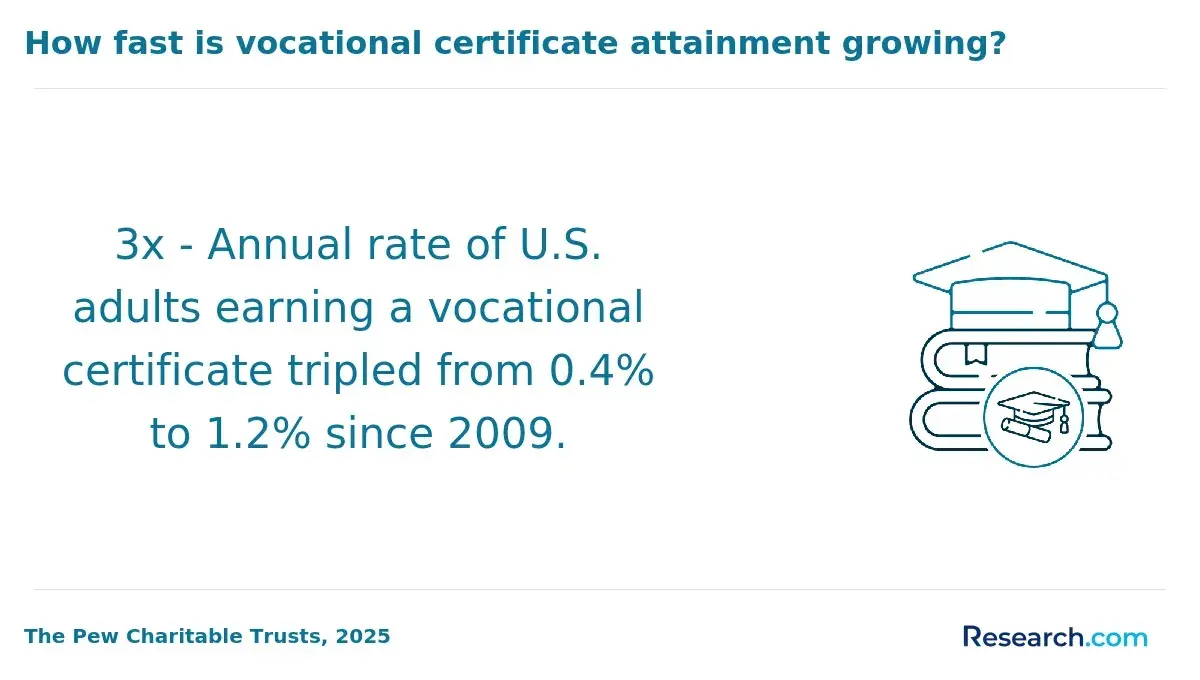
Decreases in degree completions coincide with a rise in certificate attainment, especially in specialized early childhood credentials, signaling some students prioritize faster entry into the workforce over extended degree programs. This reflects the shifting makeup of the student body toward older, part-time learners often returning to education for career changes rather than direct postsecondary progression. Using aggregated national data to infer labor market outcomes can mislead; some regions will still experience educator scarcity despite overall static or declining enrollment. Strategic alignment between credential type, program modality, and regional employment trends is essential for prospective candidates weighing educational investments against realistic job prospects within this uneven landscape.
A student currently pursuing a bachelor's in child development noted growing class sizes in core courses despite an overall enrollment dip at their institution, largely driven by the convenience of expanded online options attracting working adults. They expressed mixed feelings, unsure if the increase in peers signals heightened competition for local jobs or simply broader interest that could enhance networking opportunities. Their experience highlighted broader institutional shifts toward accommodating nontraditional student needs while grappling with the market uncertainty that evolving enrollment trends create for those planning long-term careers in early childhood education.
How Many Child Development Graduates Enter the Workforce Each Year?
The number of child development graduates entering the workforce annually does not straightforwardly indicate whether the field faces oversupply or undersupply, largely due to variations in employer demand, credential requirements, and labor market timing. Data from the National Center for Education Statistics and IPEDS show that between 25,000 and 30,000 degrees in child development or closely related fields are awarded nationwide each year across associate, bachelor's, and graduate levels. However, only about 60% to 70% of these graduates enter child development-related jobs within 12 to 18 months, as many pursue further education, alternate careers, or face regional job scarcity, separating degree completion from immediate workforce entry.
Workforce data from the Bureau of Labor Statistics projects a moderate 5%-7% growth in relevant roles over the next decade, signaling steady but limited expansion that fails to uniformly absorb all new graduates. Geographic disparities play a significant role; areas with robust early childhood programs show higher absorption rates of graduates, while oversupply and heightened competition occur in saturated urban markets. Furthermore, employer expectations often include additional certifications or licensing beyond a degree, complicating direct entry and creating uneven access to available positions.
This dynamic results in a nuanced labor market where prospective students and holders of child development degrees must weigh location-specific demand, the necessity of credential stacking, and potential underemployment risks against the volume of credentialed peers. Misinterpreting graduate output as a simple surplus can overlook underserved regions struggling to fill vacancies, while overestimating demand may lead to frustration and stagnant employment for some graduates. The interaction between degree conferral data, regional hiring trends, and employer requirements therefore provides a more comprehensive lens for evaluating workforce alignment than graduate counts alone.
Does Job Growth Support the Rising Supply of Child Development Graduates?
Despite projections indicating roughly 6% growth in early childhood education and child care jobs over the next decade, the increasing number of child development graduates is outpacing new job openings. This imbalance is particularly acute in metropolitan areas where the volume of entry-level candidates exceeds available positions, creating a highly competitive environment. Many employers now prioritize candidates with practical experience, certifications, or specialized skills-such as expertise in special education or early intervention-over degree credentials alone, further challenging recent graduates without these advantages. A graduate entering the field solely with a bachelor's degree but lacking relevant internships may find themselves navigating underemployment or needing to relocate to areas with more favorable regional hiring trends for entry-level child development positions.
Replacement demand due to retirements provides some absorption of new professionals, but it does not fully offset the surplus created by rising graduate completions, according to data from major education and labor statistics authorities. Higher degree levels tend to open pathways to less saturated leadership or policy-related roles, which remain more insulated from this supply pressure. These dynamics underscore the importance of aligning educational choices and credentials with evolving employer expectations and geographic labor market realities. For students weighing options, considering program elements that include hands-on training or related credentials-similar in strategic value to certain online medical coding programs known for their practical outcomes-can prove decisive in improving employment prospects within this crowded field.
How Competitive is the Entry-Level Market for Child Development Graduates?
The entry-level market for child development graduates presents a complex landscape shaped by varied demand and persistent competition. While demand for early childhood roles grows steadily, supply frequently outpaces openings, especially in urban areas where candidate-to-job ratios can exceed three to one. Employers increasingly prioritize hands-on experience and specialized certifications over purely academic qualifications, putting recent graduates without such credentials at a disadvantage. The resulting competition is neither solely about graduate oversupply nor employer under-hiring but reflects a blend of uneven regional demand, sector-specific needs, and evolving qualification expectations. The following factors critically impact hiring prospects in this field.
- Applicant Volume: Many new graduates enter the child development job market annually, exceeding the number of entry-level positions available. This surplus heightens competition and often leads to underemployment or delayed hiring.
- Experience Requirements: Employers frequently require internships, practicum hours, or certified training beyond a bachelor's degree. Graduates lacking such practical credentials face longer job searches and limited interview opportunities.
- Industry Variation: Public and private preschool programs tend to be more saturated and competitive compared to community-based or nonprofit organizations, which sometimes show demand gaps worth targeting strategically.
- Regional Demand Disparities: Urban centers generally suffer from candidate oversupply, while rural or underserved areas report workforce shortages, suggesting relocation or regional flexibility as a practical consideration.
- Skill Prioritization: Employers increasingly emphasize soft skills, continuing education, and specialized certifications, which affects hiring chances for candidates focused solely on degree completion.
- Credential Competition: Advanced credentials such as early childhood intervention certifications enhance employability but require investment in time and resources, lengthening the path to stable employment.
- Hiring Timelines: Data from the National Association of Colleges and Employers indicates that only about 60% of credentialed graduates secure jobs within six months, underscoring the importance of strategic job searches and resilience.
One recent graduate found that despite holding a relevant degree, competing in a metropolitan area meant facing applicant pools three to four times the number of openings. After several rejection notices citing lack of prior certified training, the graduate shifted focus to nonprofit community centers outside the city, where demand was more acute and competition less intense. While this required adapting to different organizational cultures and roles that paid less initially, it allowed the graduate to build experience and credentials that could open future opportunities. This experience highlights the need for pragmatic tradeoffs and regional-market awareness in navigating the child development job landscape.
Which Industries Have the Greatest Demand for Child Development Graduates?
Labor market trends indicate that employer demand for child development graduates is concentrated in sectors where direct impact on child welfare and education aligns with structural funding and regulatory priorities. These industries often value candidates with specialized credentials and practical experience, but hiring competition and job availability vary significantly by region and employer size. Graduates must weigh high-volume job postings against the consistency of hiring and potential for advancement. For example, a graduate comparing opportunities might find early childhood education roles abundant but competitive in metropolitan areas, while healthcare positions involving pediatric therapy may be fewer but offer more specialized career trajectories. The following industries currently generate the strongest employer demand for child development degree holders:
- Educational Services: Early childhood centers, preschools, and K-12 developmental programs drive demand due to regulatory requirements and the emphasis on early learning preparedness. Entry-level roles often require state-specific credentials, while advancement may depend on additional certifications or teaching licenses.
- Healthcare And Social Assistance: Opportunities include pediatric therapy, child life specialist positions, and intervention programs. Employers prioritize clinical and community engagement skills; demand levels fluctuate with healthcare funding and regional policy focus on early intervention.
- Government Agencies: Public health departments and social services hire graduates for policy implementation, program administration, and direct child welfare services. These roles offer stability but often require advanced degrees and face limited openings, increasing competition.
- Nonprofit Organizations: Specialized roles emphasize family engagement, behavioral assessment, and advocacy. Although smaller in scale, these employers seek practitioners with niche skills and relevant experience focused on community-based child development supports.
- Private Family Support Services: This sector targets personalized intervention services, often in home or community settings. Employers value flexible practitioners trained in diverse developmental approaches, but job volume is limited and varies by local demand.
Prospective students and current graduates should critically assess regional market data and employer expectations to realistically evaluate child development graduate job demand by industry. Balancing volume, competition, and skill requirements helps inform career decisions more effectively than broad program promotion. For those interested in related healthcare management paths, exploring options like the fastest online MHA can complement a child development background with administrative expertise in growing healthcare sectors.
Careful consideration of top industries hiring child development degree holders highlights that robust demand does not always translate to easy entry, underscoring the importance of targeted skill acquisition, credentialing, and geographic flexibility for improved employment prospects.
Where are Child Development Graduates Most in Demand?
National demand statistics for child development graduates often mask significant local disparities shaped by employer density, regional education systems, and workforce needs. For instance, a graduate entering the job market in California may encounter numerous openings weighted heavily in urban public education and early intervention sectors, yet face intense competition compounded by high living expenses and crowded applicant pools. Conversely, similar candidates relocating to smaller metro areas with emerging childcare programs might find fewer overall roles but benefit from less saturated competition and a stronger likelihood of sustained employment, particularly where social service agencies are expanding but credential requirements remain stringent.
The interplay between industry concentration and geographic labor supply also plays a crucial role in shaping practical opportunities. Public education systems and nonprofit child welfare organizations in states with growing youth populations sustain heightened hiring activity, while private sector roles, such as those in corporate wellness or edtech, remain limited and highly competitive. Moreover, employers increasingly emphasize applied experience alongside formal degrees, narrowing viable candidate pools and impacting long-term employability. This dynamic means prospective graduates must weigh local job volume against applicant density and specialization fit, as high job counts in areas like Houston or New York may not translate into accessible opportunities without relevant certifications or internships.
Labor market data from 2024 highlights that while some regions experience oversupply driven by abundant graduates and limited program growth, other areas suffer workforce shortages as demand outpaces available credentials. This fragmentation suggests geographic mobility and targeted skill development are essential considerations for child development professionals, with relocation to emerging markets offering potential advantage despite possible tradeoffs in salary or amenities. Ultimately, students and degree holders should prioritize nuanced, location-specific analysis over broad regional popularity to align their career choices with genuine demand and realistic employment conditions.
Which Child Development Specializations and Degree Levels Face the Strongest Demand?
Employer demand within child development reflects notable specialization and credential-related patterns rather than broad, uniform needs across all fields and degree levels. Data from the U.S. Bureau of Labor Statistics and Lightcast underscores that early childhood education, special education, and early intervention remain the primary areas where shortages persist, influenced by mandated credential norms and rising policy focus on inclusivity. For example, a bachelor's degree graduate specializing in early childhood education is more likely to find opportunities in public schools or childcare administration than a graduate without a clear specialization or with a less market-relevant credential.
Conversely, a graduate holding a master's degree in clinical counseling related to child development may face a narrower but more advanced set of roles, often leaning toward supervisory or policy positions rather than direct care. This differentiation highlights that job prospects depend fundamentally on how demand aligns with specific skills, credentials, and experience rather than on degree attainment alone. According to LinkedIn Workforce Insights, postings for positions requiring associate degrees continue to increase in nonprofit and community agency sectors, albeit generally at support or assistant levels. Key demand areas include:
- Early Childhood Education: Driven by persistent shortages in preschool and daycare settings, this specialization requires at least a bachelor's degree and often state certifications. Employers seek candidates with curriculum planning and practical classroom experience.
- Special Education: Strong demand is linked to federal mandates and expanding inclusion policies. Positions typically require a bachelor's or higher with specific credentials, plus experience managing individualized education programs.
- Early Intervention Specialists: Growing recognition of developmental disabilities fuels need for specialists trained in early developmental assessments, often requiring a bachelor's degree paired with clinical experience or certification.
- Child Development Assistants: Associate degree holders with local certification can fill assistant and coordinator roles, especially within community-based agencies and nonprofits emphasizing hands-on support.
- Graduate-Level Clinical Roles: Master's degree holders in clinical or counseling fields are sought for supervisory, program development, or mental health support roles, though direct-care job markets are narrower.
Are Employer Skill Gaps Affecting Demand for Child Development Graduates?
The current labor market for child development graduates reflects not a simple shortage of candidates but a pronounced deficit in those with employer-valued competencies. Despite steady graduate volumes, hiring managers report difficulty filling roles that demand practical experience, digital proficiency, and up-to-date knowledge of licensing and developmental standards. For example, a hiring scenario involving candidate pools with strong academic credentials but limited hands-on work with diverse child populations often results in extended vacancies, as employers prioritize applied skills over theoretical knowledge alone. This dynamic creates a false impression of oversupply when the real issue lies in mismatched qualifications.
Data from 2024 reveal how child development graduate employer skill mismatch trends significantly influence regional and industry-specific hiring competitiveness. Employers increasingly value candidates demonstrating specialized certifications, interdisciplinary communication abilities, and familiarity with adaptive learning technologies, competencies not uniformly developed across programs. Graduates without these targeted skills face heightened competition and limited opportunities despite ongoing demand. Prospective students and degree holders must therefore critically assess program curricula, internship offerings, and relevant project experiences to improve alignment with market needs. Additionally, exploring options like BSN to MSN online programs in related fields can provide transferable skills that enhance employability in overlapping care and education roles.
Such nuanced demand underscores the importance of strategic educational choices informed by operating realities rather than volume-based assumptions. Professionals who successfully integrate data-driven and culturally responsive methods into their practice stand out in a saturated market. Understanding these practical tradeoffs is crucial for those evaluating the supply-demand balance and seeking clear paths to long-term workforce integration in child development careers.
What is the Future Supply-and-Demand Outlook for Child Development Graduates?
Targeted job searches that focus on specific entry-level job titles and geographic regions typically outperform broad, high-volume applications by better aligning graduate qualifications with actual employer demand. For example, a child development graduate who prioritizes openings in urban centers or licensed childcare settings, where regulatory requirements drive heightened qualification standards, will often find more realistic opportunities. Conversely, graduates who apply indiscriminately across regions with stagnant population growth or limited public funding may face intensified competition and prolonged joblessness. Tailoring resumes to incorporate employer language and demonstrating niche skills like special needs accommodation or infant mental health through tangible projects can significantly enhance interview conversion rates.
Effective allocation of effort toward roles where a candidate's credentials closely match stated requirements is critical amid shifting labor-market dynamics. The future employment demand for child development degrees is uneven, with many employers increasingly valuing specialized competencies beyond foundational degrees. Graduates who engage in continuous market research, time applications strategically, and provide evidence of job readiness often experience improved outcomes compared to those relying solely on generic application strategies. Prospective students and existing degree holders should also broaden their perspective on related fields, considering, for instance, workforce expansions in healthcare, which could parallel growth in child development roles.
Given these complexities and supply-demand mismatches revealed in recent labor data, graduates benefit from nuanced decisions rather than generic advice. Exploring the best online BSN programs for non nurses also exemplifies how alternative pathways with practical orientation can complement child development qualifications, thereby enhancing employability in interconnected care-focused sectors.
References
- Promising Models To Support and Expand the Early Childhood Educator Workforce - Center for American Progress https://www.americanprogress.org/article/promising-models-to-support-and-expand-the-early-childhood-educator-workforce/
- Child Care Market Growth, Trends & Industry Forecast 2034 https://www.fortunebusinessinsights.com/child-care-market-116172
- Lost Potential: The Hidden Cost of Barriers to Early Childhood Education - PIQE https://www.piqe.org/lost-potential-the-hidden-cost-of-barriers-to-early-childhood-education/
- Top Careers in Child Development https://mybrightwheel.com/blog/careers-in-child-development
- The Early Childhood Education Workforce Shortage https://www.savvas.com/resource-center/blogs-and-podcasts/college-and-career-readiness/career-paths/early-childhood-education-workforce-shortage
- Over-Supply vs. Under-Supply: Pump Smart and Keep Baby’s Milk Just Right https://www.thebreastchoicels.com/post/over-supply-vs-under-supply-pump-smart-and-keep-baby-s-milk-just-right
- Ask an LC: Everything You Need to Know About Overproduction & Undersup https://onewillow.com/blogs/all/ask-an-lc-everything-you-need-to-know-about-overproduction-undersupply
- Workforce https://ecereport.ca/en/workforce-report/
- Why Now Is the Time to Earn Your ECE Degree https://www.athenacareers.edu/earning-your-ece-degree-now-puts-you-ahead-in-a-competitive-market/
- Shibboleth Authentication Request https://academic-eb-com.ezproxy.its.uu.se/levels/collegiate/article/child-development/24057
Other Things You Should Know About Child Development
Employers in child development increasingly prioritize hands-on experience and demonstrated practical skills over academic credentials alone. Students should aim to supplement their degree with internships, practicums, or volunteer roles that provide direct interaction with children and families. Prioritizing programs that integrate substantial applied learning can improve employability by aligning graduates' skills with employer expectations, as many entry-level positions demand evidence of real-world competence beyond classroom theory.
While a master's degree or higher can open doors to supervisory, policy-making, or specialized roles, the labor market for child development remains relatively constrained in salary growth compared to other fields. Graduates must balance the cost and time commitment of advanced study against modest gains in earnings and job security. For most, prioritizing relevant certifications and ongoing professional development alongside experience may provide a better return on investment than pursuing advanced degrees solely for economic advancement.
Choosing a specialized concentration-such as early intervention or special education-can narrow employment opportunities but also align graduates more closely with less saturated niches that employers actively seek. Conversely, generalist programs offer broader career flexibility but often face higher competition. Prospective students should assess local or regional labor markets and consider whether acquiring niche skills may mitigate oversupply risks while meeting specific community needs.
Geographic flexibility can be a decisive factor given uneven distribution of child development roles across urban, suburban, and rural areas. Graduates limited to high-supply, low-demand regions may face prolonged job searches, while willingness to relocate can expose them to markets with better alignment between graduate output and available positions. Considering mobility early allows students to target programs with strong networks and placement support in areas exhibiting sustained employer demand.