
World Online Ranking of Best Microbiology Scientists - 2026 Report

Co-Founder and Chief Data Scientist
On June 2, 2026, Research.com released the 5th edition of its annual report ranking the best scientists in microbiology. The primary objective of this publication is to increase the online visibility of distinguished researchers who are actively expanding our understanding of microscopic organisms.
This report serves as a vital resource for academic institutions, aspiring students, and policymakers navigating the complex landscape of microscopic sciences. It highlights the foremost experts driving innovations in disease control, antibiotic resistance, and environmental sustainability.
For the 2026 edition, the research team examined more than 5,500 profiles utilizing OpenAlex, CrossRef, and other bibliometric databases. This rigorous data collection ensures that only the most influential scholars are recognized globally.
To qualify for inclusion, researchers must hold a minimum D-index of 40 in their respective fields. The final ranking methodology carefully considers the D-index score, the proportion of work contributed to the field, and notable awards.
Latest studies in microbiology research
Recent discoveries in microbiology reveal how microorganisms directly influence large-scale environmental and ecological systems. A study published in PLOS Biology found that gut bacteria inside marine fish actively produce calcium carbonate, a mineral essential for regulating ocean chemistry. This symbiotic partnership expands the known boundaries of marine biomineralization and offers crucial data for understanding the global carbon cycle.
Microbiology also provides critical tools for modern wildlife conservation efforts. Researchers from Edith Cowan University utilized advanced DNA techniques to analyze the poop of the critically endangered Gilbert's potoroo, identifying the specific fungi these rare marsupials rely on for survival. This non-invasive approach allows conservationists to locate suitable new habitats and protect vulnerable animal populations from extinction.
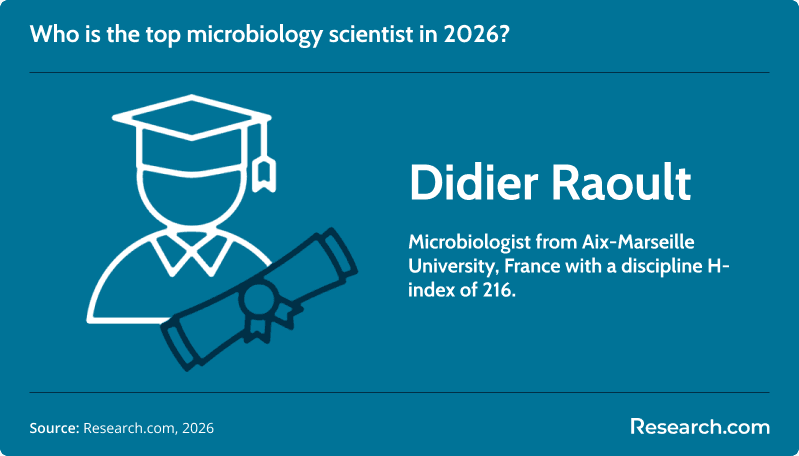
The key findings for the 2026 edition of the best microbiology scientists ranking
- Didier Raoult from Aix-Marseille University in France retains the number one spot globally as the leading active microbiology scientist.
- The United States continues to dominate the global landscape, emerging as the top country with 429 ranked scholars.
- The National Institutes of Health secures its position as the top institution worldwide, hosting 21 of the leading scientists.
- Australia demonstrated the most improvement year-over-year, moving up from 10th place in the previous report to 7th place in the current edition.
- The top 1% of researchers in this discipline possess an impressive average D-index of 184.0.
- Scientists in the top 1% also demonstrated high productivity, averaging 1,068.8 publications and 161,157.6 citations.
The full ranking for the 2026 list of the best microbiology scientists can be found here:
WORLD’S BEST MICROBIOLOGY SCIENTISTS RANKING
Countries with the highest number of leading microbiology scientists
The United States retains its global dominance, securing the number one rank with 429 leading scientists, despite a slight decrease from the 468 scholars recorded in the 2025 evaluation. The United Kingdom ranks 2nd with 90 recognized researchers, a marginal drop from 92 in the previous edition. Germany firmly holds 3rd place, representing 63 elite scientists, just as it did in the prior publication.
France demonstrated positive growth by securing the 4th position with 60 scholars, moving up from 5th place in the preceding assessment. The Netherlands dropped from 4th place in the previous report to 5th place with 54 researchers, while China made a powerful debut into the top tier, capturing 6th place with 31 featured experts. Australia also showcased remarkable advancement, moving up from 10th place in the past evaluation to claim 7th rank with 30 researchers.
Rounding out the leaderboard, Switzerland shifted from 7th place in the previous ranking to 8th place, followed by Belgium maintaining 9th place and Canada dropping from 8th to 10th.
Please note that the country associated with a scientist is based on the affiliated research institution according to MAG, not on their actual nationality.
Institutions with the highest number of leading scientists
The National Institutes of Health continues to be the premier hub for microbiological research, holding the 1st position with 21 leading scientists compared to 27 in the 2025 analysis. The Centers for Disease Control and Prevention retains 2nd place, housing 19 prominent scholars, which is a slight decrease from the 22 experts recorded in the prior evaluation. Institut Pasteur firmly maintains 3rd place with 16 top-tier researchers, perfectly matching its scholar count from the preceding ranking.
The University of Hong Kong showcased strong momentum, moving up from 8th place in the previous report to secure the 4th position with 14 recognized experts. The University of Oxford maintained their 5th place ranking from the past assessment, while the University of California, San Francisco improved its placement from 7th place in 2025 to 6th place this year. Ghent University claims 7th place with 11 distinguished academics.
The University of Pittsburgh also emerged as a leading facility, moving into the top 10 to secure 8th place with 11 scholars, while Aix-Marseille University held 9th place, down from 6th place last year. Conversely, Harvard University experienced a downward shift, dropping from 4th place in the past evaluation to land at 10th place with 10 leading scholars.
Advancing microbiology research through online universities
The integration of digital learning platforms is transforming how students and professionals engage with complex biological sciences. As demand for specialized laboratory knowledge grows, online universities provide flexible pathways for researchers to master advanced bioinformatics and data analysis tools.
This shift toward digital learning reflects a broader academic trend impacting all fields, as more students prioritize remote accessibility over traditional campus constraints. In fact, a 2024 report highlighted that over 495,000 master's degrees were pursued through online programs, officially surpassing traditional in-person graduate enrollments. By leveraging these modern online universities, the next generation of microbiologists can seamlessly collaborate across global borders to address urgent public health challenges.
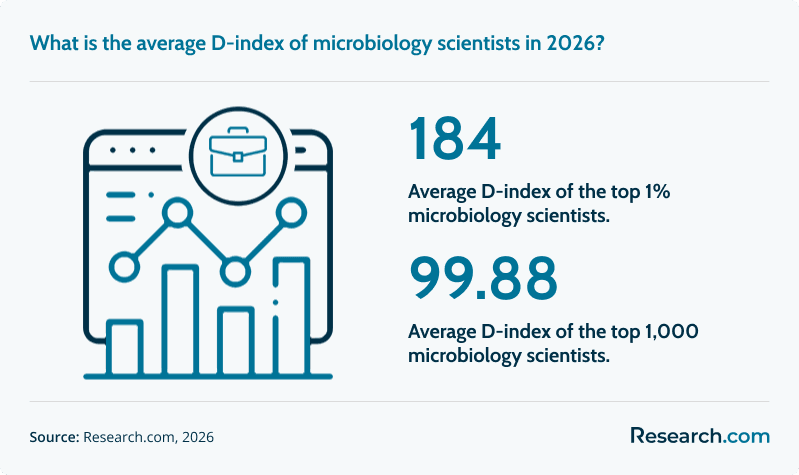
H-index ranking—leaders, averages, and distribution
Didier Raoult from Aix-Marseille University in France is the top-ranked scholar in Europe and holds the global number one spot with a D-index of 216.
In North America, Robert E. W. Hancock from the University of British Columbia in Canada leads the region, securing the 2nd global position with a D-index of 190.
Representing Oceania, Edward C. Holmes from the University of Sydney in Australia holds the 7th global rank with a D-index of 179.
For Asia, Kwok-Yung Yuen from the University of Hong Kong in China leads the continent, sitting at the 8th position worldwide with a D-index of 177.
In Africa, the highest-ranking scholar is Paul D. van Helden from Stellenbosch University in South Africa, who holds the 374th global rank with a D-index of 100.
Finally, Arnaldo Lopes Colombo from the Federal University of São Paulo in Brazil represents South America, placing 611th globally with a D-index of 90.
The average D-index for the top 1% of scientists is 184.0, which contrasts with the overall average of 99.88 for the entire ranking.
When analyzing research output, the top 1% of scholars produced an average of 1,068.8 publications, compared to the overall group average of 407.92.
Similarly, the top 1% received an impressive average of 161,157.6 citations, while the general average for the top 1,000 stood at 42,167.55.
You can learn more about the methodology used to create this report here.
About Research.com
All research was coordinated by Imed Bouchrika, Ph.D., a computer scientist with a well-established record of collaboration on a number of international research projects with different partners from the academic community. His role was to make sure all data remained unbiased, accurate, and up-to-date.
Research.com is the number one research portal for science and educational rankings. Our mission is to make it easier for professors, research fellows, and students to progress with their research and find the top experts in a wide range of scientific disciplines. Research.com is also a leading educational platform that helps students find the best colleges, academic opportunities, and career paths.


