
2027 How to Become a Middle School Math Teacher in Vermont: Requirements & Certification

Co-Founder and Chief Data Scientist
If you want to teach middle school math in Vermont, the main decision is not simply whether you like mathematics. You need to know which licensure pathway fits your background, what education and testing requirements apply, how student teaching works, how Vermont’s math standards shape classroom practice, and whether the career makes financial and professional sense for you. This guide explains the full route to becoming a Vermont middle school math teacher, including degree expectations, certification options, classroom preparation, salary context, professional development, financing strategies, and alternatives if you decide another teaching path is a better fit.
Quick Answer: How do you become a middle school math teacher in Vermont?
To become a middle school math teacher in Vermont, you typically need a bachelor’s degree, completion of an approved teacher preparation program, supervised student teaching, required Praxis exams, a background check, and an educator license issued through Vermont’s licensing system. Career changers and out-of-state teachers may be able to use alternative, transcript review, peer review, or reciprocity pathways, depending on their prior education and experience.
Key Things You Should Know Before Choosing This Path
- Licensure is essential. Public school teaching roles in Vermont require the appropriate educator license and endorsement for the grade level and subject you plan to teach.
- Math preparation matters. Middle school math teachers need both content knowledge and adolescent teaching skills, because students are moving from arithmetic foundations toward algebraic and abstract reasoning.
- Student teaching is not optional for most traditional candidates. Vermont candidates commonly complete a supervised classroom experience before licensure.
- Salary varies by role, district, experience, and source. The article below includes several salary figures from cited sources, including Vermont teaching wages and national middle school teacher data.
- Vermont classrooms need strong math instruction. The 2023 Vermont Mathematics assessment showed uneven proficiency across grades, which makes well-prepared math teachers especially important.
- Steps to becoming a middle school math teacher in Vermont
- Education requirements for Vermont middle school math teachers
- Certification and licensing process in Vermont
- Student teaching, internships, and classroom experience
- Vermont math standards and curriculum expectations
- Job market and salary expectations
- Professional development and continuing education
- Classroom management and teaching methods
- Career advancement and specializations
- Legal and ethical responsibilities
- Common challenges for Vermont math teachers
- Diversity and inclusion in middle school math classrooms
- Resources for new Vermont middle school math teachers
- Impact of an advanced degree
- How Vermont compares with other states
- Middle school math vs. elementary teaching in Vermont
- How to finance your teacher preparation
- Digital learning tools for math engagement
- Alternative teaching careers in Vermont
- Graduate perspectives on teaching middle school math
- Transitioning from middle school to high school teaching
- Dual certification options
- Certification pathway choices in Vermont
What are the steps to becoming a middle school math teacher in Vermont?
The standard route is to earn the right degree, complete teacher preparation, document your math competency, and apply for Vermont licensure. The exact pathway depends on whether you are a first-time college student, a career changer, or an already licensed teacher moving from another state.
| Step | What you need to do | Why it matters |
| 1. Earn a bachelor’s degree | Complete an undergraduate degree in education, mathematics education, mathematics, or a closely related field. | A bachelor’s degree is the usual minimum academic requirement for initial teacher licensure. |
| 2. Complete an approved preparation program | Choose a program that includes pedagogy, adolescent development, assessment, classroom management, and supervised teaching. | Teacher preparation connects math knowledge with practical instruction for middle grades learners. |
| 3. Build math content competency | Take coursework and assessments that demonstrate your readiness to teach middle school mathematics. | Students need teachers who can explain concepts clearly, diagnose misconceptions, and connect skills across grade levels. |
| 4. Complete student teaching | Work in a school under the supervision of a mentor teacher, usually during the final phase of your preparation program. | This experience helps you practice lesson planning, assessment, differentiation, and classroom routines before leading your own classroom. |
| 5. Pass required exams | Prepare for and complete required Praxis exams, including the Praxis Core Academic Skills for Educators tests and a mathematics subject assessment when applicable. | Testing is one way Vermont verifies basic academic skills and subject readiness. |
| 6. Apply for licensure | Submit transcripts, test results, preparation documentation, and required application materials to Vermont’s educator licensing system. | You cannot assume degree completion alone authorizes you to teach in a Vermont public school. |
| 7. Complete background checks | Follow fingerprinting and criminal background check requirements. | Schools must verify candidate eligibility and student safety before placement or employment. |
If you need a faster undergraduate route, compare legitimate options carefully. Some 1 year master's programs online may help licensed teachers or bachelor’s degree holders advance, but they are not a substitute for checking Vermont licensure requirements. Likewise, accelerated bachelor’s options can shorten the timeline only if transfer credits, accreditation, and teacher preparation requirements line up.
What are the educational requirements for becoming a middle school math teacher in Vermont?
Vermont middle school math teachers need preparation in two areas: mathematics and teaching. A strong candidate understands ratios, proportional reasoning, geometry, statistics, algebraic thinking, and functions, but also knows how early adolescents learn, struggle, collaborate, and develop confidence in math.
- Bachelor’s degree: A bachelor’s degree is the common starting point for initial licensure. The degree may be in education, mathematics education, mathematics, or a related field, provided it supports the required endorsement and preparation standards.
- Teacher preparation: Candidates generally need a state-approved or otherwise acceptable teacher preparation program with coursework in instructional design, assessment, inclusive teaching, classroom management, and student development.
- Student teaching: Supervised school-based practice is central to preparation. It gives candidates evidence of readiness to teach real students, not just complete coursework.
- Accreditation: Before enrolling, verify that the college or university is properly accredited and that the program is designed for teacher licensure. If you are comparing online options, use resources such as Research.com’s guide to nationally accredited online colleges as a starting point, then confirm licensure alignment directly with the school and the Vermont Agency of Education.
- Graduate study: A master’s degree is not always required for initial entry, but an online master’s in education or related graduate program may support salary movement, leadership roles, curriculum work, or specialized endorsements.
Who is this career best for?
| You may be a strong fit if... | You may want another path if... |
| You enjoy explaining ideas in several different ways. | You only enjoy advanced math and do not want to revisit foundational concepts daily. |
| You are patient with students who have math anxiety or uneven prior preparation. | You prefer working mostly independently rather than managing a classroom community. |
| You want a career with structure, public service, and long-term student impact. | You need rapid entry into a high-paying technical role without completing licensure steps. |
| You can balance content instruction with behavior support, family communication, and school responsibilities. | You are not willing to complete background checks, testing, student teaching, or ongoing professional learning. |
What is the certification and licensing process for a middle school math teacher in Vermont?
Vermont educator licensure is regulated through the state’s education system, including oversight connected to the Vermont State Board of Education. Candidates should always verify current requirements with the Vermont Agency of Education before enrolling in a program, applying for a license, or accepting a position.
- Traditional preparation pathway: This route is usually best for first-time teachers. It combines a bachelor’s degree, educator preparation coursework, supervised teaching, testing, and licensure application materials.
- Reciprocity pathway: Teachers licensed in another state may be able to seek Vermont licensure through reciprocity if their credentials, experience, and documentation meet Vermont expectations.
- Alternative routes: Vermont has options such as peer review and transcript review for candidates whose background does not follow the traditional teacher preparation sequence. These routes can be useful for career changers with strong math backgrounds.
- Career-change preparation: Some adults explore education through programs outside the middle school math track, including elementary education degree online options. This can be helpful if you are deciding between grade levels, but you must confirm that any program meets the endorsement you actually want.
- Background screening: Candidates should expect fingerprinting and criminal background checks before student teaching, licensure, or employment.
- Fees and documentation: Application fees, transcript submissions, exam scores, and preparation-program verification may be part of the process. Keep copies of everything you submit.
Traditional vs. alternative licensure: which makes sense?
| Pathway | Best for | Main advantage | Watch out for |
| Traditional teacher preparation | Undergraduate students and first-time teachers | Structured coursework, advising, and student teaching placement | Can take longer if you already have a bachelor’s degree |
| Transcript review | Candidates with substantial relevant coursework | May recognize prior academic preparation | Gaps in pedagogy or endorsement requirements may still need to be completed |
| Peer review | Experienced professionals with strong evidence of teaching competency | Can support nontraditional candidates | Requires careful documentation and may not be the fastest route for everyone |
| Reciprocity | Licensed out-of-state teachers | Can reduce duplication for already qualified educators | Vermont may still require additional review, testing, or documentation |
How important is teaching experience and what are the internship opportunities for middle school math teachers in Vermont?
Teaching experience is where many candidates discover whether middle school math is truly the right career. Coursework can prepare you for instructional theory, but classroom experience shows you how to respond when students are confused, disengaged, anxious, ahead of pace, or working at very different levels in the same room.
- Student teaching: Vermont candidates commonly complete a substantial student teaching placement. The original article notes a minimum of 12 weeks of student teaching to qualify for certification. Confirm the current requirement with your preparation program and the Vermont Agency of Education.
- University partnerships: Institutions such as the University of Vermont and Castleton University have offered teacher preparation programs with school-based placements. Ask any program how placements are assigned, whether middle school math placements are available, and how mentor teachers are selected.
- Pre-student-teaching experience: Tutoring, after-school programs, summer learning programs, math clubs, and classroom volunteering can help you build confidence before formal student teaching.
- Feedback and reflection: Treat every observation as evidence. Keep notes on lesson pacing, student misconceptions, assessment results, behavior routines, and how your mentor teacher adjusts instruction.
Questions to ask before accepting a student teaching placement
- Will I teach middle grades math, or will my placement be in a different grade or subject?
- How often will my university supervisor observe me?
- What responsibilities will I gradually take over during the semester?
- How will I receive feedback from my mentor teacher?
- Will the placement expose me to students with different learning needs, including students receiving special education services?
What are the Vermont standards and curriculum requirements for teaching middle school math?
Vermont math teachers are expected to align instruction with state academic expectations, local curriculum decisions, assessment practices, and broader goals for student readiness. The article notes Vermont’s use of the Common Core State Standards for Mathematics, which emphasize conceptual understanding, procedural fluency, problem solving, reasoning, and mathematical communication.
- Common Core alignment: Middle school math instruction generally includes ratios and proportional relationships, the number system, expressions and equations, geometry, statistics and probability, and preparation for algebraic thinking.
- Equity and access: Effective math teaching in Vermont means helping all students participate in rigorous mathematics, including students who are below grade level, multilingual learners, students with disabilities, and students who have historically been underserved in STEM fields.
- Problem-based learning: Students learn more deeply when they investigate, explain, test strategies, and discuss errors rather than only memorize procedures.
- Local curriculum: Districts may choose specific instructional materials, pacing guides, assessments, and intervention systems. New teachers should study the local curriculum before the school year begins.
- Performance evidence: Teachers should use multiple forms of assessment, including formative checks, student explanations, written work, projects, quizzes, and performance tasks.
A practical way to plan Vermont-aligned middle school math lessons is to begin with the standard, identify the misconception students are likely to have, choose a task that makes student thinking visible, and end with evidence of what students can do independently.
What is the job market like and what are the salary expectations for middle school math teachers in Vermont?
Salary expectations should be read carefully because sources may define occupations differently. Some figures refer to middle school teachers broadly, others to math teachers, and others to selected teaching occupations in Vermont. District contracts, years of experience, graduate credits, location, and school budget conditions can all affect actual pay.
| Salary or labor figure | Amount or finding stated in the source article | How to interpret it |
| Average annual salary for math teachers in Vermont | Approximately $87,230 | This figure is presented as about 15% higher than the national average of $74,210; confirm the source definition before using it for personal budgeting. |
| Entry or less-experienced salary range | $42,010 to $63,020 annually | Newer teachers may fall in this range depending on district salary schedules and credentials. |
| Experienced teacher salary range | $96,320 to $138,080 | Higher salaries generally require experience, advanced education, specialized roles, or placement on the upper end of a salary schedule. |
| Highest average salary states for middle school teachers | California: $95,860; New York: $95,170; Washington: $91,920 | These states are included for comparison and should be weighed against local cost of living and certification rules. |
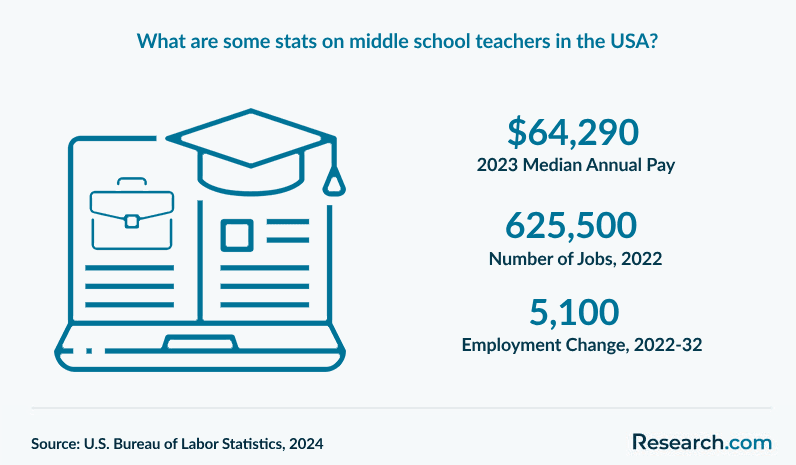
| National median annual pay for middle school teachers | $64,290 in 2023 | This national figure comes from the U.S. Bureau of Labor Statistics data cited in the original article. |
| National middle school teacher employment | Approximately 625,500 jobs in 2022 | This provides national context, not a Vermont-specific hiring guarantee. |
| Projected national change | 5,100 positions between 2022 and 2032 | Use this as broad labor-market context rather than a promise of openings in a specific Vermont district. |
For comparison with other undergraduate pathways, some students review guides to the highest paying degrees. That comparison can be useful, but teaching has a different value proposition: public service, schedule structure, retirement benefits in many systems, and the possibility of long-term community impact.
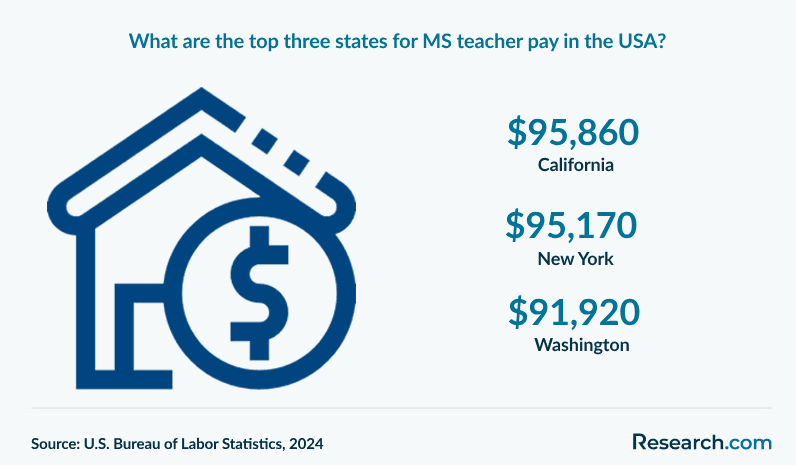
Location still matters. Burlington, Montpelier, and other higher-cost areas may have different salary and housing trade-offs than rural districts. Before accepting an offer, ask for the salary schedule, health insurance contribution, retirement information, tuition reimbursement policy, mentoring support, and expectations for duties outside regular instruction.
What professional development and continuing education opportunities are available for middle school math teachers in Vermont?
Professional learning is part of remaining an effective Vermont educator. Math instruction changes as assessments, technologies, intervention models, and student needs change. Continuing education also helps teachers maintain licensure and qualify for new roles.
- Licensure-related professional learning: Vermont educators complete professional learning connected to state teaching and leadership standards. Requirements can vary by license stage, endorsement, and renewal cycle, so confirm your obligations through official Vermont educator licensure guidance.
- Vermont Professional Learning Network: The VT-PLN has been identified as a statewide structure supporting educator learning and equitable access to professional development.
- Math-specific organizations: Groups such as the Vermont Council of Teachers of Mathematics can help teachers find workshops, conferences, peer support, and instructional resources.
- Instructional priorities: Useful professional development topics include proficiency-based learning, formative assessment, intervention strategies, math discourse, culturally responsive teaching, and technology-supported instruction.
- Graduate education: A master’s, EdD, or endorsement program can support leadership or specialization, but only if it fits your budget, district salary schedule, and career goals.
According to the U.S. Bureau of Labor Statistics (2024), the median annual pay for middle school teachers in the United States was $64,290 in 2023. The same cited material reported approximately 625,500 jobs for middle school teachers in 2022, with an expected employment growth of 5,100 positions between 2022 and 2032.
What are effective classroom management strategies and teaching methods for middle school math teachers in Vermont?
Middle school math classrooms work best when students know what to do, why the work matters, and how to recover from mistakes. Strong management is not separate from instruction; it is what makes meaningful math learning possible.
| Strategy | How to use it in math class | Why it helps |
| Set routines early | Teach students how to enter, start warm-ups, use materials, ask for help, transition to groups, and submit work. | Predictable routines reduce off-task behavior and protect instructional time. |
| Use formative checks | Try exit tickets, whiteboards, short quizzes, error analysis, and quick written explanations. | You can adjust instruction before misunderstandings become long-term gaps. |
| Normalize mistakes | Analyze common errors publicly without shaming students and ask, “What can this mistake teach us?” | Students with math anxiety are more likely to participate when errors are treated as part of learning. |
| Differentiate tasks | Offer scaffolds, extension problems, visuals, manipulatives, and small-group support. | Middle school classes often include students with wide differences in readiness. |
| Build math discussion | Ask students to justify strategies, compare methods, and respond to peer reasoning. | Mathematical communication deepens understanding and reveals misconceptions. |
| Use technology intentionally | Choose tools that support visualization, practice, feedback, or collaboration instead of using technology as a filler activity. | Digital tools are most valuable when they make thinking visible or personalize practice. |
What are the career advancement opportunities and specializations for middle school math teachers in Vermont?
Middle school math teaching can lead to several career directions. Some teachers remain classroom specialists and become highly skilled mentors. Others move into curriculum, intervention, technology integration, teacher leadership, or administration.
- Department or team leadership: Experienced teachers may coordinate grade-level planning, lead data meetings, mentor new teachers, or support curriculum implementation.
- Instructional coaching: Math coaches help colleagues improve instruction, analyze assessments, and strengthen intervention systems.
- Special education collaboration: Math teachers who understand learning differences can support inclusive classrooms and co-teaching models. If this interests you, review Research.com’s guide on how to become a special education teacher in Vermont.
- Educational technology: Teachers may specialize in using adaptive software, data dashboards, simulations, and interactive platforms to support math learning.
- Administration: Teachers who pursue educational leadership preparation may move into assistant principal, principal, or district-level roles.
- Curriculum and assessment: Some educators help design pacing guides, local assessments, intervention materials, or proficiency-based learning systems.
In May 2024, the average annual wages for selected teaching occupations in Vermont, based on data from 2022, were stated as follows: kindergarten teachers earned an average of $54,770, elementary school teachers earned $64,400, middle school teachers earned $62,030, and secondary school teachers earned $62,390.
What legal and ethical considerations must Vermont middle school math teachers follow?
Vermont teachers are responsible for more than academic instruction. They must protect student safety, maintain professional boundaries, follow school policy, provide equitable access to learning, and comply with reporting laws.
- Valid licensure: Teachers must hold the proper license and endorsement for their assignment.
- Mandated reporting: Educators are required to report suspected child abuse or neglect through the appropriate channels.
- Student privacy: Teachers must protect confidential student information, including grades, disability status, behavior records, and family circumstances.
- Equity and nondiscrimination: Math instruction should be accessible to students regardless of disability, race, language background, gender, income, or prior math achievement.
- Professional boundaries: Communication with students and families should follow district policy, especially when using email, messaging apps, learning platforms, or social media.
- Assessment integrity: Teachers should grade fairly, document evidence, avoid bias, and follow school and state assessment rules.
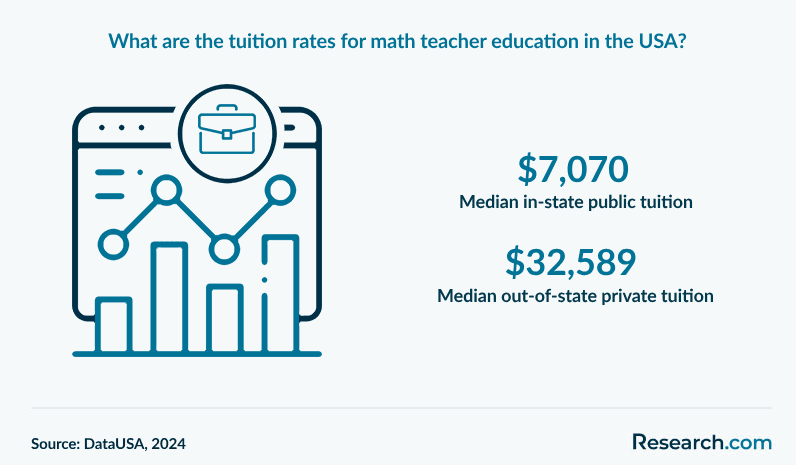
Cost is also part of the ethical decision to enter teaching. Candidates should compare program tuition, fees, placement requirements, testing costs, transportation, lost wages during student teaching, and the salary schedule they are likely to enter. The original article cites DataUSA (2024), stating that the median in-state public tuition for math teacher education programs is $7,070, while out-of-state students attending private institutions had a median tuition of $32,589. It also states that 3,269 degrees were awarded in math teacher education programs across the United States in 2022.
What challenges do middle school math teachers in Vermont encounter and how can they overcome them?
Middle school math teachers often face a difficult combination: wide skill gaps, math anxiety, changing adolescent behavior, family communication demands, intervention pressure, technology decisions, and limited planning time. Rural schools may also require teachers to cover multiple preparations or collaborate across small departments.
| Challenge | What it looks like | Better response |
| Uneven math readiness | Some students are ready for abstract reasoning while others struggle with fractions, integers, or multiplication facts. | Use diagnostic checks, small groups, targeted practice, and tasks with multiple entry points. |
| Low math confidence | Students say they are “bad at math” before trying. | Use growth-oriented feedback, visible progress tracking, and mistake analysis. |
| Behavior and engagement | Students disengage during lectures or independent worksheets. | Mix direct instruction with discussion, manipulatives, partner tasks, and real-world applications. |
| Technology overload | Too many platforms create distraction without improving learning. | Choose fewer tools and connect each one to a clear instructional purpose. |
| Teacher isolation | New teachers may feel alone, especially in smaller schools. | Join mentorship programs, professional networks, and math teacher communities. |
How can middle school math teachers foster diversity and inclusion in Vermont classrooms?
Inclusive math teaching means designing lessons so every student can access challenging mathematics and see themselves as capable problem solvers. It is not a separate activity added after the lesson; it should shape examples, grouping, feedback, assessment, and classroom culture.
- Use culturally responsive examples: Connect problems to local communities, student interests, environmental issues, sports, budgeting, design, data, and real decisions students recognize.
- Offer multiple ways to participate: Students can explain orally, write, draw models, use manipulatives, create tables, or present strategies.
- Be careful with tracking and labels: Avoid letting early performance define a student’s long-term access to rigorous math.
- Support students with disabilities: Collaborate with special educators and use accommodations and modifications appropriately.
- Teach math language directly: Vocabulary such as “proportional,” “equivalent,” “variable,” and “rate” should be explicitly taught and revisited.
Educators who are drawn to child-centered work beyond mathematics may also explore broader careers working with children to compare settings, age groups, and long-term goals.
What resources and support are available for new middle school math teachers in Vermont?
New teachers should not try to build every lesson, routine, assessment, and intervention system alone. Vermont educators can look to district mentors, math teacher organizations, the Vermont Agency of Education, professional learning networks, and experienced colleagues for support.
- District mentorship: Many new teachers are paired with experienced educators who can help with lesson planning, parent communication, grading systems, and classroom management.
- Vermont Council of Teachers of Mathematics: Math-specific professional groups can connect teachers with workshops, lesson ideas, and peer advice.
- Vermont NEA and local networks: Professional associations can provide guidance, community, and policy information.
- Agency resources: The Vermont Agency of Education provides information on standards, assessment, licensure, and professional learning.
- Online teacher communities: Online groups can be useful for ideas, but verify materials for standards alignment, accessibility, and mathematical accuracy before using them.
The need for effective support is clear when looking at student performance data. In the 2023 Vermont Mathematics assessment, the percentage of students scoring proficient or above was 37% in grade 3, 35% in grade 4, 38% in grade 5, 53% in grade 6, 46% in grade 7, 36% in grade 8, and 33% in grade 9. These results point to the importance of targeted instruction, early intervention, and strong middle grades math teaching.
How can an advanced degree impact my teaching career in Vermont?
An advanced degree can help Vermont teachers deepen instructional expertise, qualify for leadership roles, move into curriculum or administration, and potentially advance on a district salary schedule. The value depends on three factors: whether the degree is accredited, whether it aligns with Vermont licensure or endorsement goals, and whether your district recognizes it for compensation or advancement.
If you are considering doctoral-level study, compare affordability and program purpose carefully. Research.com’s guide to the cheapest online EdD programs may help you identify lower-cost options, but you should still ask each program how it supports licensed educators, research interests, and leadership outcomes.
How does Vermont compare to other states in supporting middle school math teachers?
Vermont can appeal to teachers who value smaller communities, close teacher-student relationships, and professional collaboration. However, state comparisons should be made carefully. A higher salary in another state may come with higher housing costs, different licensure rules, larger districts, or different classroom conditions.
| Comparison factor | Why it matters | What to check |
| Licensure portability | Moving states can require additional documentation or testing. | Reciprocity rules, endorsement requirements, and renewal expectations. |
| Salary and benefits | Base salary alone does not show total compensation. | Salary schedules, health insurance, retirement, tuition support, and contract days. |
| Cost of living | Housing and transportation can affect take-home value. | Local rent, commuting distance, taxes, and rural transportation needs. |
| Professional support | Mentoring and planning time can affect early-career success. | New teacher induction, coaching, common planning, and district curriculum support. |
| Grade-level flexibility | Some teachers later move across grade bands or subjects. | Additional endorsements, graduate credits, and district staffing needs. |
Looking at other states can help you understand how requirements differ. For example, Research.com’s overview of elementary school teacher requirements in Virginia can provide a useful comparison point if you are evaluating mobility or long-term teaching options.
How do middle school math and elementary teaching careers in Vermont compare?
Middle school math and elementary teaching both require patience, planning, assessment skills, and strong relationships with students. The difference is specialization. Middle school math teachers focus more deeply on mathematical reasoning and adolescent learners, while elementary teachers usually teach multiple subjects and build broad foundational skills.
| Career path | Instructional focus | Best fit for |
| Middle school math teacher | Math concepts, problem solving, early algebraic reasoning, data, geometry, and proportional thinking. | Teachers who want subject specialization and enjoy working with early adolescents. |
| Elementary teacher | Reading, writing, math, science, social studies, classroom routines, and whole-child development. | Teachers who want to teach several subjects and work with younger children. |
If you are unsure which age group fits you best, compare this pathway with Research.com’s guide on how to become an elementary teacher in Vermont.
How can I finance my journey to becoming a middle school math teacher in Vermont?
Teacher preparation costs can include tuition, fees, textbooks, exam fees, background checks, transportation to placements, and unpaid time during student teaching. Build a full budget before enrolling rather than comparing tuition alone.
- Start with federal aid: Submit the FAFSA if you are eligible and compare grants, loans, and work-study options.
- Ask about educator scholarships: Colleges, districts, community foundations, and state programs may offer support for future teachers, especially in shortage areas.
- Use transfer credits wisely: If you already have college credits, ask how many apply to the teacher preparation program and whether they reduce your time to completion.
- Compare public and private options: The original article cites median in-state public tuition of $7,070 for math teacher education programs and $32,589 for out-of-state students attending private institutions.
- Check employer support: If you work in a school as a paraeducator, tutor, or substitute, ask whether the district supports licensure pathways.
- Choose the right credential route: Research.com’s guide to the cheapest way to get a teaching credential in Vermont can help you compare lower-cost paths.
How can emerging digital learning tools enhance classroom engagement for middle school math teachers in Vermont?
Digital tools can help middle school math teachers visualize abstract concepts, provide practice at different levels, collect quick assessment data, and support collaboration. They should not replace strong instruction. The best tools make student thinking more visible or give students feedback that helps them improve.
- Adaptive practice platforms: Useful for fluency and targeted review, especially when students have different skill gaps.
- Graphing and visualization tools: Helpful for functions, geometry, data displays, and pattern recognition.
- Interactive assessment tools: Can provide immediate information about which students understand a concept and which need reteaching.
- Virtual manipulatives: Support fractions, ratios, equations, and geometry when physical materials are unavailable.
- Collaboration platforms: Allow students to explain strategies, critique reasoning, and build shared solutions.
If you are interested in teaching more advanced mathematics and using digital tools with older students, compare the middle school pathway with how to become a high school math teacher in Vermont.
What alternative teaching paths are available in Vermont for those who do not want to become a middle school math teacher?
If you like education but are not sure middle school math is the right match, Vermont offers other teaching paths. The right option depends on the age group you prefer, the subject you want to teach, and whether you want a classroom, support, or specialist role.
| Alternative path | Why it may be a better fit | Related Research.com guide |
| Preschool teacher | You want to work with younger children and focus on early development. | How to become a preschool teacher in Vermont |
| Elementary teacher | You prefer teaching multiple subjects instead of specializing only in math. | Elementary teaching pathway in Vermont |
| Special education teacher | You want to support students with disabilities and individualized learning plans. | Special education teacher requirements in Vermont |
| High school math teacher | You prefer deeper subject specialization and older students. | High school math teacher pathway in Vermont |
What do graduates have to say about becoming a middle school math teacher in Vermont?
-
: "
Teaching middle school math in Vermont has been deeply rewarding. The best moments happen when students who once doubted themselves finally understand a concept and begin to participate with confidence. — Sammy
"
-
: "
I value the chance to make math practical and hands-on. Collaborating with other teachers has helped me design lessons that are more creative, more relevant, and more effective for students. — Jake
"
-
: "
My preparation, mentoring, and school community made the transition into teaching manageable. Watching students grow as problem solvers is the reason I stayed committed to this career. — Marissa
"
What do graduates say about their career journey as middle school math teachers in Vermont?
Graduates often describe the strongest preparation as a mix of rigorous coursework, real classroom practice, mentoring, and steady feedback. They also note that learning from other subject areas can improve math teaching. For example, reviewing music teacher education requirements in Vermont can show how different disciplines approach performance, practice, creativity, and assessment.
Should I consider transitioning from middle school math to high school teaching?
Moving from middle school math to high school teaching can be a good choice if you want deeper content specialization, more advanced courses, and older students. It may also require additional endorsement review, coursework, or testing. Before transitioning, compare curriculum expectations, classroom culture, student independence, and your long-term career goals.
Looking at another high school subject can clarify how grade-level specialization changes the role. Research.com’s guide to becoming a high school history teacher in Vermont offers a useful contrast in content depth and instructional expectations.
Should I explore dual certification options to enhance my teaching career in Vermont?
Dual certification can make you more flexible, especially in smaller schools where staffing needs change. It may also help you support interdisciplinary learning or qualify for additional assignments. However, adding endorsements takes time and should be connected to a real career goal rather than pursued only because it sounds useful.
For example, candidates interested in literacy, writing, or cross-disciplinary instruction can review Vermont English teacher certification requirements to understand how another subject pathway compares.
What are my certification pathway options in Vermont?
Vermont candidates may qualify through traditional preparation, transcript review, peer review, reciprocity, or other routes depending on their background. The best pathway is the one that matches your current education, teaching experience, subject knowledge, timeline, and budget.
Before choosing a route, read official requirements, talk with Vermont licensure staff or an approved preparation program, and compare options using Research.com’s guide to teaching certificate requirements in Vermont.
Common mistakes to avoid when preparing to become a Vermont middle school math teacher
- Choosing a program before checking licensure alignment: An education degree is not automatically enough. Confirm the program prepares you for the Vermont license and endorsement you need.
- Looking only at tuition: Include fees, exams, background checks, transportation, student teaching costs, and lost work time.
- Assuming online means easier: Online coursework can be flexible, but student teaching, assessment, and licensure requirements still apply.
- Ignoring math content depth: Middle school teachers need strong understanding of foundational and pre-algebra concepts, not just general comfort with math.
- Waiting too long to get classroom experience: Volunteer, tutor, substitute, or observe early so you know whether the age group fits you.
- Relying on salary averages alone: Review actual district salary schedules and benefits before making financial decisions.
- Not preparing for inclusive instruction: Middle school math classes include diverse learners. Plan for differentiation from the beginning.
References:
- Bureau of Labor Statistics. (2024). Middle school teachers. Bureau of Labor Statistics.
- Bureau of Labor Statistics. (2024). Occupational employment and wages, May 2023: Teachers and instructors, all other Professional learning. Vermont professional learning information.
- Education Vermont. (2023). Agency of education releases 2023 statewide assessment results. Education Vermont.
- Office of Superintendent of Public Instruction. (2024). National assessment of educational progress (NAEP) state results. Office of Superintendent of Public Instruction.
- Math Teacher Edu. (2014, July 30). Vermont math teacher salary expectations. Math Teacher Edu.
- Vermont Department of Labor. (2024). Occupational employment and wages in Vermont. Vermont occupational wage data.
Related Articles for Nearby States
- 2027 How to Become a Middle School Math Teacher in New Hampshire: Requirements & Certification
- 2027 How to Become a Middle School Math Teacher in Massachusetts: Requirements & Certification
- 2027 How to Become a Middle School Math Teacher in New York: Requirements & Certification
- 2027 How to Become a Middle School Math Teacher in Connecticut: Requirements & Certification
- 2027 How to Become a Middle School Math Teacher in Rhode Island: Requirements & Certification
- 2027 How to Become a Middle School Math Teacher in Maine: Requirements & Certification
- 2027 How to Become a Middle School Math Teacher in New Jersey: Requirements & Certification
- 2027 How to Become a Middle School Math Teacher in Delaware: Requirements & Certification
- 2027 How to Become a Middle School Math Teacher in Maryland: Requirements & Certification
- 2027 How to Become a Middle School Math Teacher in Virginia: Requirements & Certification
Key Insights
- Becoming a Vermont middle school math teacher usually requires a bachelor’s degree, teacher preparation, student teaching, required exams, a background check, and state licensure.
- The best preparation programs combine math content, adolescent development, classroom management, assessment, and supervised practice in real middle school settings.
- Vermont offers more than one certification route, including traditional preparation, reciprocity, transcript review, and peer review, so career changers should not assume they must start from scratch.
- Salary data varies by source and occupation definition. Figures cited in the article include $62,030 for Vermont middle school teachers, $64,290 as the 2023 national median pay for middle school teachers, and approximately $87,230 for math teachers in Vermont.
- Student math outcomes show why strong instruction matters: 2023 Vermont Mathematics proficiency rates ranged from 33% in grade 9 to 53% in grade 6 among the grade levels cited.
- Do not choose a program based only on speed or tuition. Accreditation, Vermont licensure alignment, student teaching placement, total cost, and district salary recognition are more important.
- Middle school math is best for educators who enjoy both mathematics and early adolescent development. If you prefer younger students, multiple subjects, or deeper advanced math, compare elementary, preschool, special education, or high school pathways.
Other Things You Should Know About Becoming a Middle School Math Teacher in Vermont
In 2027, aspiring middle school math teachers in Vermont must earn a bachelor's degree in education with a focus on mathematics. Additionally, they must complete a state-approved teacher preparation program, pass the Praxis exams, and apply for the Middle Grades (5-9) Mathematics endorsement.
Yes, in Vermont, teachers who wish to specialize in middle school math must obtain a specific endorsement. This endorsement is typically referred to as the "Mathematics Endorsement" for grades 5-9.
To qualify, you must demonstrate proficiency in mathematics content and pedagogy, which often involves completing additional coursework or passing relevant assessments. This endorsement ensures that you are well-prepared to teach math effectively to middle school students.
To become a middle school math teacher in Vermont in 2027, candidates need a bachelor's degree in education or mathematics. They must also complete a state-approved educator preparation program that includes coursework and student teaching specific to middle school mathematics.
In 2027, middle school math teachers in Vermont need to complete 45 hours of professional development every three years to renew their teaching license. These hours must align with state standards and ensure the teacher's skills and knowledge remain current.


