2027 Traditional BSN Graduate Interviews: Preparing Examples of Teamwork, Judgment, and Learning
Audited and Verified:
Our Editorial and Data Verification Process
Research.com uses government datasets, official education statistics and primary institutional information to support its career and degree guides. Our review process checks factual accuracy, occupational definitions, source dates and the requirements associated with the credentials discussed.
How This Article Was Fact-Checked
Our editorial team verifies salary estimates, employment projections, education requirements and program information against original data providers and official organizations. Salary figures are checked against the relevant occupational definitions and reporting periods. Information about licensure, accreditation and required in-person training is reviewed separately.
Fact-checked and verified on:

Co-Founder and Chief Data Scientist
A traditional BSN graduate interview asks you to translate supervised clinical learning into evidence that you can work safely as a new nurse. You do not need to sound like an experienced RN; you need to explain what you noticed, what you did within your student role, when you sought help, and what changed afterward.
This guide helps soon-to-graduate and newly graduated BSN students prepare credible examples of teamwork, judgment, and learning while evaluating whether an employer's orientation will support their transition into practice.
Key Things You Should Know
- Prepare at least three distinct examples: one involving collaboration, one involving a safety or prioritization decision, and one showing how you used feedback or corrected a mistake.
- For each example, cover the situation, your student-level responsibility, your actions, and the result or learning; never claim independent care or a patient outcome you cannot verify.
- A traditional prelicensure BSN commonly takes about four academic years, but graduation, NCLEX eligibility, RN licensure, and readiness for independent unit assignments are separate milestones.
What Is a Traditional BSN Graduate Interview Like?
For a new-graduate RN position or nurse residency, expect questions about clinical placements, communication, patient safety, feedback, and why you want that unit. The format may include a recruiter screen, a nurse-manager conversation, a panel, or a hypothetical scenario. Ask the employer which stages to expect rather than assuming every hospital uses the same process.
Interviewers generally evaluate your readiness to learn under supervision, not whether you have already mastered the unit. A traditional BSN is prelicensure education; an experienced RN pursuing flexible BSN completion routes for licensed RNs brings a different practice history and should not be your benchmark for interview answers.
Prepare a short explanation of each rotation, the populations you encountered, and your actual responsibilities. For every example, distinguish what you observed from what you performed and what your instructor or preceptor approved.
What Questions Test Teamwork in Traditional BSN Interviews?
Common prompts include "Tell me about a disagreement with a teammate," "Describe a time you asked for help," and "How did you communicate a concern to your preceptor?" A strong answer names your contribution without taking credit for the team's work or blaming another person.
Choose an example from a clinical rotation, simulation, group project, or relevant job. Explain who needed information, how you communicated it, and how you checked that the next person understood. If the example involved patient care, state your supervised role and leave out identifying details.
Adaptable example: "During a supervised rotation, I noticed that a planned task conflicted with another team member's schedule. I clarified the timing with my preceptor, shared the updated plan with the team, and confirmed who would follow up. I learned to close the communication loop rather than assume a message was received." Replace this with something you actually did; do not imply the coordination alone improved a clinical outcome.
A student preceptor's job is to supervise learning, not simply to arrange a placement. That distinction remains important in later education, including preceptor-provided FNP program comparisons, where placement support and verified clinical competence are separate questions.
How Can You Demonstrate Judgment in Nursing Interview Scenarios?
Clinical judgment means using available information to recognize a concern, decide what needs attention, act within your role, and reassess. In an interview scenario, you rarely have enough patient information to prescribe a complete plan. Show how you would establish immediate safety, gather relevant facts, communicate promptly, and follow unit policy and supervision requirements.
Use this sequence when practicing hypothetical questions:
- Identify the immediate concern and what information is missing.
- Explain what you would assess or verify within your role, without inventing findings.
- State when and how you would notify the supervising RN, preceptor, provider, or emergency response team as the situation and policy require.
- Describe appropriate documentation, reassessment, and handoff after the concern is addressed.
For example, if asked about a patient who seems different from earlier in the shift, avoid declaring a diagnosis from the prompt alone. Explain that you would promptly assess relevant changes, seek help rather than wait for certainty, and communicate specific observations. Interviewers can then see your priorities and limits.
Do not borrow authority from a specialty you have not entered. Even short PMHNP certificate pathways for nurses involve preparation beyond a prelicensure BSN; a new graduate's answer should reflect RN-level responsibilities and supervised onboarding, not advanced practice authority.
Choose a real, appropriately shareable example with a clear correction: misunderstanding an assignment, giving an incomplete handoff in simulation, or needing to revise a skill after instructor feedback. The strongest account shows accountability and a specific change in behavior. It does not require a dramatic patient-care error.
A useful structure is: "I missed or misunderstood X; my instructor or teammate pointed out Y; I corrected it by doing Z; now I use this check." If an incident involved actual patient safety, protect confidentiality and describe only your own verified actions. Do not suggest that a serious error was resolved solely through personal reflection when reporting, supervision, or institutional processes applied.
Learning from feedback matters throughout nursing education, but interview evidence should come from your own experience. Future options such as DNP application options by selectivity are not substitutes for showing how you respond to correction in supervised practice today.
If you are still selecting a program, distinguish admission to the university from admission to its nursing major. A traditional BSN generally serves students seeking initial RN preparation and commonly includes prerequisite sciences and general education before or alongside sequenced nursing courses. Schools set their own GPA, laboratory, entrance-exam, interview, and application rules; clinical sites may separately require background checks, immunizations, and other clearances.
Check when nursing admission occurs, whether prerequisite courses expire, and what happens if you cannot enter the next clinical sequence on schedule. If you already hold an RN license, a traditional prelicensure BSN may repeat preparation you do not need; graduate nursing routes for associate-degree nurses address a different entry status and goal.
For the graduate job interview, you usually need not recite your admission credentials. Be ready instead to explain how your coursework and clinical access prepared you for the role.
Traditional BSN curricula combine general education with nursing sciences, health assessment, pharmacology, patient-centered care, population health, and supervised practice. Programs typically use classroom work, skills labs, simulation, and clinical placements to develop communication, prioritization, documentation, and safety habits. The exact courses and placement experiences vary.
Connect a course to an observed action in your interview: "In simulation, I practiced a structured handoff; during clinical, I used my instructor's feedback to make my report more concise." That is stronger than claiming a course made you independently competent. Further study has a different purpose; when considering it later, budget planning for BSN-to-MSN study should be tied to a defined role rather than treated as a replacement for new-RN experience.
A traditional BSN is commonly planned around four academic years of full-time study, though transfer credit, prerequisite sequencing, repeat courses, and clinical availability can change the timeline. For an interview, this matters most when describing your anticipated graduation and license-application timing: give dates you can substantiate, not a guaranteed start date.
Total cost extends beyond tuition to mandatory fees, books, equipment, required clearances, travel to clinical sites, and reduced work hours. Compare a school's published cost of attendance with your own commuting and living costs; do not assume that a lower tuition figure means a lower total cost. Later graduate study, including affordable online nurse practitioner programs, would require a separate cost and eligibility calculation - not an assumption that the BSN already qualifies you for NP practice.
If you are choosing where to study, check three distinct matters: the institution's accreditation, the nursing program's accreditation status and scope, and the state nursing board's approval or recognition for initial RN preparation. Confirm each for the specific campus and program; one does not automatically establish the others.
Compare programs using information that predicts whether you can finish and enter practice: published completion and NCLEX results with their reporting years and cohort sizes, clinical placement arrangements, simulation and on-site requirements, progression policies, and support for students who fall behind. Ask where graduates obtain supervised transition-to-practice opportunities, but do not treat placement assistance as a job guarantee.
Keep the credential matched to your immediate goal. Advanced nursing leadership doctorates online serve a different stage of professional development and do not replace verification that a prelicensure BSN prepares graduates to seek initial RN licensure.
Completing a BSN does not itself authorize RN practice. Graduates apply to the relevant state board of nursing, meet its eligibility requirements, obtain authorization to test, pass the NCLEX-RN, and receive a license before practicing as an RN. Board procedures and employer rules vary, so verify the requirements where you intend to work.
In an interview, state accurately whether you are still a student, have graduated, are awaiting examination authorization, have scheduled or passed NCLEX, or hold an active RN license. Ask whether an offer is conditional on licensure and when that condition must be met. Passing an exam is not the same as an employer confirming that you may begin RN duties.
Initial RN licensure is also distinct from later advanced practice preparation. For example, post-master's FNP certificate completion timelines concern nurses with prior graduate preparation, not a shortcut from BSN graduation to independent advanced practice.
What Careers, Salaries, and Job Outlook Follow a Traditional BSN?
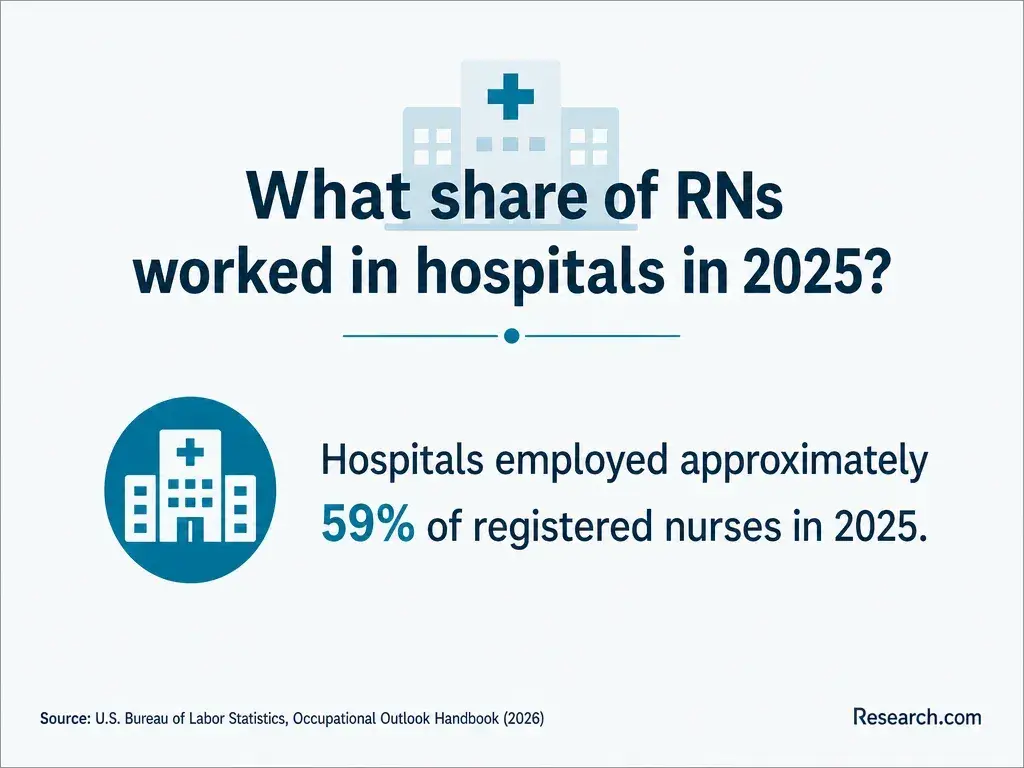
After licensure, BSN graduates may apply for new-graduate RN roles in hospitals and other settings that provide appropriate onboarding. An offer's fit depends on unit acuity, staffing support, preceptor access, orientation length and evaluation, scheduling, and whether help is available when a new nurse needs to escalate a concern. Ask those questions alongside interview questions about your own performance.
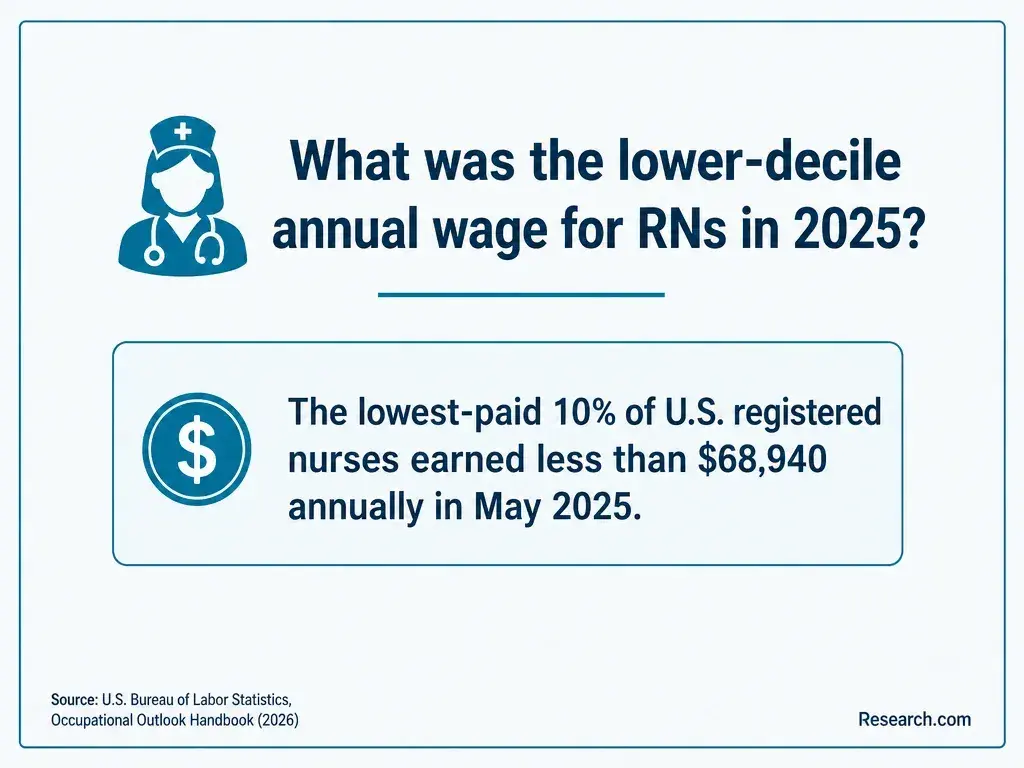
The U.S. Bureau of Labor Statistics reports pay and employment projections for the registered nurse occupation, not for traditional BSN graduates or individual units. An occupation-wide median is therefore context, not an expected starting offer; compare actual offers by location, shift differentials, benefits, and orientation support. Likewise, projected RN job growth does not guarantee an opening in a preferred specialty or city.
Specialty practice develops through employer orientation, demonstrated competence, and, where applicable, further education and credentials. If a future psychiatric advanced practice role interests you, online PMHNP tuition and fee considerations belong in a later pathway decision. For this interview, prioritize whether the employer can support your first transition from supervised student work to licensed RN responsibilities.
Other Things You Should Know About Nursing
Yes. A job can demonstrate conflict resolution, reliability, or feedback. Explain the transferable behavior, but do not present it as proof of clinical competence.
Test the connection and audio, choose a private space, and keep brief notes with your example headings nearby. Answer the interviewer rather than reading a script.
Bring one if the employer requests it or if it helps you discuss relevant work. Include only material you are permitted to share; exclude patient identifiers and confidential site information.
Send a concise thank-you message if you have the interviewer's contact information. Reaffirm your interest, mention a specific point from the conversation, and follow the employer's stated timeline for next steps.
- Error Reporting and Disclosure - Patient Safety and Quality https://www.ncbi.nlm.nih.gov/books/NBK2652/
- Patient safety | who.int https://www.who.int/news-room/fact-sheets/detail/patient-safety
- THE BEHAVIORAL INTERVIEW, A METHOD TO EVALUATE ACGME COMPETENCIES IN RESIDENT SELECTION: A PILOT PROJECT - PMC https://pmc.ncbi.nlm.nih.gov/articles/PMC4803420/
- Nursing Interview Tips: How to Prepare | denvercollegeofnursing.edu https://www.denvercollegeofnursing.edu/blog/tips---advice/how-to-prepare-for-a-nursing-job-interview.html
- Using the STAR method for your next behavioral interview (worksheet included) | MIT https://capd.mit.edu/resources/the-star-method-for-behavioral-interviews/
- Feedback for Learning | columbia.edu https://ctl.columbia.edu/resources-and-technology/resources/feedback-for-learning/
- Learning Over Blaming: A Better Approach to Accountability in a Healthcare Setting | Center for Interprofessional Health https://ipe.umn.edu/news-media/collaboration-insights/learning-over-blaming-better-approach-accountability-healthcare
- Tanner's Clinical Judgment Model: Thinking Skills in Nursing | Nevada State University https://nevadastate.edu/son/rn-bsn/tanners-clinical-judgment-model-enhancing-critical-thinking-skills-in-nursing/
- How To Use the STAR Interview Response Technique | indeed.com https://www.indeed.com/career-advice/interviewing/how-to-use-the-star-interview-response-technique
- Novice to expert: The value of nursing expertise | WSNA https://www.wsna.org/news/2024/novice-to-expert-the-value-of-nursing-expertise