2027 Safety Assessment vs a Home Visit Care Plan: Community Nursing Concepts
Audited and Verified:
Our Editorial and Data Verification Process
Research.com uses government datasets, official education statistics and primary institutional information to support its career and degree guides. Our review process checks factual accuracy, occupational definitions, source dates and the requirements associated with the credentials discussed.
How This Article Was Fact-Checked
Our editorial team verifies salary estimates, employment projections, education requirements and program information against original data providers and official organizations. Salary figures are checked against the relevant occupational definitions and reporting periods. Information about licensure, accreditation and required in-person training is reviewed separately.
Fact-checked and verified on:

Co-Founder and Chief Data Scientist
A nurse may identify a fall hazard during a home visit, but identifying it is not the same as planning what happens next. For nursing students and early-career nurses, that distinction affects clinical judgment, documentation, and communication with patients and caregivers.
This guide compares a safety assessment with a home visit care plan, shows how findings become practical goals and follow-up, and explains which education and supervised experience help prepare nurses for community practice. It also helps you decide whether you need a new degree or more focused training.
Key Things You Should Know
- A safety assessment identifies and prioritizes risks; a home visit care plan records agreed goals, nursing actions, responsibilities, and reassessment.
- Both depend on the individual home and patient: a finding does not automatically justify the same intervention for every household.
- Community health coursework and supervised clinical practice build these skills, but an active RN license and employer-specific orientation - not a degree alone - determine readiness for an RN home health role.
What is the difference between a safety assessment and a home visit care plan?
A safety assessment is the information-gathering and clinical-judgment process used to recognize hazards and determine which need attention. A home visit care plan turns relevant findings, patient priorities, and clinical needs into documented goals, actions, responsibilities, and follow-up. Assessment informs the plan; the plan does not replace reassessment when circumstances change.
This comparison shows what each produces during the same visit.
| Question | Safety assessment | Home visit care plan |
| What is its purpose? | Identify and prioritize potential harm. | Organize care around agreed needs and goals. |
| What might it record? | Observed hazards, patient-reported concerns, functional limitations, and existing supports. | Goals, interventions, education, referrals, responsible people, and review dates. |
| How is it evaluated? | Are findings accurate, current, and appropriately escalated? | Were actions completed, and did the patient's status or goals change? |
For example, noticing that a patient has difficulty reaching a bathroom at night is an assessment finding. Discussing an acceptable response, arranging an appropriate referral if indicated, and checking whether the response helped are care-planning activities. The nurse must also consider the patient's preferences, authority to act, and applicable clinical protocols.
Neither document expands a nurse's legal scope. An RN's home visit plan differs from advanced practice diagnosis or prescribing; shorter online post-master's FNP certificates address a separate educational pathway for eligible nurses seeking advanced practice preparation.
How do nurses conduct a safety assessment during a community home visit?
The nurse prepares by reviewing the referral, available history, visit purpose, and agency safety procedures. In the home, the nurse seeks permission to assess relevant areas and combines the patient's account with observation and clinical assessment. The aim is not to grade a household's cleanliness or impose hospital standards; it is to identify risks that matter to this person's health and ability to receive care.
A structured review helps students avoid focusing only on obvious trip hazards. Depending on the visit and nursing role, relevant domains include:
- Movement and environment: access routes, lighting, stairs, mobility aids, and ability to reach essential areas.
- Care delivery: safe storage and use of medications and supplies, equipment operation, and infection-prevention needs.
- People and resources: caregiver capacity, food and utility access, communication needs, and the patient's own priorities.
- Urgent concerns: changes in condition or threats that require prompt escalation under agency policy.
Students should distinguish an observation from an inference: "patient reports two recent falls" is different from assuming why the falls occurred. They should document objectively, discuss concerns without blame, and bring urgent findings to their supervising nurse or appropriate clinical team. Behavioral health concerns may also emerge during visits, but assessment and escalation within an RN role should not be confused with the specialized preparation described in accelerated mental health NP master's coursework.
What steps are included in a home visit nursing care plan?
A useful plan connects a specific finding to a feasible response. It should reflect the patient's goals, available support, the nurse's scope, and the organization's documentation requirements - not simply copy a standard list of home safety advice.
The following sequence shows how assessment findings become a plan that the team can carry out and review:
- Prioritize needs: distinguish immediate concerns from issues suitable for routine follow-up.
- Agree on goals: describe an observable, patient-relevant change and when it will be reviewed.
- Choose actions: specify nursing care, education, coordination, or referrals appropriate to the findings and authorized orders or protocols.
- Assign responsibility: record what the nurse, patient, caregiver, and other team members have agreed to do.
- Evaluate and revise: check what happened, identify barriers, and update the plan when the patient's condition or circumstances change.
For a student, a care-plan exercise demonstrates reasoning; it is not authorization to implement orders independently. An RN coordinating care also should not assume that further schooling automatically changes prescribing authority. One-year family nurse practitioner pathways are a distinct consideration for eligible nurses pursuing an NP role, not a requirement for writing an RN home visit care plan.
Prelicensure ADN and BSN programs can prepare graduates to seek RN licensure; both include foundational assessment and supervised clinical learning. A BSN commonly provides more explicit population-health and community-focused coursework, but course titles, placements, and depth vary. For a licensed ADN-prepared RN, an RN-to-BSN program may strengthen that foundation without repeating initial licensure preparation.
The best next step depends on the job, not the prestige of the credential. A new graduate interested in home health should compare employers' entry requirements and orientation, including supervision during early visits. An experienced RN may benefit more immediately from home health onboarding, case-management experience, or targeted continuing education than from another degree. Graduate education becomes relevant when a specific leadership, education, public health, or advanced practice position requires it.
Someone with a bachelor's degree outside nursing must first identify a route that actually prepares them for RN licensure. Comparing direct-entry MSN coursework and clinical requirements with accelerated BSN or ADN options can clarify that decision; a non-nursing degree alone does not confer an RN license.
Relevant learning is often spread across health assessment, fundamentals, pharmacology, adult health, gerontology, population or community health, and care-coordination courses. Assessment courses develop interviewing and examination skills; community health courses add social context, prevention, access to services, and population-level thinking. Simulation may let students practice prioritizing hazards or communicating a referral, while supervised clinical work tests their judgment with actual patients under faculty and site requirements.
When comparing curricula, ask for a syllabus or course description rather than relying on a "community health" course title. Look for how students are evaluated on objective documentation, patient-centered teaching, escalation, and revision of a plan. Also ask whether the program offers an approved community placement; volunteer outreach is valuable experience but does not automatically satisfy supervised nursing clinical requirements.
Behavioral health content can help an RN recognize and communicate concerns encountered in the home. It is not equivalent to the advanced assessment and population-focused clinical preparation associated with online PMHNP certificate clinical requirements for eligible graduate-prepared nurses.
There is no single admission standard for "community health nursing." A prelicensure ADN or BSN applicant may need specified science prerequisites, minimum grades, an entrance assessment, and separate admission to the nursing major. Clinical participation can add immunization, background-check, or other site requirements after academic admission. An RN-to-BSN program instead generally requires an RN license, while graduate programs set their own degree, licensure, experience, and prerequisite rules.
Ask each school whether it prepares students for initial RN licensure or assumes they already hold it. Then request written confirmation of prerequisite equivalencies, science-course age limits, application deadlines, and clinical eligibility in the state where you intend to train. If grades or application rules are your main obstacle, compare nursing programs with broader admission pathways, but verify the actual nursing-track criteria rather than treating university admission as a nursing seat.
There is usually no separate degree required solely to perform community safety assessments. A traditional prelicensure BSN commonly spans four academic years; an ADN often takes about two years of nursing study after any required prerequisites. An RN-to-BSN or graduate program's length depends on transferred credit, course load, and required placements. These are planning benchmarks, not promises of completion dates.
Total cost is more useful than a tuition-only comparison. Request a program-specific estimate that includes fees, books, equipment, required screenings, travel to clinical sites, and any reduced earnings while completing supervised experiences. For an employed RN, compare that total with employer education assistance and the actual credential required for the desired position. Affordable nursing master's study for BSN graduates may be worth investigating for a defined graduate-level goal, but a master's degree is not necessary simply to improve an existing home visit assessment.
Online delivery can reduce travel for lectures, but it does not remove skills labs, simulation, supervised clinical placements, or required in-person evaluations. Campus programs may make scheduled practice and faculty contact more visible; online or hybrid programs may offer more control over lecture time. Neither format guarantees that community or home health placements will be available near a student.
Before enrolling, ask who secures placements, which sites qualify, when on-site sessions occur, and whether the program can enroll and place you in your state. Working students should compare the actual weekly clinical schedule - not just whether lectures are asynchronous - with employment and caregiving obligations. The same caution applies at the doctoral level: short online Doctor of Nursing Practice degrees may still have in-person, practice, or project requirements and are not needed for routine RN home visits.
For initial RN practice, confirm that the specific prelicensure program meets the applicable state board of nursing's requirements for NCLEX-RN eligibility. Check institutional accreditation and any nursing program accreditation separately; an institutional accreditation claim does not establish state board approval of a particular nursing track. Graduation, NCLEX eligibility, passing the examination, and issuance of an RN license are distinct steps.
An already-licensed RN considering additional study should confirm that the program awards the intended credential and that its clinical activities meet school and site rules. Employer orientation and competency checks still matter for home visits, regardless of accreditation status. Admission policies are a different question from licensing approval: information about entrance exam policies for nursing applicants cannot establish that a graduate will qualify for licensure in a given state.
What careers, salaries, and job outlook are available in community nursing?
Licensed RNs may work in home health, public health departments, community clinics, school health, or outreach programs, subject to each employer's requirements. Home health roles often combine direct assessment with teaching, documentation, and coordination across visits; public health positions may emphasize prevention and population programs. Some employers seek prior clinical experience because nurses work away from an immediately available bedside team.
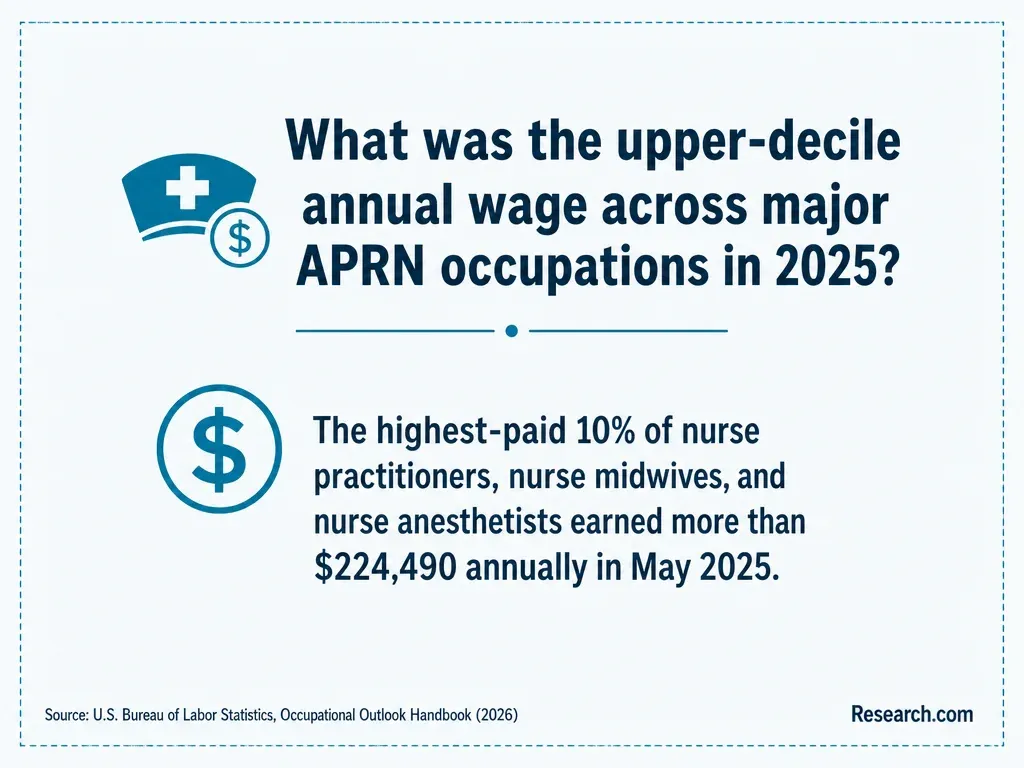
For salary and outlook, the U.S. Bureau of Labor Statistics' registered nurses occupation is a useful national benchmark, but its median wage and employment projections cover RNs across settings. They do not establish a home health offer, a new graduate's pay, or the return on a particular degree. Compare local postings for the specific role, including travel expectations, caseload, mileage reimbursement, orientation, and access to clinical backup.
If advancement is the goal, start with the position's actual credential requirement. Associate-to-master's nursing pathways may suit an eligible RN targeting a graduate-level role; they are usually an unnecessarily large investment if the immediate gap is supervised home health experience.
Other Things You Should Know About Nursing
Only if the program, clinical site, and applicable rules permit the assigned activity and level of supervision. Students should confirm expectations with their instructor rather than assuming that a classroom exercise authorizes an independent visit.
Explore the patient's concern, explain the relevant risk without pressure, document the discussion, and follow agency guidance for any continuing concern. A refusal does not make the assessment finding disappear.
Not without following the employer's consent, device, storage, and privacy policies. Written, objective documentation may be appropriate when photography is not authorized.
No. Involve a caregiver according to the patient's wishes, decision-making arrangements, and privacy requirements. If a caregiver is expected to carry out part of the plan, confirm that the person understands and can reasonably perform it.
- Chapter 16 Community Assessment - Nursing - NCBI - NIH https://www.ncbi.nlm.nih.gov/books/NBK590038/
- Safety Management - Hazard Prevention and Control | Occupational Safety and Health Administration http://www.osha.gov/safety-management/hazard-prevention
- 42 CFR Part 484 -- Home Health Services | ecfr.gov https://www.ecfr.gov/current/title-42/chapter-IV/subchapter-G/part-484
- Steps for Creating and Maintaining a Care Plan | Caregiving https://www.cdc.gov/caregiving/guidelines/index.html
- World guidelines for falls prevention and management... - PMC https://pmc.ncbi.nlm.nih.gov/articles/PMC9523684/
- Module 1: Detecting Change in a Resident's Condition | Agency for Healthcare Research and Quality https://www.ahrq.gov/patient-safety/settings/long-term-care/resource/facilities/ltc/mod1sess2.html
- Plan of Care in Home Healthcare: What to Include | Relias https://www.relias.com/blog/plan-of-care-home-health
- Nursing Scope and Standards of Practice | ANA https://www.nursingworld.org/practice-policy/scope-of-practice/