2027 Conflict Resolution in Social Work: Social Work Training and Workplace Applications
Audited and Verified:
Our Editorial and Data Verification Process
Research.com uses government datasets, official education statistics and primary institutional information to support its career and degree guides. Our review process checks factual accuracy, occupational definitions, source dates and the requirements associated with the credentials discussed.
How This Article Was Fact-Checked
Our editorial team verifies salary estimates, employment projections, education requirements and program information against original data providers and official organizations. Salary figures are checked against the relevant occupational definitions and reporting periods. Information about licensure, accreditation and required in-person training is reviewed separately.
Fact-checked and verified on:

Co-Founder and Chief Data Scientist
Disagreements over care plans, family decisions, limited services, and team responsibilities are part of social work - not a sign that practice has failed. Resolving them well requires more than persuasive communication: social workers must protect client choice, recognize power differences, and know when safety or legal duties rule out mediation.
This guide is for students, new practitioners, and social services professionals deciding what training they need. It explains workplace techniques, how programs teach and assess them, and when a degree, supervised experience, or shorter course is the better next step.
Key Things You Should Know
- Social work conflict resolution combines listening and negotiation with ethical judgment, documentation, and safety assessment; mediation is not appropriate in every dispute.
- BSW and MSW students develop these skills through coursework and supervised field education, but a degree or field placement does not itself confer a license or independent clinical authority. Match training to the role: a focused course may suit an existing practitioner, while jobs requiring a social work degree or license need the applicable pathway.
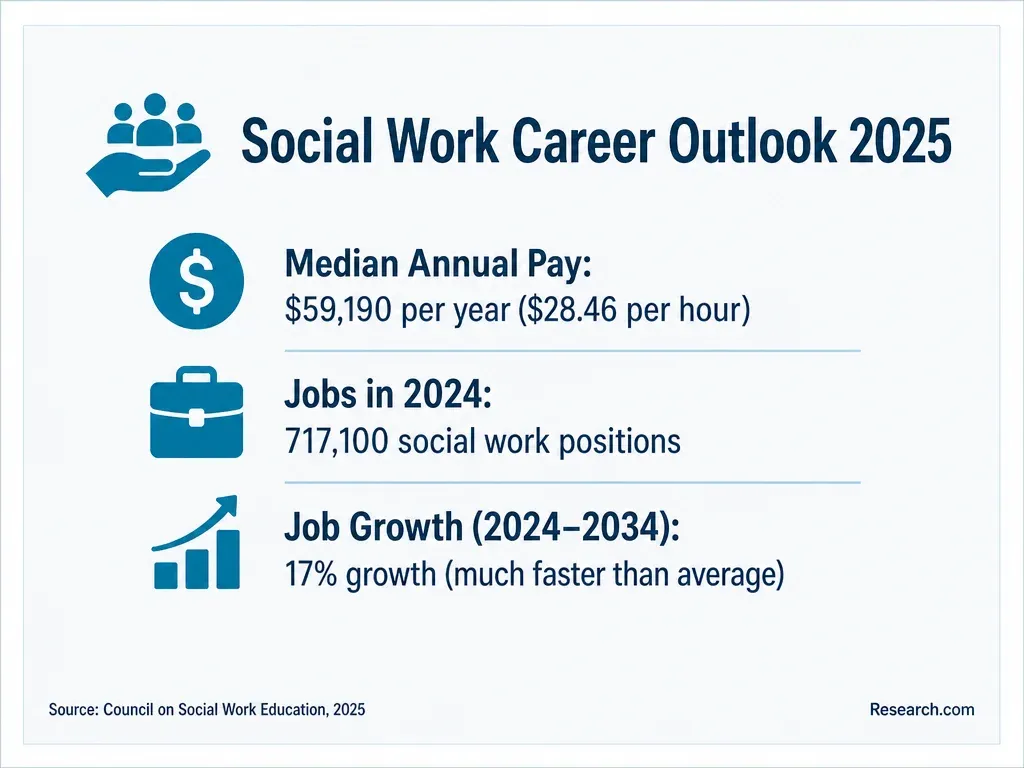
- The U.S. Bureau of Labor Statistics reports a May 2025 median annual wage of $61,780 for social workers across specialties, not a wage specific to mediation.
What is conflict resolution in social work?
Conflict resolution in social work is the process of identifying a disagreement, understanding each party's needs and constraints, and working toward a safe, fair next step. The goal is not always agreement. A useful outcome may be a clarified care plan, a supported client decision, a referral, or an appropriately escalated concern.
A social worker might help a client and service team address competing goals, facilitate a family meeting, or raise a dispute about access to benefits. These situations differ from formal mediation, in which a trained neutral facilitates negotiation under an agreed process. A social worker advocating for a client cannot simply claim neutrality, and organizational authority or unequal power can make a seemingly voluntary agreement unfair.
Conflict skills apply to generalist services as well as specialized practice. For someone exploring an entry route, accredited bachelor's pathways into social work offer broader preparation in ethics, systems, and field practice than a stand-alone mediation course. That broader degree is unnecessary, however, if the intended job calls only for facilitation skills and does not require a social work qualification.
How do social workers resolve conflicts in workplace settings?
Effective resolution begins with the social worker's role, not a preferred technique. A hospital social worker coordinating discharge, a child welfare worker documenting a safety concern, and a nonprofit supervisor handling staff disagreement have different authority and obligations. Each should follow applicable law, agency policy, supervision arrangements, and professional ethics.
For an ordinary service or team disagreement, this sequence helps distinguish a negotiable issue from one requiring another response:
- Clarify the disagreement and each person's role; ask what outcome the client wants and what decisions are actually open to negotiation.
- Check for immediate safety concerns, coercion, discrimination, reporting duties, or confidentiality limits before proposing a joint conversation.
- Listen separately when needed, reflect each person's concerns without promising a result, and identify shared goals and practical constraints.
- Facilitate options within the social worker's authority, confirm consent and responsibilities, and involve a supervisor or specialist when the issue exceeds that authority.
- Document the material decisions, referrals, and follow-up according to agency requirements, then check whether the plan worked.
For example, a dispute over who will arrange transportation might be resolved by clarifying eligibility, available services, and the client's preference. An allegation of abuse is different: a facilitated compromise must not replace required safeguarding or reporting procedures. Early-career workers should ask how an employer handles escalation, consultation, and caseload pressures when considering graduate social work career planning.
What education and training prepare social workers for conflict resolution?
The right educational route depends on whether the goal is to improve performance in an existing role or qualify for a new one. A workshop can strengthen a practitioner's facilitation skills; it cannot replace a degree or license an employer or state requires.
The following routes differ in scope and entry requirements. Compare them against actual job postings and the kinds of conflicts you expect to handle.
| Route | Relevant preparation | When it fits - and its limit |
| BSW | Generalist coursework and supervised field education | Fits entry-level social work preparation; does not establish independent clinical practice rights. |
| Traditional or foundation MSW | Foundational and specialized study with field education | Fits graduates of other disciplines seeking MSW preparation; relevant work alone does not usually confer advanced standing. |
| Advanced-standing MSW | Specialized study building on a qualifying BSW | May reduce repeated foundation coursework when the program accepts the prior social work degree; eligibility is school-specific. |
| Focused continuing education or mediation training | Practice in negotiation, facilitation, or a setting-specific process | Fits a defined skills gap; does not substitute for required social work education, supervision, or licensure. |
Students comparing MSW routes should review social work master's entry routes explained, then confirm eligibility and field expectations with each program. A DSW may serve an experienced practitioner's leadership or practice-improvement goals, while a PhD generally emphasizes research. Neither is ordinarily necessary just to learn workplace conflict resolution.
For a prospective BSW or MSW student, confirm the exact program's Council on Social Work Education (CSWE) accreditation status and whether that status applies to the intended enrollment and graduation pathway. Institutional accreditation and CSWE programmatic accreditation answer different questions. Then check the licensing board in the state where you intend to practice: license categories, qualifying education, examinations where required, supervision, and permitted activities vary by jurisdiction.
This matters even when the immediate goal is conflict resolution. An agency facilitation role may not require a clinical license, while a position that includes regulated clinical services may require a qualifying MSW, a state license, and further supervised experience. Neither a conflict-resolution concentration nor an MSW alone authorizes independent psychotherapy. Use licensure-focused MSW program selection questions to organize inquiries, but obtain the controlling requirements from the program and the relevant state board before enrolling.
BSW applicants typically must satisfy university requirements and any separate requirements for entering the social work major. Traditional or foundation MSW programs generally consider applicants with a bachelor's degree, including degrees outside social work. Advanced-standing MSW admission ordinarily requires a qualifying BSW and satisfaction of the program's additional criteria; a psychology, sociology, or human services degree alone should not be assumed to qualify.
Programs may review transcripts, grades, writing, references, relevant experience, and prerequisites, but their requirements differ. Applicants should also distinguish admission from field-placement readiness: an agency may impose separate screening or onboarding conditions. If an accessible application route is important, use an online MSW application accessibility guide to develop a shortlist, then verify each school's published criteria and ask whether its field sites can support the practice experience you want.
What careers use social work conflict resolution skills, and what are their salary and outlook?
Conflict skills are useful in child and family services, schools, healthcare, behavioral health, housing services, and agency leadership. Duties range from coordinating a disputed service plan to facilitating a team discussion. Hiring standards differ: some roles accept a BSW or another relevant degree, others require an MSW or a state license, and school or clinical positions may have additional requirements.
The U.S. Bureau of Labor Statistics figures below describe occupations, not mediation jobs or pay guaranteed by a particular degree. Use the closest match to your target duties rather than applying an all-social-workers figure to every offer.
| BLS occupation | May 2025 median annual wage | Projected employment growth, 2025-2035 |
| Child, family, and school social workers | $59,550 | 4% |
| Healthcare social workers | $67,880 | 8% |
| Mental health and substance abuse social workers | $60,280 | 10% |
| Social workers, all specialties | $61,780 | 6% |
These medians combine workers with different experience, credentials, employers, and locations; projected growth is not a hiring guarantee. For a realistic choice, compare job postings' degree and license requirements alongside caseload, safety procedures, supervision, and pay. Location can also change the calculation, so comparing pay locations for master's-prepared social workers is a useful supplement to local job offers.
Other Things You Should Know About Social Work
Sometimes, but not automatically. Advocacy duties, an existing client relationship, or authority over services may create a conflict with a neutral mediator role. Disclose the role and consider an independent mediator when appropriate.
Do not treat participation as voluntary if refusal brings improper pressure or retaliation. Clarify available alternatives, document relevant decisions, and seek supervisory guidance where needed.
Only under applicable law and agency policy, with any required consent. Follow the organization's records and confidentiality rules; do not make a personal recording to help recall the conversation.
Describe a real, appropriately anonymized example from training or work: your role, how you listened and checked boundaries, when you sought guidance, and what you learned. Do not claim an outcome or authority you cannot substantiate.
- Communication skills training for improving the... - PMC https://pmc.ncbi.nlm.nih.gov/articles/PMC9949884/
- Conflict Management in Healthcare - StatPearls - NCBI - NIH https://www.ncbi.nlm.nih.gov/books/NBK470432/
- Addressing Domestic Violence in Mediation: The Need for More Uniformity and Research - Harvard Negotiation Law Review https://journals.law.harvard.edu/hnlr/2021/05/addressing-domestic-violence-in-mediation-the-need-for-more-uniformity-and-research/
- Power-informed practice in social work - Samina Karim, 2023 https://journals.sagepub.com/doi/10.1177/14680173231180307
- Social Work Simulation Education in the Field | Applied Learning in Social Work Education Journal https://alswe.simmons.edu/article/social-work-simulation-education-in-the-field/
- Full article: Dilemmas and conflicting pressures in social work practice | tandfonline.com https://www.tandfonline.com/doi/full/10.1080/13691457.2021.1954884
- Understanding the 9 Core Competencies of Social Work | Tulane School of Social Work https://tssw.tulane.edu/news/understanding-9-core-competencies-social-work
- The Nine CSWE Social Work Competencies | texascollege.edu https://www.texascollege.edu/the-nine-cswe-social-work-competencies
- Chapter 27., Section 9. Transforming Conflicts in Diverse Communities - Main Section | Community Tool Box https://ctb.ku.edu/en/table-of-contents/culture/cultural-competence/transform-conflicts/main
- Teamwork Conflict Management Training and Conflict Resolution Practice via Large Language Models | mdpi.com https://www.mdpi.com/1999-5903/16/5/177