2027 Patient Identification and Nursing Workflow: Safety Concepts Students Encounter
Audited and Verified:
Our Editorial and Data Verification Process
Research.com uses government datasets, official education statistics and primary institutional information to support its career and degree guides. Our review process checks factual accuracy, occupational definitions, source dates and the requirements associated with the credentials discussed.
How This Article Was Fact-Checked
Our editorial team verifies salary estimates, employment projections, education requirements and program information against original data providers and official organizations. Salary figures are checked against the relevant occupational definitions and reporting periods. Information about licensure, accreditation and required in-person training is reviewed separately.
Fact-checked and verified on:

Co-Founder and Chief Data Scientist
A correct medication, specimen, or treatment can still harm someone if it reaches the wrong patient. Nursing students therefore learn patient identification as a repeated safety check woven through assessment, documentation, handoffs, and care - not as a single question asked at admission.
This guide explains what the check involves, how programs teach it, and what to look for in clinical preparation. It also puts degree format, licensure, cost, and career claims in perspective so you can choose training that supports safe practice rather than merely covering the topic on paper.
Key Things You Should Know
- Before care or specimen collection, nurses use at least two approved patient identifiers and match them to the relevant order, record, label, or device; a room number is not an identifier.
- Safe identification depends on workflow as well as memory: active verification, bedside labeling, clear handoffs, and stopping when information conflicts.
- Classroom instruction alone is insufficient. Compare programs by supervised practice, observed competency, state board status, and the requirements of the clinical sites where students learn.
What is patient identification in nursing, and why does it matter for safety?
Patient identification means confirming that the person receiving care is the person named in the applicable order and health record. It is distinct from assessing whether an order is clinically appropriate: nurses must do both. A mismatch can lead to wrong-patient medication administration, mislabeled specimens, incorrect documentation, or care based on another person's history.
The underlying problem is often a chain of small failures. Patients may share names, change rooms, be unable to speak, or have records open on nearby workstations. Electronic alerts and barcode systems add defenses, but they do not replace checking the person and resolving conflicting information. Students considering later quality-improvement work can explore DNP program options beyond new clinical licensure; an initial RN degree, not a DNP, is the relevant starting point for someone who wants to become a nurse.
How do nurses use two identifiers throughout the clinical workflow?
Nurses use at least two identifiers approved by their organization - commonly a patient's full name and date of birth or an assigned medical record number. When the patient can respond, asking them to state identifying information is generally stronger than asking a leading yes-or-no question.
The nurse compares the response and identification band with the order, electronic record, medication, specimen label, or other care item. A room or bed number is not an acceptable identifier because occupants can change.
The check recurs at points where a wrong-patient error could enter the workflow: medication administration, specimen collection, treatments, transfers, and documentation. For example, collecting a specimen from the right person is not enough if its label is later attached to another patient's tube.
In behavioral health, a patient's ability or willingness to answer may vary; nurses follow the site's approved alternative verification process rather than guessing. Nurses exploring that specialty can compare psychiatric NP MSN programs by duration, but those advanced practice programs do not replace initial RN preparation.
What nursing workflows help prevent patient identification errors?
Reliable workflows make the correct check easier to perform at the point of care and harder to bypass when a unit is busy. Students should learn not only the sequence but also what to do when it fails.
- At the bedside: Match the patient's approved identifiers to the band and the care item before proceeding; follow policy when a band is missing or unreadable.
- During medication administration: Compare the patient, medication, and order using required checks and barcode scanning where available; investigate alerts instead of working around them.
- During specimen collection: Verify the patient before collection and label the specimen according to site policy, typically in the patient's presence rather than at a distant workstation.
- At handoff and documentation: Confirm the correct chart and communicate unresolved identity questions before care continues.
- When information conflicts: Pause, protect the patient, and escalate through the clinical site's process rather than choosing the most plausible record.
These principles apply across specialties, although local procedures differ. A nurse comparing affordable online psychiatric nurse practitioner programs should separately verify how each program teaches supervised assessment and safety workflows; a low tuition figure says little about clinical readiness.
Patient identification is usually reinforced across courses rather than confined to one lecture. The examples below show where a prospective student might expect to encounter the concept and what meaningful assessment could look like; course names vary by school.
| Learning area | Connection to identification | Evidence of learning to ask about |
| Foundations and skills lab | Identification before basic care and specimen collection | Observed skills checkoffs and feedback |
| Pharmacology and medication administration | Matching the patient, order, medication, and documentation | Scenario-based assessment and supervised practice |
| Clinical judgment and informatics | Resolving conflicting information and using the correct EHR record | Cases involving chart selection, escalation, and error prevention |
| Clinical courses | Applying checks with real patients under supervision | Faculty or preceptor evaluation against stated competencies |
For an already-licensed RN, graduate coursework may examine workflow design and safety data rather than reteach entry-level identification. If that is the goal, compare online BSN-to-MSN programs organized by tuition alongside their actual curriculum; a graduate degree is unnecessary simply to learn a safer bedside routine.
Preparation typically progresses from explanation and demonstration to skills lab, simulation, and supervised patient care. In simulation, an instructor might introduce a wrong chart or mismatched label and evaluate whether the student recognizes the discrepancy, pauses, and communicates it. In clinical placements, faculty and site staff assess performance under the program's supervision arrangements. Passing a written test or completing a simulation does not establish readiness to practice independently.
Ask a prospective prelicensure program how identification and medication-safety competencies are observed, what happens after an unsuccessful checkoff, and how students receive feedback in clinical settings. Already-licensed RNs considering degree completion face a different question: online BSN completion clinical policies may differ from those of prelicensure programs. An RN-to-BSN program's lack of new bedside rotations should not be mistaken for an initial RN training pathway.
For initial RN preparation, confirm that the program meets the requirements of the state board of nursing relevant to your intended license. Separately check the institution's accreditation and whether the specific nursing program holds applicable accreditation, such as ACEN or CCNE accreditation. These are different reviews: institutional accreditation concerns the college or university, nursing program accreditation concerns the named program, and the state board determines licensure eligibility under its rules.
Check the exact degree and campus or delivery option rather than assuming every nursing offering shares the same status. If you later consider a graduate route, even a list of DNP programs with accessible admission requirements cannot establish that a particular program qualifies you for a new clinical role. Verify its track, accreditation scope, and any applicable certification and state requirements.
A prospective RN generally completes a state-eligible prelicensure nursing program - commonly an ADN/ASN or BSN - then meets the state board's application requirements and passes the NCLEX-RN. The board, not the school, issues the license. Graduation, eligibility to test, passing the exam, and holding an active license are separate milestones; employers also provide role- and unit-specific orientation.
Admissions tests are a separate issue from the NCLEX-RN. Some applicants compare nursing schools with no TEAS or HESI requirement, but an entrance-exam policy does not waive nursing coursework, supervised clinical education, or state licensing requirements. Before applying, ask the program which state licenses its graduates may seek and confirm the answer with the relevant board.
Online lessons can teach the rationale for two identifiers, EHR chart-selection risks, and responses to a mismatch. Effectiveness for a prelicensure student also depends on opportunities to practice, receive corrective feedback, and demonstrate safe performance in required labs, simulation, and supervised clinical care. "Online" does not mean entirely remote or self-paced.
Before enrolling, get a written explanation of in-person requirements, clinical placement responsibility, geographic restrictions, and competency evaluation. An RN investigating continuing from an ADN into MSN study should verify whether the option assumes an existing RN license; it is not a substitute for a prelicensure program's hands-on preparation.
An ADN is often described as a two-year degree and a traditional BSN as a four-year degree, but prerequisites, admission timing, course sequencing, and clinical placement availability can change an individual timeline. Accelerated BSN study may be shorter for someone with an earlier bachelor's degree, while requiring an intensive schedule. Compare the time from your current starting point, not just the advertised nursing-course length.
For a usable cost estimate, request a program-specific total that includes tuition, mandatory fees, books, equipment, uniforms, health and background requirements, travel to clinical sites, and examination and licensing costs. Add the income you may give up if clinical schedules limit paid work. When comparing nursing admission options beyond highly selective programs, weigh admission likelihood against total cost, state eligibility, clinical access, and completion support - not admissions claims alone.
What careers, salaries, and job outlook can nursing graduates expect?
Once licensed, an RN may seek work in hospitals, ambulatory care, long-term care, or community settings. Patient identification remains part of each role, but workflows and orientation differ. A new graduate should compare supervised orientation, access to experienced colleagues, staffing support, and escalation practices rather than assume that graduation establishes independent specialty competence.
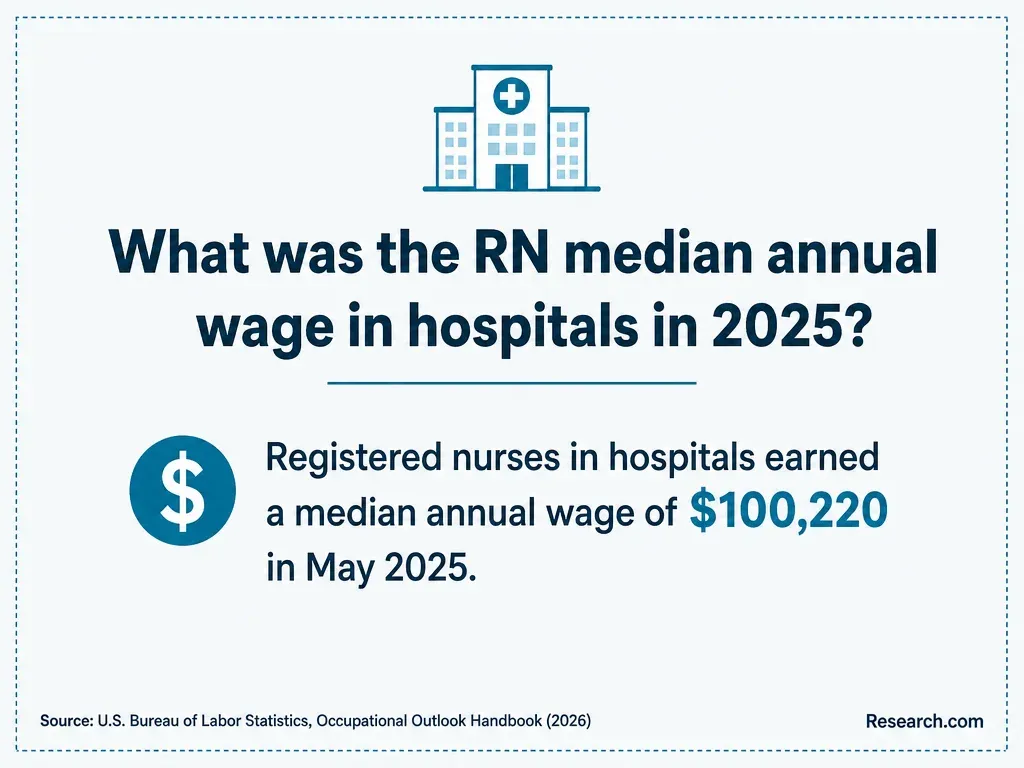
The U.S. Bureau of Labor Statistics reports wages and employment projections for the registered nurse occupation, not for graduates of a particular ADN or BSN program. Its Occupational Outlook Handbook is a useful benchmark when reviewing an offer, but local setting, shifts, experience, and employer matter. Advanced practice roles require additional role-specific education and authorization: accelerated FNP education comparisons are relevant only to appropriately qualified nurses pursuing that distinct career, not to students choosing initial patient-safety training.
Other Things You Should Know About Nursing
A photograph can help a team recognize a patient, but do not assume it counts as an approved identifier. Follow the clinical site's policy for the required identifying information.
Use the organization's approved alternative process, which may involve an identification band and verified record information. Ask a supervising nurse when the identity remains uncertain.
Yes. Tell the supervising nurse or instructor promptly and follow the site's reporting process. Near misses can reveal workflow weaknesses before harm occurs.
Family input may help resolve uncertainty, but it does not automatically replace the clinical site's required verification process. A student should involve the supervising nurse when identifiers conflict.
- Patient Identification Errors: A Systems Challenge | PSNet https://psnet.ahrq.gov/web-mm/patient-identification-errors-systems-challenge
- New and Accepted Student Roster Process | texas.gov https://www.bon.texas.gov/students_new_accept_student.asp.html
- Use of identification wristbands among patients receiving inpatient treatment in a teaching hospital - PMC https://pmc.ncbi.nlm.nih.gov/articles/PMC4376029/
- Tool 3 Patient identification and matching to intended care | SA Health https://www.sahealth.sa.gov.au/wps/wcm/connect/public+content/sa+health+internet/resources/tool+3+patient+identification+and+procedure+matching
- Medication Errors Occurring with the Use of Bar-Code Administration Technology | pa.gov https://patientsafety.pa.gov/ADVISORIES/Pages/200812_122.aspx
- Patient safety | who.int https://www.who.int/news-room/fact-sheets/detail/patient-safety
- Two Forms of Identification - UTMB Health Resource Center https://www.utmb.edu/health-resource-center/two-forms-of-identification
- Certified Background Check for All Nursing Students | Northwestern Oklahoma State University https://www.nwosu.edu/nursing/background-checks/
- Compliance - Nursing Students - UW-Madison https://students.nursing.wisc.edu/compliance/
- Two Patient Identifiers - Understanding The Requirements https://www.jointcommission.org/en/knowledge-library/support-center/standards-interpretation/standards-faqs/000001463