2027 Outpatient Nursing vs Hospital Bedside Nursing: Work, Pay Structure, and Fit
Audited and Verified:
Our Editorial and Data Verification Process
Research.com uses government datasets, official education statistics and primary institutional information to support its career and degree guides. Our review process checks factual accuracy, occupational definitions, source dates and the requirements associated with the credentials discussed.
How This Article Was Fact-Checked
Our editorial team verifies salary estimates, employment projections, education requirements and program information against original data providers and official organizations. Salary figures are checked against the relevant occupational definitions and reporting periods. Information about licensure, accreditation and required in-person training is reviewed separately.
Fact-checked and verified on:

Co-Founder and Chief Data Scientist
An outpatient RN offer may promise more predictable hours than a hospital bedside job, but a daytime schedule can come with different pay, patient demands, and advancement options. For nursing students, new graduates, and RNs considering a move, the best setting depends on the actual position - not its label.
This comparison explains how the work differs, how to compare total compensation, which preparation matters, and what to ask before accepting a job or choosing a nursing program.
Key Things You Should Know
- Outpatient nurses usually manage shorter encounters and follow-up across a caseload; hospital bedside nurses provide continuous care for admitted patients, including changes in condition during a shift.
- Compare annual earnings, not just hourly rates: a 36-hour hospital week totals 1,872 scheduled hours a year, while a 40-hour outpatient week totals 2,080, before overtime or unpaid time off.
- Both RN paths require appropriate state licensure and setting-specific onboarding. A specialty certificate or graduate degree does not replace demonstrated job competencies.
What is the difference between outpatient nursing and hospital bedside nursing?
Outpatient nursing cares for people who are not admitted for an overnight hospital stay. Jobs range from primary care and specialty clinics to infusion centers, ambulatory surgery, dialysis, and hospital-owned practices. Hospital bedside nursing generally means direct care for admitted patients on units such as medical-surgical, telemetry, pediatric, or intensive care.
The distinction is a care setting, not a different RN license. This table shows the usual pattern; an outpatient surgery unit and a primary care office, for example, can be very different workplaces.
| Comparison | Outpatient RN | Hospital bedside RN |
| Patient contact | Scheduled visits, procedures, calls, or follow-up over time | Repeated assessment and care throughout an admission or shift |
| Workflow | Appointments, care coordination, triage, and throughput | Shift assignments, treatment plans, handoffs, and response to changes |
| Typical pressure point | High visit volume, limited appointment time, and follow-up queues | Acuity, staffing, interruptions, and around-the-clock coverage |
Someone entering nursing should choose a program for RN eligibility and clinical preparation, not assume a school admits students into a permanent "outpatient" or "bedside" track. Admission-focused nursing school comparisons can help build an application shortlist, but approval, clinical access, and graduate eligibility still need separate checks.
What does an outpatient nurse do compared with a hospital bedside nurse?
An outpatient RN might assess symptoms before a visit, administer ordered treatment, teach a patient how to manage a condition, coordinate referrals, document results, and identify concerns that need prompt escalation. The exact mix depends on whether the job is in primary care, oncology infusion, endoscopy, behavioral health, or another service. Phone and electronic-message triage can be a substantial clinical responsibility, not simply administrative work.
A hospital bedside RN typically assesses assigned patients throughout a shift, administers medications and treatments, monitors responses, coordinates with other clinicians, documents care, prepares patients and families for discharge, and hands off unresolved needs. The nurse must reprioritize when a patient deteriorates or a new admission arrives.
Autonomy is not the dividing line: both roles require RN judgment within state scope and employer policy. A clinic RN who flags a concerning symptom may be making a consequential decision even though the patient is not in a hospital bed. Outpatient RN duties should not be confused with those of a nurse practitioner; accelerated FNP education comparisons concern a separate advanced-practice pathway with its own eligibility and clinical requirements.
How do outpatient and hospital nursing salaries and pay structures compare?
There is no reliable national pay rule that makes every hospital job better paid than every outpatient job. The U.S. Bureau of Labor Statistics reported a $93,600 median annual wage for registered nurses in May 2024. That occupation-wide figure is a historical benchmark - not a current offer, a new-graduate salary, or a measure of the difference between these two settings. Specialty, region, employer, experience, and hours matter.
Hospital offers may include night, weekend, holiday, on-call, overtime, or incentive pay. Outpatient offers may instead provide a steadier weekday schedule, although procedure centers and infusion services can also have call or extended hours. The hypothetical comparison below isolates scheduled base pay; it does not predict what either job will pay.
| Illustrative offer | Scheduled calculation | Annual base pay before unpaid time off |
| Hospital: $40/hour, 36 hours/week | $40 × 36 × 52 weeks | $74,880 |
| Outpatient: $38/hour, 40 hours/week | $38 × 40 × 52 weeks | $79,040 |
The lower hourly rate produces more scheduled base pay in this example because it includes more hours. Compare expected differentials, overtime rules, paid leave, health coverage, retirement contributions, parking, commute, and the cost of childcare for the shifts actually offered. If an employer proposes graduate study as a route to higher pay, weigh tuition and foregone earnings first; planning the cost of a BSN-to-MSN transition is a different calculation from comparing two RN offers.
For an RN position in either setting, the core requirement is an active RN license valid for the practice location. Initial licensure generally follows completion of a qualifying prelicensure nursing program, NCLEX-RN passage, and the state board's other requirements. Graduation alone is not a license. Employers may require or prefer a BSN, prior experience, life-support training, or role-specific competencies; these expectations vary by job.
Some outpatient teams also employ LPNs/LVNs, medical assistants, and advanced practice nurses. Their titles, permitted duties, and supervision requirements are not interchangeable with an RN's. In a specialty clinic, read the posting carefully: "nurse" may describe several distinct positions.
Graduate preparation is necessary for some advanced-practice roles, not for ordinary outpatient RN practice. For example, accelerated mental health NP certificate study is relevant to eligible nurses seeking that advanced-practice population focus - not an RN prerequisite for working in an outpatient behavioral health clinic. Certification, state APRN authorization, and employer credentialing remain separate decisions.
A qualifying prelicensure ADN/ASN or BSN can lead toward initial RN licensure and, afterward, applications in either setting. A prelicensure BSN includes bachelor's-level preparation; an RN-to-BSN is for someone who already holds an RN license and does not serve as a first-licensure route. An accelerated BSN may fit someone with a prior non-nursing degree, provided they meet that program's prerequisites.
Choose the entry route by eligibility, cost, clinical preparation, and the employers you hope to approach - not by assuming one degree guarantees a setting. Hospital new-graduate residencies may be an accessible first step for some applicants, while other new graduates obtain outpatient positions with structured orientation. Specialty clinics may prefer relevant experience.
An ADN-prepared RN considering later leadership, education, or advanced study can examine nursing master's bridges for ADN graduates. But a bridge is not necessary merely to move from bedside to an RN clinic job. Verify each prospective program's entry license requirement, award, clinical obligations, and relevance to the role before paying for additional education.
Hospital bedside care runs continuously. A posting may specify three 12-hour shifts, but weekends, holidays, rotating schedules, call, or shifts running past the scheduled handoff can affect family life. Fewer scheduled workdays do not necessarily mean easier recovery after nights or consecutive shifts.
Many offices operate mainly on weekdays, making outpatient work appealing to nurses who need a repeatable routine. Yet a five-day schedule can mean more commuting and less freedom to arrange appointments. Ambulatory surgery, dialysis, urgent care, and infusion positions may start early, run late, or include weekends. Ask for the actual posted rotation, not just "day shift."
For working parents studying after licensure, schedule predictability matters more than an "online" label: courses can still require live sessions or fixed deadlines. Exploring RN-to-BSN nontraditional clinical formats may help identify questions to ask about required activities, but confirm the specific program's schedule and practice requirements.
Both settings depend on assessment, medication safety, clear documentation, patient education, teamwork, and knowing when to escalate. Hospital bedside nurses often need sustained monitoring, rapid reprioritization, safe handoffs, and unit-specific equipment skills. Outpatient nurses may rely more heavily on concise assessment, telephone triage, longitudinal follow-up, procedure preparation, and coordinating care across services.
The specialty can matter more than the building. Oncology infusion requires different onboarding from primary care; hospital critical care requires different competency checks from a general inpatient unit. A student or new RN should look for supervised practice, a named preceptor or mentor, and a clear process for confirming readiness - not assume that a classroom course or previous rotation establishes independent competence.
Mental health illustrates another boundary: an outpatient psychiatric RN needs relevant assessment and safety skills, while an NP role requires distinct graduate preparation. Comparing accelerated psychiatric nursing master's programs makes sense only if that advanced-practice role, rather than an outpatient RN position, is the goal.
Choose a credential that matches the patients and duties in the target job. Hospital nurses may consider relevant medical-surgical, critical care, or other specialty certification after meeting the awarding organization's practice requirements. Outpatient nurses may find ambulatory care, oncology, or another service-specific credential more useful. Basic or advanced life-support credentials may be required by an employer, but they are not substitutes for an RN license or orientation.
Before paying for an exam, check the certifying body's current license, experience, examination, and renewal rules, then ask whether the employer recognizes the credential or offers support. A certificate earned through a course is not necessarily professional board certification, and neither independently expands legal scope.
Likewise, online FNP certificate routes after an MSN address formal preparation for eligible nurses pursuing a different advanced-practice role. They are not an ambulatory RN specialty certification.
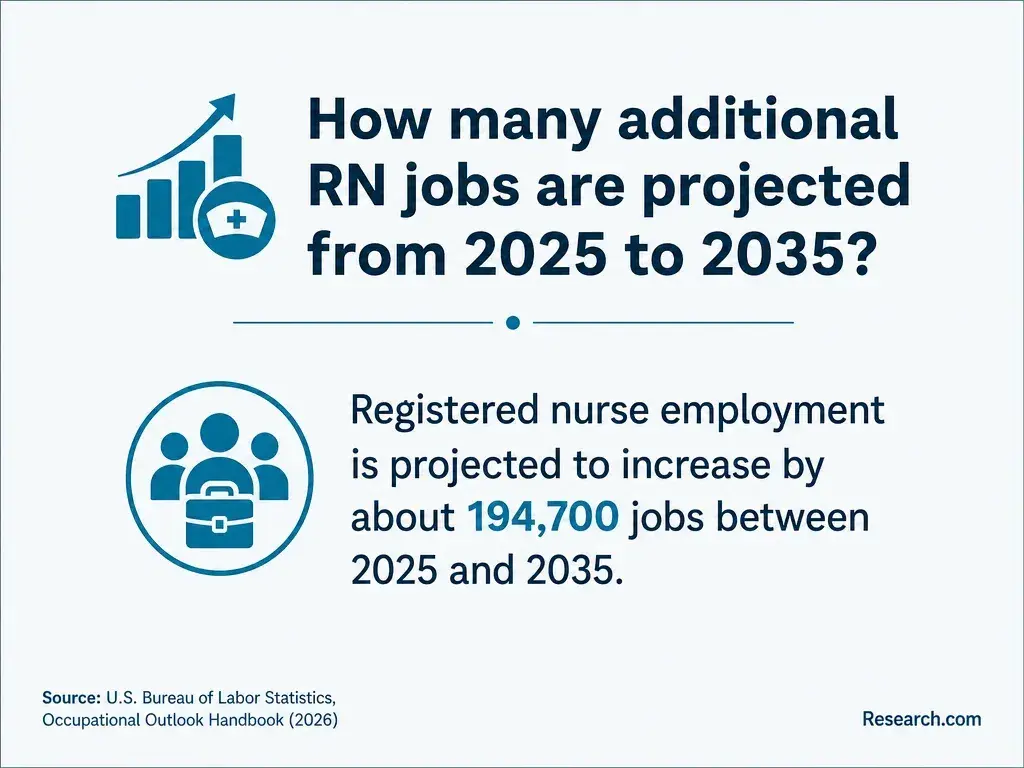
BLS projects growth for the registered nurse occupation, but its national outlook does not guarantee openings in a particular clinic, unit, or city. Local specialty demand, staffing budgets, turnover, and employer hiring rules are more useful when comparing specific offers. Check multiple local postings for experience requirements and whether outpatient employers will train new graduates or bedside RNs changing specialties.
Bedside experience can support movement into charge, specialty, education, or management roles, depending on employer criteria. Outpatient experience can support care coordination, specialty practice, quality work, clinic leadership, or population-focused services. Neither pathway has a universal promotion ladder.
If the intended next step is nurse practitioner practice, evaluate it as a separate career decision: supervised graduate clinical education, certification, state authorization, and financing all matter. Online NP tuition and fee considerations are relevant to that plan, but an NP degree is not required for RN advancement in either setting.
How can students choose an accredited nursing program for their goals?
Start with a program that prepares graduates for the license you need, then assess whether its supervised clinical experiences and employer connections expose you to the settings you want. Institutional accreditation, nursing program accreditation, and state board approval or recognition serve different purposes; confirm each status and its scope with the institution, accreditor, and applicable board. Also check the program's published NCLEX outcomes with their reporting year rather than treating a headline pass rate as a personal prediction.
For the programs on your shortlist, ask where students actually complete inpatient and ambulatory rotations, who arranges placements, what simulation and on-site attendance are required, and what new-graduate transition support is available. Compare total costs - including travel and time away from work - alongside the likelihood that you can complete the required schedule. A clinical rotation offers exposure, not a promise of employment or independent specialty readiness.
Applicants with a prior bachelor's degree can use exploring accessible accelerated BSN pathways as a starting point, then verify prerequisites, laboratory rules, clinical scheduling, approval, and eligibility for initial RN licensure directly. After narrowing both programs and workplaces, request a unit or clinic shadow opportunity where permitted: observing the real workflow can reveal more about fit than a setting name.
Other Things You Should Know About Nursing
Some triage, care-management, and utilization-review roles permit remote work, but many require substantial experience and location-specific licensure. "Remote" does not eliminate clinical accountability, privacy rules, or an employer's scheduling requirements.
Usually, yes: patients generally arrive for a procedure and leave without an inpatient admission. The work may involve perioperative assessment, recovery, and discharge rather than the appointment-based workflow of a primary care clinic.
Often, but employers assess recent experience and unit requirements. Ask about a transition orientation, supervised skills validation, and support for rebuilding competencies before taking an independent assignment.
Ask how assignments or caseloads are set, who helps with escalation, how long orientation lasts, and why the position is open. Compare the answers with what you observe and with the written offer.
- Board of Nursing | dchealth - DC.gov https://dchealth.dc.gov/bon
- A Time and Motion Analysis of Nursing Workload and... - PMC https://pmc.ncbi.nlm.nih.gov/articles/PMC11216543/
- Fact Sheet #56C: Bonuses under the Fair Labor Standards Act (FLSA) | U.S. Department of Labor https://www.dol.gov/agencies/whd/fact-sheets/56c-bonuses
- California Board of Registered Nursing | ca.gov https://www.rn.ca.gov/
- Inpatient vs. Outpatient Nursing: What's the Difference? | indeed.com https://www.indeed.com/career-advice/finding-a-job/inpatient-vs-outpatient-nursing
- What is Nursing? Your Questions Answered | ANA https://www.nursingworld.org/practice-policy/workforce/what-is-nursing/