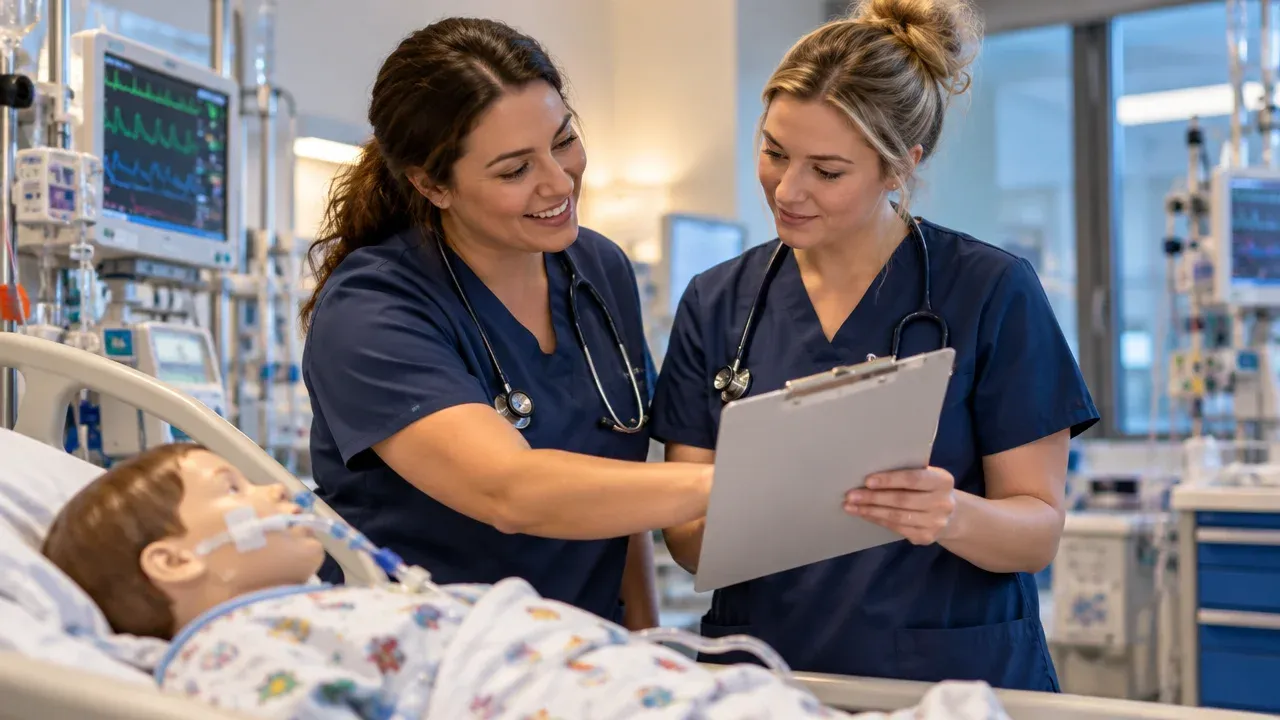
2027 Online MSN Nursing Education Programs for Nurses in West Virginia: Teaching Practicum and Cost
Audited and Verified:
Our Editorial and Data Verification Process
Research.com uses government datasets, official education statistics and primary institutional information to support its career and degree guides. Our review process checks factual accuracy, occupational definitions, source dates and the requirements associated with the credentials discussed.
How This Article Was Fact-Checked
Our editorial team verifies salary estimates, employment projections, education requirements and program information against original data providers and official organizations. Salary figures are checked against the relevant occupational definitions and reporting periods. Information about licensure, accreditation and required in-person training is reviewed separately.
Fact-checked and verified on:

Co-Founder and Chief Data Scientist
An online MSN in nursing education can let a West Virginia RN prepare to teach without relocating, but online coursework does not eliminate supervised teaching or local placement logistics. The decision hinges on whether a program can enroll you in West Virginia, approve a feasible practicum site, and fit your budget and work schedule.
This guide explains how to compare those requirements, estimate the full cost, and judge whether an educator MSN, or a shorter professional-development route, matches the teaching job you want.
Key Things You Should Know
- An educator MSN is generally a postlicensure degree: expect to document an active RN license, and do not treat it as an NP or initial-licensure pathway.
- Check three separate matters before enrolling: institutional accreditation, nursing program accreditation, and authorization to enroll a West Virginia student; then obtain the teaching-practicum rules in writing.
- Compare the full degree price, not tuition alone, including required credits, fees, practicum travel, possible campus visits, and any income lost when teaching hours conflict with paid shifts.
What Is an Online MSN in Nursing Education for West Virginia Nurses?
An online MSN in nursing education is a graduate nursing degree for licensed nurses who want to design instruction, teach, assess learning, or develop staff. "Online" usually describes the academic coursework.
Supervised teaching may occur at an approved school, health system, or other educational site. Programs vary in whether they emphasize academic faculty work, hospital staff development, or both.
For a West Virginia RN, the most useful first distinction is the entry route. A BSN-to-MSN track builds on a nursing bachelor's degree. Some RN-to-MSN routes accept an RN with an associate degree and add bridge coursework; compare the actual award and required credits rather than assuming every bridge works alike.
Online ADN-to-MSN program comparisons can help identify routes to investigate, but the school must confirm educator-track availability and your eligibility.
This is a non-APRN specialty. It does not, by itself, prepare a graduate to practice as a nurse practitioner. If the goal is primarily to precept colleagues or lead occasional training at work, employer-supported educator development may be more direct than a full MSN.
Which Accreditation Should West Virginia Nurses Look for in MSN Programs?
Verify institutional accreditation for the university and programmatic accreditation for the nursing degree. CCNE and ACEN are nursing accreditors to check, but confirm that the specific MSN falls within the accreditor's stated scope; accreditation of a school's BSN alone does not establish accreditation of its MSN. Ask the program to document whether it can enroll a student residing in West Virginia and arrange any required in-state teaching experience.
These checks answer different questions. Accreditation concerns educational oversight, while state authorization concerns where the school may serve students. Neither automatically guarantees placement, employment, or eligibility for an optional educator certification. A program's online label is not evidence of West Virginia enrollment eligibility.
Accreditation is also not a substitute for matching the credential to the job. Someone exploring DNP application options by selectivity should first establish whether the desired position calls for educator preparation, doctoral study, or both; an easier application route does not resolve a credential mismatch.
What Are the Admission Requirements for Online MSN Nursing Education Programs?
Most postlicensure educator tracks ask for an RN license, transcripts from an eligible nursing degree, and evidence of academic readiness. Schools may also request a résumé, statement of goals, references, or nursing experience.
Minimum GPA, prerequisite, and license-location rules differ, so use the requirements for the specific educator track and entry term, not a university-wide graduate admissions page alone.
If you hold an ADN, ask whether the school offers an RN-to-MSN educator route and whether it awards a BSN along the way. If you hold an RN license and a bachelor's degree outside nursing, ask for an individual review rather than assuming you qualify or must start over. Clinical experience can strengthen an application without replacing coursework the school requires.
Do not confuse admission to an educator MSN with admission to an accelerated advanced-practice track. For example, comparing 12-month family NP programs addresses a different clinical role, curriculum, and set of supervised experiences.
Delivery format matters most when paid shifts, travel, and the teaching practicum must coexist. The comparison below separates coursework convenience from obligations that may still require attendance at set times.
| Factor | Online or hybrid MSN | Campus-based MSN |
| Course participation | May include asynchronous work, live sessions, or both | Often includes scheduled in-person classes |
| Teaching practicum | Usually requires an approved site and supervised teaching, potentially near home | May use established local teaching sites, subject to availability |
| Travel | Check for campus intensives, simulation sessions, and site visits | Expect regular trips to campus and possibly a separate practicum site |
| Best fit | RN who needs less routine commuting and can secure an acceptable site | RN who benefits from face-to-face instruction and accessible local placements |
Ask for a sample course calendar and practicum schedule before choosing. An asynchronous lecture does not make a scheduled classroom observation or preceptor meeting asynchronous.
Placement support also needs a precise definition: a school might suggest contacts while leaving the student responsible for securing a site. That distinction matters in other graduate tracks too, including preceptor-provided FNP program comparisons, although FNP clinical placements are not educator teaching practicums.
Expect graduate nursing courses in evidence appraisal, quality or leadership, and the nursing discipline, paired with educator-specific work. The educator sequence commonly addresses learning theory, curriculum design, instructional technology, simulation or clinical teaching, assessment, and evaluation. Exact course titles and the balance between classroom and staff-development teaching differ by school.
Look beyond the catalog titles to the work you will produce. A course may require a lesson plan with measurable objectives, a learning activity, an assessment rubric, or an evaluation of instruction. Those products are more relevant to an educator job than simply completing graduate credits. Ask whether faculty provide feedback on both teaching design and actual delivery.
Specialty content should match the intended role. A short PMHNP certificate pathway for nurses develops a different, advanced-practice population focus; it is not a substitute for coursework in teaching and learner assessment.
A teaching practicum is the supervised application of educator skills, not simply time spent working as an RN. Depending on the program, a student may observe an educator, plan and deliver instruction, facilitate simulation, coach learners in a clinical setting, and evaluate learning. The school determines which activities and hours count, who may supervise them, and how performance is documented.
Before paying a deposit, request answers to the placement questions most likely to change your timeline or cost:
- Does the school find a West Virginia site, approve one you propose, or require you to secure it independently?
- Which settings qualify for your intended role: a nursing program, hospital education department, clinical unit, or another site?
- What qualifications must the preceptor hold, and must the school and site complete an agreement before hours begin?
- How many supervised hours are required, when may they occur, and can any approved activities take place during paid employment?
- How are teaching, learner assessment, faculty oversight, and final competencies evaluated?
A nurse's usual shift, informal precepting, or a self-arranged teaching opportunity does not automatically count. If using an employer site, clarify whether the teaching role is distinct from regular duties and obtain the required permissions before collecting learner evaluations or using workplace materials. De-identify information and follow school and employer privacy rules.
When comparing doctoral options later, do not interpret DNP pathways that do not add a new clinical specialty as proof that practice or project requirements disappear. For this MSN decision, obtain the educator practicum handbook itself.
Completion time depends on the entry route, total required credits, course sequence, enrollment pace, and when a practicum site becomes available. An ADN-to-MSN student may need bridge courses that a BSN-prepared student does not. Part-time study can make weekly coursework more manageable but may extend tuition-bearing terms and delay completion.
Ask the school for a term-by-term plan based on your transcript and intended pace. Check whether educator courses run every term, whether the practicum has prerequisites, and what happens if a site agreement is delayed. A published "time to finish" is useful only if its credit load and placement assumptions are realistic alongside your job.
If you are deciding between an MSN and a later doctorate, DNP programs organized by completion time address a separate decision. A short advertised duration should not outweigh whether the degree supplies the teaching preparation your target employer expects.
There is no single West Virginia price for an online educator MSN: residents may choose an in-state institution or an out-of-state school authorized to enroll them, and tuition policies differ. Without a program-specific, current tuition schedule and degree audit, a quoted total would be misleading. Request an estimate for your entry route, credit load, and expected terms, then compare these price components:
- Tuition price: published charge per credit or term multiplied by the credits or terms you are expected to take, including any bridge coursework.
- Required fee prices: online, technology, graduate, or course-specific charges and any continuing-enrollment fees.
- Practicum-related prices: potential travel, parking, lodging, screening, or site requirements not included in tuition.
- Materials and financing costs: books, software, loan interest, and any charges incurred if completion takes longer than planned.
Compare the total with available employer tuition assistance, including grade requirements, annual limits, and repayment obligations if you leave your job. Federal aid eligibility is individual and does not make every program equally affordable.
For a BSN-prepared RN, BSN-to-MSN bridge cost comparisons can generate candidates, but confirm that each quoted price applies to an educator track and includes its required practicum terms.
Possible roles include nursing faculty, clinical instructor, simulation educator, and nursing professional development or staff-development specialist.
Requirements differ: a school may specify graduate nursing preparation and clinical experience for a faculty opening, while a hospital may prioritize expertise in its patient population and demonstrated ability to teach staff. An MSN can support an application; it does not guarantee a faculty appointment or replace employer onboarding.
The National League for Nursing offers the Certified Nurse Educator credential, and the American Nurses Credentialing Center offers a nursing professional development certification. These are professional certifications, not state nursing licenses. Check each organization's current eligibility criteria, experience requirements, examination rules, and renewal conditions before treating either as a near-term outcome of graduation.
If your actual goal is psychiatric-mental health advanced practice rather than teaching, investigate affordable psychiatric-mental health NP pathways instead. An educator MSN does not supply that population-focused preparation or confer APRN authority.
What Salary and Job Outlook Can Nursing Education Graduates Expect?
For academic teaching, the closest Bureau of Labor Statistics occupation is nursing instructors and teachers, postsecondary. Hospital-based educators may instead be classified under other occupations, so an academic instructor wage figure should not be presented as every educator MSN graduate's pay.
BLS occupation-wide medians also combine workers with different experience, employers, locations, and credentials; they are not a starting salary or a return-on-investment promise.
Use the latest BLS wage and projection figures for the specific occupation you are considering, then compare actual West Virginia faculty or health-system postings for required credentials, schedule, and stated pay.
A move from bedside nursing can change earnings even if the teaching position offers a more desirable schedule. Ask whether a faculty offer is for a full-time, part-time, or adjunct appointment and whether preparation and grading time are compensated.
Nurse practitioner wage or growth figures would answer a different career question. If clinical advanced practice is your goal, affordable online nurse practitioner programs are more relevant to compare than educator MSN programs; neither occupation's published median predicts your individual offer.
Other Things You Should Know About Nursing Programs
Only with any required employer and school permission. Remove protected patient information and confidential workplace material; do not assume a familiar slide deck is yours to submit or publish.
Notify the program immediately. Faculty must determine which completed activities count, approve any replacement site and preceptor, and explain the effect on your course timeline.
No. Forgiveness depends on the specific loan and program rules, and sometimes your employer and repayment history - not on whether your MSN classes are online.
Potentially, but ask the employer about its hiring requirements and the duties involved. If the job includes nursing practice, verify the applicable license and practice-location rules rather than relying on the degree or remote-work arrangement alone.
- Cost of Attendance (Budget) | 2025-2026 Federal Student Aid Handbook https://fsapartners.ed.gov/knowledge-center/fsa-handbook/2025-2026/vol3/ch2-cost-attendance-budget
- Student Financial Aid - Grant Opportunities - WV.gov https://grants.wv.gov/funding-sources-2/Pages/Student-Financial-Aid.aspx
- 18C-3-4. Nursing Scholarship Program - West Virginia Code https://code.wvlegislature.gov/18C-3-4/
- Requirements | WV RN Board - West Virginia Board of Nursing https://wvrnboard.wv.gov/licensing/requirements
- DAPIP | Homepage - Office of Postsecondary Education (OPE) https://ope.ed.gov/dapip/
- Guidance on Clinical Practice and Supervision | ca.gov https://docs.ctc.ca.gov/Document/Download/30526
- How to Find a Preceptor for Your Nursing Practicum | Walden University https://www.waldenu.edu/online-masters-programs/master-of-science-in-nursing/resource/nursing-student-know-how-finding-a-preceptor-for-your-practicum
- Section 3. Securing a Practicum Preceptorship | Academics at Walden University https://academicguides.waldenu.edu/nursing-practicum-manual/preceptorship
- How to Become a Nurse Educator | Texas A&M University College of Nursing https://nursing.tamu.edu/degrees/msn-education/blog/becoming-a-nurse-educator.html
- Nurse Educator Program | psu.edu https://www.nursing.psu.edu/nurse-educator/