Online MBA in Technology Management: Admissions Guide for Small Business Owners

Co-Founder and Chief Data Scientist
Running a business can make graduate school appealing and difficult at the same time: you may need stronger financial and technology decisions, but cannot step away from customers or staff. This admissions guide explains what an online MBA in technology management typically requires, how to present business ownership in an application, and which program details to verify before applying.
It also helps you decide whether the degree is worth the time and expense - or whether a shorter course would solve your immediate problem more effectively.
Key Things You Should Know
- Business ownership can demonstrate leadership and decision-making experience, but each school sets its own degree, test, work-experience, and application requirements.
- Before applying, verify that the technology management concentration is available online and that its schedule, total cost, and projects fit your business.
- The U.S. Bureau of Labor Statistics projects about 1.1 million annual openings across management occupations from 2025 to 2035; that broad figure does not predict demand for MBA graduates or income from your own business.
What is an online MBA in technology management?
An online MBA in technology management combines a broad business-management education with coursework on making, financing, and overseeing technology decisions. Depending on the school, technology management may be a formally designated concentration, a track, or simply a group of electives. Those distinctions matter: an MBA with one technology elective may not offer the depth - or the credential wording - you expect.
For an owner, the most useful work may involve deciding whether a new system improves margins, managing a vendor implementation, or protecting customer data while the company grows. The degree generally prepares you to manage such decisions, not to become a software engineer or hands-on cybersecurity specialist.
As you explore schools offering online MBA programs with accessible admissions, confirm the actual concentration, delivery format, and entry criteria on each university's current program pages. An accessible admissions process does not, by itself, indicate that the curriculum fits your business.
Is an online technology management MBA worth it for small business owners?
It can be worthwhile when you need sustained instruction across finance, marketing, operations, and technology strategy - and have a realistic way to use those skills in your company. Its value is less certain if one urgent problem, such as selecting accounting software or improving paid advertising, is driving the decision. A targeted course, adviser, or experienced hire may address that problem faster.
Think about return in terms of both money and operating capacity. Compare the full cost of study and the time it takes away from the business with plausible benefits: fewer costly technology purchases, better cash-flow decisions, stronger processes, or new growth opportunities. Do not count hoped-for revenue as a guaranteed return from the degree.
For an established owner seeking peer-level leadership discussion rather than a conventional MBA core, online executive MBA programs may also merit comparison. Check their experience expectations, schedule, and cost; an executive format is not automatically more flexible.
What are the admission requirements for an online technology management MBA?
Requirements vary by university. Online MBA applications commonly ask for an undergraduate degree, transcripts, a résumé, and written responses about professional goals. Some programs request recommendations or an interview; GMAT or GRE policies, minimum grades, deadlines, and required work experience differ. A technology management concentration does not universally require a technology degree or certification.
Business owners should make their experience legible to reviewers. Describe the size and complexity of decisions you have made - such as managing cash flow, hiring, choosing systems, or improving a process - without implying that owning a company automatically satisfies a particular program's management-experience rule. If your undergraduate major was not business, check for foundation courses and consider refreshing accounting and quantitative skills.
Use this checklist to prepare an application without mistaking common practices for a school's official requirements:
- Check each university's current degree, grade, test, experience, deadline, and concentration-entry rules.
- Gather transcripts and a résumé that shows your responsibilities and measurable business decisions.
- Choose a specific business challenge to explain why technology management coursework fits your goals.
- Ask potential recommenders whether they can discuss your judgment and leadership firsthand.
- Confirm any prerequisite courses, test waivers, or additional documents directly with admissions.
If earlier grades are a concern, review online MBA programs for low-GPA applicants and ask how each school evaluates later professional achievement. Do not assume that business success overrides a published minimum.
First, confirm the university's institutional accreditation through the U.S. Department of Education's accreditation database or the accreditor's own directory. Then check whether the business school claims separate accreditation from an organization such as AACSB, ACBSP, or IACBE, and verify that claim with the accreditor. Institutional accreditation and business-school accreditation answer different questions; neither alone establishes that a particular concentration is offered online.
Quality also depends on fit. Ask for the current course sequence, faculty information, examples of applied work, and details of career services available to online students. For your business, investigate whether projects can address a real operational issue, how group assignments are scheduled, and whether required residencies would interrupt a busy season. Compare what the school documents, not just what a ranking or marketing description suggests.
The MBA core usually develops management-level skills in accounting, finance, marketing, operations, strategy, and leadership. Technology management coursework may then examine digital strategy, technology investment, innovation, project delivery, data-informed decisions, or technology risk. Actual course titles and requirements vary, so read the catalog rather than inferring a standard curriculum from the concentration name.
The distinction is practical for an owner: a finance course can help you assess whether a system purchase is affordable, while a technology strategy course may help you compare its operational benefits and implementation risks. Neither necessarily teaches you to build the system. A capstone or consulting project may let you apply both sets of skills, but confirm whether your own company is an eligible project client.
If your goal requires substantial depth in another discipline as well, compare single-degree study with dual-degree MBA programs. Verify the degrees actually awarded and the additional coursework before assuming that a broader credential justifies the extra commitment.
Completion time depends on required credits, course sequencing, transfer or waiver policies, and how many courses you take at once. An accelerated schedule may reduce elapsed time but concentrate deadlines during the same weeks you need to run payroll, serve customers, or supervise staff. Ask for both a part-time course plan and the maximum time allowed to finish.
Published tuition is not necessarily the full price. Compare each program's required credits and tuition basis, then add mandatory fees, books or software, possible travel, and financing costs. Check whether taking fewer courses changes per-term charges or affects aid eligibility. If your company will fund study, discuss the accounting and tax treatment with a qualified professional rather than assuming tuition is a deductible business expense.
Before committing, identify the cash-flow source for each term's bill and the work you would need to delegate during exams and group projects. A lower-priced program can still be costly if its fixed meeting times repeatedly pull you away from the business.
Online study removes a regular commute, but it does not necessarily remove fixed commitments. Programs can include live evening classes, scheduled team meetings, proctored exams, or campus visits. A campus program may offer more face-to-face contact, while its travel and class schedule can be harder to combine with ownership responsibilities.
The comparison below highlights scheduling differences to investigate; neither column describes every program.
| Feature | Online MBA | Campus-based MBA |
| Attendance | May mix recorded work with required live sessions | Typically requires travel to scheduled classes |
| Collaboration | May rely on remote group meetings across time zones | May make in-person meetings easier to arrange |
| Business disruption | Can reduce travel, but deadlines still compete with operations | May require more predictable time away from the business |
| Networking | Depends on cohort design and access to events | May provide more routine in-person interaction |
When comparing online MBA programs, request a sample weekly schedule and ask whether attendance, group meetings, or residencies are mandatory. Choose based on how the format works during your busiest month, not your quietest one.
For many owners, the immediate outcome is not a new job title. It is greater capacity to lead a growing company: evaluating vendors, directing technology projects, managing budgets, and hiring or supervising specialists. If you later seek employment, those responsibilities may support applications for operations, technology project, product, or general-management roles.
Employers will still assess the scope of your experience. Leading a software purchase for a small firm is useful evidence of judgment, but it may not meet requirements for a senior enterprise technology role. Build a record of projects, budgets, teams, and results that you can explain without disclosing confidential company information. If you want a hands-on technical position, technical training and relevant work experience may be more direct than an MBA.
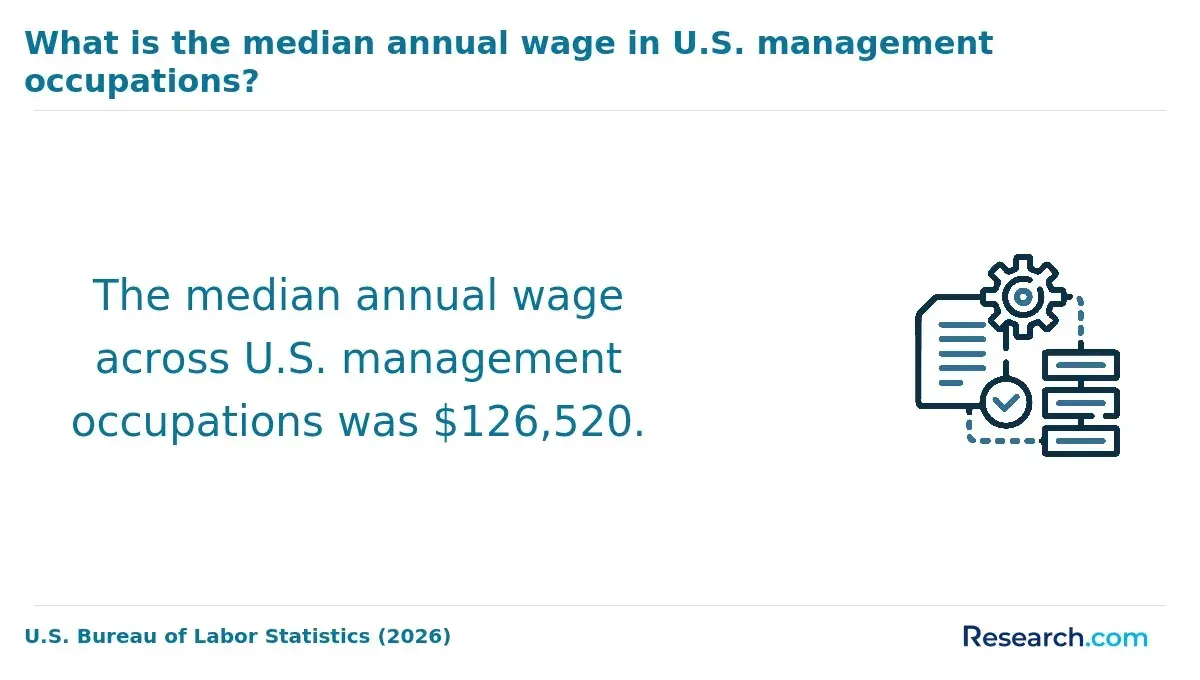
There is no single salary for technology management MBA graduates, and business-owner income is especially dependent on company performance. For context, the U.S. Bureau of Labor Statistics reports a median annual wage of $126,520 for management occupations in May 2025. That figure covers workers across many occupations and experience levels; it is not a forecast of your post-MBA pay or business profits.
The BLS projects management employment overall to grow faster than the average for all occupations from 2025 to 2035. For a potential career move, compare the specific occupation, location, and experience requirements of jobs you would actually pursue. For an owner planning to remain self-employed, use business cash flow and realistic growth assumptions - not occupational wages - to evaluate the degree.
Do technology management MBA graduates need certifications or licenses?
The MBA itself generally does not lead to a professional license, and owning a business does not create a universal technology-management certification requirement. Particular jobs or contracts may favor credentials in project management, cloud platforms, information security, or a specific software product. Those credentials demonstrate different skills from an MBA and may require separate exams or experience.
Start with the work you intend to do. If you will manage specialists and investment decisions, MBA coursework may be relevant. If a client or employer needs proof that you can configure or secure a particular system, a targeted credential and practical experience may be more useful. Check any industry-specific licensing or compliance obligations that apply to your business separately.
Other Things You Should Know About MBA
Possibly. Ask the instructor or program whether owner-operated businesses qualify, who approves the project, and what deliverables the course requires. Do not assume that every assignment can be tailored to your company.
Not necessarily. Before using real financial, customer, or employee information, ask about project rules and data protection. You may be able to use aggregated, anonymized, or fictionalized figures.
Self-employment does not automatically prevent an eligible student from applying. Aid depends on factors including the school, program, enrollment, and the applicant's eligibility; confirm details with the financial aid office.
Do not assume it is. Tax treatment depends on your circumstances and applicable rules, including whether education qualifies you for a new trade or business. Consult a qualified tax professional before budgeting around a deduction.
- DAPIP | Homepage - Office of Postsecondary Education (OPE) https://ope.ed.gov/dapip/
- Online MBA Cost & Financial Aid: Is It Worth It? | Longwood Online https://online.longwood.edu/business/mba/paying-for-graduate-school/
- MBA Requirements & Application Checklist - A-State Online https://degree.astate.edu/online-programs/business/mba/requirements-checklist/
- Online MBA - Master's Degree in Business Administration | University of Maryland Global Campus https://www.umgc.edu/online-degrees/masters/mba-business-administration
- Accreditation Process | AACSB https://www.aacsb.edu/educators/accreditation/accreditation-process
- MBA Requirements: What You Need to Apply in 2026 | SCU https://www.scu.edu/business/blog/admissions/mba-requirements/
- How IT MBA Skills Drive Business Decisions and Data-Driven Strategies | University of the Cumberlands https://www.ucumberlands.edu/blog/applying-mba-it-skills-across-enterprises
- MSITM vs MBA: Which Graduate Degree Is Right for Tech Leaders? | Northwest University https://www.northwestu.edu/school-business/blog/msitm-vs-mba-choosing-the-right-graduate-degree-for-tech-leadership
- MBA Scholarships & Financial Aid: How to Pay for an MBA | University of Tulsa https://onlinedegrees.utulsa.edu/degrees/business/mba/how-to-pay-for-mba/
- MBA in Cybersecurity: Online Degree & Career Guide | UIS https://onlinecbm.uis.edu/degrees/business/mba/cybersecurity-management-program/online-degree-guide/