Online MBA in Operations Management: Curriculum and Workload for Small Business Owners

Co-Founder and Chief Data Scientist
Running a business leaves little room for coursework that cannot improve how the business operates. An online MBA in operations management may help owners strengthen processes, control costs, and plan growth, but its broad business core and ongoing deadlines require a substantial commitment.
This guide explains what you are likely to study, how to test the workload against your operating schedule, and when a full MBA offers more value than a shorter course or targeted advice.
Key Things You Should Know
- An operations management MBA combines a general MBA core with courses on processes, capacity, quality, supply chains, and decisions informed by data; the concentration's depth varies by school.
- For an owner, the workable course load depends less on the "online" label than on live meetings, team projects, deadlines, and who can run the business while you study.
- Do not justify tuition with management salary figures alone: the U.S. Bureau of Labor Statistics reports a $126,520 median annual wage for management occupations in May 2025, not earnings attributable to an MBA or to business ownership.
What is an online MBA in operations management?
It is a graduate business degree that combines general management education with focused study of how organizations deliver products or services. Operations management concerns decisions about capacity, workflows, quality, inventory, suppliers, and performance. "Online" describes the delivery method, not a universal schedule: a program may still require live classes, fixed deadlines, team meetings, or campus visits.
The operations component may be a formally named concentration, a track, or a selection of electives. Those are not interchangeable. For a small business owner, the broad MBA core can matter as much as the specialization: a faster workflow will not solve a cash-flow problem if pricing, financing, or customer demand is the real constraint. An MBA is management-level training, not a substitute for engineering expertise or hands-on experience with a particular production system.
What does an online operations management MBA curriculum include?
There is no standard curriculum shared by all schools. The comparison below separates the MBA core from operations-focused study and applied work, so you can judge whether a program addresses the decisions you actually face.
| Curriculum component | Common subjects | Potential use in a small business |
| MBA core | Managerial accounting, finance, marketing, strategy, and organizational behavior | Connect operating changes to margins, customer demand, staffing, and cash flow |
| Operations concentration or electives | Process analysis, capacity planning, quality, supply chains, inventory, and operations analytics | Evaluate bottlenecks, service delays, supplier risk, and stock decisions |
| Applied coursework | Case studies, simulations, team projects, or a capstone, where offered | Test a proposed improvement against business constraints |
Course titles alone reveal little about depth. Examine syllabi for the methods taught, the software or data expected, and whether you can use your own business in an assignment. A capstone may address a real company problem, but access to that option and permission to use confidential business data must be confirmed with the school.
How much workload does an online MBA require for small business owners?
No single weekly-hour estimate reliably describes every online MBA. Reading, quantitative assignments, discussions, exams, and projects change the time required from course to course; your preparation in accounting or analytics also matters. An asynchronous lecture may be available whenever you want, while its assignment deadline remains fixed.
Before enrolling, request a recent syllabus for a core course and an operations course. Put their deadlines, live sessions, and likely project meetings on the same calendar as payroll, purchasing, customer commitments, and your busiest season. Then identify who has authority to make routine operating decisions while you are unavailable. This test is more useful than assuming that a lighter course load will automatically fit.
Team projects deserve particular scrutiny: classmates may have schedules that conflict with your business hours. If collaboration is a constraint, a guide to online MBA programs with limited group work can help frame questions, but confirm the group-work requirements in the specific courses you would take. Ask, too, how missed deadlines, temporary breaks, and course sequencing work during an unexpected business disruption.
Requirements differ by school, and an operations concentration does not generally imply a separate operations-specific entrance credential. Applicants commonly need a bachelor's degree and may be asked for transcripts, a résumé, essays, recommendations, or an interview. Schools set their own policies on work experience, GMAT or GRE scores, waivers, and foundation coursework.
Ownership experience can provide strong examples of budgeting, hiring, supplier negotiation, and process improvement. Describe your responsibilities and decisions clearly rather than assuming an admissions committee will infer them from the title "owner." If you have not studied accounting or statistics recently, ask whether the program provides preparation before quantitative core courses.
Application timing also varies. A search for online MBA programs with rolling admission may help an owner plan around seasonal demand, but rolling admission does not necessarily mean that every course or concentration starts whenever you choose.
Completion time depends on required credits, term length, course availability, and whether you study part-time or take an accelerated course load. Ask for a term-by-term plan that includes operations electives; a short advertised completion time may assume a pace or course sequence your business cannot accommodate.
For cost, compare the full required curriculum rather than a tuition rate in isolation. Check whether tuition is charged per credit, course, or term, then account for mandatory fees, materials, software, any required travel, and financing costs. The less visible expense is operating capacity: paying for temporary coverage or turning down work to meet academic deadlines can change the decision even when tuition is affordable.
If you are considering budget-conscious MBA program choices 10 000, verify the current total cost and whether the program actually offers the operations coursework you want. A lower-priced general MBA is not automatically a lower-cost way to solve a specific operating problem. Compare the degree's expense with a targeted course or advisor using improvements you could realistically measure in your own business, not a projected MBA salary increase.
Online study can reduce commuting and make it easier to stay present for daily operations. Campus study may offer more predictable face-to-face contact and a clearer separation between work and class. Neither format is inherently more flexible: a campus course might meet on a manageable evening, while an online course might require frequent live attendance and team calls.
Compare the actual timetable, not the delivery label. Ask about attendance rules, exam windows, residencies, access to instructors, and whether online students can use the career and networking resources that matter to you. Graduate management programs with asynchronous courses can be a useful starting point if unpredictable operating hours are your main constraint; confirm which courses are asynchronous and which still have scheduled commitments.
The most useful class project starts with a business decision you can observe and influence. For example, a service owner could map the steps between booking and delivery, identify where jobs wait, and test whether changing scheduling reduces delays without increasing labor costs. A retailer could examine reorder rules alongside cash tied up in stock and the cost of running out.
Choose a measure before making a change - such as turnaround time, rework, stockouts, or cash tied up in inventory - and compare it with results afterward. Keep the financial and customer effects in view: a process that lowers labor time but harms service may not be an improvement. For sensitive payroll, customer, or supplier information, obtain permission before using real data in coursework or substitute anonymized figures. Faculty feedback can sharpen an analysis, but it does not replace legal, accounting, or industry-specific advice.
For an owner, the primary outcome may be a better-run business rather than a new job. If you later seek employment, operations management study can be relevant to roles overseeing service delivery, production, logistics, or broader business operations. Hiring will still depend on your industry experience, the scale of operations you have managed, and an employer's requirements; the degree alone does not establish readiness for a senior role.
The U.S. Bureau of Labor Statistics reports a May 2025 median annual wage of $126,520 across management occupations. That broad figure is not the salary of operations MBA graduates or an estimate of what an owner will earn. For a career change, compare the duties and pay of specific occupations with the experience you can demonstrate, rather than using the management-wide median to forecast your return on tuition.
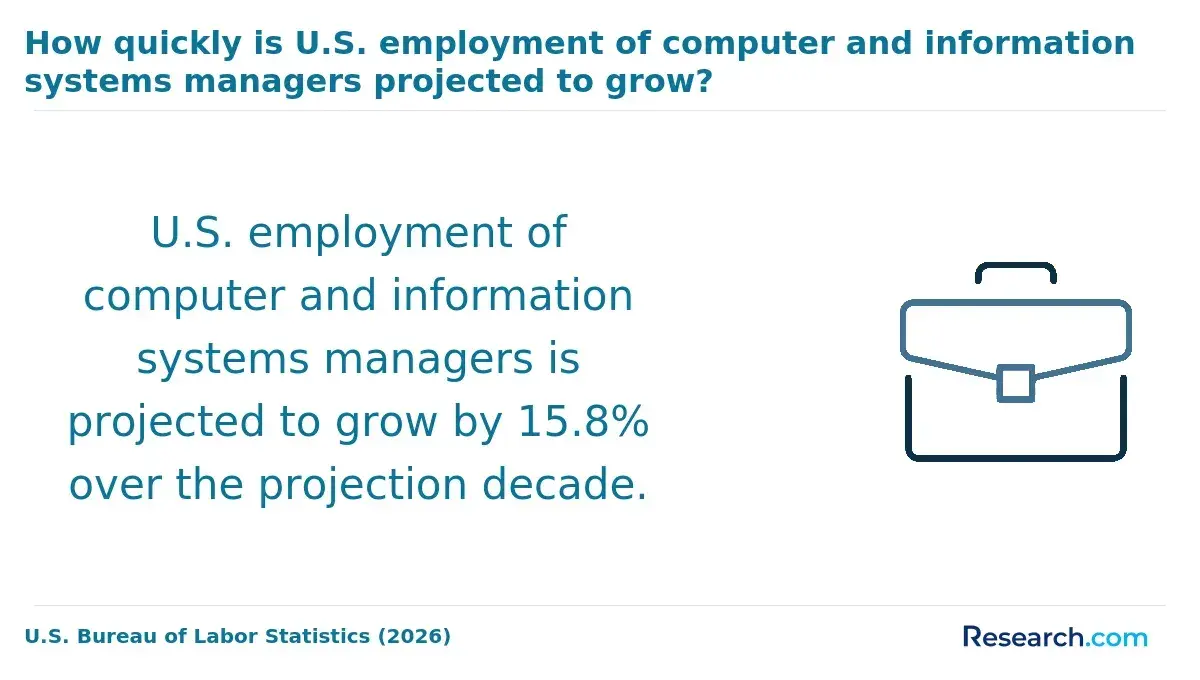
The U.S. Bureau of Labor Statistics projects overall employment in management occupations to grow faster than the average for all occupations from 2025 to 2035, with about 1.1 million openings annually on average from growth and replacement needs. This is a broad occupational outlook, not a forecast of openings reserved for MBA holders or operations specialists.
Owners weighing a future move into employment should look beyond that aggregate trend. An employer may value evidence that you managed inventory, improved delivery, led staff, or controlled a budget, but may also expect experience in its industry or at a different operating scale. The strongest career case for the degree connects coursework to results you can document.
How can you choose an accredited online MBA in operations management?
First, verify the university's institutional accreditation through the accreditor or the U.S. Department of Education's recognized accreditation records. Then check whether the business school holds a separate business accreditation, if that distinction matters to you. Institutional accreditation and specialized business-school accreditation answer different questions; neither confirms that an operations concentration is available online.
Next, get written confirmation of the concentration name, required courses, online availability, course rotation, live-session rules, total required credits, and current tuition and fees. Request sample syllabi and a completion plan at the pace your business can sustain. When comparing costs across subjects, even a tuition-focused MBA program search degree programs resource covering information systems can offer a price reference, but it cannot establish the price or curriculum of an operations concentration.
Choose the MBA if you need both broad management development and sustained operations study, have reliable coverage for your business, and can afford the commitment without depending on speculative earnings. If the immediate need is a specific inventory method, scheduling fix, or supply-chain skill, a focused course, experienced mentor, or specialist may deliver a more direct return.
Other Things You Should Know About MBA
Not necessarily. Schools may record a concentration on the diploma, transcript, or neither. Ask the registrar how the completed credential is documented.
Tax treatment depends on your circumstances and applicable tax rules; business ownership alone does not make tuition deductible. Consult a qualified tax professional before including a deduction in your cost estimate.
Often you can study a process involving your team, but check school rules and protect employee and customer information. Make participation and data use appropriate for your workplace.
The receiving school decides whether to accept graduate credits and apply them to its MBA requirements. Ask about transfer limits and course equivalencies before enrolling if a later move is possible.
- The time commitment and workload for an online MBA degree | WashU Olin Business School https://olin.washu.edu/about/news-and-media/news/2022/12/the-time-commitment-and-workload-for-an-online-mba-degree.php
- How does the workload of an MBA compare to undergraduate? | Tippie College of Business https://tippie.uiowa.edu/about/who-we-are/advisor/mba/workload-comparison
- A systematic literature review of capstone courses in software engineering - ScienceDirect https://www.sciencedirect.com/science/article/pii/S0950584923000459
- Curriculum - Online Master of Business Administration | Mitch Daniels School of Business https://business.purdue.edu/graduate-programs/online/master-of-business-administration/curriculum.php
- MS Supply Chain Management Online vs. Traditional MBA | Global Supply Chain Institute https://haslam.utk.edu/gsci/news/msscm-vs-mba/
- What's the Difference Between Asynchronous and Synchronous Learning? | Ohio State Online https://online.osu.edu/content-hub/blogs/whats-the-difference-between-asynchronous-and-synchronous-learning/
- Online MBA in Operations Management Masters Programs Texas | North American University https://www.na.edu/mba/programs/operations-management/
- Synchronous vs. Asynchronous Learning | Saint Leo University https://www.saintleo.edu/about/stories/blog/synchronous-vs-asynchronous-learning-for-course-delivery
- What Does Asynchronous Mean? A Simple Guide to Online Learning Formats - Professional Development at Charlotte https://professional.charlotte.edu/what-does-asynchronous-mean-a-simple-guide-to-online-learning-formats/
- Online MBA (OMBA) in Operations Management | FAU Business https://business.fau.edu/masters-phd/mba-program/online-mba/concentrations/operations-management/