Online MBA in Entrepreneurship: Admissions Guide for First-Time Managers

Co-Founder and Chief Data Scientist
Your first management role may have exposed gaps in budgeting, delegation, and business decision-making, while also giving you ideas for a new venture. An online MBA in entrepreneurship can address both, but admission policies vary, and the degree is a substantial commitment.
This guide explains what schools commonly assess, how to present early leadership experience, and what to check before applying. You'll be able to decide whether an MBA fits your next step or whether a shorter, more targeted option would serve you better.
Key Things You Should Know
- First-time managers should document decisions they have made about people, resources, or projects. A management title alone tells an admissions committee less than specific evidence.
- Entrepreneurship is usually added to a broad MBA core, so verify that a school offers a formal online concentration rather than only an entrepreneurship elective.
- The U.S. Bureau of Labor Statistics reports a $126,520 median annual wage for management occupations in May 2025, but that figure is not an expected starting salary for an MBA graduate or a first-time manager.
What is an online MBA in entrepreneurship?
An online MBA in entrepreneurship is a graduate business degree that combines general management study with coursework on identifying, launching, financing, or growing ventures.
The MBA core typically covers areas such as accounting, finance, marketing, operations, and organizational behavior. Entrepreneurship courses apply some of those disciplines to uncertain markets and resource-constrained businesses.
Schools label the entrepreneurship component differently: it may be a formal concentration, a track, a certificate, or a few electives. Check the degree requirements and whether the option is available to online students. For a new manager, the broad core may be as valuable as the venture courses if the immediate challenge is leading a team rather than starting a company.
A dual degree is a different commitment from an MBA concentration. If you need substantial study in another field, compare online MBA programs that offer dual degrees rather than assuming entrepreneurship electives will provide that depth.
What are the admission requirements for an online entrepreneurship MBA?
Requirements are set by each university, not by the entrepreneurship specialization as a whole. Applicants commonly encounter a bachelor's degree requirement and requests for transcripts, a résumé, recommendations, and a statement of purpose.
Schools differ on minimum grades, work experience, interviews, and GMAT or GRE policies; some waive tests or do not require them. Confirm the current policy for the online MBA and your intended entry term.
First-time managers need not pretend to have years of executive experience. An application can show readiness through a promotion, team-lead assignment, hiring contribution, project budget, customer problem solved, or decision made under uncertainty.
Explain your role and the outcome without claiming credit for an entire team's work. If your bachelor's degree is outside business, ask whether accounting or quantitative foundation courses are required or merely recommended.
Use this preparation sequence to separate verified requirements from steps that strengthen your application:
- Check each program's degree, experience, testing, deadline, and online-concentration policies; record what is required and what is optional.
- Choose examples that show how you influenced people, allocated resources, handled conflict, or learned from an unsuccessful decision.
- Ask recommenders who observed your work to describe your judgment and readiness for broader responsibility.
- Explain why you need both general management training and entrepreneurship study, and name a realistic way you would apply them.
If your supervisory role is recent, ask admissions whether its experience expectation is a firm minimum or whether earlier professional and informal leadership experience also counts. Do not assume an attractive application can override a stated eligibility rule.
How much does an online MBA in entrepreneurship cost?
There is no single price for this degree. Schools may charge per credit, course, or term, and the published tuition figure may exclude mandatory fees.
A useful comparison totals required credits at the applicable tuition rate, then adds program fees, books or software, any required travel, and financing costs. Ask whether entrepreneurship courses carry a separate charge and whether a slower pace changes term-based fees.
For a like-for-like starting point, affordable AACSB-accredited online MBA programs can help you compare MBA tuition and fees. Confirm each school's current price and entrepreneurship availability directly before using a comparison to build a budget.
As a first-time manager, consider what you can afford without depending on an unpromised promotion. Employer tuition assistance may lower your cost, but eligibility, reimbursement timing, and repayment obligations vary. Federal student aid eligibility also depends on the school, program, and student; review your options before borrowing.
Completion time depends on required credits, term schedules, course sequencing, and whether you enroll full time or part time. An advertised accelerated timeline may assume a heavy course load or continuous enrollment. For a manager learning to supervise others, a slower pace can leave more room to apply lessons at work, even if it delays graduation.
When comparing accelerated programs, check the concentration as well as the calendar. Lists of fast online MBA programs in healthcare management, for example, concern a different specialization; their timelines do not establish how quickly an entrepreneurship concentration can be completed. Ask whether its courses are offered often enough to support the school's advertised MBA timeline.
The management core helps students read financial statements, evaluate investments, understand customers, improve operations, and lead teams. Entrepreneurship coursework may address opportunity assessment, customer discovery, business models, venture finance, and growth strategy. Exact courses and project requirements vary.
For a first-time manager, the connection between these subjects matters. A promising product idea still requires a budget, clear responsibilities, feedback to colleagues, and decisions about limited staff time.
Look for assignments that let you practice those decisions, not just write a pitch. If a school advertises an incubator, mentor, or venture project, confirm that online MBA students can participate and whether participation is required.
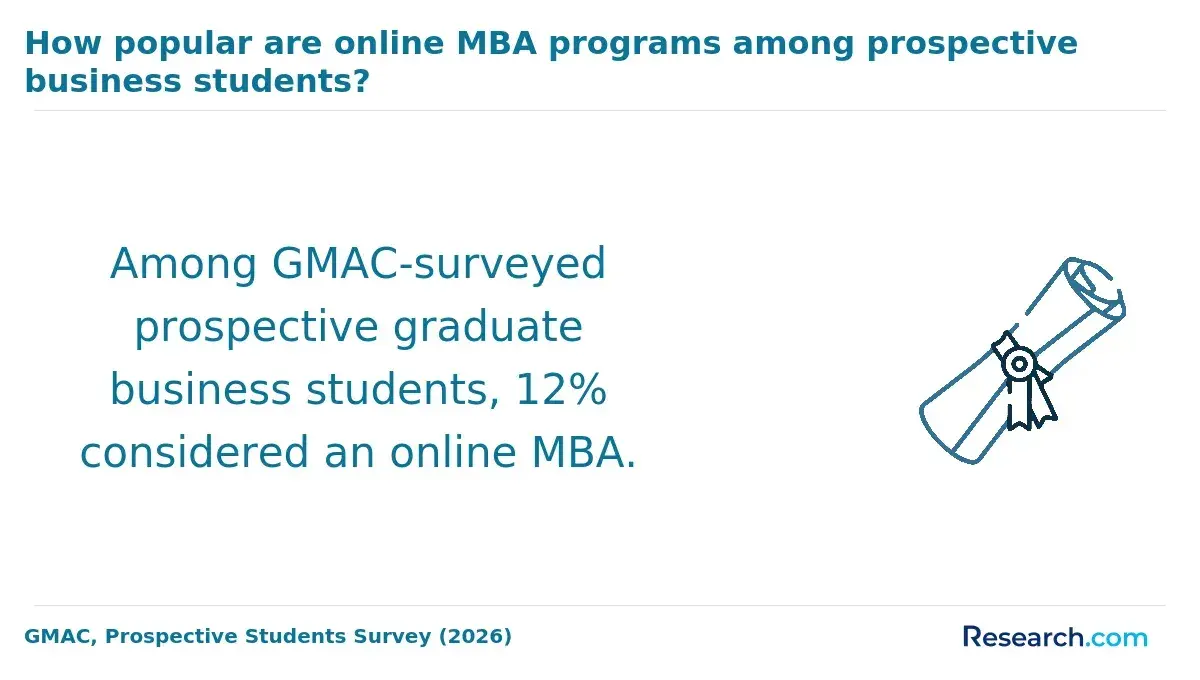
An online format can let you remain employed and test management lessons in your current role. It does not necessarily mean studying whenever you want: live classes, group meetings, and campus visits may still be required. Campus-based study may offer more frequent in-person contact and recruiting activities, but access to those opportunities varies by school and program.
If scheduling is your main constraint, compare online MBA programs with asynchronous classes, then ask how often team projects require meetings. A first-time manager should also compare career support, alumni access, and venture resources available specifically to online students rather than assuming they match the campus experience.
First verify that the university holds recognized institutional accreditation. This is distinct from specialized business-school accreditation, which may be offered through organizations such as AACSB, ACBSP, or IACBE. A business school's accreditation does not mean its entrepreneurship concentration has a separate accreditation.
Check the institution and business-school accreditors in their official directories, and confirm that the online MBA is offered by the accredited institution. Accreditation is an important screen, not a verdict on fit: you still need to assess curriculum, cost, scheduling, and support for online students.
For a first-time manager, the most immediate use may be better performance in an existing role: managing a team, overseeing a business unit, or leading a new initiative. Depending on prior experience, the degree may also support work in product development, business development, innovation, or small-business operations. Starting or buying a business is another path, but coursework does not remove the need for customers, capital, and sound execution.
The Bureau of Labor Statistics projects about 1.1 million openings per year in U.S. management occupations, on average, from 2025 to 2035, including openings created when workers leave occupations.
That broad figure signals a substantial management labor market; it does not measure demand for entrepreneurship MBAs. Employers will still assess your industry knowledge, management record, and ability to deliver results.
There is no reliable single salary for this degree. Pay depends on the job, location, industry, experience, and employer; an owner's income also depends on business performance.
The $126,520 U.S. management-occupation median reported by the Bureau of Labor Statistics for May 2025 describes workers across management jobs, not entrepreneurship MBA graduates. Many of those workers have substantially more experience than a first-time manager.
For a personal decision, compare compensation for roles you could plausibly pursue with your current experience, then consider whether the MBA would make you more competitive for a specific next role. Do not count a potential raise as certain when deciding how much to borrow.
How do you choose a reputable online entrepreneurship MBA program?
Start with your near-term management gap and your longer-term venture goal. A program with strong entrepreneurship electives may suit someone testing a business idea. A manager who mainly needs coaching, finance, and organizational behavior may get more value from a well-fitting general MBA.
If you only need to learn one skill, an employer course, mentor, or shorter credential may be the better first investment.
Use the following checks to narrow your options before paying an application fee:
- Confirm the formal entrepreneurship offering, its required courses, and online availability in the current catalog.
- Request a complete cost estimate and ask which fees or travel requirements are excluded.
- Ask for sample schedules, live-session expectations, group-project demands, and the usual course sequence.
- Verify accreditation and ask which career, alumni, and venture resources online students can actually use.
- Speak with admissions about how the program assesses applicants at your management career stage.
Location may matter even for an online degree if you hope to build a local network. Texas-based applicants, for instance, can use a comparison of top online MBA programs as a regional starting point, then independently verify which schools offer online entrepreneurship study. Choose based on the experience and resources you can use, not a ranking alone.
Other Things You Should Know About MBA Programs
Not necessarily. Some programs invite applicants to discuss a venture idea, but others welcome students interested in innovation within an existing organization. Follow the school's prompt rather than inventing a launch plan.
Do not share protected customer, employee, or company information without authorization. Ask the instructor whether you can use anonymized data, public information, or a hypothetical case.
It may help with financial analysis and operating decisions. Check whether courses address acquisitions and due diligence; entrepreneurship coursework focused only on startups may leave important gaps.
Usually not, but project rules vary. Ask whether you can test an idea, analyze a proposed venture, or work on a business challenge without committing to launch.
- MBA Requirements: What You Need to Get Into Business School | Southwest Minnesota State University https://online.smsu.edu/resources/article/mba-requirements/
- Components of the US College Application | harvard.edu https://psil.hsites.harvard.edu/components-us-college-application
- Procedures | Office of Graduate Education https://oge.mit.edu/graduate-admissions/applications/procedures/
- Wharton MBA Application Timeline & Deadlines | MBA Program https://mba.wharton.upenn.edu/application-timeline-deadlines/
- Test Waiver & Quantitative Readiness Course | umich.edu https://michiganross.umich.edu/graduate/online-mba/admissions/application-requirements/test-alternatives
- Why First-Time Managers Need MBA-Level Training | UVA Darden School of Business https://www.darden.virginia.edu/executive-education/stories/why-first-time-managers-need-mba-level-training-even-without-an-actual-mba
- Graduate Application Requirements | Suffolk University https://www.suffolk.edu/graduate-admission/apply/application-requirements
- How to Pay for an MBA: Smart Funding Strategies Explained | Jenkins MBA https://mba.ncsu.edu/2026/05/07/paying-for-your-mba-scholarships-employer-benefits-and-loans/
- GMAT and GRE Waiver Policies | JHU Carey Business School https://carey.jhu.edu/admissions/gmat-gre-waiver-policies