2027 Online BA in Psychology - Mental Health: When Retaking a Course Is Better Than Appealing Transfer Credit

Co-Founder and Chief Data Scientist
A course can transfer to an online psychology BA without satisfying the requirement you expected it to cover. If you are returning to college, that distinction can affect your graduation date, tuition bill, and preparation for later study.
This guide explains when an appeal is worth pursuing and when retaking the course is the better choice. You will learn what evidence to gather, which decisions require school approval, and how to compare both options using your actual degree audit rather than the number of credits accepted.
Key Things You Should Know
- Retake a course when its content does not meet the major requirement, an appeal is unlikely to change that finding, or waiting for a decision would delay a required course sequence.
- Appeal when a syllabus, assignments, or a documented equivalency show that the prior course meets the requirement; accepted elective credit alone does not settle the issue.
- Compare the tuition and aid treatment of a repeat with the next course offering and your remaining degree requirements before paying to take the course again.
What Is an Online BA in Psychology With a Mental Health Focus?
It is an undergraduate psychology degree that combines core study of behavior and research with courses concerning mental health, such as psychopathology, prevention, or service systems. "Mental health focus" might mean a formally named concentration or simply a choice of electives; the catalog and degree audit establish which. Online delivery describes how coursework is taught, not whether every class is asynchronous or whether an applied experience can be completed remotely.
For transfer students, the distinction matters because a course may count toward the BA's total credits but not toward a concentration, prerequisite, or upper-level major requirement. If your interest is specifically substance use, distance learning bachelor's degrees in addiction psychology offer a related curriculum to compare. Neither focus qualifies a graduate to diagnose or provide therapy.
When Is Retaking a Course Better Than Appealing Transfer Credit?
Retaking is usually better when the missing requirement reflects a real preparation gap, not an evaluation error. An introductory survey of psychology, for example, may not substitute for research methods even if it addressed a few studies. A recent methods course may also prepare you better for an advanced research seminar than an older course that lacked the required design and analysis work. An appeal remains worthwhile when the prior course covered substantially the same outcomes and the evaluator has not seen the full syllabus.
The comparison below separates reasons for an appeal from reasons to retake. It does not replace the receiving institution's decision.
| Issue in the degree audit | Appeal is more promising when | Retaking is more sensible when |
| Course awarded elective credit | Detailed materials establish a close match to the named major requirement | Content or academic level differs materially from the required course |
| Older statistics or methods course | The school permits older coursework and the methods still meet its outcomes | A published recency rule applies or essential methods preparation is missing |
| Required course sequence | A timely approval would let you enter the next course | An unresolved appeal would cause you to miss the next available offering |
| Prior low grade | The grade meets the receiving school's rule and the issue is equivalency | The grade does not meet a stated major or prerequisite minimum |
Before choosing, ask the registrar or transfer-credit office whether the issue is credit acceptance or requirement equivalency. Ask the psychology department who approves substitutions, what evidence it needs, and when a decision can be made. Obtain a written degree audit showing where the course currently applies.
Then compare the appeal's likely decision date with the next course offering. If retaking is viable, confirm its tuition, any additional fees, its place in your schedule, and whether it counts toward your aid-eligible enrollment. Do not assume that repeating a course will replace an old grade in your GPA or that aid will cover it. If cost is decisive, comparing affordable psychology colleges online can be more useful than accepting an expensive repeat at your first-choice school.
How Does Transfer Credit Work for an Online Psychology Bachelor's Degree?
The receiving institution evaluates official records and has final authority over how prior work applies to its degree. Admission, acceptance of credits, satisfaction of a psychology requirement, and eligibility to graduate are separate decisions. A transcript might show transferred credits while the audit still lists statistics, research methods, or an upper-level psychology course as incomplete.
To make an appeal reviewable, assemble the documents that explain what you learned rather than relying on a course title alone:
- Official transcripts and the catalog description from the term you took the course
- The syllabus, including learning outcomes, readings, assignments, and topics covered
- Evidence of laboratory, statistical, or research-design work if equivalency depends on it
- The current degree audit and the specific requirement you believe the course satisfies
Ask how the school handles quarter-to-semester conversions, applied or military learning, international coursework, course age, minimum grades, and credits that must be earned at the institution. An associate degree may simplify some general-education requirements without satisfying the psychology major. Use psychology program admissions and curriculum comparisons to identify questions for prospective schools, but request an individual written evaluation before assuming a course will shorten your degree.
Check that the institution holds recognized institutional accreditation and that the status applies to the school awarding your degree. Accreditation is relevant to educational quality oversight and can affect transfer and financial-aid considerations, but it does not require another college to accept a particular course as equivalent.
Do not look for APA accreditation of a general undergraduate psychology BA: APA's accreditation scope concerns specified professional psychology training, not ordinary BA majors. Likewise, a concentration name does not establish a clinical credential. This distinction also matters when reviewing accredited forensic psychology study and career preparation: verify both the institution's status and what, if anything, the particular program prepares students to do.
Typical psychology-major building blocks include introductory psychology, statistics, research methods, and study of development, social behavior, cognition, or biological influences. A mental health focus may add psychopathology, health psychology, substance use, or community mental-health topics. Requirements vary, so compare the actual catalog and prerequisite sequence rather than course names alone.
This curriculum helps explain why transfer disputes over statistics and research methods deserve close attention: those courses support later work in evaluating evidence, not just a credit total. If your intended work centers on substance-use services, an addiction counseling degree comparison resource can help you distinguish academic psychology coursework from education designed for a particular counseling credential. Studying disorders or treatment approaches in a BA does not authorize clinical assessment or treatment.
Requirements depend on the institution and on whether you apply as a first-year or transfer student. Schools commonly request prior academic records; some set separate standards for entry to the major or for accepting a course toward it. Applicants with earlier college work should ask when official transcripts are due and whether a transfer evaluation can be completed before an enrollment commitment.
If you are changing schools to avoid repeating a course, compare the admission decision with a written audit of the entire degree. A school that accepts the disputed course may still require more credits elsewhere. Applicants considering a more occupation-specific alternative, such as budget-friendly substance abuse counseling bachelor's study, should also check whether the curriculum aligns with the credential rules in the state where they hope to work.
Your remaining time depends less on the number of accepted credits than on where those credits fit in the audit. A required methods course offered infrequently can delay completion even when most general-education work transfers. Ask the advisor for a term-by-term plan that accounts for prerequisites, course availability, residency requirements, and any internship or live-session obligations.
For the appeal-versus-retake decision, compare the additional tuition and fees with the cost of waiting, including a possible extra term and time away from work. Ask the financial-aid office how each option affects eligible enrollment and satisfactory academic progress; do not assume a repeat is covered. Students considering substance-use counseling study can review FAFSA for online substance use counseling undergraduates as a starting point, then confirm their own program's eligibility and aid offer with the school.
A BA may support applications for nonclinical positions in community services, behavioral-health outreach, intake, service coordination, or research support, depending on the employer and your experience. Duties can include explaining resources, documenting contacts, arranging referrals, and assisting with program data under an organization's procedures. Coursework alone does not establish eligibility for a specific title.
If recovery services interest you, career choices across recovery service settings can help distinguish support roles from counseling roles that require state-specific credentials. When deciding whether to retake a course, consider whether it builds a skill your target role uses. Research methods, for instance, may be especially valuable for program-support work even if an appeal could clear the graduation requirement.
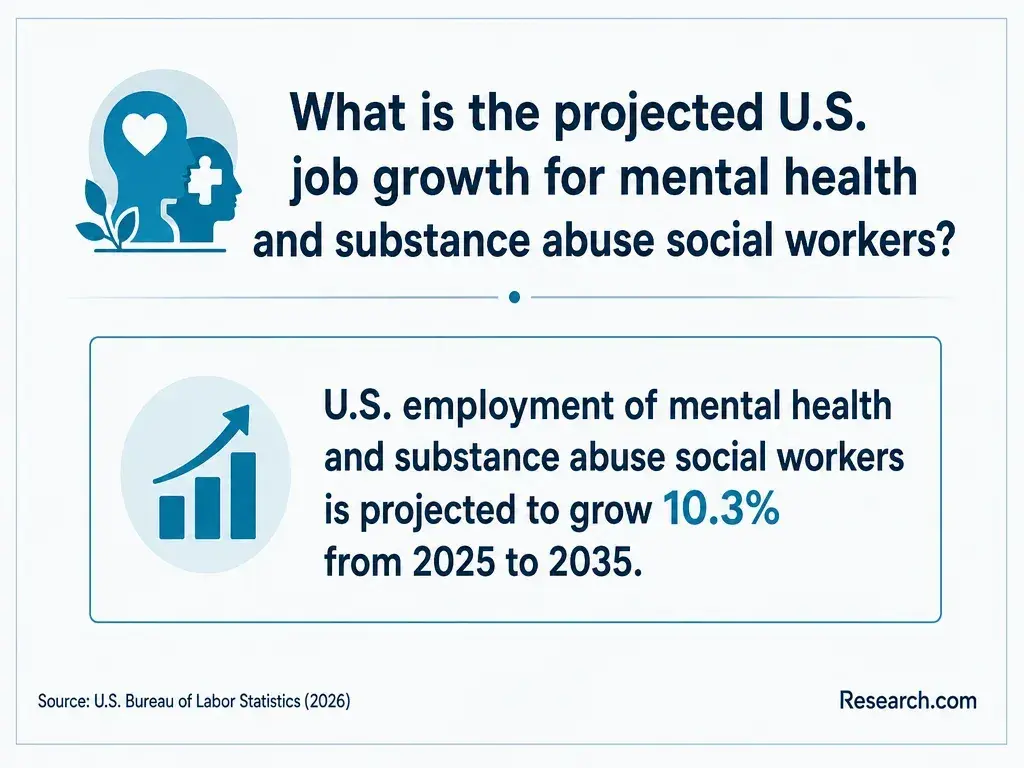
There is no single reliable salary or growth figure for graduates of a mental health psychology BA. The US Bureau of Labor Statistics reports wages and employment projections by occupation, not by undergraduate concentration. A community-service position, research-support job, and licensed counseling position therefore should not be treated as one labor market.
For a useful estimate, identify an actual job title you could qualify for, check its duties and entry requirements in the Bureau of Labor Statistics Occupational Outlook Handbook, and compare local postings with your experience. If you are weighing another degree against a retake or delayed graduation, include its tuition and time away from earnings. Fast-track graduate psychology programs may shorten a published study schedule, but speed alone does not establish job eligibility, a salary increase, or licensure.
What Further Education and Licensure Are Required for Mental Health Careers?
Providing psychotherapy, diagnosing mental-health conditions, or practicing independently generally requires education and supervised training beyond a psychology BA, followed by the applicable state licensure process. The required route depends on the profession: counseling, social work, and professional psychology are distinct pathways with different program and licensing rules. A mental health concentration is academic preparation, not a substitute for any of them.
If licensed counseling is your goal, check your state board's educational requirements before deciding which undergraduate courses to retake for preparation. Planning an accelerated clinical counseling master's can inform a later program search, but you still need to verify that a specific program meets the rules where you intend to practice. If your goal is nonclinical support work instead, targeted experience or employer training may be more direct than another degree.
Other Things You Should Know About Psychology
Possibly, but ask about appeal deadlines, withdrawal rules, and refunds immediately. Do not drop the course until the school confirms how an approved appeal would affect your schedule and aid.
No. An appeal concerns how the receiving school applies prior coursework. Its GPA and repeat-course policies determine whether a transferred grade affects any institutional calculation.
Only if the school has an applicable prior-learning, examination, or substitution policy and approves your evidence. Job experience does not automatically satisfy a major requirement.
Ask which office has final authority over the specific requirement, request the decision in writing, and use the institution's published appeal process if the degree audit still does not reflect the approved outcome.
- Program Integrity Questions and Answers - Retaking Coursework | U.S. Department of Education http://www.ed.gov/laws-and-policy/higher-education-laws-and-policy/program-integrity-information-questions-and-2
- Staying Eligible | Federal Student Aid https://studentaid.gov/understand-aid/eligibility/staying-eligible
- School-Determined Requirements - FSA Partner Connect https://fsapartners.ed.gov/knowledge-center/fsa-handbook/2026-2027/vol1/ch1-school-determined-requirements
- Undergraduate Transfer Credit | University of Arizona Catalog https://catalog.arizona.edu/policy/courses-credit/credit/undergraduate-transfer
- Transfer credit practices - UC Admissions https://admission.universityofcalifornia.edu/counselors/preparing-transfer-students/transfer-credit-practice.html
- Course Repeat Academic Regulation - University Registrar https://www.registrar.pitt.edu/course-repeat-academic-regulation-frequently-asked-questions
- Transfer Credit Appeal Process | Rockland Community College https://sunyrockland.edu/records-and-registration/transfer-credit-appeal-process/
- Financial Aid Satisfactory Academic Progress - Campus Offices https://campus.collegeforcreativestudies.edu/policy/satisfactory-academic-progress-requirements-undergraduate/
- Academic Policies & Practices - FGCU Catalog https://catalog.fgcu.edu/general-information/academic-policies-and-practices/