2027 Online BA in Psychology - Mental Health for Reading Evidence on Behavioral Interventions: Which Courses Should You Look For?
Audited and Verified:
Our Editorial and Data Verification Process
Research.com uses government datasets, official education statistics and primary institutional information to support its career and degree guides. Our review process checks factual accuracy, occupational definitions, source dates and the requirements associated with the credentials discussed.
How This Article Was Fact-Checked
Our editorial team verifies salary estimates, employment projections, education requirements and program information against original data providers and official organizations. Salary figures are checked against the relevant occupational definitions and reporting periods. Information about licensure, accreditation and required in-person training is reviewed separately.
Fact-checked and verified on:

Co-Founder and Chief Data Scientist
A course on mental health can teach you what an intervention is without teaching you whether the evidence supports it. If you are comparing online psychology BA programs, look past concentration names and examine the methods, statistics, and measurement courses you can actually take.
This guide shows how those courses work together, what to ask about research practice in an online program, and when a degree may be more than you need. It also separates the ability to read intervention research from the qualifications required to deliver treatment.
Key Things You Should Know
- Prioritize statistics, research methods, psychological measurement, and an advanced course that requires critical appraisal of intervention studies; a mental health elective alone is not enough.
- Ask for syllabi and a degree plan showing when you will analyze studies, receive feedback, and complete an evidence-focused project, not merely watch lectures about research.
- An accredited institution and a psychology BA can support evidence literacy, but neither the degree nor a mental health focus authorizes diagnosis or psychotherapy.
What Is an Online Psychology BA for Mental Health Evidence?
It is an undergraduate psychology degree used to learn how behavioral interventions are studied and evaluated. Such interventions might aim to change sleep habits, improve treatment attendance, or reduce substance use.
Evidence reading means judging whether a study's design, measures, participants, and results support a claim about an intervention, not simply recognizing its name or theory.
A BA may offer a mental health concentration, a set of electives, or no named specialization. None of those labels establishes how much research training you will receive. Compare required assignments and course availability instead.
If your goal is to provide counseling rather than assess published evidence, investigate a qualifying professional pathway, such as faster clinical mental health counseling graduate pathways, against the rules of the state where you intend to practice. An accelerated schedule does not remove licensure requirements.
Which Courses Teach Behavioral Intervention Evidence and Research Methods?
The strongest sequence moves from understanding psychological claims to testing how those claims were produced. Course titles differ, so use this comparison to inspect catalog descriptions and sample assignments.
| Course to look for | Evidence-reading skill it should develop | Useful assignment to ask about |
| Statistics for psychology | Interpret estimates, uncertainty, group comparisons, and missing data | Explain what results do and do not show using an actual dataset |
| Research methods or experimental psychology | Distinguish randomized studies from observational comparisons; identify selection and confounding | Critique the design of a published intervention study |
| Psychological measurement or psychometrics | Assess whether an outcome measure is reliable and captures the intended construct | Compare measures of an outcome such as symptoms or functioning |
| Abnormal psychology or mental health systems | Understand the condition, population, and service context without treating coursework as clinical training | Evaluate how a study defines its population and outcomes |
| Advanced methods, evaluation, or capstone | Synthesize several studies and explain limits to applying their findings elsewhere | Produce an evidence review or nonclinical evaluation proposal |
For example, a study may find improvement after a program begins. Without an appropriate comparison, that change alone cannot establish that the program caused it. A good methods course teaches you to ask what else changed, who was included, and whether the outcome mattered to participants, not only whether a test reached statistical significance.
If you already have substantial statistics and research training, confirm whether additional undergraduate courses fill a real gap. Later, online psychology master's completion planning may matter if a particular research role requires graduate study; a master's is not a prerequisite for learning to critique a paper.
How Do You Choose an Accredited Online Psychology Bachelor's Program?
First, confirm that the institution holds recognized institutional accreditation and that the online BA is the degree shown in its current catalog. Then check whether the evidence-focused courses are required, offered regularly online, and accessible without a competitive or restricted enrollment process.
Institutional accreditation is important, but it does not certify that a particular curriculum teaches intervention appraisal. APA accreditation is not the standard to seek for a general psychology BA.
Request recent syllabi for methods, statistics, and the proposed capstone. Look for graded study critiques, data interpretation, feedback from qualified instructors, and instruction in research ethics.
Ask whether students can use published studies or appropriately authorized public data if they cannot secure a research placement. A program's general promise of "hands-on learning" is less informative than its actual assignment and supervision requirements.
Accreditation questions change with the credential and occupation. For instance, accredited forensic psychology study and career preparation requires separating an institution's status from claims about a specialization or future professional eligibility. Apply that same distinction to a mental health concentration.
Beyond the core methods sequence, look for developmental, social, learning, and biological psychology. These subjects help explain why an intervention tested with one population or in one setting may not work the same way elsewhere. Mental health and substance use electives add context, but they should complement not replace statistics and research design.
A feasible path is introductory psychology and quantitative preparation, followed by statistics and research methods, then measurement or an advanced methods elective, and finally an evidence-focused project. Check prerequisites and the terms in which courses run: a rarely offered methods course can delay a capstone even when every course appears in the catalog.
If your interest is specifically addiction services, compare the BA's research training with substance use counseling education and degree options. A practice-oriented program may better serve a counseling goal, while a methods-rich psychology curriculum may better serve intervention appraisal. Verify any state credential requirements separately.
Either format can teach rigorous evidence appraisal. Online study may make lectures and readings easier to fit around work, but live research meetings, group projects, proctored assessments, or a placement can still impose fixed hours.
Campus study may make it simpler to join a research group or meet faculty informally; it does not automatically provide better methods instruction.
Compare the experiences available to you, not the delivery labels. Ask who gives feedback on study critiques, whether research opportunities accept remote students, and whether any project requires local site approval or travel.
If speed is a priority, examples of accelerated undergraduate forensic psychology study can illustrate scheduling trade-offs, but a faster timetable is useful only if it leaves room to master statistics and methods.
Requirements vary by institution and by whether you apply as a first-year or transfer student. Schools commonly ask for prior transcripts; some have additional rules for entering the major or taking upper-level methods courses. Do not assume admission to the university means immediate access to every psychology course.
If you have prior credits, request a written degree audit showing not just what transfers, but what satisfies statistics, research methods, general education, and residency requirements. Ask which office decides course equivalencies and how to appeal a decision. A prior course with "research" in its title may not cover the design or statistics prerequisite your new program requires.
Applicants considering a more occupation-specific bachelor's route can compare admissions and remaining-credit rules while planning affordable bachelor's-level substance abuse counseling study. Neither a published completion estimate nor an advertised transfer policy replaces your own approved audit.
Time and total cost depend on accepted credits, course sequencing, enrollment pace, tuition rules, and fees. A transfer student may finish sooner than a first-time student, but only if the accepted credits apply to remaining requirements and the needed courses are offered when planned. Build your estimate from a school-issued audit and a term-by-term course schedule.
For a meaningful cost comparison, include tuition for remaining credits, mandatory online or technology fees, materials and software, and any travel or unpaid time required for a project. Check financial-aid eligibility for your intended enrollment pace. Fast-track bachelor's study in psychology may reduce time in school, but it is not necessarily cheaper or compatible with a demanding job.
If you need only to read research for an existing role and already hold a bachelor's degree, ask whether a statistics course, research-methods course, or supervised evidence-review project would meet your goal at a lower cost than another full degree.
A methods-rich BA can support applications for nonclinical research support, program coordination, behavioral-health outreach, or evaluation-assistant work. Tasks may include literature searches, consent-approved research administration, data cleaning, service documentation, and explaining findings to a team. Employers may also require particular software skills, relevant experience, background checks, or additional credentials.
Turn coursework into evidence of readiness: retain a study critique, a reproducible analysis of permitted data, or an evidence brief that states its limitations. Remove confidential material and confirm you have permission before sharing work completed for an agency or research team.
If you are weighing a specialized graduate credential for a different field, compare its actual duties and qualifications with master's-level forensic psychology employment pathways; intervention-reading skills alone do not qualify you for forensic assessment or clinical practice.
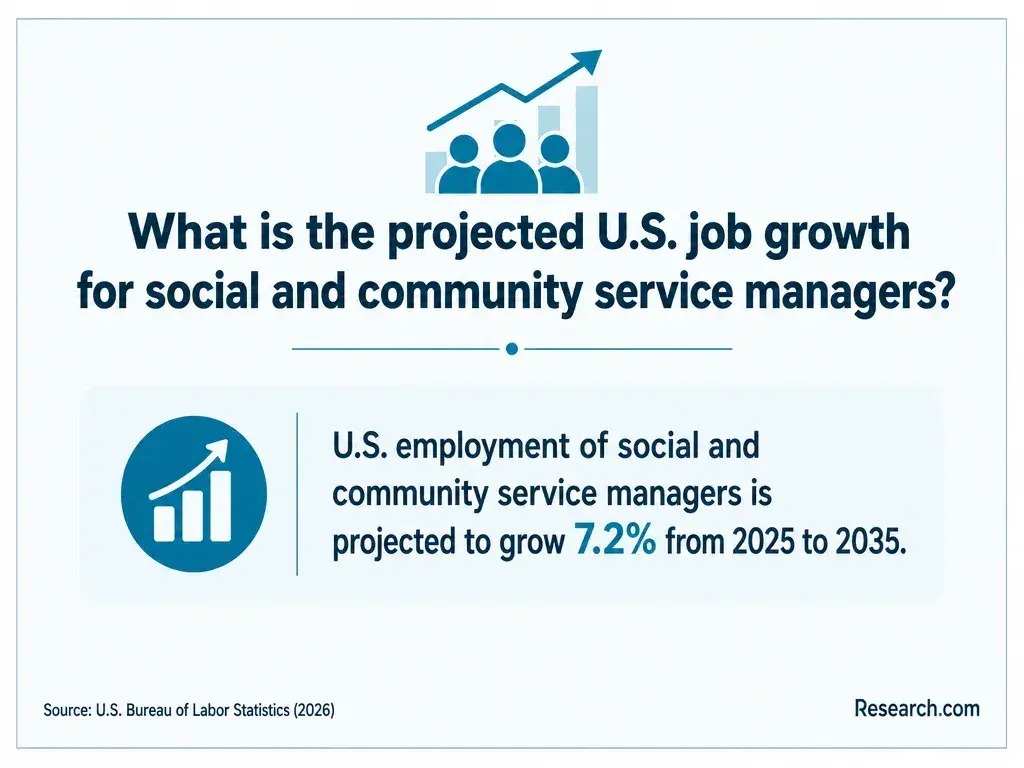
There is no single salary or growth rate for "psychology BA graduates." The relevant US Bureau of Labor Statistics occupation depends on the job's duties, employer, location, and entry requirements. A research-support position and a community-service position should not be evaluated using a licensed psychologist's occupational median.
Before investing in a degree, identify a few actual target job titles, inspect local postings, and compare their stated education and experience requirements with the appropriate Bureau of Labor Statistics occupational outlook. Use its wage reference year and projection period when comparing figures.
An occupation-wide median is not an offer or a graduate outcome. Include the cost of any later education in the decision. Even forensic psychology master's intensive study options should be judged by the specific roles they prepare students to pursue, not by a broad psychology salary figure.
Does a Psychology BA Qualify You for Mental Health Licensure?
A psychology BA, including one with mental health coursework, does not by itself authorize psychotherapy, diagnosis, independent psychological assessment, or use of a protected professional title. Licensed occupations have distinct degree, program, supervised-experience, examination, and state requirements. Some support or peer roles have their own state or employer rules.
If your goal is treatment delivery, start with the license and state where you want to work, then work backward to an eligible program. Compare required supervised training and scheduling as carefully as classroom courses.
Intensive schedules in accredited mental health counseling study do not make those requirements optional. If your goal is instead to judge intervention claims for research or service planning, prioritize the BA's methods sequence and opportunities to practice evidence appraisal.
Other Things You Should Know About Psychology Programs
Start with a well-conducted systematic review to understand the overall evidence, then inspect individual studies when you need to judge populations, measures, or a disputed finding. A review's conclusions still depend on the quality of the studies it includes.
Read it as preliminary research that has not necessarily completed peer review. Check its methods and limitations, and look for a later published version before relying on its claims.
No single package is universally required for evidence reading. More important is being able to interpret analyses, document your steps, and recognize when a method does not fit the data.
Not automatically. Check licensing or copyright terms, whether the instrument is appropriate for your purpose, and what permissions or institutional review your project needs. Reading about a measure does not qualify you to administer a restricted clinical assessment.
- Psychology and Behavioral Health Associate Degree Online | The Pennsylvania Institute of Technology https://www.pit.edu/programs/psychology-and-behavioral-health/
- Statistical Significance versus Clinical Relevance - PMC - NIH https://pmc.ncbi.nlm.nih.gov/articles/PMC11633268/
- Chapter 6: Systematic Review Overview | ACIP GRADE Handbook | CDC https://www.cdc.gov/acip-grade-handbook/hcp/chapter-6-systemic-review-overview/index.html
- Assess Certainty - Systematic Reviews and Meta-Analyses https://guides.lib.vt.edu/SRMA/assesscertainty
- What Can You Do with a bachelor's in Psychology? | UMass Global https://www.umassglobal.edu/blog-news/can-you-do-a-bachelors-psychology-top-careers-skills-build-your-future
- What is Abnormal Psychology? - Adult Psychopathology https://openbooks.library.umass.edu/adultpsychopathology/chapter/module-1-what-is-abnormal-psychology/
- Systematic Reviews: Step 6: Assess Quality of Included Studies https://guides.lib.unc.edu/systematic-reviews/assess-quality
- Risk of bias: why measure it, and how? | Eye | Nature Index https://www.nature.com/articles/s41433-021-01759-9