2027 Online BA in Psychology - Mental Health Admissions with a Personal Statement About Community Service: What to Ask Before Applying

Co-Founder and Chief Data Scientist
Community service can give an online psychology BA application a compelling purpose, but it does not replace admissions requirements - or prove that a program leads to the mental health work you want.
If you have volunteered in outreach, crisis-resource distribution, recovery support, or another community setting, this guide will help you turn that experience into a credible personal statement. It also identifies the questions to ask about admission, online coursework, applied learning, cost, and career boundaries before you commit.
Key Things You Should Know
- Ask whether the personal statement is required, how it is evaluated, and whether community service can demonstrate readiness without being presented as clinical experience.
- Confirm institutional accreditation, the credits that will actually satisfy degree requirements, the remaining credit total, and any scheduled or in-person obligations before estimating time or cost.
- A psychology BA can support applications for nonclinical mental health service roles, but it does not authorize therapy or diagnosis; compare the program with the qualifications required for your target job.
What Is an Online BA in Psychology for Mental Health Careers?
An online BA in psychology is an undergraduate degree centered on the scientific study of behavior and mental processes. A program may offer mental health courses or a named concentration, but those are different from a professional qualification to treat mental health conditions. Check the catalog to learn whether "mental health" is an official concentration, a set of electives, or simply a description of possible interests.
For an applicant with community service experience, the best fit depends on the work you hope to do next. Psychology may suit someone who wants broad preparation in human development, research, and behavior while exploring outreach or support roles. If your goal is specifically substance-use services, compare the BA's course requirements with online addiction counseling coursework and admissions; neither program title alone establishes eligibility for a state-regulated counseling role.
Is an Online Psychology Bachelor's Degree Accredited?
Check whether the institution holds accreditation recognized by the U.S. Department of Education. Confirm the school's current status with its accreditor and ask whether the online BA is offered under that institution's accreditation. Accreditation matters for decisions such as credit recognition, federal aid eligibility, and graduate applications, but it does not guarantee that another school will accept a course or that a licensing board will approve a degree.
Do not look for APA accreditation as a test of an undergraduate psychology major: APA's professional accreditation is not a general seal for psychology BAs. Likewise, accreditation cannot turn a forensic or mental health elective into a professional credential. If you are comparing specialized options, choosing forensic psychology study by cost and entry criteria illustrates why the exact degree and credential goal matter more than a specialty label.
What Admissions Requirements Apply to Online Psychology Programs?
Requirements vary by school and by entry route. First-time applicants should check high school or equivalent credential requirements, transcripts, deadlines, and whether an essay is requested. Transfer applicants should ask separately about university admission, admission to the psychology major, and the courses that will satisfy major requirements. An accepted transfer credit may count as an elective rather than replace statistics or research methods.
Before writing, obtain the current prompt and ask admissions whether it expects an explanation of academic interest, evidence of preparation, career goals, or all three. Ask whether a recommendation, résumé, or documented service hours are required; do not assume that volunteering substitutes for a transcript or prerequisite. If you are also considering a licensure-oriented graduate route, keep its application and financing requirements separate from BA admission; paying for an online mental health counseling degree involves a different level of study and cost decision.
Service is strongest as evidence of what you observed, did, and learned - not as proof that you already know how to counsel people. An applicant who helped organize accessible resource information, for example, could explain how questions about barriers to care led them to seek training in research methods or community psychology. Describe your own responsibilities accurately, connect one concrete lesson to the BA's curriculum, and explain the next skill you need to develop.
Before drafting, decide which service experience best supports your academic purpose. Then ask the admissions office about word limits and any school-specific prompt. Protect the privacy of people you served: omit names, identifying circumstances, and unverified diagnoses. Avoid claiming that an organization's outcomes were caused by your work unless you have appropriate evidence and permission. If recovery services motivated your application, exploring work in addiction recovery services can help you describe a realistic goal without implying that volunteering qualified you to provide treatment.
Ask for a degree plan showing required psychology courses, statistics, research methods, and available mental health electives. For community-facing work, developmental and social psychology can provide useful context; methods training helps you evaluate claims about programs and outcomes. Ask which courses are offered online each term and whether a desired elective is reliably available. A catalog listing does not mean a course will fit your graduation schedule.
Also clarify whether a capstone, research project, or placement is required, who approves its site, and whether your existing volunteer work could qualify. Do not assume that an agency role is automatically approved or that access to clients permits use of their information in coursework. If a forensic interest is competing for your electives, compare the BA's actual learning opportunities with accelerated forensic psychology master's costs and outcomes only as a later-stage alternative - not as an equivalent undergraduate path to clinical practice.
Completion time depends on the school's total credit requirement, credits applied to specific requirements, course sequencing, and the number of courses you can take each term. For a transfer applicant, the useful figure is not simply "credits accepted"; it is the remaining coursework on an approved degree audit. Ask about prerequisite order, courses offered only in certain terms, and the institution's minimum credits that must be completed there.
Online delivery may still involve live meetings, group work, or scheduled supervision. If community service, employment, or caregiving limits your availability, request a term-by-term plan at a sustainable pace and ask how a leave would affect it. Do not use an accelerated graduate program's timeline to estimate BA completion; faster completion planning for accredited clinical counseling study concerns a distinct degree with different scheduling and training obligations.
Request a written estimate based on your remaining required credits, not an advertised cost for a typical student. Confirm the tuition rate that applies to you, mandatory online and course fees, books or software, and any travel or placement expenses. Then compare that estimate with the courses in your degree audit; transfer credits save money only when they reduce coursework you would otherwise have to pay for.
Ask the financial aid office how your enrollment pace and transfer evaluation affect aid eligibility, and check any employer assistance or scholarships before relying on them. If substance-use work is your goal, substance use counseling bachelor's financial aid options may help frame a comparison, but confirm aid and program charges with each school. A lower tuition rate is not necessarily the lower-cost route if it requires more credits or an unpaid placement you cannot accommodate.
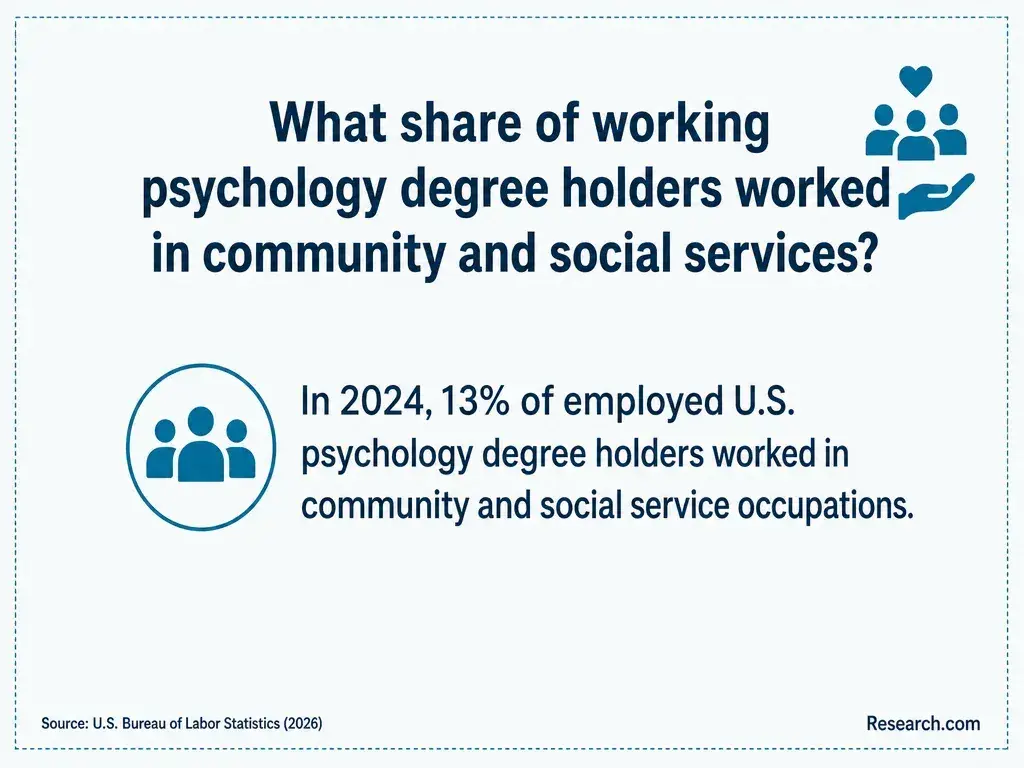
A BA may help you compete for nonclinical roles such as behavioral-health program assistant, intake or referral coordinator, community outreach worker, or research support staff. Actual eligibility depends on the employer, setting, experience, and sometimes a state credential. Community service can support an application when it demonstrates reliable communication, appropriate referrals, documentation, or collaboration - not independent clinical judgment.
The distinctions below can help you compare job postings against your experience and the curriculum.
| Role direction | Typical focus | Qualification to verify |
| Outreach or program support | Information sharing, scheduling, and service coordination | Employer experience and training requirements |
| Research support | Recruitment or data tasks under a research team's direction | Methods skills and data-access training |
| Counseling or psychological practice | Regulated assessment or treatment | Required professional degree, supervision, and state license |
A forensic interest does not remove those boundaries. Graduate forensic psychology job options and qualifications concern a different educational pathway and should be checked against individual job requirements before you select undergraduate electives.
There is no dependable salary that applies to everyone with a psychology BA. Pay attaches to an occupation, employer, location, and level of experience - not to the major alone. For a useful comparison, identify job titles you could realistically pursue, check their stated qualifications and local pay ranges, and use U.S. Bureau of Labor Statistics occupational wage data as context. An occupation-wide median includes workers with different credentials and tenure; it is not a prediction of your starting pay.
Compare the likely pay for a target support role with the BA's remaining cost and any earnings you would give up while studying. If you are weighing a later counseling degree, cost and length of shorter counseling master's programs are separate investments to evaluate. Do not assign a counselor's occupational pay to a BA-only pathway.
Does a Psychology BA Lead to Licensure or Graduate Training?
A psychology BA can provide academic preparation for graduate applications, but it does not itself license someone to diagnose conditions, provide psychotherapy, or practice as a psychologist. Counseling, social work, psychology, and other regulated routes have different degree, program, supervised-experience, examination, and state requirements. Ask the relevant graduate program and licensing board whether your planned undergraduate courses meet prerequisites for the specific profession you want.
If you want stronger research skills or a nonclinical specialization, compare the purpose and total cost of inexpensive psychology master's degree pathways with targeted coursework or supervised work experience. If your goal is licensed therapy, prioritize programs designed for that credential rather than assuming a general psychology master's will qualify. Your community service statement should name the stage you are applying for now and present future professional training as a plan, not an outcome the BA promises.
Other Things You Should Know About Psychology
Yes, if the prompt permits it. Describe the activity, your responsibilities, and what you learned accurately; do not invent hours or an organizational affiliation.
Generally, you can describe relevant work through any organization. Focus on your responsibilities, respect for the people served, and the academic insight the experience gave you.
Only if you choose to and it directly helps answer the prompt. You do not need to disclose a diagnosis to explain your interest or demonstrate readiness for psychology study.
Check the school's application policy. If editing tools are permitted, keep the experiences and claims your own, verify every detail, and submit a statement that reflects your voice.
- Colorado Transfer https://cdhe.colorado.gov/students/attending-college/colorado-transfer
- Ten Steps for Writing an Exceptional Personal Statement - PMC https://pmc.ncbi.nlm.nih.gov/articles/PMC9580322/
- Roles & related school programs | mass.gov https://www.mass.gov/info-details/roles-related-school-programs
- Your financial path to graduation | consumerfinance.gov https://www.consumerfinance.gov/paying-for-college/your-financial-path-to-graduation/
- Principles of Good Practice for Distance Education | texas.gov https://reportcenter.highered.texas.gov/agency-publication/miscellaneous/principles-of-good-practice-approved-oct-2023/
- First-Year Admission Requirements | University of Oregon https://www.uoregon.edu/admissions/undergraduate/find-your-path/first-year-students/
- Policies for Online Teaching | Teaching and Learning Resource Center https://teaching.resources.osu.edu/teaching-topics/policies-online-teaching
- Strategies for Success in Online Courses | Academic Advising Center https://www.advising.ufl.edu/strategies-for-success-in-online-courses/
- What Degree Do I Need to Become a Counselor or Therapist? | Palo Alto University https://paloaltou.edu/resources/blog/what-degree-do-i-need-become-counselor-or-therapist
- Ten Tips For Succeeding in Classes Online | udel.edu https://www.act.udel.edu/tips-for-online-success/