2027 Online BA in Psychology - Addictions: Choosing a Degree for Coordinating Peer Support Staff
Audited and Verified:
Our Editorial and Data Verification Process
Research.com uses government datasets, official education statistics and primary institutional information to support its career and degree guides. Our review process checks factual accuracy, occupational definitions, source dates and the requirements associated with the credentials discussed.
How This Article Was Fact-Checked
Our editorial team verifies salary estimates, employment projections, education requirements and program information against original data providers and official organizations. Salary figures are checked against the relevant occupational definitions and reporting periods. Information about licensure, accreditation and required in-person training is reviewed separately.
Fact-checked and verified on:

Co-Founder and Chief Data Scientist
If you already work in recovery services or a community organization, an online psychology BA may strengthen your ability to coordinate peer support staff - but it may not be the fastest route to that role.
Coordinators need operational judgment, respect for the peer model, and an understanding of local credential rules, not just knowledge of addiction. This guide shows how to assess the degree against your experience, compare it with more direct training, and check the practical requirements before committing to school.
Key Things You Should Know
- An addictions-focused psychology BA can support peer-program coordination, but it does not itself qualify you to counsel clients, supervise clinical treatment, or meet every employer's hiring requirements.
- Relevant peer-work experience, staff leadership, and any state-recognized peer credential may matter more than the concentration; compare job postings before enrolling.
- Choose an online program only after checking its institutional accreditation, remaining credits and total cost, course scheduling, and access to approved community-based experience.
What Is an Online Bachelor's Degree in Psychology-Addictions?
It is a psychology bachelor's degree with coursework focused on substance use, behavior, and recovery. Schools may call that focus a concentration, emphasis, track, or set of electives; those labels are not interchangeable. Check the transcript and catalog to see whether "addictions" is an officially awarded concentration or simply a topic you can study.
For a prospective peer-support coordinator, the value lies in applying psychological science to staff training, communication, service evaluation, and collaboration with clinicians - not in gaining clinical authority. A BA is usually a broader and longer commitment than targeted peer-supervisor training. If you need the degree for advancement, compare lower-cost online psychology study pathways against programs offering stronger local partnerships and applied learning.
What Jobs Can You Get Coordinating Peer Support Staff?
Job titles vary: peer support coordinator, recovery program coordinator, peer services manager, and recovery-support supervisor may describe different levels of responsibility. A coordinator might recruit and schedule peers, arrange training and reflective supervision, maintain referral relationships, monitor documentation, and help resolve concerns about workload or role boundaries. Some positions also involve budgets and grant reporting.
The distinction between coordinating a service and providing treatment should guide your job search. The following comparison shows what to look for in a posting.
| Role | Usual focus | Qualification to verify |
| Peer support specialist | Recovery-oriented support grounded in lived experience | Employer and state peer-credential rules |
| Peer services coordinator | Staff scheduling, training support, referrals, and program quality | Leadership experience, degree preferences, and supervisory expectations |
| Addiction counselor | Substance-use treatment within an authorized scope | State certification or licensure and supervision requirements |
Experience as a peer worker or community-services lead can be especially persuasive for coordinator openings. A psychology BA may fill gaps in research literacy or organizational communication, but it does not replace experience managing people. Even master's-level forensic psychology employment pathways concern different job markets; an advanced degree's title is not a substitute for peer-service qualifications.
What Education and Licensing Requirements Apply to Addiction Services Careers?
There is no single nationwide license for coordinating peer support staff. Employers may require a bachelor's degree, prior peer work, supervisory experience, or a particular peer credential. State agencies and certifying bodies set rules for recognized peer-specialist credentials, including any training, examination, lived-experience, or supervision conditions. An employer may also impose requirements beyond the state minimum.
These requirements differ from those for substance-use counselors. A psychology BA with addictions coursework does not, by itself, authorize diagnosis, psychotherapy, or substance-use counseling. If you want to move into clinical work, compare the actual educational and supervised-practice rules for your state and occupation before considering fast online clinical mental health counseling master's programs. A shorter advertised timeline cannot waive licensure requirements.
Before applying for a coordinator job, ask who provides clinical supervision, who supervises peers in the peer-support model, and which decisions the coordinator can make independently. Those answers reveal more about the position than its title.
Online study can let an experienced recovery-services worker remain employed while earning a degree. It does not necessarily mean self-paced study: live classes, group projects, examinations, and placements may have fixed times. Campus study may offer easier access to local faculty and agency contacts, while a well-supported online program may allow you to build experience in your own community.
For this career goal, compare the applied experience as closely as the classroom format. Ask whether you can complete an approved nonclinical project at your current organization, who would supervise it, and whether your work schedule permits the required hours. Employer permission and academic approval are separate; holding the job does not automatically earn internship credit. If you later pursue clinical training, clinical counseling degree formats and completion estimates need separate scrutiny because their field-placement obligations differ from those of a psychology BA.
Expect a foundation in psychological research methods, statistics, development, social psychology, and behavior. Addiction-related courses may examine substance use, prevention, recovery systems, and the social conditions affecting access to care. Course names and required sequences vary by school.
Choose courses by the work you hope to demonstrate. Methods and statistics help you interpret program reports without claiming that a change in service use proves your team caused it. Social and developmental psychology can inform staff training and communication. Courses on ethics, cultural responsiveness, and health systems can help you recognize referral boundaries and unequal barriers to support. None of these courses grants permission to perform clinical assessment or treatment.
If you might later seek a research-oriented graduate degree, preserve strong methods preparation and investigate fast-paced master's study in psychology only after checking whether its research opportunities fit that goal. A general psychology master's is not automatically a counseling credential.
First-year and transfer admission rules differ by institution. Schools may request prior transcripts and evidence that applicants meet their general undergraduate standards; entry to the psychology major can have additional conditions. Applicants with an associate degree or earlier college study should ask for a degree audit, not just a count of accepted credits. A course can transfer as elective credit without satisfying psychology, statistics, or general-education requirements.
If you are returning to school while working in recovery services, send transcripts early and ask the registrar or transfer office to identify outstanding requirements in writing. Clarify course substitutions, required credits taken at the institution, and the order in which methods and advanced courses are offered. Reviewing psychology degree transfer pathways can help you formulate those questions, but the enrolling school has final authority over your evaluation.
Completion time depends principally on applicable transfer credits, enrollment pace, prerequisite sequencing, and how often required courses run. Someone studying around full-time work may need a different schedule from a student able to enroll full time. Request a term-by-term degree plan rather than relying on an advertised completion estimate.
For cost, compare the price of the remaining degree, not tuition alone. Ask each school for tuition and mandatory fees, estimated books or technology charges, any travel or placement expenses, and the cost of an extra term if a required course is unavailable. Account for unpaid time away from work. Federal aid eligibility depends on the institution, program, enrollment, and individual circumstances; the guide to FAFSA for online substance use counseling undergraduates addresses aid questions worth raising, though aid for a psychology BA must be confirmed with your school.
There is no defensible single salary for graduates of this concentration. Peer coordinators, frontline peer workers, program managers, and licensed counselors have different duties and pay structures. Location, funding source, supervisory responsibility, credentials, and experience can matter more than the wording on a diploma.
For a useful estimate, collect local postings for the exact coordinator role you want, note their stated pay and required qualifications, and compare them with your current compensation. The U.S. Bureau of Labor Statistics reports occupational wages for categories such as substance abuse, behavioral disorder, and mental health counselors, but that counselor category is not a salary measure for peer coordinators or psychology BA graduates. If clinical counseling is a genuine alternative goal, compare its pay possibilities with the added education and supervision costs; a shorter clinical mental health counseling master's cost guide is a starting point, not a substitute for a program-specific budget.
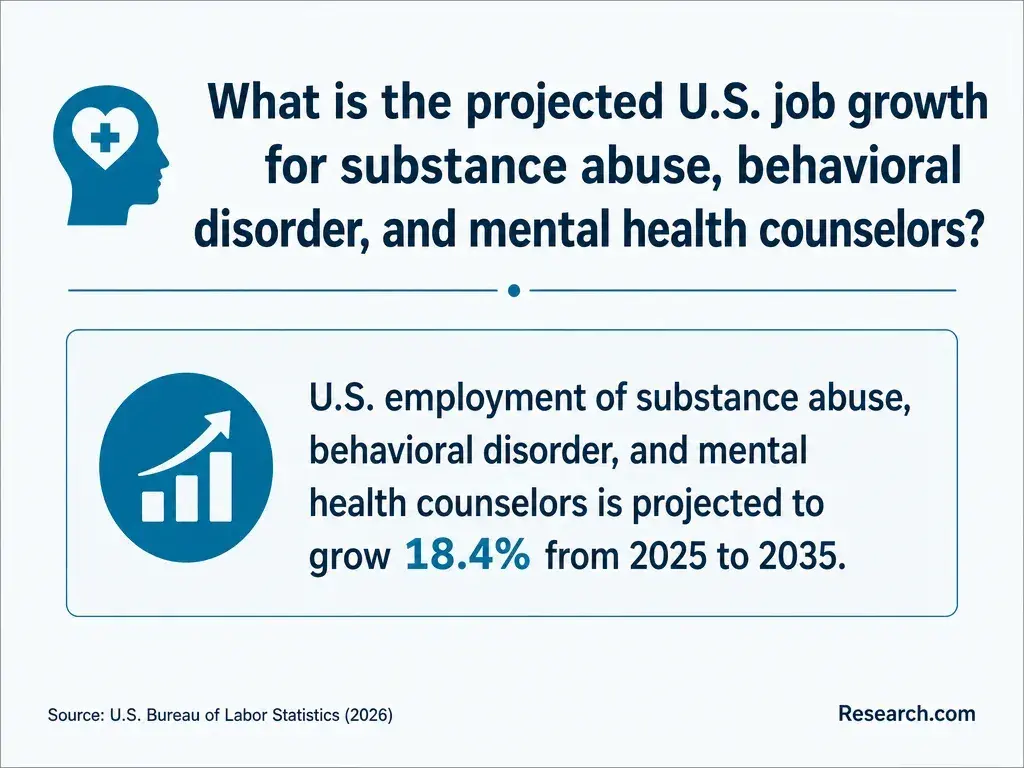
Demand for behavioral-health services is relevant context, but it does not establish a measurable growth rate for peer-support coordinator jobs. The Bureau of Labor Statistics publishes projections for substance abuse, behavioral disorder, and mental health counselors; those projections describe a broader, differently qualified occupation. Do not apply its growth figure to a coordinator opening.
A better local outlook check is to review health systems, recovery organizations, community agencies, and public contracts for recurring peer-leadership openings. Look at whether posts are permanent or grant-funded, whether they require a peer credential, and whether they offer a path from frontline work into staff leadership. If your interests instead lie in justice-system work, under-two-year forensic psychology graduate program options address a different educational decision; they should not be mistaken for evidence of demand for peer coordinators.
How Can You Choose an Accredited Online Psychology Program?
Confirm that the institution holds recognized institutional accreditation and that the degree, addictions focus, and online format appear in its current catalog. Do not look for APA accreditation of a general psychology BA: APA's professional accreditation does not function as a blanket endorsement of undergraduate psychology majors.
Then test the program against your intended work. Request a written degree audit and sample schedule; ask which courses teach recovery-related content, whether local nonclinical experience can be approved, and how faculty assess applied work.
Speak with an advisor about access to statistics and research-methods courses, career services, and support for students already employed in community agencies. Ask an employer which qualifications would actually change your eligibility for promotion.
Choose the BA if it closes a documented degree requirement and adds skills you cannot efficiently gain at work. If your immediate gap is peer supervision, grant reporting, or a state credential, targeted training may offer a more direct return. If you instead need a clinical qualification, compare the entire pathway - including mental health counseling fees and financial support - under the rules of the state where you intend to practice.
Other Things You Should Know About Psychology
Follow the posting's stated qualifications and decide what you are comfortable sharing. If lived experience is a credential condition, ask the employer or certifying body how it verifies eligibility and protects applicant privacy.
Only with the required school and employer permissions. Use an approved, nonconfidential description or a properly authorized, deidentified deliverable; do not assume removing names makes client information safe to publish.
Potentially, if the employer's policies and applicable credential rules allow it. Clarify how staff obtain timely guidance, document services securely, and escalate safety concerns across locations.
Ask whether funded peer-supervisor training or a recognized credential meets the next role's requirements. Revisit the BA if later postings or promotion policies make a bachelor's degree necessary.
- Cost of Attendance (Budget) | 2025-2026 Federal Student Aid Handbook https://fsapartners.ed.gov/knowledge-center/fsa-handbook/2025-2026/vol3/ch2-cost-attendance-budget
- Become a Certified Recovery Peer Advocate | ny.gov https://oasas.ny.gov/recovery/become-certified-recovery-peer-advocate
- Requirements Related to the Practice of Counseling - NCBI https://www.ncbi.nlm.nih.gov/books/NBK259170/
- Medi-Cal Peer Support Services Specialist Program - DHCS https://www.dhcs.ca.gov/medi-cal-peer-support-services-specialist-program-frequently-asked-questions/
- Types of Financial Aid: Grants, Work-Study, and Loans | studentaid.gov https://studentaid.gov/understand-aid/types
- Online Substance Abuse and Addictions Degree | ASU Online https://asuonline.asu.edu/online-degree-programs/undergraduate/counseling-psychological-sciences/
- Transferring Credit | Undergraduate Admissions | University of Houston https://www.uh.edu/undergraduate-admissions/apply/transfer/transferring-credit/
- Online Bachelor's Degree in Psychology in Addictions | Purdue Global https://www.purdueglobal.edu/degree-programs/psychology/bachelor-psychology-addictions/
- 8 Career Paths With a Bachelor's Degree in Psychology | Abilene Christian University https://acu.edu/2020/04/14/8-career-paths-with-a-bachelors-degree-in-psychology/
- FAQs for Clinical Courses: Practicum, Internship, & Field Experience - Wake Forest Department of Counseling https://counseling.wfu.edu/faqs-for-clinical-courses-practicum-internship-field-experience/