2027 Online AGPCNP Programs for Nurses in Vermont: MSN Options and Primary Care Clinicals
Audited and Verified:
Our Editorial and Data Verification Process
Research.com uses government datasets, official education statistics and primary institutional information to support its career and degree guides. Our review process checks factual accuracy, occupational definitions, source dates and the requirements associated with the credentials discussed.
How This Article Was Fact-Checked
Our editorial team verifies salary estimates, employment projections, education requirements and program information against original data providers and official organizations. Salary figures are checked against the relevant occupational definitions and reporting periods. Information about licensure, accreditation and required in-person training is reviewed separately.
Fact-checked and verified on:

Co-Founder and Chief Data Scientist
For a Vermont RN considering adult-gerontology primary care practice, the hardest part of choosing an online program may be finding one that both admits Vermont residents and supports supervised clinicals close to home. An online classroom does not solve either problem automatically. This guide explains the MSN and other graduate routes, what can and cannot be confirmed about Vermont-based schools, and how to check clinical placement, certification eligibility, cost, and licensure before committing to a program.
Key Things You Should Know
- AGPCNP preparation is for primary care of adults across adulthood and aging; it is not interchangeable with family NP or adult-gerontology acute care preparation.
- Before applying to an out-of-state online program, confirm two separate conditions: Vermont enrollment eligibility and a workable arrangement for Vermont clinical placements.
- Graduates generally pursue one of two national adult-gerontology primary care NP credentials, then meet Vermont's separate requirements for APRN licensure.
What are online AGPCNP programs for nurses in Vermont?
An adult-gerontology primary care nurse practitioner (AGPCNP) program prepares an RN to assess, diagnose, manage, and coordinate care for adults, including older adults, in primary care settings. "Online" usually describes academic coursework. Supervised patient-care hours still take place in person, and a program may also require live classes, simulation, or campus visits.
The relevant routes depend on the nurse's existing education. A BSN-prepared RN may seek an AGPCNP MSN or DNP; an already graduate-prepared nurse may be eligible for a post-graduate AGPCNP certificate after the school evaluates prior coursework and clinical preparation. An MSN in education or leadership does not, by itself, prepare someone for NP certification.
Population focus should drive the choice. AGPCNP preparation does not cover pediatric primary care in the way an FNP track does. Nurses who need care across the lifespan can compare AGPCNP training with 12-month FNP program options, while checking whether any advertised accelerated schedule leaves enough time for required clinicals.
Which Vermont schools offer online AGPCNP MSN or graduate nursing programs?
Do not assume that a Vermont-based graduate nursing school offers an online AGPCNP MSN. A school may offer graduate nursing education, or even a different NP population focus, without offering this specific degree, track, and delivery format.
A confirmed Vermont-based online AGPCNP MSN option is not established here; applicants should obtain the current catalog and a written answer from the school rather than treating an unverified listing as an available program.
The distinction matters when comparing local and out-of-state choices. This table identifies what to verify, rather than claiming that either Vermont school currently admits students to an online AGPCNP track.
| School to investigate | Question to resolve before applying | Decision implication |
| University of Vermont | Does its current graduate nursing catalog offer the adult-gerontology primary care NP focus, at what degree level, and in what format? | A local graduate option is useful only if its current track and attendance requirements match the intended credential. |
| Norwich University | Does its current MSN or other graduate nursing catalog specifically offer AGPCNP preparation and accept Vermont clinical sites? | Online graduate nursing availability alone does not establish AGPCNP availability. |
| Out-of-state online school | Will it enroll a Vermont resident, approve Vermont sites and preceptors, and prepare graduates for the intended certification and Vermont APRN application? | A distant school may be practical if all three conditions are met in writing. |
An already certified NP seeking a different population focus should ask about a formal transcript-and-competency review rather than assuming a second full MSN is necessary. Accelerated postgraduate family NP certificates illustrate a different population-focus route; an FNP certificate would not substitute for AGPCNP preparation.
How do online AGPCNP programs arrange primary care clinicals in Vermont?
Clinical placement is a three-party feasibility test: the school must approve the experience, a Vermont site and qualified preceptor must agree to it, and the experience must meet the program's educational and certification requirements.
A willing clinic does not guarantee school approval. Likewise, a school's "placement assistance" may mean introductions and paperwork support rather than a guaranteed Vermont assignment.
Before paying a deposit, ask the program to explain its placement process in writing. These questions expose the most consequential scheduling and cost risks:
- Who finds the site and preceptor, and what happens if no Vermont placement is available by the scheduled term?
- Which adult primary care settings, patient encounters, preceptor credentials, and clinical schedules does the program accept?
- Who negotiates affiliation agreements, verifies the site, supervises learning, and evaluates clinical performance?
- How many in-person campus visits or simulation sessions are required, and can clinical hours be completed while working?
Existing RN employment, volunteer work, and simulation should not be counted as AGPCNP clinical hours unless the program explicitly approves the supervised experience. This is a material difference from some non-APRN degree-completion routes, such as comparing RN-to-BSN practice expectations; NP preparation requires population-focused supervised care.
Check three different issues: the institution's accreditation, the graduate nursing program's accreditation, and the program's ability to enroll and arrange clinical education for a Vermont resident.
Nursing accreditation by the Commission on Collegiate Nursing Education (CCNE) or Accreditation Commission for Education in Nursing (ACEN) should be verified for the applicable program and degree - not inferred from a general claim that the university is accredited.
Then ask the school for a written explanation of how its specific AGPCNP track meets the educational criteria for the intended national certification examination and Vermont APRN application. The Vermont Board of Nursing, not an accreditor, makes state licensing decisions. Accreditation also does not mean a school guarantees a clinical site.
Pay attention to the exact population focus on a school's accreditation and program materials. For example, short PMHNP certificate pathways for nurses address psychiatric-mental health preparation, not adult-gerontology primary care certification.
An AGPCNP MSN typically combines advanced pathophysiology, advanced pharmacology, and advanced health assessment with adult-gerontology primary care coursework and supervised clinical practice. Other coursework may cover diagnostic reasoning, prevention, chronic-condition management, evidence-based practice, and the healthcare needs of older adults. Course titles and sequencing vary by school.
The key curriculum question is not simply whether those subjects appear on a course list. Ask how the school assesses hands-on examination skills and clinical judgment, when clinical courses begin, and whether required patient-care experiences include the adult and older-adult populations needed for this track. An online lecture cannot replace faculty-supervised clinical evaluation.
Comparing MSN-PMHNP program length comparisons may clarify how specialty tracks pace graduate study, but psychiatric clinical courses and encounters cannot be treated as AGPCNP curriculum equivalents without a receiving program's formal review.
Most postlicensure AGPCNP MSN applicants need an active RN license and a qualifying nursing degree, commonly a BSN. Schools may also evaluate GPA, statistics or other prior coursework, professional recommendations, a statement of purpose, and nursing experience.
Requirements differ, and admission to a university is not the same as admission to its AGPCNP track. A nurse with an associate degree should ask whether an RN-to-MSN pathway actually leads to the AGPCNP population focus.
A nurse with an MSN or DNP in another specialty should request a documented review of advanced coursework and supervised hours; prior practice does not automatically waive new clinical requirements. Applicants should also ask when background checks, immunizations, and site-specific clearances become necessary.
Guides to comparing nursing school acceptance requirements can help frame general application questions, but prelicensure nursing admission standards should not be mistaken for AGPCNP graduate-track requirements.

There is no reliable single price or completion time for a Vermont nurse: programs differ in credits, tuition rates, transfer decisions, enrollment pace, and clinical scheduling. A post-graduate certificate may require less repeated coursework than a second MSN, but only after the school determines which prior competencies count. A delayed clinical placement can also extend enrollment and increase costs.
Compare written, program-specific estimates on the same basis. The table separates costs that may be easy to overlook when comparing advertised tuition.
| Cost or time component | What to request from each school |
| Academic charges | Total required credits, tuition per credit, mandatory fees, and charges for continued enrollment |
| Clinical preparation | Placement-related fees, clearance costs, and any expenses the student bears when securing a site |
| Attendance | Required visits, travel, lodging, and time away from paid RN work |
| Completion schedule | Clinical-course sequence, available start terms, part-time limits, and policies if placement is delayed |
| Credentialing | Expected certification examination and Vermont licensing expenses at the time of application |
For nurses balancing graduate study against household income, master's nursing education on a BSN graduate's budget is best evaluated by total cost and feasible working hours, not tuition alone. Confirm employer reimbursement conditions and financial-aid eligibility with the relevant offices before relying on either.
Graduation, national certification, and Vermont APRN licensure are separate milestones. After completing an eligible AGPCNP program, a nurse can review the current adult-gerontology primary care NP examination requirements of the American Nurses Credentialing Center (ANCC) or the American Academy of Nurse Practitioners Certification Board (AANPCB). The resulting credential depends on the certifier; neither certificate alone grants authority to practice as a Vermont APRN.
Before enrolling, compare the school's curriculum and clinical documentation against the intended certifier's eligibility rules. Before applying to practice, consult the Vermont Board of Nursing's current APRN application instructions for RN-license status, certification, educational documentation, and other requirements.
A nurse already licensed as an APRN in another state should ask the board about the applicable Vermont application route rather than assuming an existing credential transfers automatically.
Certification is population-specific. Even if affordable psychiatric-mental health NP pathways appear financially attractive, PMHNP education and certification do not establish AGPCNP eligibility or primary care authority.
After obtaining the required credentials, an AGPCNP may pursue adult primary care roles in ambulatory practices, community health settings, and services focused on older adults. The fit of a job depends on its actual patient population, mentoring, call schedule, documentation workload, and scope under Vermont law - not just its NP title. Employers may prefer experience with chronic-condition management and care coordination.
The U.S. Bureau of Labor Statistics reports wages for the broader nurse practitioner occupation, not a separate Vermont AGPCNP starting salary. A national or state NP median therefore cannot predict an individual graduate's offer.
For a useful comparison, ask prospective employers about base pay, productivity terms, benefits, and support for a newly certified NP, then compare those terms with current RN earnings and education costs.
An experienced nurse seeking administration rather than direct adult primary care may not need AGPCNP preparation. Online DNP leadership pathways for graduate nurses address a different goal and should not be mistaken for NP licensure tracks.
How strong is the job outlook for AGPCNPs in Vermont and nationwide?
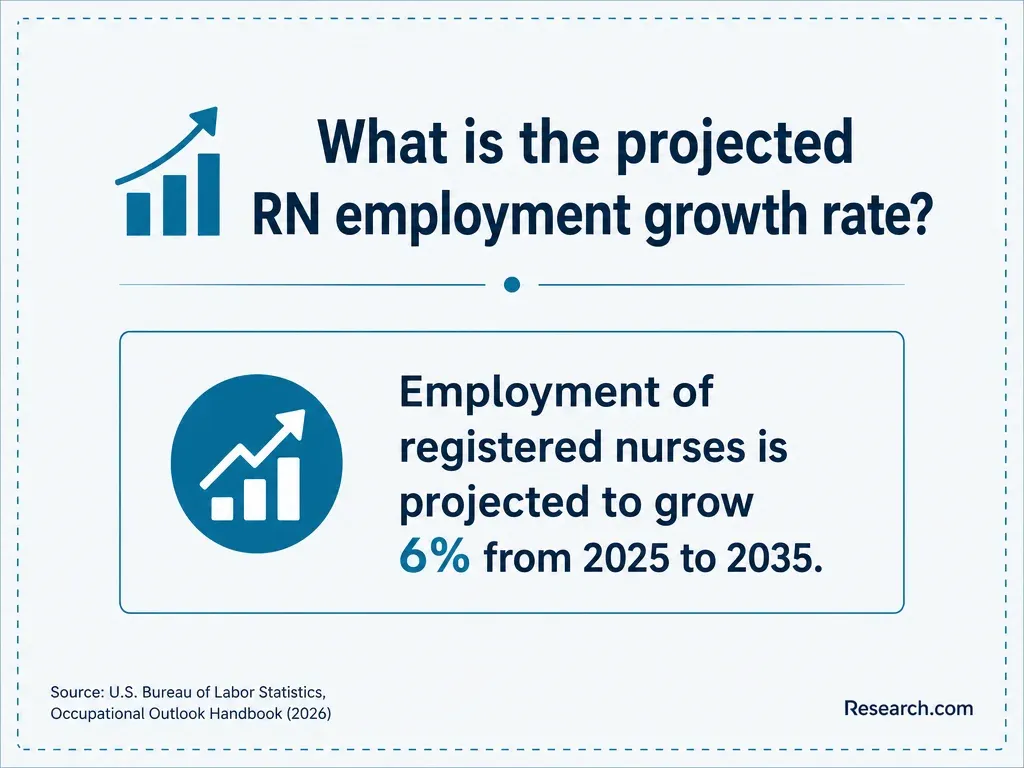
National Bureau of Labor Statistics projections for nurse practitioners indicate strong growth for the occupation, but they do not isolate AGPCNPs or guarantee openings near a Vermont nurse's home. Vermont is a small labor market: one practice's vacancy, staffing model, or willingness to hire a newly certified NP can matter more to an applicant than a national growth rate.
Use occupational projections as context, then test local demand directly. Review Vermont NP postings for patient-population fit and experience requirements, speak with potential clinical sites about hiring, and check whether positions provide structured onboarding. A rural placement may build useful connections, but it is not a job offer.
Strong projected demand alone does not justify taking on unaffordable debt. Compare the complete training expense with realistic local opportunities; budget-conscious NP education pathways are worth considering only when the track, Vermont eligibility, and clinical arrangements also fit.
Other Things You Should Know About Nursing
Often, but clinical terms may require substantial daytime availability. Ask for a term-by-term schedule and discuss work-hour limits with the program before committing.
Possibly, under a program's and certifier's applicable rules. Obtain written approval before counting telehealth encounters; an employer's permission is not enough.
Not necessarily. The school and clinical site must approve the arrangement, and the nurse must have the appropriate authority for the activities and location involved.
Notify the program immediately. Ask how it approves a replacement, documents completed hours, and handles any interruption to progression; do not continue counting hours under an unapproved arrangement.
- Advanced Practice Registered Nurse Roles - StatPearls - NCBI Bookshelf https://www.ncbi.nlm.nih.gov/books/NBK589698/
- NYS Nursing: License Requirements - Office of the Professions https://www.op.nysed.gov/professions/nurse-practitioners/certification-requirements
- MSN AGPCNP Primary Care Online | Chamberlain University https://www.chamberlain.edu/nursing-programs/master-of-science-in-nursing/adult-gerontology-primary-care-nurse-practitioner
- MSN in Adult-Gerontology Primary Care Nurse Practitioner | qu.edu https://grad.qu.edu/programs/masters-degree/msn-adult-gerontology-primary-care-nurse-practitioner/
- Credit Hour Definition (Policy AA-55) | Clarkson College https://catalog.clarksoncollege.edu/academic-information-policies/credit-hour-definition
- MSN in AGPCNP | Online Master's Degree | Capella University https://www.capella.edu/online-nursing-degrees/msn-nursing-program/masters-msn-agpcnp/
- Doctor of Nursing Practice (D.N.P.) | University of Vermont https://www.uvm.edu/cnhs/nursing/program/doctor-nursing-practice
- Nurse Practitioner Clinicals: What You Need to Know | Herzing University https://www.herzing.edu/clinicals/nurse-practitioner
- Apply to St. John Fisher's Online AGPCNP Program https://onlinenursing.sjf.edu/programs/agpcnp/
- Nursing, M.S.N. | Vermont State University https://vermontstate.edu/academic-programs/nursing-msn/