2027 Nurse Residency, Fellowship, and Orientation: How Employers Use These Terms
Audited and Verified:
Our Editorial and Data Verification Process
Research.com uses government datasets, official education statistics and primary institutional information to support its career and degree guides. Our review process checks factual accuracy, occupational definitions, source dates and the requirements associated with the credentials discussed.
How This Article Was Fact-Checked
Our editorial team verifies salary estimates, employment projections, education requirements and program information against original data providers and official organizations. Salary figures are checked against the relevant occupational definitions and reporting periods. Information about licensure, accreditation and required in-person training is reviewed separately.
Fact-checked and verified on:

Co-Founder and Chief Data Scientist
A nursing job posting may promise a residency, fellowship, or extended orientation without explaining what the nurse will actually receive. That distinction matters when a new graduate is preparing for independent assignments or an experienced RN is moving into an unfamiliar specialty. This guide explains how employers commonly use each term, what to verify about supervision, scheduling, pay, and licensure, and how to judge whether an offer provides enough support for the role you want.
Key Things You Should Know
- Orientation is job-specific onboarding; a residency usually adds structured development for new graduate RNs; a fellowship commonly supports experienced nurses entering a new specialty. Employer labels are not standardized.
- A residency may run about 12 months, while unit orientation often lasts weeks to months. Ask separately when supervised shifts end and when classroom or cohort activities end.
- Compare the paid training schedule, preceptor support, competency checks, license deadline, and employment commitment - not the program name alone.
What are the differences between nurse residency, fellowship, and orientation?
Employers use these terms to describe overlapping forms of transition-to-practice support. Orientation prepares an employee for a particular organization and assignment. A nurse residency generally combines new-graduate RN onboarding with structured learning over a longer period. A nurse fellowship commonly helps a licensed nurse transfer into a specialty in which they have limited experience. These are employment programs, not nursing degrees or licenses.
The comparison below shows the usual emphasis of each term. A job posting may combine them: for example, a new graduate can complete unit orientation during the first part of a yearlong residency, whereas nurses interested in advanced clinical roles later look to academic routes like accelerated family NP study options rather than employer-run fellowships.
| Employer term | Typical participant | Main purpose | What to confirm |
| Orientation | Any newly hired nurse | Learn local policies, workflows, equipment, and assigned duties | Length of precepted shifts and criteria for taking an assignment independently |
| Residency | Usually a newly licensed RN | Support the transition from student to practicing nurse | Whether education and mentorship continue after unit orientation |
| Fellowship | Often an experienced RN changing specialties | Develop setting-specific knowledge and clinical competence | Prior-experience rules and the specialty skills assessed |
None of these labels guarantees a particular number of supervised shifts. The written schedule and competency process tell you more than the program title.
Who qualifies for nurse residency and fellowship programs?
New-graduate RN residencies commonly recruit nurses completing an approved prelicensure nursing program and seeking their first RN role. Employers may set limits on prior RN employment, graduation date, or time since licensure. Some accept applicants before graduation or before they pass the NCLEX but require an active RN license by a specified start date. Others hire graduates into a separate role pending licensure.
Fellowships often require an active RN license and a stated amount of nursing experience, but specialty experience may be unnecessary - that is the gap the fellowship is designed to address. An ICU-to-OR applicant, for example, should ask whether the employer wants prior critical-care experience, general RN experience, or simply evidence of readiness for perioperative training. Requirements differ by employer and unit.
If you have not yet completed nursing school, an employer residency is not an alternative route to initial RN preparation. First compare eligible prelicensure programs, including less competitive accelerated nursing programs if you already hold a non-nursing bachelor's degree; admission and eventual RN licensure remain separate decisions.
How long do nurse residency, fellowship, and orientation programs last?
New-hire orientation may take several weeks or several months, depending on patient acuity, the nurse's background, scheduling, and demonstrated competence. Many new-graduate residencies are designed around roughly a year of development, even though precepted unit shifts may end earlier. Specialty fellowships may also span months, with the duration varying by specialty and employer.
A useful distinction is calendar length versus supervised clinical time. A "12-month residency" might include an initial period of closely supervised shifts followed by periodic seminars, mentoring, or projects while the nurse works a regular assignment. Ask for the expected dates of each phase, the number of precepted shifts, and the process for extending orientation if competencies are not yet met. A longer advertised program is not necessarily safer if hands-on support ends too soon—just as nurses evaluating time-efficient online DNP pathways must weigh actual clinical hour structure against overall calendar length.
Orientation usually starts with employment requirements and organization-wide training, then moves to unit-specific practice. A nurse may learn EHR documentation, medication systems, escalation procedures, equipment, patient populations, and the unit's staffing model. Supervised shifts with a preceptor allow the employer to observe performance in the actual setting rather than assume school experience or a prior job translates directly.
The nurse and preceptor should receive clear expectations for progressively taking on patient assignments. Competency checks may address assessment, clinical judgment, medication safety, communication, documentation, and when to seek help. Simulation or classroom work can support learning, but neither replaces observation of performance where the employer requires it.
Before accepting an offer, ask who decides that orientation is complete and what happens if a skill or patient situation has not yet been encountered. Completion should mean the nurse has met the employer's stated expectations for the assigned role - not that the nurse will never need consultation or additional training, whether on the unit or later when planning a faster MSN-PMHNP pathway or another advanced specialty step.
Residencies build on prelicensure education by helping new RNs apply clinical judgment while managing the pace and accountability of employment. Depending on the employer, sessions may cover prioritization, recognizing deterioration, communication with patients and teams, documentation, delegation within the RN's scope, evidence-based practice, and professional well-being. Unit orientation supplies the setting-specific supervised practice that makes those topics concrete.
Look for a connection between teaching and assessment. A useful program explains how preceptors give feedback, how educators respond to learning gaps, and whether residents can raise safety concerns without being left to manage beyond their competence. Cohort meetings and mentorship can help, but they do not compensate for inadequate support during a shift.
A residency is also distinct from academic degree completion. An RN considering later coursework can compare no-traditional-clinical RN-to-BSN options, but an RN-to-BSN program does not substitute for an employer's unit orientation or competency checks.
An experienced RN brings transferable assessment, communication, and safety skills, but may be new to a specialty's equipment, workflows, patient risks, and escalation decisions. A fellowship can provide a planned sequence of instruction, supervised shifts, feedback, and competency evaluation instead of expecting prior RN experience to cover those gaps automatically.
For a specialty change, compare the fellowship's training to the actual job. Ask which patients and procedures fellows will encounter, who precepts them, whether shifts include the schedules they will eventually work, and how the employer handles limited case exposure. A fellowship for an ED-to-ICU transition, for instance, should be judged against ICU responsibilities - not simply the nurse's years in emergency care.
An RN fellowship does not itself qualify a nurse for an advanced practice role. A nurse seeking NP practice needs the required graduate population-focus preparation, certification, and state authorization; preceptor assistance in online family NP programs concerns that separate educational pathway, not employer specialty onboarding.
Some employer transition programs seek external recognition, but accreditation is not inherent in the words residency or fellowship. Relevant organizations include the American Nurses Credentialing Center's Practice Transition Accreditation Program and the Commission on Collegiate Nursing Education, which accredits eligible nurse residency programs. Check the accreditor's own listing for the employer, program, location, and current status rather than relying on a general claim that the hospital is "accredited."
Employer-program accreditation is different from accreditation of a nursing degree program, institutional accreditation, state board approval of prelicensure education, and an individual nurse's specialty certification. An employer can provide useful training without a separately accredited residency; conversely, an accreditation label does not tell you how many supported shifts your specific unit offers. Verify both external status and the local training plan, much as you would check institutional and programmatic accreditation during ADN-to-MSN program planning.
To practice as an RN, a nurse needs authorization under the applicable state's rules. Employers may allow a graduate to apply for a residency before receiving an RN license, but the deadline for starting work as an RN is employer- and jurisdiction-specific. Passing the NCLEX, graduating, and holding an active license are distinct milestones. Ask the recruiter what happens if licensure is delayed and confirm any temporary-permit rules with the relevant state board of nursing.
Fellowships for experienced RNs ordinarily require an active license appropriate to the job location. If moving states, verify whether your existing license or a valid multistate privilege authorizes practice there; do not assume a pending endorsement application is sufficient. Neither a residency nor a fellowship grants a license, extends a compact privilege, or authorizes practice outside the nurse's scope. Nurses pursuing higher-level credentials later on face similar state and institutional checks, much like reviewing doctoral nursing application requirements compared across graduate schools before applying.
Employer residencies and fellowships are generally paid nursing jobs, but there is no universal residency or fellowship wage. Compensation depends on the employer, market, job classification, shift, and experience policy. A fellowship may pay an experienced RN at their existing rate, place them on a new pay scale, or use another arrangement; the title alone cannot establish which applies.
Compare written offers using the same assumptions: base hourly rate, paid hours during classroom and precepted shifts, shift and weekend differentials, overtime eligibility, benefits start date, and any change in pay after training. Also ask whether classes or projects occur during paid time and whether a bonus carries a repayment obligation. An apparently higher rate may be less attractive if expected hours, differentials, or benefits differ.
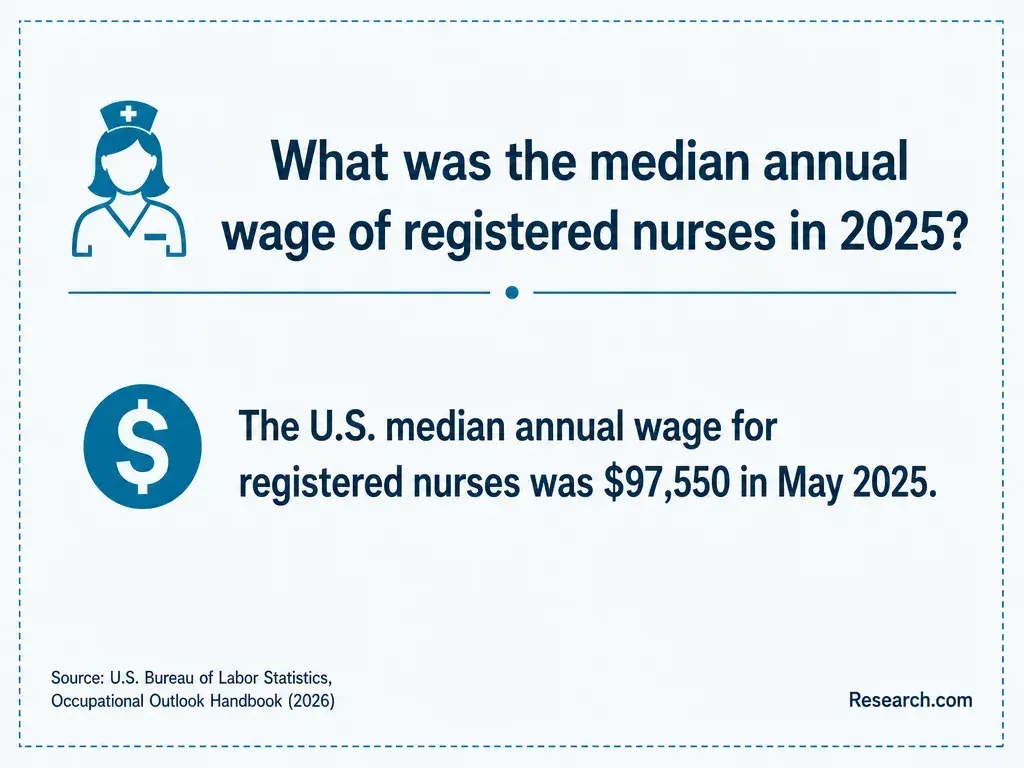
Broad RN wage statistics describe an occupation, not the pay for a particular training program. The employer's written compensation terms are the appropriate basis for this decision, just as nurses budgeting for future advancement rely on transparent cost comparisons across online NP pathways rather than broad tuition estimates.
How can nurses choose a reputable residency or fellowship program?
Start with the role you will be expected to perform after training, then ask the employer to show how it prepares and assesses nurses for that role. A reputable program can explain its staffing support, supervision, and response when someone needs more time - not merely advertise a prestigious name or a long duration.
Use these questions with the recruiter, unit manager, and, if possible, a recent participant. Their answers reveal differences that a job posting may hide.
- Training: How many shifts are precepted, how are preceptors prepared, and what happens if the assigned preceptor changes?
- Progression: Which competencies must be demonstrated, who signs them off, and can supervised time be extended?
- Support: Who is available for clinical escalation after orientation, including on nights and weekends?
- Work terms: Which learning activities are paid, what schedule follows training, and is there a minimum-service or repayment agreement?
- Evidence: Is any claimed accreditation current and specific to this program, and can the employer explain how it evaluates participant feedback and retention?
For a new graduate, strong precepted practice and an achievable first assignment may matter more than a program label. For an experienced RN changing specialties, prioritize exposure to the new setting's actual patients and tasks—just as clinicians expanding into behavioral care evaluate practical clinical exposure when comparing shorter online PMHNP certificate programs. Request the written offer and training outline before committing; if answers differ between the recruiter and unit, resolve them before accepting.
Other Things You Should Know About Nursing
Possibly, but transfer rules vary by employer. Ask whether moving units requires a new orientation, changes your cohort participation, or affects any employment agreement before requesting a transfer.
Not necessarily. Some offers include minimum-service terms, sign-on bonuses, or repayment provisions; others do not. Review the written agreement, including what happens if you leave or transfer early.
Do not assume so. Employment training and school-approved supervised clinical education serve different purposes. Only the educational program and other applicable authorities can determine whether a particular experience meets an academic requirement.
Tell your preceptor, educator, or manager which duties still require support, using specific examples without disclosing patient information inappropriately. Ask for a documented learning plan, appropriate supervision, and clear reassessment criteria; escalate immediate patient-safety concerns through workplace channels.
- Supporting the Health and Professional Well-Being of Nurses | nih.gov https://www.ncbi.nlm.nih.gov/books/NBK573902/
- Nurse Residency Programs: Providing Organizational Value | nih.gov https://pmc.ncbi.nlm.nih.gov/articles/PMC8389136/
- Residencies & Fellowships at UT Southwestern Medical Center https://jobs.utsouthwestern.edu/nursing-residency/
- Why We Need Preceptors and the Benefits of Preceptorship | Baylor University Online https://onlinenursing.baylor.edu/news/why-we-need-preceptors-and-benefits-preceptorship
- Enhance Nurse Residency Program Outcomes: The Role of Accreditation | College of Nursing - The University of Iowa https://nursing.uiowa.edu/ionrp/blog/role-of-accreditation
- RN Residency FAQs | providence.jobs https://providence.jobs/rn-residency-faq/
- CommonSpirit Health | National Nurse Residency Program https://www.commonspirit.careers/nnrp
- Nurse Residency Program Accreditation: Why CCNE Matters | RegisteredNursing.org https://www.registerednursing.org/articles/nurse-residency-program-accreditation/
- RN Residency Vs. RN Fellowship: What's The Difference? | nursejournal.org https://nursejournal.org/resources/nursing-residency-vs-fellowship/
- Finding New Grad Nurse Residency Programs | Trusted Health https://www.trustedhealth.com/new-grad/how-to-find-new-grad-nurse-residency-programs