
2027 Most Affordable Associate Degrees for Full-Time Workers

Co-Founder and Chief Data Scientist
Working full time makes the cheapest advertised tuition only part of the decision: a required daytime lab or an extra semester can change what a degree really costs. College Board reported average published tuition and fees of $4,050 for in-district students at public two-year colleges in 2024-25. That makes community colleges a useful starting point, but not an automatic winner for every worker.
This guide compares associate degree fields by likely expenses, scheduling constraints, and career fit, then shows you what to verify before enrolling.
Key Things You Should Know
- Start with in-district public community colleges: average published tuition and fees were $4,050 in 2024-25, before books, transportation, and other expenses.
- Business, general information technology, and transfer-oriented programs may offer more scheduling flexibility; nursing and clinical healthcare programs often require fixed, in-person hours.
- Compare the cost of every remaining course after transfer credit and aid - not just the price per credit - and confirm that the degree meets your career or transfer goal.
Top 10 Most Affordable Associate Degrees for Full-Time Workers
Business Programs
A business administration AA or AS can suit workers planning to transfer into a bachelor's program; an accounting or business AAS may emphasize workplace skills. Common courses include accounting, management, and spreadsheets. These programs can be relatively affordable when required courses are offered online or after work, with few specialized equipment costs. Check whether online classes have live meetings and whether credits apply to your intended bachelor's major. An associate degree can support applications for administrative or bookkeeping roles, but management positions generally require experience.
Healthcare Programs
Healthcare is not one interchangeable degree path. A healthcare administration program may have online-friendly coursework, while a diagnostic or therapy-related AAS may require equipment, labs, clinical placements, and separate program admission. Those requirements can raise total expenses or conflict with a daytime job, even at a low-tuition college. Before applying, confirm clinical hours, travel, supplies, background-check costs, and whether the program meets requirements for any relevant certification or license. Choose the specific occupation first; then compare programs that prepare students for it.
Information Technology Programs
An IT support, networking, or cybersecurity associate program may offer evening or asynchronous classes and fewer in-person requirements than a clinical major. Budget for any required software, computer equipment, and optional certification exams. Compare an AAS designed for employment with an AS designed for transfer; the least expensive choice depends on your next step. Entry-level hiring can depend on demonstrated skills and experience as well as a degree. Ask whether you can complete required projects on your own schedule and whether courses prepare you for credentials employers request.
Nursing / Pre-Nursing Programs
An associate degree in nursing (ADN) is a potential route toward registered nursing, but admission is commonly selective and clinical shifts may be incompatible with a fixed work schedule. Prerequisites, uniforms, health screenings, exams, and travel affect cost. Graduates must also meet state requirements and pass the licensing exam; the degree alone is not a license. A pre-nursing AA or AS usually covers prerequisites and does not guarantee admission to an ADN program. Verify placement availability, total required credits, and the nursing program's approval before choosing the cheapest option.
Criminal Justice Programs
A criminal justice AA or AS may be most useful as an affordable transfer pathway; an AAS may focus more on immediate workplace preparation. Online evening coursework can fit shift workers, but internships or required field experiences may not. Public-safety employers set their own hiring, training, and background standards, so the degree does not automatically qualify you for an officer role. Ask your target employer whether a degree is required or rewarded, and check whether credits will apply to a bachelor's program if advancement is your goal.
Psychology / Counseling Programs
A psychology AA or AS is generally a transfer-oriented choice, not a stand-alone qualification to practice counseling. It can be affordable when general education and introductory psychology courses are available online, but its value depends heavily on how those credits apply to a bachelor's degree. Licensed counseling generally requires graduate education and other state-specific steps. If you need a quicker route into work, compare human-services support programs or relevant certificates instead. Confirm transfer agreements and the full education path before treating a low-cost associate degree as a career endpoint.
What Are the Most Affordable Associate Degrees for Working Adults?
The most affordable associate degree is the one you can finish at the lowest workable total cost. For many full-time workers, in-district community-college business, IT, or transfer-oriented programs are strong starting points because they may avoid specialized clinical expenses. They are not universally cheaper: an extra term caused by limited evening course availability can outweigh a lower tuition rate.
This comparison identifies the main cost and scheduling questions by field; it is not a ranking of published program prices.
| Degree path | Potential cost pressure | Work-schedule question |
| Business | Usually fewer specialized materials; check course and technology fees | Are required courses available asynchronously? |
| IT | Equipment, software, and possible certification exams | Can projects and labs be completed outside work hours? |
| Criminal justice or psychology | Additional bachelor's-level study if the career goal requires it | Will courses transfer into the intended major? |
| Nursing or clinical healthcare | Prerequisites, supplies, screenings, and clinical travel | Can required clinical shifts fit your job? |
Request a degree audit and an itemized estimate from each college. Compare tuition and mandatory fees for all remaining credits, residency eligibility, books, travel, and likely time to completion. Subtract grants and confirmed employer benefits when estimating your net cost; do not assume that advertised tuition is your final bill.
Are Online Associate Degrees More Affordable Than Campus Programs?
Online associate degrees are not inherently cheaper than campus degrees. They may reduce commuting and parking expenses, but online course fees, technology costs, or higher nonresident tuition can offset the savings. A nearby public college's evening program may cost less overall than a remote college's online program.
Delivery format also determines whether you can keep working full time. "Online" can mean self-paced access to lectures while still requiring live sessions and fixed deadlines; healthcare programs may require local clinical work. Workers whose households move frequently, including military families, may find useful planning considerations in guides to online degrees for military spouses, but should still verify residency pricing and transfer rules at each school.
How Long Do Affordable Associate Degrees Take to Complete?
Associate degrees commonly require roughly two years of full-time study, but a worker taking fewer courses per term should expect a longer timeline. Required credits, prerequisite sequences, course availability, and clinical placements matter more than the length of an individual online class. Previously earned credits may shorten the path only if the college accepts them and applies them to remaining requirements.
Ask for a term-by-term plan based on the hours you can actually study. If a bachelor's degree is the ultimate goal, compare the complete associate-to-bachelor's timeline with accelerated bachelor's degree online accredited options; a faster-looking associate pathway is not necessarily the shorter or cheaper route to that goal.
What Accreditation Should Affordable Associate Degree Programs Have?
Choose a college with institutional accreditation recognized by the U.S. Department of Education. This is important when evaluating federal financial aid eligibility and future transfer, although accreditation alone never guarantees that another college will accept a course or apply it to your major.
For nursing and other regulated healthcare fields, also check the relevant state board's requirements and whether programmatic accreditation or program approval matters for your intended license, certification, employer, or next school. Do this before paying for prerequisites: an inexpensive program that does not support your intended credential may be a costly detour.
What Are the Admission Requirements for Affordable Associate Degrees?
Many community colleges admit students to the institution with a high school diploma or equivalent, but entry into a particular major can have separate requirements. Nursing and some allied-health programs may require prerequisites, a minimum GPA, an entrance assessment, and limited-seat selection. Other programs may use placement to determine which math or writing courses you need.
Send previous college transcripts early and request an official evaluation. Confirm which credits satisfy degree requirements, whether older coursework is accepted, and whether you must complete a minimum number of credits at the new college. Work experience does not automatically earn credit; ask whether the school formally awards credit for prior learning.
What Courses Do Affordable Associate Degree Programs Include?
Most associate programs combine general education - such as writing, math, and communication - with courses in the major. An AA or AS may emphasize transferable coursework; an AAS often emphasizes occupational training, though the design varies by college. Business students may take accounting, IT students networking, and nursing students anatomy and supervised clinical courses.
Review the required course sequence rather than just the catalog description. A low-cost program may be difficult to finish while working if a prerequisite is offered only once a year or a lab meets during your shift. If you intend to transfer, obtain written guidance on which courses apply to your intended bachelor's major.
What Jobs Can You Get With an Affordable Associate Degree?
An associate degree can help you pursue roles such as bookkeeper, IT support specialist, or administrative assistant, depending on skills and employer requirements. An ADN can be part of the route to registered nursing after state licensing requirements are met. Criminal justice and psychology degrees may be more valuable as transfer foundations than as direct routes to a specific licensed occupation.
Compare local job postings with the courses you would actually complete. If your target role mainly asks for a specific technical skill, a shorter credential may be worth comparing; some certifications that pay well may cost less than a degree, though they serve different purposes and do not replace required licensure or transferable college credit.
How Much Can You Earn With an Affordable Associate Degree?
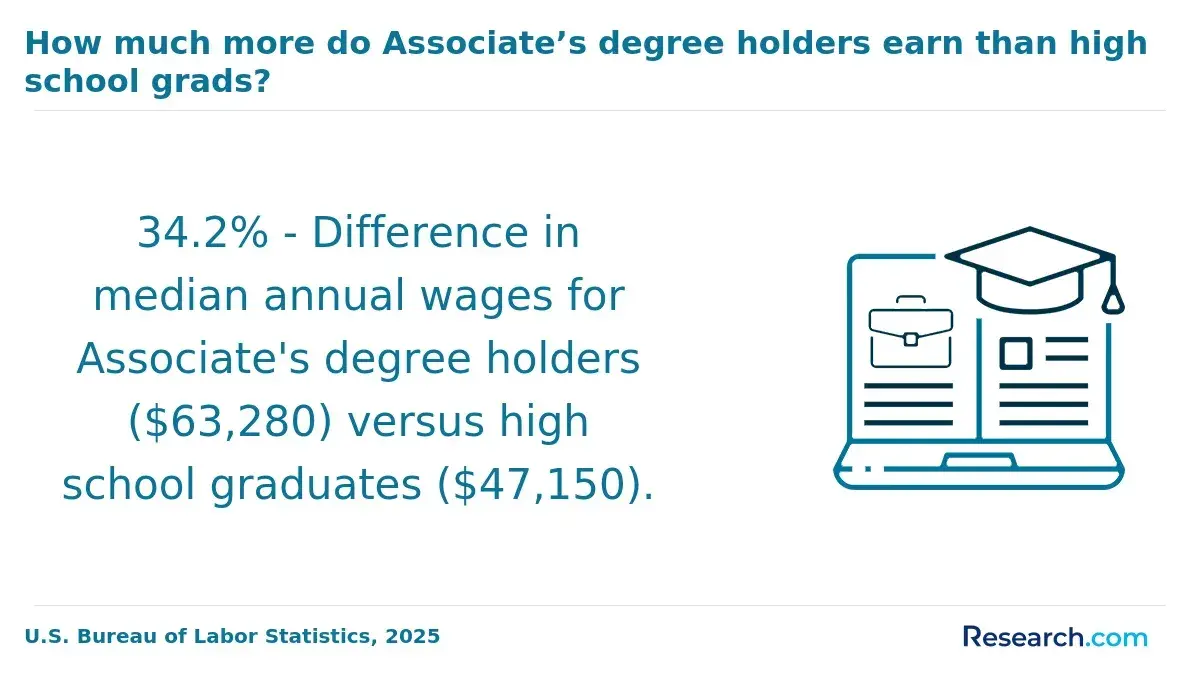
Earnings depend on the occupation, location, experience, and required credentials - not simply on having an associate degree. For context, the U.S. Bureau of Labor Statistics reported a 2024 median annual wage of $93,600 for registered nurses. That is a wage for the occupation, not a forecast for ADN graduates; registered nurses may enter through different educational routes and must be licensed.
For a useful return-on-cost comparison, look up wages for the specific job you want in your area, then weigh realistic entry requirements against your net education cost and any income you might lose by changing work hours. Be skeptical of schools that present an occupation-wide median as a guaranteed graduate salary.
Which Affordable Associate Degrees Offer the Best Job Outlook?
Job outlook is strongest as a decision tool when it is tied to an occupation you can realistically enter. The Bureau of Labor Statistics projects registered nurse employment to grow 5% from 2024 to 2034. Demand does not remove the need for a license or make clinical training compatible with every full-time job. IT and healthcare also contain many distinct roles with different entry requirements; a broad major name is not enough to judge prospects.
Choose the field that matches both your target job and your available study hours. If your goal is licensed counseling, research graduate and state licensing requirements rather than choosing psychology based on an associate-level job outlook; even a guide to what is the easiest masters degree to get cannot establish which program qualifies you for a particular license.
Other Things You Should Know About
Yes, if required courses and any in-person components fit your schedule. Ask the college for a part-time, term-by-term plan before enrolling.
No. Compare your residency rate, mandatory fees, accepted transfer credits, financial aid, and the number of terms needed to finish.
Eligible students may qualify, but aid amounts and requirements can depend on enrollment and the program. Complete the FAFSA and ask the college's aid office for an estimate based on your planned course load.
Start with your goal. AA and AS programs often support transfer, while AAS programs often focus on employment; verify the specific curriculum and transfer agreement rather than relying on the abbreviation.
References
- Employer-offered educational assistance programs can help pay for college | Internal Revenue Service https://www.irs.gov/newsroom/employer-offered-educational-assistance-programs-can-help-pay-for-college
- The Federal Work-Study Program - FSA Partner Connect https://fsapartners.ed.gov/knowledge-center/fsa-handbook/2024-2025/vol6/ch2-federal-work-study-program
- Price of Attending an Undergraduate Institution - COE https://nces.ed.gov/programs/coe/indicator/cua/price-of-attending-an-undergraduate-institution
- [PDF] Nursing Program Student Handbook - Lakeland Community College http://www.lakelandcc.edu/c/document_library/get_file
- Tuition and Fees Charts - Student Financial Services https://sfs.gsu.edu/resources/student-acct/tuition-breakdown/
- How Many Hours of Work Per Online Course Credit | ASU Online https://asuonline.asu.edu/newsroom/online-learning-tips/discover-weekly-number-hours-online-students-study/
- Tuition Rates, Fees, & Expenses | Johnston Community College https://www.johnstoncc.edu/admissions-and-aid/paying-for-college/tuition-rates-fees-expenses.html
- Employer Tuition Assistance Plans May Help Pay for College | Campus https://campus.edu/blog/financial-aid/employer-tuition-assistance-programs-can-help-pay-for-college
- Transfer Credit Policy | Columbia Southern University https://www.columbiasouthern.edu/admissions/transfer-credit/transfer-credit-policy
- Earn College Credit for Your Experience | sunyempire.edu https://sunyempire.edu/academics/get-credits/index.html


