2027 LPN-to-RN Bridge Programs in New Mexico: Admission, Schedules, and Campus Requirements
Audited and Verified:
Our Editorial and Data Verification Process
Research.com uses government datasets, official education statistics and primary institutional information to support its career and degree guides. Our review process checks factual accuracy, occupational definitions, source dates and the requirements associated with the credentials discussed.
How This Article Was Fact-Checked
Our editorial team verifies salary estimates, employment projections, education requirements and program information against original data providers and official organizations. Salary figures are checked against the relevant occupational definitions and reporting periods. Information about licensure, accreditation and required in-person training is reviewed separately.
Fact-checked and verified on:

Co-Founder and Chief Data Scientist
An LPN-to-RN bridge can build on your practical nursing education, but the word "bridge" does not tell you how many courses will count, when you must be on campus, or whether clinical shifts fit around work. For licensed practical nurses considering New Mexico programs, those details determine whether a shorter route to RN eligibility is workable.
This guide explains how to assess admission, schedules, approval, attendance, costs, and licensure before committing to a school. It also identifies the questions that require an answer from the specific program you plan to enter.
Key Things You Should Know
- An LPN-to-RN route may lead to an associate or bachelor's nursing degree; confirm the award and the nursing courses your LPN education actually replaces.
- Before applying, check three separate matters: nursing-program admission, New Mexico Board of Nursing approval, and any applicable nursing-program accreditation.
- Online coursework does not remove supervised clinical training; request the next cohort's lab, simulation, clinical, and campus schedule before planning work or childcare.
What are LPN-to-RN bridge programs in New Mexico?
An LPN-to-RN bridge is a prelicensure RN pathway for someone who has completed practical nursing education and holds an LPN license. It may award advanced standing toward an associate degree in nursing or, where offered, a bachelor's degree in nursing. Advanced standing is determined by the school; an LPN license alone does not waive every introductory course or clinical competency.
For an LPN whose immediate goal is RN licensure, an associate-degree bridge can be the more direct option if its credits, clinical schedule, and total cost fit. A BSN route may suit someone who wants the bachelor's degree as part of the same educational step. An RN-to-BSN program is different: it generally assumes the student already holds an RN license. After licensure, RN-to-BSN project-based learning options may be worth comparing with earning a BSN before the NCLEX-RN.
What admission requirements do New Mexico LPN-to-RN programs have?
Expect separate admission decisions for the college and its nursing cohort. A school may review your LPN license, practical nursing transcript, prerequisite grades, science labs, GPA, and any required entrance or placement exam. It may also require an LPN transition course or competency assessment before awarding advanced standing. Requirements vary by program and entry term; neither college admission nor a favorable transfer-credit evaluation guarantees a nursing seat.
Ask the nursing department to review your transcript against its current bridge degree plan, not just the college's general transfer policy. Confirm whether anatomy and physiology or microbiology courses have age limits, whether your lab format is accepted, and whether prerequisites must be finished before application. If testing is an obstacle, exploring nursing admission without these entrance exams can broaden your search, but verify the New Mexico bridge cohort's rule directly.
Clinical participation can have additional conditions after academic selection, such as a background review, health documentation, immunizations, or site-required training. Ask when these are due and what happens if a clinical site cannot clear you; do not assume an admission offer resolves placement eligibility.
How long do LPN-to-RN bridge programs take in New Mexico?
There is no reliable statewide completion time. Your remaining prerequisites, awarded LPN credit, entry point in the nursing sequence, course availability, and full- or part-time enrollment determine the calendar. A bridge advertised by nursing semesters may take longer if you must first complete sciences or wait for the next cohort.
Request a term-by-term plan showing the first eligible start date and expected graduation term. Check whether a transition course runs before the main sequence, whether nursing courses are offered every term, and how a missed clinical or failed course affects reentry. Those questions reveal more than a headline program length. Later-stage degree advertisements, including short-format DNP degree programs, describe a different educational goal and do not shorten initial RN preparation.
A school name alone is not enough to establish that its specific LPN-to-RN entry route is currently accepting students or meets your licensure needs. Confirm the exact degree and campus with the nursing department, then verify the RN program's status with the New Mexico Board of Nursing.
Check nursing-program accreditation separately through the accreditor the school names, such as ACEN or CCNE where applicable. Institutional accreditation answers a different question and does not replace board approval.
These checks have different purposes. Use them together rather than treating an accreditation claim as proof of an available bridge seat.
| Check | What it establishes | Question to ask |
| Board approval | The RN education program's regulatory status | Does approval cover the program and location I would attend? |
| Nursing-program accreditation | The accreditor's recognized scope and status | Is my degree program included, and for what period? |
| Bridge availability | Whether LPN advanced placement is offered for your entry term | Is an LPN cohort open, and how is advanced standing awarded? |
Ask each school for its published NCLEX-RN results and identify the reporting year and cohort before comparing outcomes; a whole-program pass rate may not isolate bridge students. If no suitable bridge seat is available, less restrictive nursing admission options may suggest other schools to investigate, but easier admission is not evidence of board approval or a shorter RN route.
A bridge may deliver some lectures online while requiring in-person skills labs, simulation, examinations, and supervised clinical shifts. "Hybrid" describes the mix of delivery methods, not permission to choose clinical hours or complete the degree remotely.
The format label is less useful than a sample calendar. Compare these commitments for the cohort you would enter, especially if you work as an LPN or arrange childcare.
| Component | Possible format | Scheduling issue to verify |
| Lecture | Campus, live online, or asynchronous online | Are attendance or timed exams required? |
| Skills and simulation | Scheduled in-person sessions | Which campus, dates, and make-up rules apply? |
| Clinical placement | Supervised in-person shifts | Who assigns the site and shift, and how far away may it be? |
Do not use the flexibility of an advanced, postlicensure program as a proxy for an RN bridge. For example, online psychiatric NP master's schedule options concern a later credential with different entry and clinical requirements.
Bridge coursework typically builds from practical nursing preparation toward RN-level assessment, clinical judgment, pharmacology and medication safety, care coordination, and management of patients with more complex needs. The precise sequence is the school's decision. Supervised clinical work evaluates how you apply those skills with patients; prior LPN employment and simulation do not automatically substitute for required RN-program experiences.
Ask for a degree audit that distinguishes credit awarded for prior coursework from nursing courses and clinical experiences you must still complete. Also confirm who arranges placements and whether your current workplace can be used. Placement rules are specific to the program and clinical site. Online FNP programs that provide preceptors address graduate advanced-practice placements, not a New Mexico LPN-to-RN bridge's clinical arrangements.
Campus requirements can include orientation, skills checks, simulation, proctored assessments, and meetings with faculty. Some clinical shifts may occur away from campus, but they still require travel and attendance at assigned times. The exact requirements depend on the school, campus, and cohort.
Before accepting a seat, request a written or published schedule covering mandatory campus dates, clinical days and shift lengths, possible travel radius, and policies for missed sessions. Ask which commitments are fixed and which can change after placement assignments. This is particularly important if your LPN job cannot accommodate rotating shifts. Graduate resources on comparing postgraduate FNP certificate schedules should not be used to infer bridge attendance requirements.
No single price represents every New Mexico bridge. Tuition depends on the school, residency classification, charge per credit or term, and how many credits you actually need after evaluation. Compare remaining cost to graduation, not the advertised price of one semester.
Request an itemized estimate that includes tuition and mandatory fees, books and equipment, clinical compliance costs, transportation, testing, and RN examination and licensure expenses. Add the income you may forgo if clinical shifts reduce your LPN work hours.
Then compare financial-aid eligibility and any employer reimbursement terms against the school's term-by-term plan. Nurse practitioner program tuition comparisons concern a later graduate pathway and should not be substituted for an RN bridge cost estimate.
Graduation does not automatically convert an LPN license into an RN license. After completing an eligible RN program, a graduate applies for RN licensure through the New Mexico Board of Nursing, follows its current examination and background-review instructions, registers for the NCLEX-RN, and must satisfy the board's requirements before practicing as an RN. Passing the exam is not, by itself, a substitute for the board issuing the license.
Confirm the board's instructions for your circumstances before paying fees or making employment plans, particularly if you have a license or education from another jurisdiction. Later graduate study, such as online DNP leadership pathways for graduate nurses, neither replaces this initial RN licensure process nor grants an RN license.
What careers, salaries, and job outlook follow New Mexico RN programs?
Once licensed, an RN may seek roles in hospitals, outpatient care, long-term care, or community settings, subject to employer hiring and orientation requirements. An LPN's prior patient-care experience can help during the transition, but RN responsibilities require RN-level judgment, documentation, and accountability. A new RN should compare orientation quality, staffing support, shifts, and commute alongside pay.
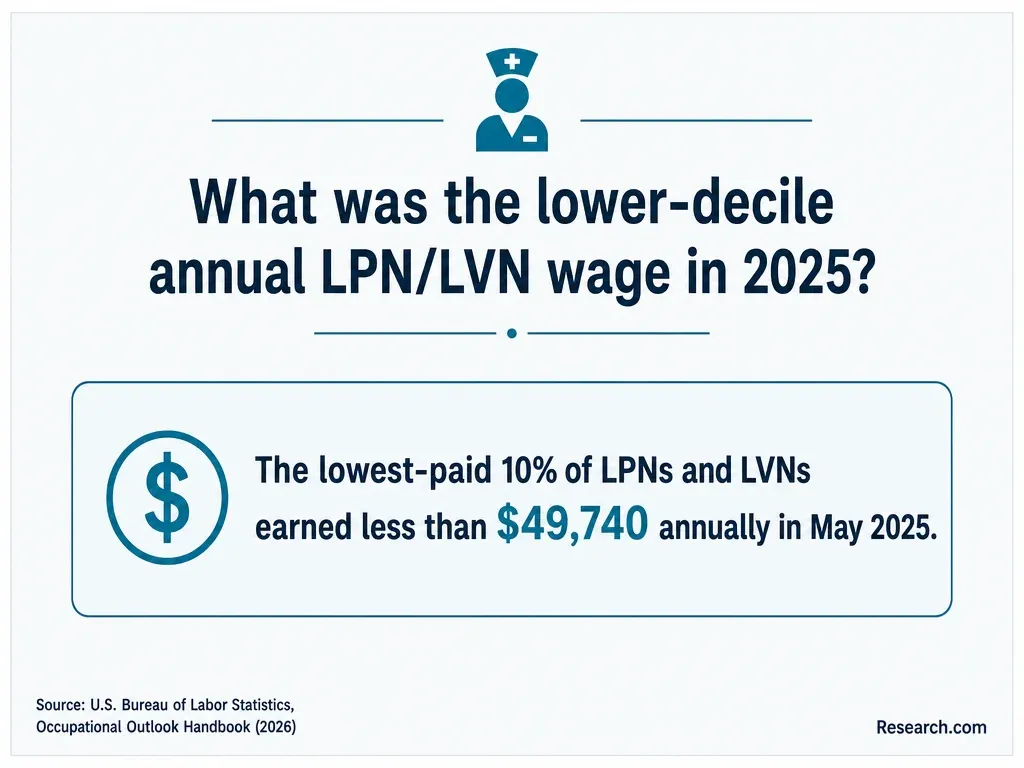
The U.S. Bureau of Labor Statistics reports wages and employment projections for registered nurses as an occupation, not for graduates of a particular New Mexico bridge. Those national figures are useful context, but they cannot predict a local offer or a new graduate's salary; compare actual New Mexico job postings and employer offers for the role and location you want.
An RN bridge also does not qualify someone for nurse practitioner practice. If that is a later goal, PMHNP education costs and program choices are a separate decision after RN licensure and appropriate further education.
Other Things You Should Know About Nursing
Often, yes, if your license remains active and your employer can accommodate the program's fixed attendance requirements. Student status does not expand your LPN scope of practice.
Ask the school to evaluate your transcript and confirm its license-status rule for admission. Credit decisions and eligibility to practice as an LPN in New Mexico are separate matters.
Ask about repeat limits, readmission, and when the course and clinical placement will next be available. A delayed course can affect graduation timing and financial aid.
Some employers offer education assistance. Check eligibility, reimbursement timing, minimum grades, and any work commitment before counting it toward your budget.
- NCLEX Pass Rates - California Board of Registered Nursing https://www.rn.ca.gov/education/passrates.shtml
- 16.12.2 NMAC - State Records Center & Archives - New Mexico https://www.srca.nm.gov/parts/title16/16.012.0002.html
- How the BSN Online Clinical Experience Works | Chamberlain University https://www.chamberlain.edu/academic-resources/bsn-online-clinical-experience
- N.M. Admin. Code § 16.12.2.9 | State Regulations | US Law | LII / Legal Information Institute https://www.law.cornell.edu/regulations/new-mexico/N-M-Admin-Code-SS-16.12.2.9
- Clinical Clearance FAQ - Current Students | CAHE https://www.cahe.edu/current-students/clinical-clearance-faq
- Immunization/CPR/Background Check Policies - Penn Nursing https://www.nursing.upenn.edu/students/handbooks-forms/bsn-handbook/immunizationcprbackground-check-policies/
- LPN to RN Advanced Placement Option Nurse Education Associate of Science | NSCC https://www.northshore.edu/academics/programs/nsg/advanced-placement/index.html
- Allied Health Clinical Student Information | HowardCC https://www.howardcc.edu/admissions-aid/apply-for-admission/alliedhealth/admitted/
- Nursing Clinical Rotations | Tulane BSN Program https://nursing.tulane.edu/clinical-rotations
- Nursing | LPN Advanced Placement Option AAS | Pikes Peak State College Academic Catalog https://catalog.pikespeak.edu/programs/nursing/lpn-advanced-placement-option-aas/