
Is an Online MBA in Business Analytics Worth It for Small Business Owners?

Co-Founder and Chief Data Scientist
A small business owner can collect sales, customer, and inventory data without knowing which numbers should guide the next decision. An online MBA in Business Analytics promises both management training and better use of that data, but tuition and study time compete with the needs of the business.
This guide explains what the degree teaches, where it can improve operations, and when a shorter course or adviser may deliver more value. It is designed to help owners assess the investment against their own business goals, cash flow, and available time.
Key Things You Should Know
- An online MBA in Business Analytics is most likely to be worth it when an owner needs broad management skills as well as analytics and can apply coursework to recurring business decisions.
- Count tuition, fees, borrowing costs, and time away from the business. A targeted course or adviser may be a better buy for one defined problem.
- The Bureau of Labor Statistics reports a $126,520 median annual wage for management occupations in May 2025, but that is neither a small business owner's income nor an MBA earnings estimate.
Is an online MBA in Business Analytics worth it for small business owners?
It can be, but only if the breadth of an MBA addresses more than a single analytics problem. The strongest case is an owner who must improve pricing, cash-flow planning, customer acquisition, and operations while building the management capacity to act on the findings. An owner who only needs a better sales dashboard may get results sooner from a short course or specialist.
Unlike an employee seeking a promotion, an owner may not receive a higher salary after graduation. The potential return could instead appear as improved margins, fewer stockouts, better retention, or less time spent on avoidable work. Those gains are uncertain and can be hard to separate from market conditions or changes the owner would have made anyway.
The following comparison separates the scope of each learning option from the commitment it asks of an owner.
| Option | Best fit | Main limitation |
| Online MBA with a formal analytics concentration | Several linked management problems and a need for structured, graduate-level learning | Substantial expense and sustained study time |
| Targeted analytics course or certificate | A specific skills gap, such as forecasting or interpreting marketing data | Usually less coverage of finance, leadership, and strategy |
| Mentor, adviser, or consultant | An immediate decision requiring experienced outside help | May solve the problem without developing the owner's independent skills |
Set a maximum affordable investment before comparing schools. You can compare affordable MBA schools 10 000 as an initial search, but verify each program's current total charges and analytics coursework rather than assuming a low advertised price meets both needs.
How can business analytics skills help small business owners make better decisions?
Business analytics uses data, statistical methods, and judgment to inform decisions. For an owner, its value lies less in producing elaborate models than in asking a measurable question, checking the quality of the data, and acting on a result.
For example, a retailer can compare product-level gross margins and seasonal demand before placing an order. A service business can examine which customer-acquisition channels bring repeat clients rather than judging campaigns by leads alone. A contractor can compare estimated and actual labor hours to spot jobs that look profitable in revenue reports but strain cash flow.
Good analysis also reveals what the numbers cannot establish. A sales increase after a price change does not, by itself, prove the price change caused it. Small datasets, changing customer behavior, and inconsistent records can mislead. Owners should pair analysis with frontline knowledge and test consequential changes on a manageable scale.
What does an online MBA in Business Analytics teach small business owners?
An MBA combines a general management core with analytics-focused study. The core typically addresses financial accounting, managerial finance, marketing, operations, strategy, and leadership. For an owner, those subjects provide the context needed to turn an analytical finding into a budget, staffing, or growth decision.
Analytics coursework may cover data visualization, forecasting, statistics, and evidence-based decision-making. The emphasis is generally managerial: framing a business question, interpreting results, communicating uncertainty, and deciding what to do next.
An MBA concentration is not automatically equivalent to a technical master's degree in statistics or data science; the depth of programming and mathematical training depends on the school.
Applied assignments can be especially valuable if a program permits students to investigate a real operating challenge. Confirm whether company-based projects are allowed and how confidential customer or financial information must be protected.
Online delivery can reduce travel and make it easier to keep operating a business, but it does not guarantee control over study hours. Live classes, group meetings, deadlines, and possible residencies can still collide with peak trading periods. A campus program may make in-person networking easier, while requiring more regular travel or time away from work; actual opportunities vary by school.
Before enrolling, ask for a sample course schedule and the rules for changing pace or taking a leave. Test whether required meetings fit the weeks when payroll, inventory, or client delivery already consume your attention. Owners considering a faster path can review accelerated graduate business degrees, but a shorter calendar can mean a heavier simultaneous workload rather than less work overall.
There is no universal course list. Many programs pair MBA core courses with analytics electives or a formal concentration. Depending on the institution, analytics subjects may include business statistics, predictive modeling, database concepts, data visualization, and decision analysis; a capstone may integrate those skills with a business problem.
Check the catalog rather than the marketing label. Determine which courses are required, which are electives, whether the concentration is formally recorded, and whether the assignments use tools your business can realistically maintain. An owner who delegates analysis but makes financial decisions may benefit more from interpretation and managerial finance than from extensive coding.
A business bachelor's degree is not necessarily required. Owners educated in another field can use an online MBA programs for nonbusiness majors to identify possibilities, then check each school's foundation courses and quantitative preparation expectations.
Requirements differ by school. Applicants commonly need a bachelor's degree and may be asked for transcripts, a résumé, a statement of purpose, and recommendations.
Professional experience can strengthen an application, and operating a business may provide substantial examples of leadership and decision-making. GMAT or GRE policies vary; some schools do not require a test, while others specify eligibility for a waiver.
Before applying, confirm the program's current requirements and explain what you manage: budgets, employees, customers, vendors, or growth initiatives. If your quantitative background is limited, refresh basic accounting and statistics.
For a test-policy shortlist, check MBA tuition comparison GMAT required options carefully; a no-GMAT listing is not a substitute for checking the school's current admissions page.
Completion time depends on the required credits, term schedule, course load, and whether prerequisite work is necessary. Part-time study may protect operating hours but extends the period during which tuition payments and assignments compete with business demands. Accelerated study compresses that pressure.
For a meaningful cost comparison, add required tuition and fees to books, software, any travel, and financing costs. Then account for owner time: hours spent studying may require paid coverage or postpone revenue-generating work. Published per-credit tuition is not the total program price.
Ask each school for a written estimate based on your intended pace and concentration. The online MBA cost guide can help establish a budget-oriented shortlist, but confirm current charges and whether the advertised figure includes mandatory fees. If you borrow, assess repayments against conservative business cash-flow projections, not hoped-for sales growth.
For most owners, the immediate opportunity is to run the existing business more effectively: improve pricing, evaluate expansion, allocate marketing spending, or build reporting that supports delegation. The degree may also help an owner communicate plans to lenders, partners, or a growing management team, though the credential itself does not secure financing or customers.
Owners who later seek employment may find their operating experience relevant to operations management, business development, or analytics-informed management roles. Their prospects will depend on business scale, demonstrated results, technical skills, and employer requirements. An MBA does not by itself qualify someone for a specialized data-science role or a senior position in an unfamiliar industry.
There is no dependable salary figure that applies specifically to small business owners who complete an analytics MBA. Owner income depends on the business's profitability, compensation choices, debt, and reinvestment needs.
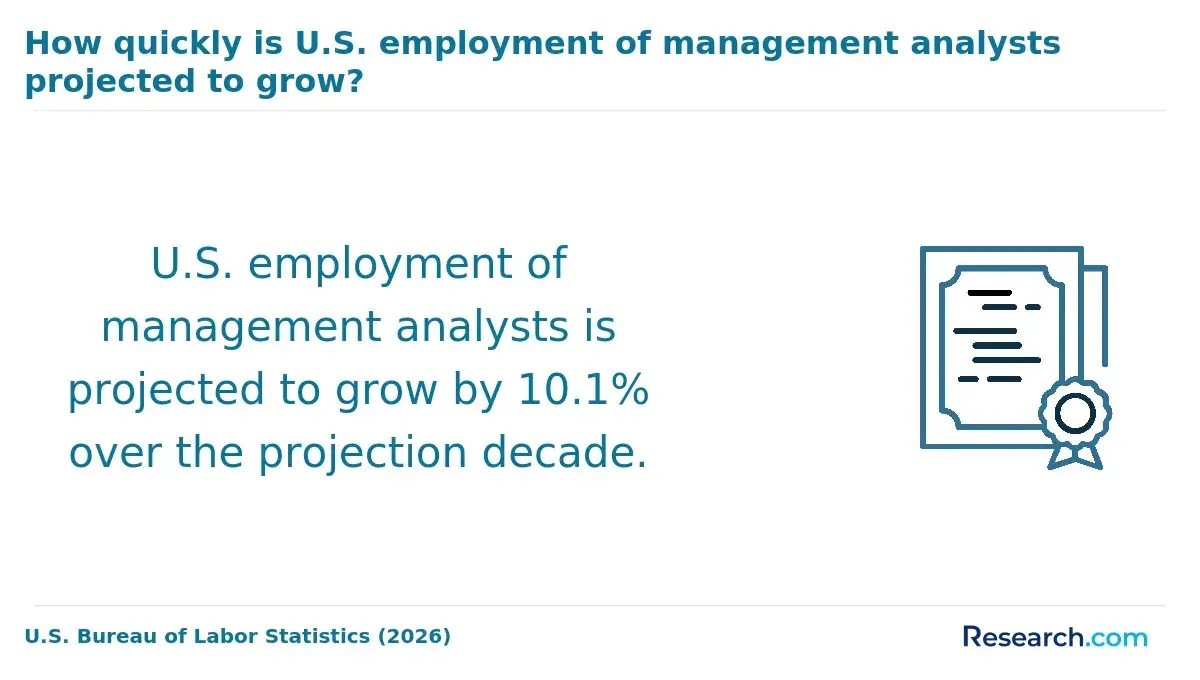
For employment context, the U.S. Bureau of Labor Statistics reports a $126,520 median annual wage for management occupations in May 2025 and projects that employment in the group will grow faster than the average for all occupations from 2025 to 2035.
That broad occupational median includes people with different degrees and levels of experience. It does not measure MBA graduates' pay, predict an owner's income, or show that the degree caused an earnings increase. Owners considering a future salaried role should investigate pay for the specific occupation and location, then weigh that possibility separately from the degree's value to their current business.
How can small business owners choose an accredited online MBA program?
Start by confirming that the institution holds recognized institutional accreditation. Then check whether its business school or MBA has specialized accreditation, such as AACSB, ACBSP, or IACBE; institutional and specialized accreditation are different claims. Verify both through the relevant accreditor rather than relying only on an advertisement.
Fit matters alongside accreditation. Request the current curriculum, complete cost estimate, sample weekly schedule, policies on live sessions and leave, and rules for using business data in projects. Ask whether faculty or career services can support an owner's growth goals, not just corporate job searches.
Finally, identify a decision you want to improve during the program and assess whether the coursework will help you address it. If you cannot identify one, defer the MBA until its business purpose is clearer.
Other Things You Should Know About MBA Programs
It may be able to, but payment does not automatically make tuition deductible. Tax treatment depends on the business structure and circumstances; consult a qualified tax professional before budgeting for a tax benefit.
Ask the instructor first. You may need to remove identifying details, obtain permission, or use simulated data to protect customers, employees, and confidential finances.
A degree is not a substitute for the lender's financial and underwriting requirements. The planning skills you develop may help you present a clearer business case, but approval is not guaranteed.
Some schools accept eligible transfer credit, subject to limits on course equivalence, grades, and age of coursework. Request a written evaluation before assuming earlier study will shorten the program or reduce its cost.
- Online MBA ROI: What Factors Should You Calculate? | Howard University Online MBA https://onlinemba.howard.edu/blog/online-mba-return-on-investment/
- How does the workload of an MBA compare to undergraduate? | Tippie College of Business https://tippie.uiowa.edu/about/who-we-are/advisor/mba/workload-comparison
- What Skills Can You Gain From a Master of Business Analytics and AI Curriculum? | Freeman News https://freemannews.tulane.edu/2025/06/09/what-skills-can-you-gain-from-a-master-of-business-analytics-curriculum
- Tuition and Financial Aid | MIA-BUS https://onlinemba.miami.edu/admissions/tuition/
- Is an MBA in Data Analytics Worth It? | University of Southern Indiana https://online.usi.edu/degrees/business/mba/data-analytics/why-mba-data-analytics/
- 5 key reasons why data analytics is important to business | upenn.edu https://lpsonline.sas.upenn.edu/features/5-key-reasons-why-data-analytics-important-business
- How Much Does an Online MBA Cost? | University of Bridgeport https://www.bridgeport.edu/news/cost-of-online-mba/
- Part-time MBA - Online/Modular Option - NYU Stern https://www.stern.nyu.edu/programs-admissions/mba-programs/part-time-mba-manhattan/academics/online-modular-option
- Understanding Opportunity Cost of Attending College | University of Phoenix https://www.phoenix.edu/blog/understanding-opportunity-cost-of-attending-college.html
- Small-Business Data Analytics: Everything You Need to Know | William & Mary Mason https://online.mason.wm.edu/blog/small-business-data-analytics-everything-you-need-to-know


