2027 How Nursing Statistics Connects to Nursing Work: Concepts Students Should Recognize
Audited and Verified:
Our Editorial and Data Verification Process
Research.com uses government datasets, official education statistics and primary institutional information to support its career and degree guides. Our review process checks factual accuracy, occupational definitions, source dates and the requirements associated with the credentials discussed.
How This Article Was Fact-Checked
Our editorial team verifies salary estimates, employment projections, education requirements and program information against original data providers and official organizations. Salary figures are checked against the relevant occupational definitions and reporting periods. Information about licensure, accreditation and required in-person training is reviewed separately.
Fact-checked and verified on:

Co-Founder and Chief Data Scientist
A statistics course can feel distant from patient care until a nurse must interpret a treatment study, spot a rise in falls, or explain what a risk estimate means. For nursing students and new nurses, the useful skill is not memorizing formulas; it is judging what data can - and cannot - support.
This guide connects core statistical concepts to supervised clinical work, evidence-based practice, and quality improvement. It also shows what to look for in nursing coursework so you can prepare for the work without choosing a degree solely to study more statistics.
Key Things You Should Know
- Nurses use statistics to interpret research and monitor care, but a group-level result does not replace assessment of an individual patient.
- Always check the denominator: in a hypothetical example, 10 events among 200 patients is 5%, while 10 among 100 is 10%.
- For most students, a statistics prerequisite plus research, evidence-appraisal, and quality-improvement coursework is more relevant than an additional degree pursued solely for quantitative skills.
How does nursing statistics support clinical decision-making and patient outcomes?
Nursing statistics is the use of numerical information and statistical reasoning to understand health patterns, evaluate evidence, and monitor care. A nurse might compare a patient's measurements over time, interpret the results of a clinical study, or notice that an adverse-event rate has changed. Statistics helps frame those observations; assessment, current protocols, and licensed clinical judgment determine what action is appropriate.
The distinction between population evidence and individual care matters. A study may show that an intervention improves outcomes on average without establishing that it is appropriate for every patient. Nurses must consider the study population, the patient's condition and preferences, potential harms, and the care team's plan.
This remains true in advanced practice preparation. When considering one-year family nursing advanced practice options, compare opportunities to appraise evidence and develop supervised clinical judgment - not speed alone. A shorter program cannot make a published average a patient-specific decision.
What statistical concepts do nursing students learn and use in practice?
Students generally need to interpret statistics more often than calculate complex models by hand. Course depth varies, but the following distinctions are especially useful when reading clinical research or unit reports.
The table connects common concepts to questions a nurse can ask. The figures are illustrative, not patient findings or evidence of a treatment effect.
| Concept | What it tells you | Nursing interpretation |
| Count, rate, and denominator | How many events occurred and among how many opportunities | Ten events cannot be compared fairly across units without knowing their patient counts or other appropriate denominators. |
| Mean and median | Two ways to describe a typical value | A few unusually long stays can raise the mean while leaving the median less affected. |
| Variation | How widely observations differ | Two groups with the same average may have very different spreads of results. |
| Absolute versus relative risk | Different ways to express a difference between groups | A change from 2% to 1% is a one-percentage-point absolute reduction and a 50% relative reduction. |
| Confidence interval | A range indicating uncertainty around an estimate | A wide interval calls for more caution than a narrow one; it is not a range of possible outcomes for an individual patient. |
| Statistical versus clinical significance | Whether an observed difference is unlikely under a statistical model versus whether its size matters in care | A statistically significant result may be too small to justify a change in practice. |
Students also encounter sampling, bias, confounding, and the difference between correlation and causation. If an advanced program requires prior statistics, confirm its actual prerequisite policy rather than assuming every doctorate uses the same standard; comparing prerequisite policies in DNP programs can help frame questions for admissions staff.
How do nurses apply statistics to evidence-based practice?
Evidence-based practice combines research evidence with clinical expertise and patient circumstances. Statistics helps nurses decide how much confidence to place in a study before considering a practice change. A low p-value alone is not enough: study design, comparison group, outcome definition, effect size, uncertainty, and relevance to the local patient population all matter.
A practical reading sequence is to identify the patient group and outcome first, then compare absolute results between groups. Next, check whether assignment methods, missing data, or other differences could explain the finding. Finally, ask whether the potential benefit is meaningful alongside risks, resources, and patient preferences. This is an appraisal process, not permission for a student or nurse to change care outside their role or organization's procedures.
The same standard applies across specialties. If short-format online PMHNP study is an educational option, ask how students practice evaluating mental-health research and applying it under appropriate supervision, rather than treating a course title as evidence of appraisal competence.
Quality improvement uses measures over time to see whether a care process is working as intended. For example, a team monitoring falls needs a consistent definition of a fall, a suitable denominator, comparable reporting periods, and attention to changes in patient mix. An apparent increase could reflect more events, better reporting, or both.
Process measures describe what staff did; outcome measures describe what happened to patients. Both can be informative, but neither proves by itself that a particular intervention caused a change. Small numbers can also fluctuate sharply, so teams should avoid declaring success from one favorable week.
Students considering shortest online nursing practice doctorates should examine how a program teaches measure selection, data interpretation, and organizational oversight for practice projects. A proposed improvement is not a validated patient outcome. Access to records, reporting of results, and any required quality, ethics, or research review must follow institutional rules and privacy protections.
Statistics appears at different depths because programs prepare students for different work. The right route depends first on whether you need initial RN preparation, already hold an RN license, or intend to lead improvement or research.
This comparison describes educational emphasis, not a universal curriculum or a guarantee of competence.
| Pathway | Typical connection to statistics | Best-fit question |
| Prelicensure ADN/ASN or BSN | Interpreting evidence and patient-safety measures alongside supervised clinical learning | Does the program prepare me for initial RN licensure in my intended state? |
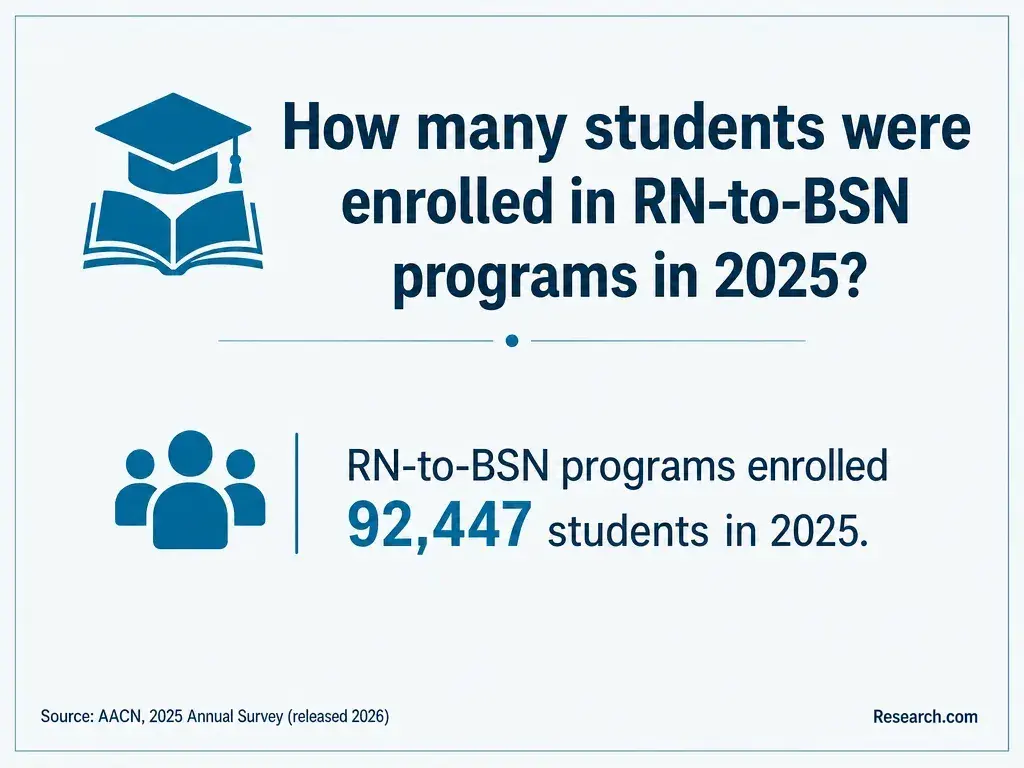
| RN-to-BSN | Deeper work in research appraisal, population health, or improvement projects | How are existing RN experience and any practice requirements incorporated? |
| MSN or DNP | Using evidence and outcomes data for an identified advanced clinical, education, informatics, or leadership goal | Does the specific track match my intended role and credential requirements? |
| PhD | Designing and conducting original research, often with more advanced methods | Do I want a research career that requires this level of preparation? |
An ADN or BSN can provide the foundation an entry-level RN needs; a graduate degree is not necessary merely to read a research article or participate in unit improvement. For an already-licensed RN considering an advanced role, lower-cost options for future nurse practitioners are worth comparing only after confirming that the specific track - not simply its statistics coursework - fits the desired population focus and licensing pathway.
A general statistics course may teach distributions, probability, sampling, and inference. Nursing research or evidence-based-practice courses then ask students to interpret those ideas in studies. Population-health and quality-improvement assignments may add rates, trends, data definitions, and clear reporting. Course names and whether statistics is a prerequisite or part of the degree vary by school.
Look for assignments that require a student to explain a study's limitations, select a meaningful denominator, and distinguish an observed change from a proven cause. A quiz on formulas alone offers less insight into how the student will use numbers in practice. Clinical rotations and simulation can provide context, but classroom performance does not establish independent clinical competence.
For licensed RNs, a capstone may be another place to apply these skills. Compare RN-to-BSN capstone and practice requirements directly with each school: a program advertised without traditional clinical rotations may still require a project, approved setting, or other practice-related work.
An online course can teach statistical interpretation through readings, datasets, discussions, and feedback. Its delivery format does not, by itself, show whether students receive adequate instruction. Ask to see the course objectives and examples of assessed work: students should have to explain results and limitations, not merely produce a number with software.
Clinical preparation is a separate question. A prelicensure nursing program may deliver some coursework online while still requiring scheduled labs, simulation, and supervised in-person clinical experiences. Postlicensure and advanced programs also vary in site, preceptor, campus-visit, and scheduling requirements. Online does not necessarily mean asynchronous or compatible with every work schedule.
For advanced clinical tracks, clarify who secures and approves placements before enrolling. A guide to online FNP school responsibilities for preceptors can help generate questions, but the program must confirm its current commitments, geographic limits, and approval process in writing.
Requirements depend on the school and pathway. A prelicensure applicant may need specified science courses and labs, a statistics prerequisite, minimum grades, or an entrance exam. An RN-to-BSN applicant typically needs an RN license or must meet the program's stated enrollment policy. Graduate tracks may require particular prior degrees, licensure, and experience. Admission to a university is not always admission to its nursing major.
If an exam is an obstacle, investigate no-HESI nursing school application pathways while checking each program's current admissions page. "No HESI" does not mean no selection criteria, and a listed statistics course may have grade, age, or transfer-equivalency rules.
Compare total cost rather than tuition alone. Ask for the current tuition schedule and required fees, then account for books, technology, equipment, health and background requirements, travel to labs or clinical sites, exam and licensing expenses, and possible lost work hours. A standalone statistics course or approved equivalent may be the more direct investment if your only gap is quantitative preparation; obtain written confirmation that the receiving nursing program will accept it before enrolling.
Three checks serve different purposes. Institutional accreditation concerns the school. Nursing program accreditation, when applicable, concerns a particular program and its accreditor, such as ACEN or CCNE. State board approval or recognition affects whether a prelicensure program meets the relevant jurisdiction's educational requirements. Verify each at the responsible organization and confirm that the status covers the exact program and location you intend to attend.
Graduation does not itself grant an RN license. The state board determines initial licensure eligibility; completing the applicable educational requirements, passing the NCLEX-RN, and meeting other state conditions are distinct steps. Advanced practice requires additional role- and population-specific education and authorization. A non-APRN graduate nursing degree does not automatically qualify someone to practice as a nurse practitioner.
This distinction is especially important when reviewing online FNP certificate program length. Before treating a shorter schedule as an advantage, ask the program, certifying organization, and intended state regulator whether the applicant's prior education and the proposed track meet their respective requirements.
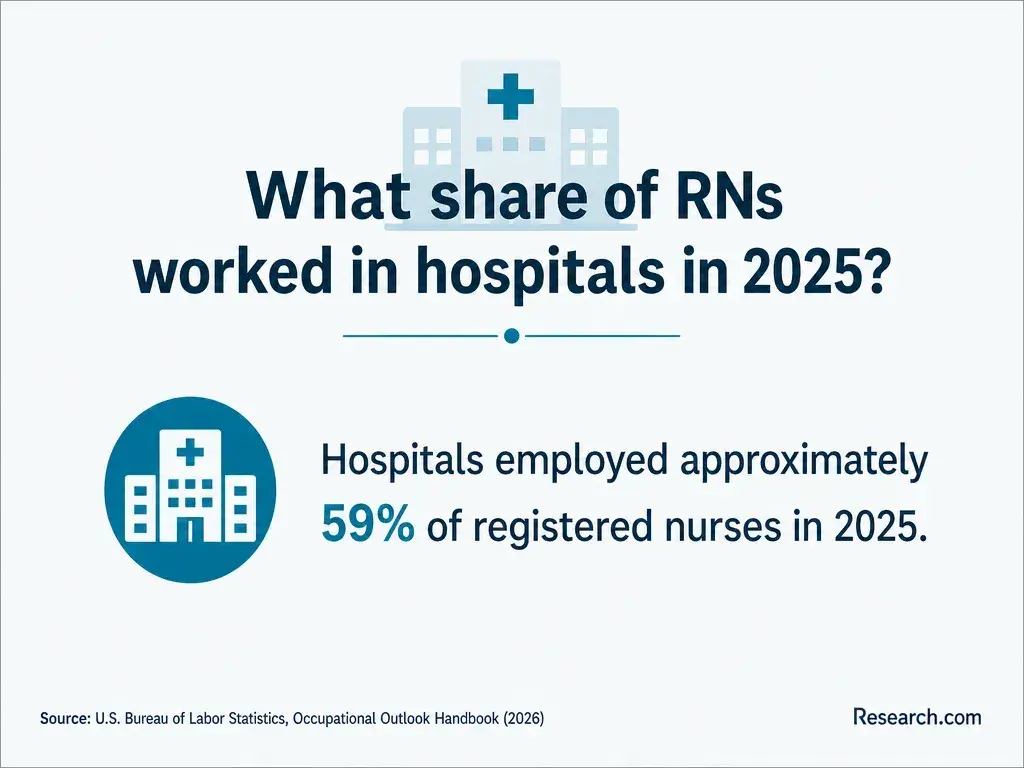
What nursing careers use statistics, and what salaries and job outlooks apply?
Bedside and ambulatory RNs use statistics to interpret evidence and monitor patient or unit trends. Quality and safety nurses work more directly with measures and reporting; informatics nurses examine data quality and workflows; nurse researchers use study design and analysis. Advanced practice nurses also interpret research, although their clinical authority depends on the appropriate education, certification, and state authorization - not statistical skill alone.
Pay and outlook should be checked against the specific occupation, location, and experience level. The U.S. Bureau of Labor Statistics reports occupation-wide median wages and employment projections for categories such as registered nurses and nurse practitioners; it does not publish a single salary for "nurses who use statistics." Those medians are not starting offers, specialty premiums, or returns guaranteed by a degree. Compare the latest published BLS occupation profile with local job postings and the credentials each employer actually requests.
If a PMHNP role is the goal, weigh PMHNP education costs and program choices against the full clinical and credential pathway, not an occupation-wide wage alone. If the goal is better data use in a current RN job, employer-supported quality-improvement training or continuing education may be more appropriate than another degree.
Other Things You Should Know About Nursing
Usually not for introductory statistics or evidence appraisal. Check your program's math prerequisites; interpreting percentages, graphs, and uncertainty is more immediately useful for most nursing coursework.
No. A calculator can produce a result, but it cannot establish whether the sample, outcome measure, comparison, or study design supports the conclusion.
Yes, if they describe their actual role and skills accurately. Do not claim that a classroom exercise improved patient outcomes or include patient-identifiable or confidential institutional information.
Generally, no. Start with the duties and qualifications in the jobs you want. A targeted course may help with a data-heavy role, but it does not replace required nursing licensure or relevant experience.
- A Primer on the Validity of Assessment Instruments - PMC - NIH https://pmc.ncbi.nlm.nih.gov/articles/PMC3184912/
- Educating Nurses for the Future - NCBI - NIH https://www.ncbi.nlm.nih.gov/books/NBK573912/
- A Practical Guide to QI Data Analysis: Run and Statistical Process Control Charts - PubMed https://pubmed.ncbi.nlm.nih.gov/38148740/
- Why we need to discuss statistical significance and p-values (again) | sagepub.com https://journals.sagepub.com/doi/10.1177/20571585241253177
- The impact of nurse staffing on falls performance... - DukeSpace https://dukespace.lib.duke.edu/server/api/core/bitstreams/7cd8352f-4e7d-41cc-b180-291dac268bec/content
- Statistical Process Control Charts | umaryland.edu https://cf.son.umaryland.edu/NRSG795/V2/module11/subtopic5.htm