2027 Fertility Clinic Nurse Orientation: Training, Competency Reviews, and Support to Compare
Audited and Verified:
Our Editorial and Data Verification Process
Research.com uses government datasets, official education statistics and primary institutional information to support its career and degree guides. Our review process checks factual accuracy, occupational definitions, source dates and the requirements associated with the credentials discussed.
How This Article Was Fact-Checked
Our editorial team verifies salary estimates, employment projections, education requirements and program information against original data providers and official organizations. Salary figures are checked against the relevant occupational definitions and reporting periods. Information about licensure, accreditation and required in-person training is reviewed separately.
Fact-checked and verified on:

Co-Founder and Chief Data Scientist
A fertility clinic nurse may move quickly between patient teaching, treatment coordination, time-sensitive messages, and emotionally difficult conversations. That makes orientation more than a tour of the clinic: it is the period when an RN learns local protocols and demonstrates safe practice with support. Whether you are a nursing student considering the specialty or an experienced RN comparing job offers, this guide explains what training and competency reviews should cover, which qualifications matter, and how to judge whether a clinic will support you after onboarding.
Key Things You Should Know
- Look for a supervised progression from observation to assigned work, with documented competency reviews and a named person to contact when a treatment plan or patient concern needs escalation.
- An RN license is the usual starting credential for RN fertility clinic roles; specialty orientation is employer training, not a substitute for licensure or proof of independent competence.
- Compare at least three parts of an offer separately: the orientation schedule, how skills are assessed, and the support available when patient volume or time-sensitive work increases.
What does fertility clinic nurse orientation typically include?
Fertility clinic nurse orientation is employer-led onboarding for reproductive endocrinology and infertility (REI) services. Its content depends on the clinic, the RN's prior experience, and the assigned duties. An experienced ambulatory nurse may need less general workflow training than a new graduate, but neither should be assumed competent with a clinic's fertility protocols without assessment.
A useful orientation starts with observation and supervised work, then increases responsibility as the nurse demonstrates readiness.
It may cover intake and history workflows, treatment calendars, patient education, medication-teaching processes, specimen identification and handoffs, electronic health record documentation, privacy, and communication with clinicians, embryology staff, and patients.
Nurses also need to know who gives orders, who communicates results, and what to do when instructions conflict or a concern arises outside usual hours.
Ask for the actual onboarding plan rather than a promised number of weeks. A clinic may have a short formal orientation but provide continuing preceptor access; another may offer a longer schedule without protected teaching time. Confirm whether a preceptor has scheduled time to observe work, how increasing patient assignments are decided, and what happens if a competency needs more practice.
Employer orientation is distinct from a school-approved clinical placement. Someone comparing family NP placement policies before enrollment should not assume that hours worked in a fertility clinic will satisfy a graduate program's supervised clinical requirements.
What education and licensing are required to become a fertility clinic nurse?
For a fertility clinic RN position, the usual pathway is to complete an approved prelicensure nursing program, meet the applicable state board's requirements, pass the NCLEX-RN, and obtain an active RN license. An ADN or BSN can provide the initial educational route; individual employers may prefer a BSN or prior ambulatory, women's health, or procedural experience. Graduation and NCLEX passage alone are not an active license.
Clinics may also employ LPNs/LVNs and medical assistants, but their permitted duties and required supervision differ by state and employer. If your goal is a practical nursing role rather than an RN position, exploring faster routes into practical nursing education can help frame the initial education decision. An LPN/LVN program does not itself qualify a graduate for an RN job.
Before applying, compare a posting's license requirement and duties with your state's scope-of-practice rules. Ask the clinic which tasks belong to RNs, which require a prescribing clinician's order, and whether it hires and trains nurses without prior fertility experience.
How do nurses train for reproductive endocrinology and infertility care?
Most RN specialty learning occurs through a combination of clinic protocols, preceptor observation, supervised patient care, case discussion, and continuing education. Training should connect the treatment schedule to the nurse's actual responsibilities: explaining approved instructions, coordinating follow-up, recognizing information that needs clinician review, documenting accurately, and avoiding independent changes to a prescribed plan.
REI work can involve rapid changes in scheduling and emotionally sensitive results. A strong preceptor demonstrates how to confirm instructions and close communication loops without expecting a new nurse to memorize every protocol immediately. Simulation or case review can help a nurse rehearse uncommon situations, but neither replaces observed performance in the clinic.
Graduate study is a separate decision. An RN seeking an advanced practice role should compare the required population-focused education, certification, and state authorization - not treat accelerated family NP study options as a substitute for fertility clinic orientation or as automatic preparation for every REI duty. For many RN clinic roles, targeted employer training is more directly relevant than another degree.
A competency review should test what the nurse can do in the assigned role, not merely whether they attended a presentation. The following areas are especially useful to ask about because an error or missed handoff can affect time-sensitive care:
- Patient identification and documentation: using the clinic's verification steps, recording teaching and communications, and protecting confidential information.
- Medication education and safety: explaining clinician-approved instructions within RN scope, checking understanding, and escalating discrepancies rather than improvising a treatment change.
- Care coordination: tracking ordered follow-up, communicating across nursing, prescribing, laboratory, and embryology teams, and confirming responsibility for unresolved items.
- Clinical judgment and escalation: recognizing concerns that require prompt assessment or clinician input under clinic policy.
- Patient-centered communication: responding respectfully to uncertainty, loss, financial stress, and different family-building circumstances.
Reviews may combine direct observation, chart audits, teach-back demonstrations, and discussion of scenarios. Ask who signs off each competency, what evidence is recorded, and whether the nurse receives a remediation plan and another observation when needed. A signed checklist should reflect demonstrated performance; it should not be treated as permanent proof of readiness for every assignment.
Keep employer competency records separate from academic requirements. Even when comparing doctoral nursing application requirements, prior orientation records may document experience without replacing a receiving program's admission, coursework, or clinical rules.
Students do not generally need an REI-specific undergraduate major to pursue an RN clinic role. A nursing curriculum's anatomy and physiology, pharmacology, health assessment, reproductive and maternal health content, patient education, ethics, and clinical judgment provide a foundation.
Coursework becomes more useful when students practice explaining complex instructions, documenting accurately, and identifying when a patient question exceeds their authority.
Clinical exposure in ambulatory care or women's health can help a student assess the setting, but a placement in another specialty does not establish fertility-clinic competence. Seek relevant experiences where available, then ask prospective employers how they train nurses whose reproductive health exposure is limited.
For someone with a prior non-nursing bachelor's degree, ABSN options for second-degree applicants may be worth comparing with ADN routes. Check prerequisites, supervised clinical arrangements, total cost, and eligibility for initial RN licensure; the previous degree alone does not confer an RN license.
Online coursework can teach nursing theory and support case-based learning, but initial RN preparation also requires program-approved, hands-on clinical education. An "online" prelicensure program may still require in-person labs, simulation, campus visits, and supervised placements. Confirm the exact requirements and whether the program can enroll you and support licensure eligibility in your state.
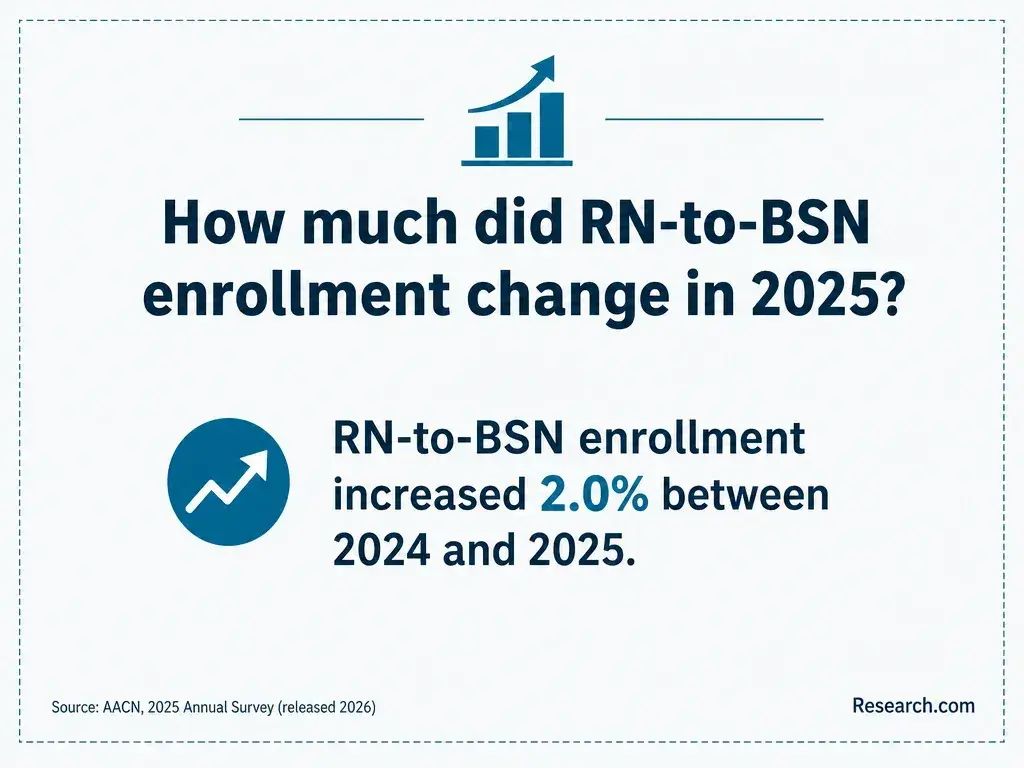
For an already-licensed RN, an online RN-to-BSN program can advance academic preparation while the employer provides fertility-specific onboarding. A guide to RN-to-BSN programs with no clinicals can help frame questions about a program's practice-based assignments, but it does not replace a clinic's observed competency review. Before enrolling, ask what must occur in person and how those commitments fit your work schedule.
The timeline depends first on whether you already hold an RN license. An unlicensed applicant must complete a qualifying nursing program and obtain licensure before starting an RN role; a licensed RN may be able to enter a clinic's orientation directly if hired.
Program length varies with prerequisites, course sequencing, enrollment intensity, and clinical availability. Clinics likewise set their own orientation schedules, so an advertised duration is less informative than the required milestones and available support.
Compare costs at the stage that applies to you. Initial nursing education can involve tuition, fees, books, equipment, travel to clinical sites, and licensure expenses.
A working RN considering another degree should include lost work time and employer tuition assistance - but should first ask whether the role actually requires that degree. A BSN-to-MSN program affordability guide is relevant if graduate study serves a defined career goal, not simply because a clinic offers an RN opening.
Request a written estimate of required education expenses and a written explanation of orientation pay, scheduling, and any training repayment agreement. Those figures are more useful for your decision than a generic national price for nursing school.
An active RN license is a legal practice credential; a specialty certification is an additional professional credential. Neither a continuing-education course certificate nor completion of clinic orientation is the same as board certification. Before paying for a credential, verify its awarding organization's current eligibility, examination, renewal, and fee rules, then check whether employers for your target role value it.
Depending on a nurse's duties and career stage, relevant professional development might include reproductive health education or a recognized credential aligned with ambulatory or women's health practice. Do not assume a broadly related credential specifically validates REI competence.
An NP credential is relevant only to someone pursuing the corresponding advanced practice role through qualifying education and authorization; cost comparisons across online NP pathways address a much larger decision than RN fertility-clinic onboarding.
For an RN starting in fertility care, a clinic with structured supervision and credible competency assessment may offer more immediate value than an optional certificate with no clear connection to assigned duties.
Fertility clinics may hire RNs for patient education, cycle coordination, telephone triage under clinic protocols, procedural support, or team coordination. Responsibilities vary by employer. A lead nurse may help with workflow and precepting, while an advanced practice position requires its own qualifying education, certification, and state authorization. A job title alone does not establish scope of practice.
The U.S. Bureau of Labor Statistics reports wages and projected employment for the broader registered nurse occupation, not a separate fertility-clinic RN category. Its RN figures can provide labor-market context, but they cannot predict a clinic offer: geography, experience, duties, schedule, and employer type matter.
Compare an offer's base pay with paid orientation time, call or weekend expectations, benefits, staffing, and advancement opportunities.
Career changers should separate entry into nursing from entry into fertility care. For a non-nurse, comparing online MSN entry options for non-nurses may clarify one possible initial-licensure route, but a qualifying degree, RN licensure, hiring, and specialty orientation remain distinct steps.
How can nurses compare reputable fertility nursing training programs?
"Training program" can mean a nursing degree, an employer's new-hire orientation, or continuing education. Evaluate each against the outcome you need. A school is responsible for its curriculum and approved clinical preparation; a state board determines licensure; an employer assesses readiness for its assigned work. A certificate provider cannot grant those other approvals.
When comparing clinic offers, request the following details from the nurse manager or educator. Specific answers make it easier to distinguish a supported transition from one that relies on informal shadowing:
- Ask for the orientation schedule, named preceptor, protected teaching time, and criteria for increasing assignments.
- Request the competency checklist and ask which skills require direct observation, who signs them off, and how additional practice is arranged.
- Clarify patient volume, after-hours coverage, access to prescribing clinicians, and escalation processes once orientation ends.
- Ask how nurses receive protocol updates, continuing education, and support after a difficult event or an identified error.
If your longer-term goal is training leadership, ask whether the employer values educator experience or formal graduate preparation before considering advanced nursing leadership doctorates online. A doctorate is not a prerequisite for learning an RN fertility-clinic role, and its coursework does not replace supervised onboarding. Choose the offer or program that can show how it develops and checks the competencies your intended job actually requires.
Other Things You Should Know About Nursing
Yes, if a clinic hires new graduates and provides suitable supervision. Ask whether its orientation has been designed for nurses without prior ambulatory or fertility experience.
It should explain the workflows needed for your job. Ask whether you can practice documentation with a preceptor and where to get help when a record or message is unclear.
Possibly. Coverage depends on the clinic's services and staffing model. Get the expected schedule, call duties, and compensation terms before accepting an offer.
Tell your preceptor or manager which tasks still need supervision and request a documented plan for additional practice and reassessment. Do not treat a calendar end date as a substitute for demonstrated readiness.
- Nursing Rights of Medication Administration - StatPearls - NCBI https://www.ncbi.nlm.nih.gov/books/NBK560654/
- Reproductive endocrinology and infertility nurse online... - PMC https://pmc.ncbi.nlm.nih.gov/articles/PMC10774875/
- Safe Medication Administration: Facilitator Guide | Agency for Healthcare Research and Quality https://www.ahrq.gov/patient-safety/settings/labor-delivery/perinatal-care/modules/strategies/medication/safe-medication-fac-guide.html
- 50 Nursing Certifications to Increase Your Salary | nurse.com https://www.nurse.com/blog/24-nursing-certifications-to-boost-your-career/
- Oversight of Assisted Reproductive Technology | American Society for Reproductive Medicine https://www.asrm.org/advocacy-and-policy/fact-sheets-and-one-pagers/oversight-of-art/
- Advanced Practice Registered Nurse (APRN) Career Guide | Nursing License Map https://nursinglicensemap.com/advanced-practice-nursing/
- Assisted Reproductive Technologies patient education booklet | ReproductiveFacts.org https://www.reproductivefacts.org/news-and-publications/fact-sheets-and-infographics/assisted-reproductive-technologies-booklet/