2027 DNP Psychiatric-Mental Health NP Programs for Nurses in Wisconsin: BSN and MSN Entry Routes and Clinical Training
Audited and Verified:
Our Editorial and Data Verification Process
Research.com uses government datasets, official education statistics and primary institutional information to support its career and degree guides. Our review process checks factual accuracy, occupational definitions, source dates and the requirements associated with the credentials discussed.
How This Article Was Fact-Checked
Our editorial team verifies salary estimates, employment projections, education requirements and program information against original data providers and official organizations. Salary figures are checked against the relevant occupational definitions and reporting periods. Information about licensure, accreditation and required in-person training is reviewed separately.
Fact-checked and verified on:

Co-Founder and Chief Data Scientist
For a Wisconsin nurse considering psychiatric-mental health nurse practitioner practice, the first choice is not simply which DNP school to attend. It is whether the program accepts your current degree, provides PMHNP preparation across the lifespan, and can support approved clinical training where you can complete it.
This guide compares BSN- and MSN-entry routes, explains the questions to ask about accreditation, placements, cost, and certification, and identifies when a shorter PMHNP pathway may meet your goal without a DNP.
Key Things You Should Know
- A BSN-to-DNP PMHNP route prepares an RN for a new advanced practice role; an MSN-to-DNP route may not provide PMHNP preparation unless that specialty is explicitly included.
- DNP programs commonly account for at least 1,000 post-baccalaureate practice hours, but a school must determine which documented prior hours count and which PMHNP experiences remain necessary.
- Before enrolling, confirm three separate outcomes: eligibility for the PMHNP certification examination, Wisconsin advanced practice authorization, and approved clinical placements you can actually attend.
What are DNP psychiatric-mental health nurse practitioner programs in Wisconsin?
A Doctor of Nursing Practice (DNP) PMHNP program combines practice-focused doctoral study with education for the psychiatric-mental health nurse practitioner role.
PMHNP preparation addresses mental health assessment and treatment across the lifespan, while doctoral study adds advanced evidence appraisal, systems improvement, and a practice-focused project. A DNP in leadership or another specialty is not automatically a PMHNP program.
Wisconsin nurses can investigate PMHNP DNP offerings at institutions such as the University of Wisconsin-Madison and the University of Wisconsin-Milwaukee. Treat any school name as a starting point, not confirmation that its PMHNP track is admitting students through your intended entry route or at your preferred location. Request the current track-specific curriculum and written eligibility information before applying.
A useful distinction is that a guide to DNP programs without traditional clinicals may describe non-NP doctoral tracks. It does not establish that a new PMHNP can qualify without supervised specialty patient-care experiences.
What are the BSN-to-DNP and MSN-to-DNP entry routes for Wisconsin nurses?
Your existing license and graduate preparation determine which route is plausible. The comparison below separates a pathway that teaches a new NP role from a doctorate that may build on an NP role you already hold.
| Starting point | Potential route | Decision-critical question |
| RN with a BSN | BSN-to-DNP with a PMHNP track | Does the track provide the coursework and supervised care required for initial PMHNP certification eligibility? |
| RN with a non-APRN MSN | PMHNP-focused post-master's preparation, possibly combined with a DNP | Will the school complete a formal gap review rather than treating the MSN as prior NP preparation? |
| Certified NP in another population focus | PMHNP post-graduate specialty preparation, with a DNP if desired | Which PMHNP courses and direct-care experiences are still required? |
| Already-certified PMHNP with an MSN | Post-master's DNP | Does the nurse need doctoral practice preparation rather than another PMHNP qualification? |
An RN seeking PMHNP practice may find an accredited PMHNP MSN or post-graduate certificate more direct than a DNP; the doctorate is not inherently required for NP certification.
A person without an RN license needs a different starting point. Comparing online MSN entry options for non-nurses can clarify initial nursing routes, but a direct-entry degree should not be mistaken for automatic PMHNP or Wisconsin APRN eligibility.
What accreditation and licensing requirements apply to Wisconsin PMHNP students?
Check institutional accreditation, the nursing program's applicable accreditation, and the exact PMHNP track's certification-eligibility statement.
These answer different questions: accreditation concerns educational oversight; the certifier determines examination eligibility; and the Wisconsin Board of Nursing determines state practice authority. If you plan to live or complete clinical work outside Wisconsin, ask the school about enrollment authorization and placement eligibility in that state as well.
Before paying a deposit, obtain written answers on whether graduates of your entry route qualify to apply for the American Nurses Credentialing Center (ANCC) PMHNP certification examination and what Wisconsin requires for advanced practice after certification. Keep your RN license in the status required by the program and regulators. Graduation, national certification, and Wisconsin authorization are separate steps.
Admission tests are another separate matter. Test-policy comparisons across nursing schools concern school admissions; a TEAS or HESI policy says nothing about PMHNP board-certification or state practice requirements.
Expect a review of your nursing degree, RN license, transcripts, graduate readiness, professional references, and statement of purpose. Schools may also request a résumé, interview, minimum GPA, statistics preparation, or relevant nursing experience.
An MSN applicant should be ready to supply course descriptions and documented supervised clinical hours for a specialty-specific gap analysis. Requirements and deadlines vary by school and entry route.
Admissions staff should confirm whether psychiatric nursing experience is required or preferred, whether your prior graduate courses can satisfy specific requirements, and whether your proposed clinical location is feasible. Acceptance into a university is not necessarily acceptance into its PMHNP track or approval of a future clinical site.
An applicant who is currently an LPN must first identify an RN-licensure pathway; LPN experience alone does not meet an RN-only DNP entry requirement. Shorter LPN education program comparisons describe a different licensed-nursing entry point, not a bridge directly into PMHNP practice.
The meaningful difference is where and when you must learn, not whether clinical practice can be skipped. Online coursework can still include scheduled discussions, examinations, skills assessments, and required campus visits.
Hybrid programs deliberately combine remote study with on-site sessions; campus-based programs may make in-person faculty contact easier but can require more frequent travel.
Ask each school for a term-by-term calendar showing live sessions, campus intensives, simulation, and clinical days. Also ask who finds and approves preceptors, whether rural or out-of-state sites are permitted, and what happens if a placement falls through. These details matter more to a working nurse's schedule than an "online" label.
Do not transfer assumptions from exploring RN-to-BSN nontraditional clinical formats to PMHNP study. RN-to-BSN completion and preparation for a new advanced practice patient-care role have different clinical objectives.
PMHNP study typically integrates advanced health assessment, pathophysiology, pharmacology, psychiatric diagnosis, psychopharmacology, psychotherapy approaches, and care across age groups. DNP coursework adds evidence appraisal, quality improvement, population health, and an applied practice project. The school's curriculum, not the degree title, shows how these elements fit together.
Clinical training should provide faculty-supervised, program-approved experience with psychiatric-mental health patients and qualified preceptors. Ask how the program develops experience across the lifespan and settings, documents patient-care hours, evaluates competency, and distinguishes clinical hours from simulation, paid RN work, and DNP project hours. The school and certifier determine which experiences satisfy their respective requirements; prior hours do not transfer automatically.
A DNP project addresses a practice problem and requires appropriate site permission, privacy safeguards, and institutional oversight. It is not a substitute for supervised PMHNP patient care.
If your primary goal is NP qualification rather than doctoral preparation, compare the curriculum and clinical access with psychiatric MSN study with condensed timelines; a shorter calendar still needs to accommodate required clinical learning.
A BSN-entry DNP generally takes longer than a post-master's DNP because it must incorporate graduate NP preparation. An MSN does not necessarily shorten the route substantially.
A non-APRN MSN holder may still need the full PMHNP specialty sequence. Part-time enrollment, course sequencing, placement availability, and accepted prior practice hours can change the completion date. Request a personalized degree plan rather than relying on an advertised minimum.
Compare total cost to completion, not tuition alone. Have each school calculate tuition under your residency and enrollment status, mandatory fees, expected terms, and any charges for continuing project enrollment.
Add travel and lodging for campus visits, clinical-site travel, background checks, health requirements, books, certification and licensing expenses, and income lost if clinical schedules reduce work hours. No reliable school-specific price is interchangeable across applicants without those assumptions.
PMHNP programs compared by tuition can help identify alternatives, but confirm whether each quoted option awards an MSN, certificate, or DNP and whether its clinical-placement arrangements work for Wisconsin. A lower tuition figure is not a lower total cost if it requires extra travel, terms, or unpaid time away from work.
For a graduate seeking initial PMHNP practice, the usual sequence is to complete an eligible PMHNP track, apply for the ANCC Psychiatric-Mental Health Nurse Practitioner (Across the Lifespan) certification examination, pass it, and complete Wisconsin's applicable advanced practice authorization requirements.
Verify the certifier's current eligibility guide and the Wisconsin Board of Nursing's current application and practice rules before graduation; the school can document education but cannot issue either credential.
Already holding another NP certification does not make its population focus interchangeable with psychiatric-mental health. For example, online family NP certificate coursework comparisons address FNP preparation, not the PMHNP education and examination needed for a psychiatric specialty change. Employers may also require credentialing and setting-specific onboarding after state authorization.
PMHNPs may work in outpatient mental health clinics, integrated primary care, hospitals, community programs, or telehealth services, subject to licensing and employer requirements.
Duties can include psychiatric evaluation, treatment planning, medication management where authorized, psychotherapy within demonstrated competence, and coordination with other clinicians. A new graduate should evaluate orientation and consultation support alongside the position's caseload and scope.
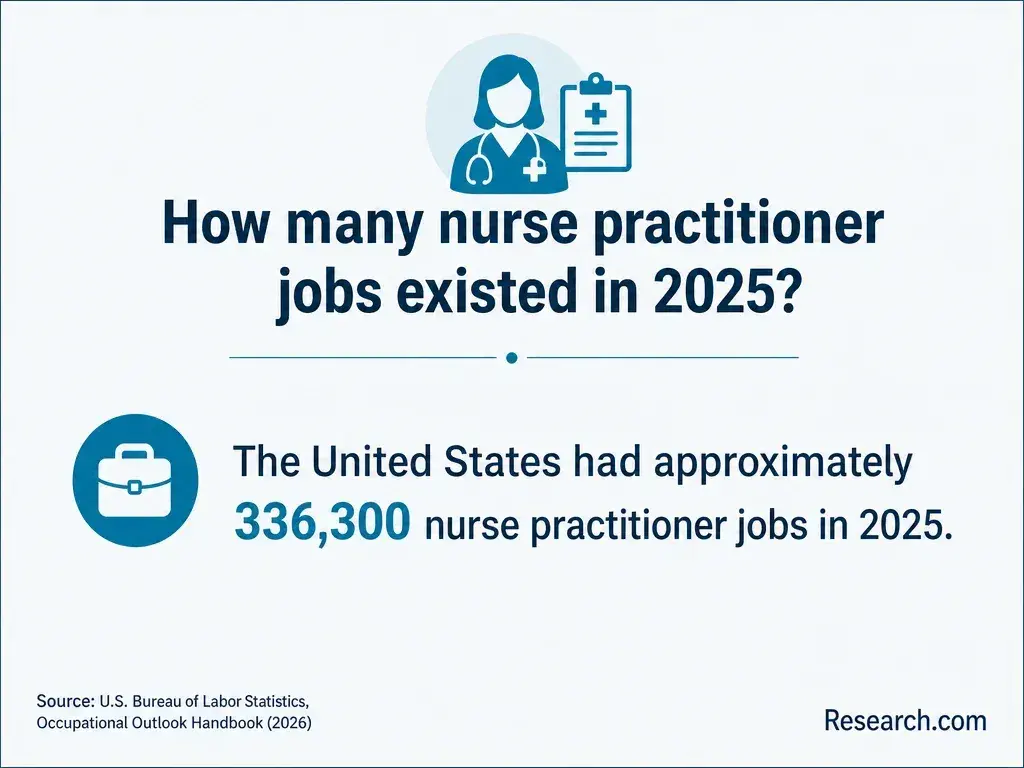
The U.S. Bureau of Labor Statistics reports wages for nurse practitioners as an occupation, not separate Wisconsin PMHNP wages or DNP-graduate salaries. Consequently, a national NP median cannot predict an offer for a Wisconsin psychiatric role.
Compare actual offers by base pay, benefits, call expectations, patient volume, administrative time, supervision or collaboration arrangements, and whether the employer pays for continuing education and credentialing.
Do not assume a DNP produces a salary premium over an MSN-prepared PMHNP doing the same job. When weighing the added doctoral expense, BSN-to-MSN tuition and fee considerations offer a useful cost-comparison framework, provided the MSN option actually includes qualifying PMHNP preparation.
What is the job outlook for psychiatric-mental health nurse practitioners in Wisconsin?
National BLS nurse practitioner projections indicate demand for the broader occupation, but they do not separately forecast Wisconsin PMHNP openings. Statewide NP projections likewise may not distinguish psychiatric specialties, rural vacancies, telehealth positions, or employers willing to hire a new graduate. Use those figures as market context, not a promise of local employment.
For a useful local assessment, review current Wisconsin postings in your intended region and setting. Separate jobs that accept new PMHNPs from those requiring independent experience, and note expectations for child, adult, or substance-use care. Ask prospective clinical partners and employers about preceptor availability and graduate onboarding; training capacity and hiring demand are related but not identical.
If projected earnings are central to your decision, compare realistic local offers with your complete education budget. Online NP tuition and fee considerations can help organize that comparison, but neither a growth projection nor an attractive tuition listing establishes a personal return on investment.
Other Things You Should Know About Nursing Programs
Not automatically. Practice is generally regulated where the patient is located. Check that state's licensing, prescribing, and telehealth rules before accepting patients there.
Yes, within appropriate education, demonstrated competence, and employer requirements. Because PMHNP certification covers the lifespan, ask prospective programs and clinical sites about meaningful child and adolescent experience if that is your career goal.
No. It can strengthen an application and clinical judgment, but RN employment is not automatically accepted as supervised NP student practice. The program evaluates any proposed prior-hour credit.
Not for every teaching role. Requirements vary by employer, course, and faculty position. If teaching is the main goal, compare the position's qualifications with an MSN, educator preparation, and a DNP before choosing another degree.
- Advanced Practice Registered Nurse (APRN) - DSPS https://dsps.wi.gov/a-z-professions-list/advanced-practice-registered-nurse-aprn/
- Facilitating Well-Rounded Clinical Experience for Psychiatric Nurse Practitioner Students | nih.gov https://pmc.ncbi.nlm.nih.gov/articles/PMC9760220/
- Psychiatric Mental Health Nurse Practitioner (PMHNP) | umkc.edu https://sonhs.umkc.edu/admissions/pmhnp.php
- BSN to DNP - Psychiatric Mental Health Nurse Practitioner | Herzing University https://www.herzing.edu/nursing/dnp/bsn-to-dnp/pmhnp
- Psych Mental Health Nurse Practitioner (PMHNP) | Bulletins https://www.uwosh.edu/nhp/graduate/certificate/psych-mental-health-nurse-practitioner-pmhnp/
- Psychiatric Mental Health Nurse Practitioner - UWM Catalog https://catalog.uwm.edu/health-professions-sciences/nursing/nursing-practice-psychiatric-mental-health-nurse-practitioner-dnp/
- Psychiatric Mental Health Nurse Practitioner Clinical Practicum Information and Process | Bellin College https://catalog.bellincollege.edu/psychiatric-mental-health-nurse-practitioner-clinical-practicum-information-and-process
- MSN to DNP: How the post-master's path works and how long it takes | Chamberlain University https://www.chamberlain.edu/blog/msn-to-dnp-how-the-post-masters-path-works-how-long-it-takes-and-what-to-check
- Psychiatric Mental Health - School of Nursing | Academic Affairs https://uwm.edu/nursing/academics/psychiatric-mental-health/
- Graduate Programs in the United States | APNA https://www.apna.org/about-psychiatric-nursing/graduate-programs/graduate-programs-in-the-united-states/