2027 DNP Family NP Programs for Nurses in South Dakota: BSN and MSN Entry Routes and Clinical Training
Audited and Verified:
Our Editorial and Data Verification Process
Research.com uses government datasets, official education statistics and primary institutional information to support its career and degree guides. Our review process checks factual accuracy, occupational definitions, source dates and the requirements associated with the credentials discussed.
How This Article Was Fact-Checked
Our editorial team verifies salary estimates, employment projections, education requirements and program information against original data providers and official organizations. Salary figures are checked against the relevant occupational definitions and reporting periods. Information about licensure, accreditation and required in-person training is reviewed separately.
Fact-checked and verified on:

Co-Founder and Chief Data Scientist
A South Dakota nurse choosing a DNP family nurse practitioner program needs to know more than whether the coursework is online. A BSN-prepared RN needs an FNP track that provides the full advanced-practice curriculum; an MSN-prepared nurse may need either that same preparation or only a doctoral completion route, depending on prior credentials. Clinical-site access can determine whether either route is workable.
This guide explains the entry paths, academic and supervised clinical requirements, costs, and credentialing steps so you can identify a program that fits your current preparation and intended practice.
Key Things You Should Know
- A BSN-to-DNP FNP route prepares an RN for a new NP population focus; an MSN-to-DNP route may add a doctorate without providing FNP preparation. Confirm the exact track before applying.
- Compare three separate requirements: advanced-practice coursework, supervised FNP patient care, and the DNP practice project. Prior employment does not automatically replace any of them.
- Graduation is not practice authorization. Graduates must meet FNP certification requirements and obtain South Dakota APRN authority before practicing as FNPs in the state.
What are DNP family nurse practitioner programs in South Dakota?
A Doctor of Nursing Practice (DNP) FNP program combines practice-focused doctoral study with education in primary care across the lifespan. The FNP track, not the DNP letters alone, is what addresses the family nurse practitioner population focus. Students develop advanced assessment, diagnosis, treatment-planning, and prevention skills under supervision while completing doctoral work in evidence-based practice and systems improvement.
These are postlicensure programs for nurses, not routes to an initial RN license. Someone who has not yet become an RN should begin with entry-level nursing degree comparisons rather than apply directly to an FNP DNP. For an RN, the first decision is whether the program actually supplies new FNP preparation or assumes the applicant already has it.
Which South Dakota DNP FNP programs accept BSN or MSN applicants?
South Dakota State University (SDSU) is a South Dakota institution to investigate for a BSN-to-DNP family nurse practitioner track. Do not assume its post-master's DNP admission route also admits an MSN graduate who lacks FNP preparation: a doctoral completion route and an FNP-qualifying track have different purposes. Ask the nursing program for the catalog and admissions requirements governing your intended entry term.
The comparison below identifies what each applicant needs to establish. It is a pathway comparison, not a claim that a particular school offers every route shown.
| Applicant's starting point | Appropriate route to investigate | Question that determines fit |
| RN with a BSN | BSN-to-DNP FNP | Does the track include all FNP coursework and supervised clinical preparation? |
| RN with a non-APRN MSN | FNP-qualifying post-master's track or BSN-to-DNP FNP with an individual credit review | Which prior courses apply, and what FNP requirements remain? |
| Already-certified FNP with an MSN | Post-master's DNP completion | Will the program accept prior graduate coursework and documented practice hours? |
An ADN-prepared RN who lacks the required bachelor's credential must address that entry gap first. Online ADN-to-MSN program comparisons can help identify a possible bridge, but only the receiving DNP program can decide whether the resulting credentials meet its admission rules.
What are the admission requirements for South Dakota DNP FNP programs?
Expect a review of your nursing degree, RN license, academic record, and readiness for graduate study. A school may also request recommendations, a statement of goals, a résumé, an interview, or evidence of relevant nursing experience. MSN applicants should be prepared to submit course descriptions and records of supervised graduate clinical hours so faculty can evaluate what, if anything, applies to the FNP track.
Before paying an application fee, request written answers on two points: whether your existing degree qualifies for the FNP track specifically, and whether you can complete its clinical work in your proposed location. Academic admission does not by itself establish clinical-site eligibility. An RN educated outside the United States should ask about credential evaluation and state licensing requirements rather than assume an overseas degree will be treated as a US BSN or MSN.
Undergraduate entrance-test policies are not a reliable guide to doctoral admission. Lists of schools' entrance exam policies for nursing applicants may concern prelicensure programs; check the DNP program's own graduate application instead.
Duration depends on entry credential, enrollment pace, course sequencing, clinical-site availability, and the DNP project. A BSN entrant generally has more advanced-practice coursework and supervised FNP care to complete than an already-certified MSN-prepared FNP entering a doctoral completion route. An MSN in education or leadership does not necessarily shorten FNP preparation substantially, because it does not establish FNP population-focus competence.
Request a term-by-term plan rather than relying on an advertised minimum. Check when FNP clinical courses start, whether they run every term, when project approvals must be obtained, and what happens if a placement is delayed. Working nurses considering shorter routes to a DNP degree should compare the routes' actual awards: the quickest doctoral completion program may not prepare a new FNP.
An FNP curriculum typically combines advanced pathophysiology, pharmacology, and health assessment with primary-care management across the lifespan. It also includes supervised clinical courses and doctoral study in evidence appraisal, population health, leadership, and quality improvement. Exact course titles, credit requirements, and project formats belong to the school's catalog for the student's entry term.
Population focus matters more than a shared DNP degree title. FNP coursework addresses family primary care; it does not substitute for psychiatric-mental health NP preparation. A nurse whose intended role is psychiatric care should compare that specialty's requirements, including psychiatric NP certificate length options if already appropriately graduate-prepared, rather than choose FNP coursework solely because a local DNP route is available.
Online coursework may reduce routine travel, but it does not make an FNP program fully remote or self-paced. Students still need approved, supervised patient-care experiences; programs may also require scheduled live classes, simulation, assessments, or campus visits. A campus-based route can make in-person faculty contact easier, but neither format guarantees a convenient clinical placement.
For a working RN, compare the actual weekly schedule and required travel against work and caregiving commitments. Ask whether the school arranges placements, assists with them, or requires students to identify potential sites. An ADN-prepared nurse considering RN-to-BSN education for working registered nurses should not carry expectations from that degree-completion format into an FNP track: advanced-practice clinical training is a different requirement.
A reliable total requires the program's current tuition schedule, required credits, fees, and a realistic completion plan. Published per-credit tuition alone will miss expenses associated with supervised care and any in-person requirements. Ask for an estimate using your entry status and any credits the program has formally accepted.
Include these items when comparing offers:
- Tuition and mandatory university or nursing-program fees for all required terms.
- Books, software, equipment, background checks, immunizations, and clinical compliance costs.
- Travel or lodging for campus activities and clinical sites, plus certification and licensing expenses.
- Lost earnings if clinical schedules require fewer paid work hours or an extra term.
If the goal is FNP practice rather than a doctorate specifically, compare the full DNP expense with an FNP-qualifying MSN. Cost-focused MSN pathways for bachelor's-prepared nurses offer a starting comparison, not proof that a particular MSN meets South Dakota certification or licensure needs. Confirm employer tuition-assistance terms and any aid eligibility with the school before counting either as savings.
FNP students complete supervised care with patients across the lifespan at sites and with preceptors approved by their program. Faculty evaluate whether encounters and demonstrated competencies meet course objectives. Clinical work as an RN, volunteer service, simulation, and previously completed graduate hours are not automatically interchangeable with these approved FNP experiences.
Placement responsibility is a practical screening test. Ask the program which sites and preceptors it can support in your area, who secures agreements, how preceptors are approved, and what happens if a site withdraws. Family nurse practitioner programs with placement services can provide a useful point of comparison, but "placement assistance" should be checked against the school's written responsibilities and geographic limits.
The DNP practice project is a separate supervised academic requirement. If it uses clinical or organizational data, the student needs the site's permission and must follow privacy and institutional review procedures. A proposed project does not establish access to patient records or approval to collect data.
Check the institution's accreditation, the nursing program's accreditation status and scope, and whether the specific FNP track meets applicable educational requirements. These are different questions from whether a student may enroll from a particular state. Obtain written confirmation from the program if you plan to complete clinical work outside South Dakota.
FNP graduates typically seek national certification through the American Nurses Credentialing Center or the American Academy of Nurse Practitioners Certification Board, subject to the chosen organization's current eligibility rules. They must separately meet South Dakota Board of Nursing requirements for APRN authority before practicing as FNPs in the state. An RN license, DNP diploma, certification examination result, and APRN authorization are distinct credentials or steps.
Be wary of treating a DNP advertised as having no new clinical rotations as an initial NP route. Comparing DNP practice and project requirements is most relevant to applicants who already hold the appropriate advanced-practice preparation; an RN newly entering the FNP role still needs the required supervised population-focus education.
What careers, salaries, and job outlook can South Dakota DNP FNP graduates expect?
With the required certification and state authority, an FNP may pursue primary-care work in clinics, community health settings, and other practices serving patients across the lifespan. Employers also assess experience, clinical fit, and onboarding needs. A DNP can support practice-improvement or leadership work, but it does not guarantee a supervisory job or a higher salary than an MSN-prepared FNP.
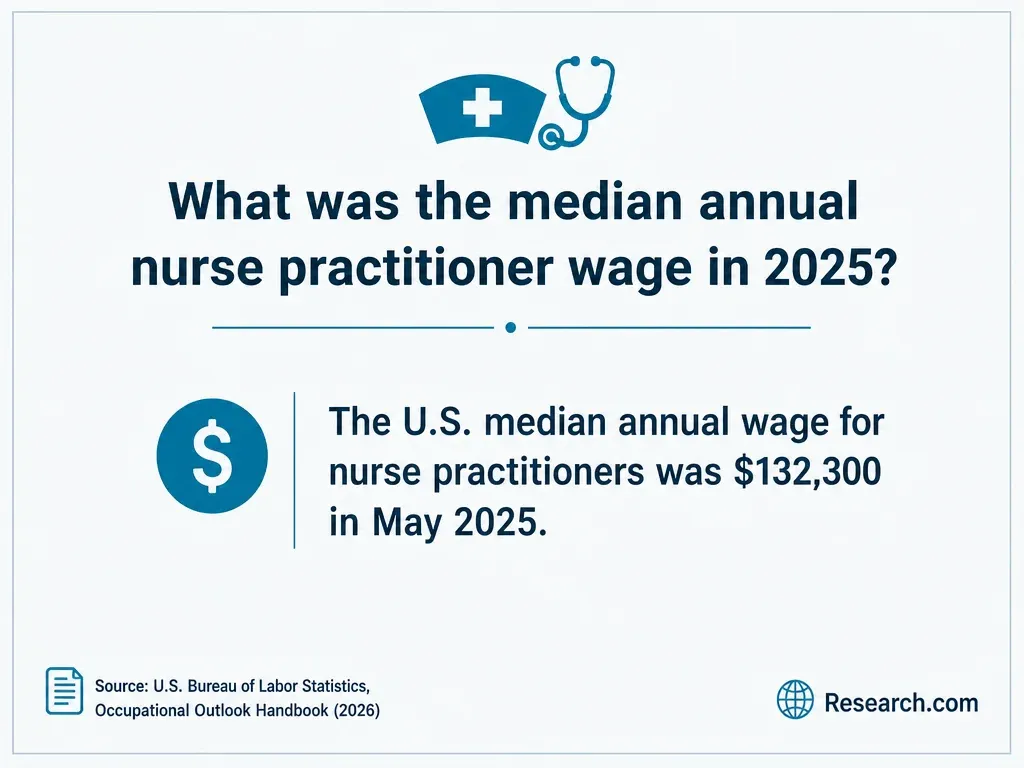
For earnings and outlook, use the US Bureau of Labor Statistics nurse practitioner occupation - not an RN wage or a claimed "DNP graduate salary" - as a national reference point. Occupational figures combine practitioners with different specialties, credentials, employers, and locations; they are not a South Dakota FNP offer. Compare actual local postings for scope of duties, compensation, call coverage, mentoring, and patient load before estimating a return on the degree.
If speed to FNP practice is the priority, investigate an eligible MSN route alongside the DNP. Consider comparing 12-month family NP programs, evaluated against your prior graduate preparation and the full time needed for clinical placement, certification, and licensure - not just their shortest published coursework schedule.
Other Things You Should Know About Nursing
No. Prescribing depends on obtaining the required state APRN authority and meeting applicable prescribing and controlled-substance requirements. Check the South Dakota Board of Nursing and the prospective employer's credentialing process before accepting prescribing duties.
Possibly, but employment there is not enough. The school must approve the site, preceptor, learning activities, and supervision; your employee duties may need to remain separate from student clinical time.
Not necessarily. A suitable project may address an approved practice or quality-improvement problem in another setting. Faculty and the host organization determine feasibility, permissions, data access, and required oversight.
No. Practice authority generally depends on where the patient is located and that jurisdiction's rules. Verify licensing and telehealth requirements for each state you intend to serve, along with employer policies.
- FY 2024 - South Dakota https://data.hrsa.gov/api/factsheet/3/46/2024
- Cost of Attendance (Budget) | 2025-2026 Federal Student Aid Handbook https://fsapartners.ed.gov/knowledge-center/fsa-handbook/2025-2026/vol3/ch2-cost-attendance-budget
- DEMSN, APRN-MSN, & Post-MSN Certificate Information | Alverno College Catalog https://catalog.alverno.edu/SON/BSNMSN/
- Bachelor's to DNP Family Nurse Practitioner | South Dakota State University https://www.sdstate.edu/nursing/graduate-nursing/bachelors-dnp-family-nurse-practitioner
- BSN Entry to DNP Application Requirements | ucsf.edu https://nursing.ucsf.edu/programs/doctoral-programs/bsn-entry-dnp-advanced-nursing-focus/bsn-entry-dnp-application
- Clinical Placements | Berkley School of Nursing https://nursing.georgetown.edu/degree-programs/online-nursing-programs/program-experience/clinical-placements/
- NP Clinical Hours, Preceptors and Placement Explained | Arkansas State University Online https://degree.astate.edu/online-programs/healthcare/msn/np-clinical-hours-and-placement/
- BSN to DNP Nurse Practitioner Admission Requirements | UTHealth Houston https://nursing.uth.edu/programs/dnp/bsn-to-dnp/admission-requirements
- Family Nurse Practitioner Degree Program | UC Davis Health https://health.ucdavis.edu/nursing/admissions/programs/DNP-FNP.html
- Admissions Requirements - Nurse Practitioner | Information Technology Services https://nursing.louisville.edu/admission/graduate-admissions/admissions-requirements-nurse-practitioner