2027 DNP Family NP Programs for Nurses in Nebraska: BSN and MSN Entry Routes and Clinical Training
Audited and Verified:
Our Editorial and Data Verification Process
Research.com uses government datasets, official education statistics and primary institutional information to support its career and degree guides. Our review process checks factual accuracy, occupational definitions, source dates and the requirements associated with the credentials discussed.
How This Article Was Fact-Checked
Our editorial team verifies salary estimates, employment projections, education requirements and program information against original data providers and official organizations. Salary figures are checked against the relevant occupational definitions and reporting periods. Information about licensure, accreditation and required in-person training is reviewed separately.
Fact-checked and verified on:

Co-Founder and Chief Data Scientist
A Nebraska nurse choosing a DNP family nurse practitioner program needs to establish more than whether a school awards a doctorate. The decisive question is whether the specific entry route provides any FNP education and supervised care experience the nurse still needs. This guide compares BSN and MSN entry, identifies Nebraska schools to investigate, and explains clinical placement, cost, certification, and licensure checks. It is designed to help licensed RNs and graduate-prepared nurses avoid paying for a doctorate that does not lead to their intended NP role.
Key Things You Should Know
- BSN-to-DNP FNP study generally combines initial family NP preparation with doctoral work; an MSN-to-DNP route may add only doctoral coursework, so confirm whether it actually includes FNP preparation.
- FNP graduates generally pursue certification through one of two organizations - the American Nurses Credentialing Center or the American Academy of Nurse Practitioners Certification Board - before seeking Nebraska APRN licensure.
- Compare the total cost of required credits, supervised clinical placements, campus visits, and reduced work hours; an online course schedule does not make patient-care rotations online.
What are DNP-FNP programs in Nebraska, and who are they designed for?
A Doctor of Nursing Practice (DNP) family nurse practitioner (FNP) program prepares nurses for advanced, family-focused primary care and practice-focused doctoral work. FNP preparation covers patients across the lifespan. The DNP is the academic degree; FNP is the population focus. Neither the degree title nor graduation alone grants authority to practice as a nurse practitioner.
BSN-entry routes suit licensed RNs who need their initial graduate FNP education as well as doctoral study. MSN-entry routes require a closer look: a post-master's DNP designed for an already-certified NP may not teach or assess a new FNP population focus. An MSN-prepared nurse from education or leadership, or an APRN changing specialties, should request a formal review of prior courses and supervised hours. A post-master's FNP certificate followed by a DNP may be more direct if the school does not offer a combined route.
An RN whose highest nursing credential is an associate degree should first check the school's entry rules rather than assume RN experience substitutes for a BSN. ADN-to-MSN bridge curriculum options can help frame that earlier educational step, but the receiving DNP program decides which credentials it accepts.
Which Nebraska schools offer BSN-to-DNP and MSN-to-DNP FNP programs?
University of Nebraska Medical Center (UNMC), Creighton University, and Nebraska Methodist College are Nebraska institutions to investigate for DNP and FNP study. Their catalogs, entry routes, and track availability can change. In particular, a school's separate FNP and post-master's DNP offerings do not establish that its post-master's route awards new FNP preparation.
The comparison below distinguishes the question a BSN-prepared applicant should ask from the additional question an MSN-prepared applicant must resolve. It is a shortlist for direct catalog and admissions verification, not a claim that every route is open for every entry term.
| School to investigate | BSN-prepared RN: verify | MSN-prepared nurse: verify |
| UNMC College of Nursing | Current BSN-to-DNP FNP track, campus requirements, and clinical geography | Whether post-master's study includes a new FNP track or only the DNP credential |
| Creighton University | Current FNP DNP entry route and required in-person learning | Eligibility for FNP preparation versus an existing-APRN post-master's DNP route |
| Nebraska Methodist College | Current FNP DNP availability, delivery format, and placement support | Whether an MSN entrant can add FNP preparation and how prior work is evaluated |
Ask each school for the catalog governing your intended start term and a written plan naming the degree, FNP track, required clinical experiences, and credential awarded. If you hold an ADN, exploring RN-to-BSN nontraditional clinical formats may help you compare a preliminary route to BSN-entry eligibility; it does not waive later FNP clinical requirements.
What are the admission requirements for Nebraska DNP-FNP programs?
Expect a school to review an RN license, qualifying nursing degree, transcripts and grades, professional references, and a statement of goals. Programs may also require RN experience, an interview, or particular undergraduate or graduate coursework. Requirements differ by institution and entry route; admission to doctoral study is not necessarily admission to an FNP track or approval for a clinical site.
MSN applicants should provide syllabi and transcripts for advanced pathophysiology, pharmacology, and health assessment; prior population-focused courses; supervised clinical-hour records; and any APRN certification. The program - not the applicant's employer - determines what counts toward its curriculum. An MSN in a non-APRN specialty does not by itself establish FNP readiness.
Applicants who are not yet RNs need an initial nursing-licensure pathway first. For an LPN considering that longer progression, LPN education options with distance coursework concern a different license and do not provide direct entry into a postlicensure DNP-FNP track. Before applying, obtain written answers about license status, prerequisites, clinical-site screening, and whether the school can enroll and place you where you intend to live.
"Online" usually describes where much of the coursework occurs, not where FNP skills are assessed or patients are seen. Either format can involve scheduled live classes, on-campus intensives, simulation, and supervised clinical care at approved sites. Campus-based study may make faculty contact and scheduled skills activities easier, while distance coursework may reduce routine travel; neither removes the need to fit clinical days around employment.
Ask for a term-by-term calendar showing synchronous sessions, campus visits, clinical-day expectations, and who secures preceptors. A rural Nebraska RN should also confirm whether the school approves local sites and what happens if a placement falls through. An MSN-prepared nurse choosing between specialties should compare population focus before format: accelerated online PMHNP MSN programs prepare for a different NP population focus and are not substitutes for FNP training.
Initial FNP preparation typically combines advanced pathophysiology, pharmacology, and health assessment with diagnosis and management across the lifespan. Students develop clinical judgment through supervised encounters involving prevention, acute concerns, chronic conditions, patient education, and follow-up. DNP study adds evidence appraisal, systems improvement, and an applied practice project; it is not the same as a research-focused PhD dissertation.
Ask for two separate hour totals: supervised, population-focused FNP patient-care hours and total DNP practice hours. A school may count qualifying experiences toward its doctoral requirements under its policies, but employment, simulation, prior APRN hours, and a DNP project should not be assumed interchangeable with new FNP direct-care experiences. Confirm site and preceptor approval, faculty oversight, patient-population exposure, and how competencies are evaluated.
For an MSN-prepared nurse who needs FNP preparation but not another full NP curriculum, online family NP certificate coursework comparisons provide an alternative to investigate. The school and certifying body must still confirm that the resulting courses and clinical training meet their requirements.
A BSN-entry student generally has more coursework and new FNP clinical preparation to complete than an MSN-prepared, already-certified FNP seeking only the DNP. An MSN in a non-APRN field may fall between those cases - or require substantial additional specialty study. Actual duration depends on the school's sequence, enrollment intensity, accepted prior work, clinical availability, and project progression.
Published per-credit tuition is only the starting point. Use the following cost components to request a comparable, written estimate from each school; posted charges and fees should be checked for your entry term.
- Tuition for all required credits, including any prerequisites or added FNP courses, plus mandatory university and program fees.
- Travel and lodging for campus visits, clinical-site travel, screening and immunization costs, equipment, and certification and licensure fees.
- Potential income lost when supervised clinical days or required sessions reduce paid work, plus any extra-term enrollment charges.
Multiply each school's applicable tuition rate by its required credits, then add its fees and your realistic travel and work-schedule costs. Compare that total with the actual curriculum - not an advertised minimum completion time. Time-efficient online DNP pathways may be useful for an already-qualified FNP, but a short nonclinical DNP cannot replace missing initial FNP preparation.
Graduates seeking to practice as FNPs in Nebraska must satisfy the Nebraska Board of Nursing's applicable APRN licensing requirements. The sequence is to complete a qualifying, population-focused educational program; meet an accepted national FNP certification organization's eligibility rules and pass its examination; and obtain state APRN authorization. RN licensure, national certification, and APRN licensure are distinct. Confirm the board's current application, documentation, and any additional practice requirements before scheduling a start date or accepting an NP job.
A licensed, certified FNP returning solely for doctoral education has a different objective from an RN seeking an initial NP license. DNP pathways that do not add a new clinical specialty may fit the former goal, but they do not qualify a nurse for FNP certification merely by awarding a doctorate. Likewise, an RN's multistate practice privilege does not itself grant APRN authority everywhere the nurse might treat patients.
Eligible FNP graduates can seek the FNP-BC credential from the American Nurses Credentialing Center (ANCC) or the FNP-C credential from the American Academy of Nurse Practitioners Certification Board (AANPCB). These are alternative national FNP certifications, not two sequential credentials. Each organization sets its own current education, examination, application, and renewal rules; Nebraska's licensing authority determines which credentials it accepts for APRN licensure.
Choose an exam after checking your program's eligibility guidance, the certifier's current handbook, and the Nebraska board's requirements. Compressed study is not evidence that a graduate can bypass required clinical preparation: accelerated family NP study options should be judged by certification eligibility and supervised training, not duration alone.
After certification, Nebraska licensure, and employer credentialing, FNPs may pursue family and primary care roles in clinics, community health organizations, rural practices, and other settings that match their preparation and the position's duties. Employers may also require orientation and documented competency. A DNP can support practice-improvement or leadership responsibilities, but it does not guarantee a management position or a different legal scope than another appropriately licensed FNP.
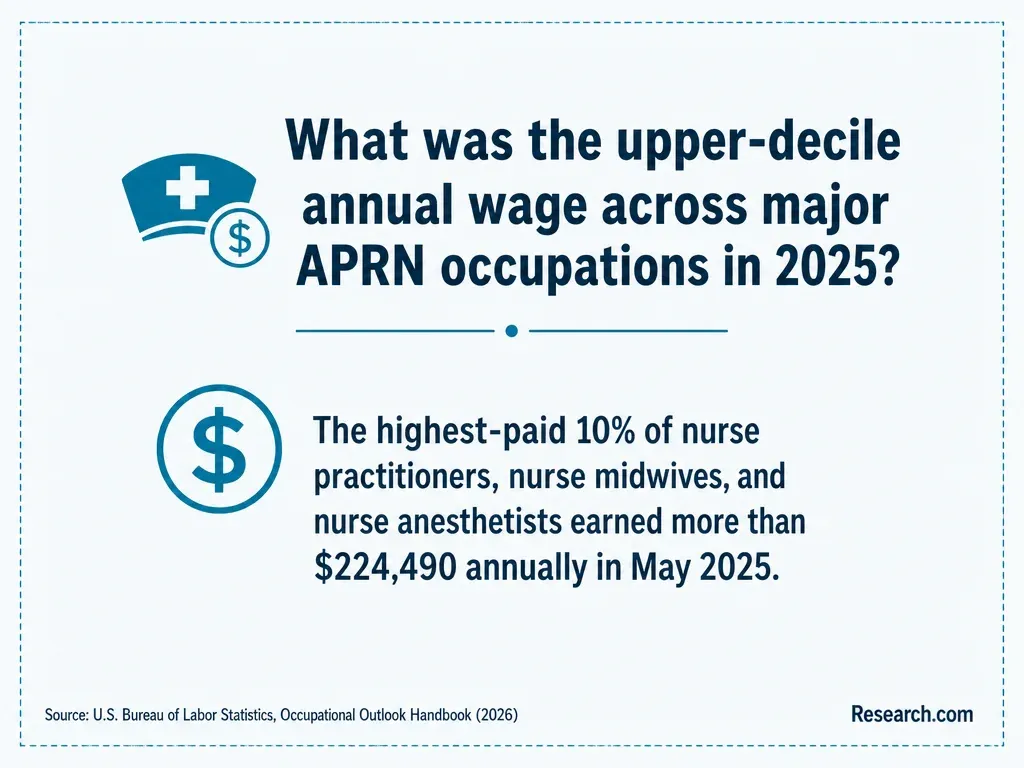
The U.S. Bureau of Labor Statistics reports national nurse practitioner wages and projected employment growth for the occupation, not salaries or placement rates for Nebraska DNP-FNP graduates. Use its May 2025 wage reference and 2025-2035 projection as labor-market context, then compare local job postings and actual offers by setting, experience, schedule, benefits, and productivity expectations. Do not justify a more expensive doctorate by treating an occupation-wide median as a promised starting salary.
If the immediate goal is initial NP practice rather than doctoral-level project work, compare the full DNP cost with qualifying MSN alternatives, including affordable online nurse practitioner programs. The lower-cost choice is useful only if it provides the intended FNP preparation and eligibility.
How can you choose an accredited Nebraska DNP-FNP program?
First verify the specific degree and FNP track in the catalog for your entry term. Then confirm institutional accreditation and the nursing program's current accreditation status and scope directly with the school and applicable accreditor. Accreditation, state authorization to enroll a student, certification eligibility, and an individual Nebraska APRN license answer different questions; a general statement that a university is accredited cannot settle all four.
Request a written degree plan and compare schools on FNP clinical placement responsibility, approved locations and preceptors, required campus attendance, accepted prior MSN work, total charges, and published FNP certification outcomes - asking for the reporting period and number of test-takers. If a school cannot say whether its MSN-entry DNP adds FNP preparation, do not assume that it does.
A BSN-prepared RN who does not specifically need a doctorate should also compare affordable graduate study after a nursing bachelor's. Make the final choice based on the credential and supervised preparation needed for the intended role, not on degree title or online convenience alone.
Other Things You Should Know About Nursing
Do not assume Nebraska licensure is enough. Practice authority can depend on where the patient is located, that state's rules, and employer requirements. Verify authorization before providing cross-state care.
No. A DNP project generally applies evidence to a practice or systems problem; a PhD dissertation develops original research. Schools set their own project requirements and approval processes.
Some federal, state, or employer programs may offer repayment for qualifying service, but eligibility depends on the program, site, debt, and service commitment. Do not count an award in your budget before it is confirmed.
No. Certification establishes a professional credential; employers still assess role-specific skills, workflows, prescribing arrangements, and readiness for the patients and services they provide.
- Guidance on Clinical Practice and Supervision | ca.gov https://docs.ctc.ca.gov/Document/Download/30526
- Get Your Nursing Education - Nebraska Center for Nursing https://center4nursing.ne.gov/education/
- Cost of Attendance (Budget) | 2025-2026 Federal Student Aid Handbook https://fsapartners.ed.gov/knowledge-center/fsa-handbook/2025-2026/vol3/ch2-cost-attendance-budget
- Doctor of Nursing Practice (DNP) Program | creighton.edu https://www.creighton.edu/academics/programs/doctor-nursing-practice-dnp
- BSN to DNP: Family Nurse Practitioner (FNP) | methodistcollege.edu https://www.methodistcollege.edu/nursing/doctor-of-nursing-practice/bsn-to-dnp-family-nurse-practitioner
- Community-Based Experiential Training Core Topic Resources | University of Nebraska Medical Center https://www.unmc.edu/familymed/education/ahec/programs/community-based-experiential-training-core-topics-resources/index.html
- How to Become a Family Nurse Practitioner: A Step-by-Step Guide for RNs | University of the Cumberlands https://www.ucumberlands.edu/blog/how-become-family-nurse-practitioner-step-step-guide-rns
- Paying for School Resources - University of Nebraska Online https://online.nebraska.edu/resources/paying-for-school
- MSN APRN Admissions Requirements - UVA School of Nursing https://nursing.virginia.edu/admissions/grad-admissions/
- Master of Science in Nursing (MSN) Admission Requirements | Bryan College of Health Sciences https://gradcatalog.bryanhealthcollege.edu/master-of-science-in-nursing-msn-admission-requirements