2027 Choosing MPH Coursework for Health Services Research

Co-Founder and Chief Data Scientist
A health services research career calls for more than an MPH course labeled "healthcare." You need coursework that prepares you to ask answerable questions about access, quality, costs, and outcomes - and to analyze the evidence responsibly.
This guide is for prospective MPH students and early-career practitioners comparing courses or programs. It explains which methods to prioritize, how to assess applied research opportunities, and when a more research-intensive degree or targeted training may be a better investment.
Key Things You Should Know
- Prioritize study design, biostatistics, health policy, and applied work with health-system data over a concentration name alone.
- Compare course depth and sequencing: an introductory statistics requirement does not establish readiness for independent research.
- Before enrolling, verify the degree's accreditation coverage, access to relevant electives and supervision, and the full cost of completing an approved project.
What Is Health Services Research in an MPH Program?
Health services research examines how healthcare is organized, financed, delivered, and experienced - and how those features relate to access, quality, equity, costs, and outcomes. An MPH student might evaluate whether a clinic's appointment changes improved access, study variation in preventive service use, or assess a policy's effects on coverage. These are population and system questions, not training to provide clinical care.
An MPH typically approaches this work through public health practice and applied research. A health policy, epidemiology, or generalist MPH may offer suitable coursework without an official "health services research" concentration. If your goal is to lead method-intensive studies or pursue research doctoral training, compare the MPH with a research-oriented MS; public health master's degree types explained can help clarify that distinction.
Which MPH Courses Build Health Services Research Skills?
Choose courses by the research tasks you want to perform, not just their titles. The comparison below shows what each area should enable you to do and where an introductory course may leave a gap.
| Course area | Useful preparation | Question to ask about depth |
| Epidemiology and study design | Define populations, comparisons, outcomes, bias, and limits of observational evidence. | Will I critique and design studies using healthcare data? |
| Biostatistics and computing | Clean data, estimate associations, assess uncertainty, and document reproducible analyses. | Is there an applied course beyond introductory statistics? |
| Health policy, economics, and systems | Interpret coverage, payment, organizational incentives, and policy context. | Will assignments evaluate real policy or delivery decisions? |
| Qualitative methods and evaluation | Investigate implementation, patient experiences, and why an intervention may work differently across settings. | Is there supervised practice in collecting and interpreting evidence? |
For a feasible sequence, take foundational epidemiology and statistics before advanced analysis, then pair a policy or systems course with an evaluation project. Ask whether electives rotate, have prerequisites, or are restricted to another department. If your target role is primarily advanced statistical modeling, compare the available MPH sequence with online biostatistics master's programs for working professionals rather than assuming one MPH elective provides equivalent depth.
How Do You Choose an Accredited MPH Health Services Research Program?
Start by confirming institutional accreditation and whether the specific MPH is covered by Council on Education for Public Health (CEPH) accreditation; a university's accreditation alone does not establish public health program accreditation. For checking CEPH accreditation before MPH enrollment, compare the accreditor's listing with the school's exact degree and program ownership.
Then request a current degree plan and recent course schedules. Check whether you can actually take advanced methods electives, find a supervisor with relevant expertise, and complete an applied practice experience or integrative project tied to a health services question. Ask who helps arrange a site or dataset and what happens if access falls through. An advertised research center is useful only if MPH students can participate under suitable supervision.
Requirements vary by school and concentration. Programs commonly review an accredited bachelor's degree or accepted equivalent, transcripts, a statement of purpose, and recommendations, but prerequisites, tests, minimum grades, and experience rules must be checked against the program's current admissions page. A non-public-health major is not automatically disqualifying; statistics, research, clinical, policy, or community experience can all help demonstrate fit.
For a methods-heavy course plan, distinguish eligibility from readiness. If your statistics background is limited, ask whether a preparatory course is required or recommended and whether it must be completed before enrollment. Applicants concerned about grades can use public health master's admissions beyond GPA to consider how recent coursework and relevant experience may strengthen an application without assuming an exception will be granted.
Choose the format that lets you complete the right courses and supervised work. Online delivery may suit employed students, but live seminars, group analyses, software access, and daytime project meetings can still limit flexibility. Campus study may make collaboration and research assistantships easier, but it can add commuting or relocation costs. Ask both formats how students obtain advising, secure approved project sites, and access restricted data where applicable.
Keep delivery and admission criteria separate. A program listed among online public health master's no-letter application paths may simplify one application requirement; it does not establish that its methods courses, scheduling, or research opportunities fit your goal. Request sample term schedules before deciding.
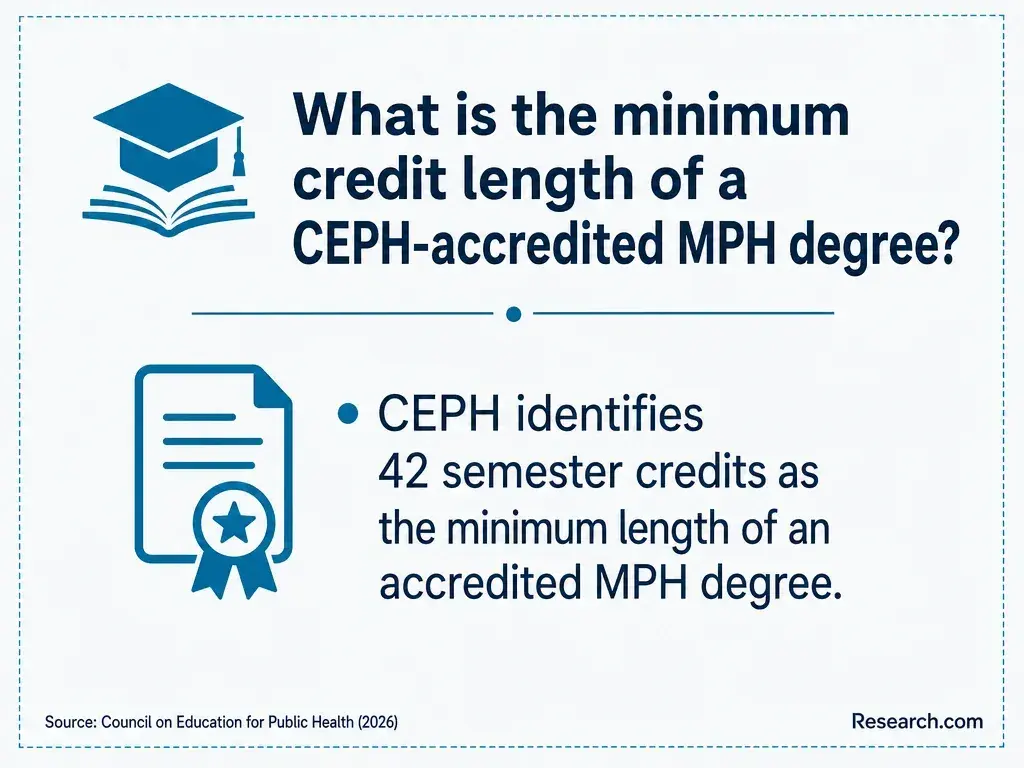
Completion time depends on credit requirements, full- or part-time enrollment, course rotation, and the scheduling of applied experiences. An advanced analysis elective offered infrequently may extend the path even when the general MPH can be completed sooner. Ask for a term-by-term plan showing prerequisites, your intended electives, and the earliest feasible project period; confirm whether the plan works at your actual enrollment pace.
If you have not completed a bachelor's degree, accelerated undergraduate coursework is a separate step, not a shortcut into graduate-level research preparation. Intensive online public health bachelor's classes may shorten individual course blocks, but eligibility for an MPH still depends on completing an accepted undergraduate degree and meeting the graduate program's rules.
There is no reliable single price for this coursework: tuition may be charged per credit or term, and total cost depends on required credits, fees, residency classification, and pace. Budget separately for any travel, software, reduced work hours, and an unpaid applied experience. A cheaper published tuition rate may be less attractive if essential electives require extra terms or travel.
Compare each school using its current tuition schedule and your proposed term-by-term plan, then subtract only aid you have actually been offered. Investigate institutional scholarships for public health graduate students, employer assistance, and their eligibility or renewal conditions; none should be assumed available until confirmed.
Relevant jobs include research coordinator, program or policy analyst, evaluation specialist, and health-system quality analyst. Early responsibilities may involve defining measures, preparing data, reviewing literature, coordinating stakeholders, and reporting findings under supervision. Independent study leadership, advanced causal analysis, and research-director roles generally require additional experience or specialized training.
Match coursework to job postings in your target setting. A health department may emphasize policy evaluation; a hospital may emphasize quality measures and operations; a research organization may expect stronger programming and study-design skills. Build portfolio evidence through an approved project, but do not publish confidential records or assume project-site access. Compare other public health master's degree types explained only if the responsibilities you want differ substantially from the MPH's practice-oriented training.
If you do not yet hold a bachelor's degree, finish that prerequisite first; affordable public health BS study options are one possible route, though a public health major is not universally required for MPH admission.
"Health services researcher" is not one standardized occupation with one dependable salary figure. Pay varies by employer, location, research duties, and experience. For a useful US benchmark, compare the Bureau of Labor Statistics occupation that matches a specific posting's duties - such as epidemiologist or statistician - rather than treating its occupational median as an MPH graduate salary.
Use local postings to compare required methods, experience, and stated pay with the cost of your proposed coursework. MPH education and long-term earnings provides broader context, but neither a degree-wide average nor an occupation-wide median predicts your offer. Employer type and your demonstrated ability to complete research tasks matter to the decision.
Do Health Services Researchers Need Licensure or Certification?
Health services research itself generally does not carry a single US professional license. A job involving clinical care, however, may require the relevant state license; an MPH does not grant it. Employers may value research experience or particular technical skills, while any optional public health certification has its own eligibility and examination rules. Check the requirements of the exact position rather than buying a credential based on its name.
If you already hold a suitable degree and need only one method - such as SQL, qualitative interviewing, or program evaluation - supervised experience or a focused course may be more direct than another full degree. Compare that approach with lower-cost routes through online public health study, while checking whether the resulting training provides the depth your target employer expects.
Other Things You Should Know About Public Health
Possibly, but access requires the organization's permission and appropriate privacy, data-use, and institutional review determinations. Enrollment alone does not authorize access to patient records.
No. Claims primarily document billed services and payments; electronic health records may contain clinical details. Each has different gaps, access restrictions, and suitable research questions.
Check target job postings and available courses. Sound study design, reproducible analysis, and interpretation matter more than assuming one package is universally required.
Potentially, with appropriate authorship, site permission, data rights, and any required ethical review. A class assignment is not automatically approved for external publication.
- Social Determinants of Health and Health Equity - NCBI - NIH https://www.ncbi.nlm.nih.gov/books/NBK573923/
- Differences Between MPH and MS Degrees | Yale School of Public Health https://ysph.yale.edu/school-of-public-health/graduate-programs/mph-degree-and-ms-degree/
- Courses - MSHP | mshp - University of Pennsylvania https://mshp.med.upenn.edu/courses
- Thesis or Capstone: HSPop MPH | Health Systems and Population Health https://hspop.uw.edu/hspopmph/program-experience/thesis-capstone/
- Econometric Methods for Causal Inference (EPI 268) | ucsf.edu https://epibiostat.ucsf.edu/econometric-methods-causal-inference-epi-268
- E-News | New online training offered to improve knowledge of Medicaid administrative data analysis https://enews.wvu.edu/articles/2023/06/14/new-online-training-offered-to-improve-knowledge-of-medicaid-administrative-data-analysis
- table of contents - Harvard PhD Program in Health Policy https://healthpolicy.fas.harvard.edu/file_url/378
- Thesis / Capstone | Master of Public Health | Brown University https://mph.sph.brown.edu/applied-learning/thesis-capstone
- What to Expect in an MPH Program - Tufts School of Medicine https://medicine.tufts.edu/news-events/news/what-expect-mph-program-insights-faculty-and-alumni