2027 Choosing an Online Data Science Master's for a Career in Wealth Management

Co-Founder and Chief Data Scientist
An online data science master's can help a wealth management professional move toward analytics, but the best program is not necessarily the one with the most finance electives. Advisors, operations specialists, and career changers need different combinations of statistical depth, usable projects, flexible scheduling, and industry access. This guide shows how to evaluate those trade-offs - and when a less technical credential may be the better investment.
Key Things You Should Know
- Choose a program that pairs statistics, programming, and data engineering with projects involving client, portfolio, or advisory-business decisions - not just stock-price prediction.
- For technical roles, test whether the curriculum offers substantial applied work; for client-facing advancement, a data science master's may be less relevant than finance training and applicable credentials.
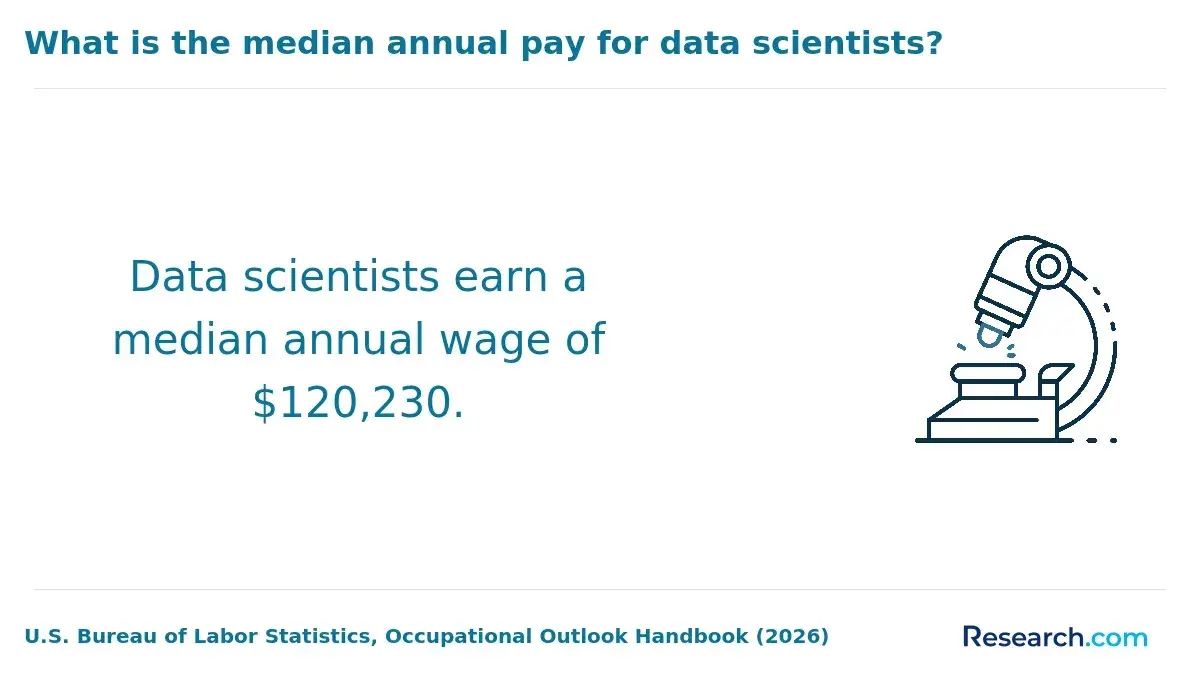
- The U.S. Bureau of Labor Statistics reports a $120,230 median annual wage for data scientists in May 2025 and projects 35% employment growth from 2025 to 2035; neither figure predicts wealth management pay or a graduate's outcome.
What is an online data science master's degree for wealth management?
It is a graduate data science program selected for its usefulness in wealth management - not necessarily a degree with "wealth management" in its name. The strongest fit teaches students to turn imperfect data into defensible decisions about clients, portfolios, risk, or advisory operations. The degree supplies analytical methods; students may need to develop financial domain knowledge through electives, work experience, or projects.
That distinction matters when comparing alternatives. A finance degree may better serve someone whose goal is client advice or investment strategy, while a data science degree is more directly aligned with building models, pipelines, and analytical products. A narrowly focused machine learning degree can suit someone who already has strong data and finance foundations; compare its breadth and project opportunities with online graduate ML programs with lower total tuition before deciding that specialization is worth the trade-off.
How can data science advance a career in wealth management?
Wealth management firms can use analytics to identify clients who may need outreach, assess portfolio exposures, forecast service demand, improve reporting, and detect unusual activity. The useful question is not simply whether a model predicts well: it is whether its output helps an advisor or operations team make a responsible, explainable decision using data they are permitted to use.
Existing experience can be an advantage. An advisor understands client conversations and the limits of automated recommendations; an operations professional knows where account and transaction data become unreliable. Pairing that knowledge with coding, statistics, and careful evaluation may support a move into an adjacent analytics role. For career changers who need introductions as well as technical training, compare a program's actual employer events, project partners, and alumni access rather than assuming an online degree provides a network. Some master's-level AI programs with alumni networking opportunities may also merit comparison if their curriculum fits the target role.
What data science careers are available in wealth management?
Job titles vary by employer, so compare the work and required skills rather than searching only for "wealth management data scientist." The roles below represent different ways analytical training can contribute to an advisory firm, bank, or wealth technology provider.
| Role | Typical focus | Important distinction |
| Client or business intelligence analyst | Client segmentation, reporting, and service trends | Often emphasizes SQL, dashboards, and communication over advanced modeling |
| Data scientist or applied ML specialist | Prediction, experimentation, and model evaluation | Requires stronger statistical and programming depth |
| Portfolio or investment analytics specialist | Exposure, performance, and risk analysis | Calls for more investment-domain knowledge |
| Data engineer | Reliable data pipelines and governed datasets | Focuses on infrastructure that other analysts and models depend on |
| Model risk or analytics governance specialist | Testing, documentation, and monitoring of analytical systems | Places particular weight on controls and explainability |
Before enrolling, read current postings for two or three target roles. If they emphasize SQL, reporting, and stakeholder communication, an expensive modeling-heavy degree may be more than you need. If they require production machine learning or rigorous statistical modeling, a program limited to introductory analytics is unlikely to close the gap.
Is an online data science master's accredited and recognized by employers?
Accreditation applies to the institution through a recognized accrediting agency; do not assume that a data science program has a separate field-specific accreditation or that the word "online" changes the credential's status. Verify the university's current institutional accreditation, how the degree appears on its transcript, and whether the program can enroll students in your state. Confirm those details with the institution before paying a deposit.
Employer recognition is a separate question. A recognizable university name may help, but it does not establish that the curriculum prepares students for wealth management work. Ask career services for outcomes relevant to experienced professionals and financial-services roles. If such outcomes are not publicly reported, do not treat general university employment figures as evidence for this specific degree.
What courses should a data science master's include for wealth management?
Prioritize a foundation in probability, statistical inference, Python or a comparable language, SQL, and data management. Then look for meaningful depth in predictive modeling, model evaluation, time-series methods, and communicating uncertainty. Finance or fintech electives are useful when they connect these methods to portfolios, client behavior, or regulated decision-making - not when they merely add industry vocabulary.
A course title is not proof of depth. Read syllabi or ask for sample assignments: does a student clean restricted or messy data, test leakage and bias, compare a model with a simpler baseline, and explain when its output should not be used? For roles that depend on integrating account, market, and client-service data, compare the database and pipeline coursework with AI graduate programs with data infrastructure training.
A strong wealth management project might evaluate whether service patterns predict requests for advisor contact, using synthetic or properly authorized data. It should define the business decision, assess errors across relevant client groups, protect privacy, and explain how a human would review the result. Be wary of programs whose only finance-adjacent examples are trading predictions: those do not, by themselves, demonstrate readiness for client or advisory operations work.
What are the admission requirements for online data science master's programs?
Requirements vary by school. Programs commonly review a bachelor's degree and evidence of quantitative and programming readiness, but they differ on prerequisite courses, work experience, tests, and whether applicants may complete preparatory study before or after admission. Read each program's current admissions policy rather than assuming a finance background automatically qualifies - or disqualifies - you.
If your experience is primarily client-facing, assess your comfort with calculus, statistics, and coding before choosing an accelerated curriculum. If you already build models, focus instead on whether the degree adds the data systems or finance context you lack. Ask admissions which prerequisite gaps must be formally satisfied and which can be addressed through preparation; self-study may help you succeed without meeting a stated course requirement.
How long does an online data science master's take and cost?
Both depend on the program's credit requirements, course availability, pace, tuition policy, and fees. Compare published costs on the same basis: tuition for the full degree plus mandatory fees, not one school's per-credit price against another school's estimated total. Also budget for software or materials, possible travel, and the time you may need to reduce paid work. For a starting comparison, explore affordable online data science programs, then verify each school's current official charges.
Before committing, obtain a term-by-term plan at the pace you can sustain and ask when required courses are offered. Employer tuition assistance can change the calculation, but check reimbursement limits and service commitments. To judge value, compare the total cost with realistic roles you could pursue given your existing experience; do not interpret a data scientist salary figure as the raise the degree will produce.
How do online and campus-based data science master's programs compare?
Online study can let a working wealth management professional keep earning and apply new skills on the job. Campus study may make in-person collaboration and local recruiting easier. Neither format is inherently stronger: project quality, access to instructors, career support, and schedule fit matter more than the delivery label.
Choose an online option if its live-session times, group work, and assessment schedule fit your job and time zone. A campus option may be preferable if you need regular in-person recruiting or a structured full-time transition. If speed is a priority, compare short online master's routes in data science, but check whether compressed terms leave enough time for a substantial wealth management project. Ask whether either format requires travel, an internship, or access to campus-only resources.
What salaries and job outlook can data science professionals expect?
The U.S. Bureau of Labor Statistics reports that the median annual wage for data scientists was $120,230 in May 2025. Its projection of 35% employment growth from 2025 to 2035 signals broad demand for the occupation, not a forecast specifically for wealth management. These national figures cover workers with different experience levels, employers, and locations; they are not starting salaries or evidence of a degree's return on investment.
For a more useful personal comparison, examine postings for your intended role and location, note whether they require a master's, and compare their responsibilities with your current skills. Consider a less costly course sequence or employer-supported project first if it can establish the specific skills those roles request.
Do wealth management data professionals need licenses or certifications?
A data science degree does not itself grant authority to provide investment advice or perform other regulated activities. Whether registration, a license, or an employer-approved credential is needed depends on the duties, firm, and applicable rules - not the analyst's job title alone. A professional building internal reports may face different requirements from someone making recommendations to clients.
Check the duties of the role you want with prospective employers and the relevant regulator before paying for a credential. Certifications can demonstrate finance or technical knowledge, but they should complement - not substitute for - the modeling, data handling, and judgment the job requires.
Other Things You Should Know About Data Science
Only with explicit employer authorization and appropriate privacy and security controls. A school assignment does not override client confidentiality or workplace data policies.
It can support an investment analytics project, but it may not demonstrate skills involving client service or account data. Match the dataset and evaluation method to the job you want.
Consider synthetic data or a clearly documented public dataset. Explain which real-world limitations the substitute cannot capture rather than presenting it as actual client information.
It can assist with coding and analysis, but you still need to check data quality, validate results, and explain errors. Those responsibilities are especially important when an analysis could affect client decisions.
References
- Cost of Attendance (Budget) | 2025-2026 Federal Student Aid Handbook https://fsapartners.ed.gov/knowledge-center/fsa-handbook/2025-2026/vol3/ch2-cost-attendance-budget
- How to Apply - Master in Data Science & Analytics - Georgetown https://analytics.georgetown.edu/admissions-tuition/how-to-apply/
- Admissions and Application Requirements - UNC Online https://online.unc.edu/online-masters-programs/masters-data-science/admissions/
- Wealth Management Advisors: How to Become One | Franklin University https://www.franklin.edu/career-guide/personal-financial-advisors/how-to-become-wealth-management-advisors
- Wealth Management Theory & Practice | CPWA | Yale School of Management https://som.yale.edu/executive-education/for-individuals/finance/wealth-management-theory-practice
- 12 Essential Skills Required for Data Scientists in 2023 | MDS@Rice https://csweb.rice.edu/academics/graduate-programs/online-mds/blog/data-science-skills
- Applications Process & Requirements | Illinois https://siebelschool.illinois.edu/admissions/graduate/applications-process-requirements
- Data Science vs. Computer Science: What's the Difference? | UCLA MSOL Data Science https://www.msol.ucla.edu/data-science-engineering/articles/data-science-vs-computer-science/
- What Can You Do With a Master's Degree in Financial Planning and Wealth Management? - MSU Broad College of Business https://broad.msu.edu/news/financial-planning-wealth-management-career-outlook/
- Master's in Financial Technology and Analytics | Stevens Institute of Technology https://www.stevens.edu/program/financial-technology-and-analytics-masters-degree