2027 Choosing an Online BS in Business Administration Around Quarter-End Accounting Deadlines
Audited and Verified:
Our Editorial and Data Verification Process
Research.com uses government datasets, official education statistics and primary institutional information to support its career and degree guides. Our review process checks factual accuracy, occupational definitions, source dates and the requirements associated with the credentials discussed.
How This Article Was Fact-Checked
Our editorial team verifies salary estimates, employment projections, education requirements and program information against original data providers and official organizations. Salary figures are checked against the relevant occupational definitions and reporting periods. Information about licensure, accreditation and required in-person training is reviewed separately.
Fact-checked and verified on:

Co-Founder and Chief Data Scientist
Quarter-end close can consume the evenings an online course expects you to use for assignments and exams. If you work in accounting and want to finish a bachelor's degree, the deciding factor is not simply whether classes are online: it is whether their deadlines, accounting content, and total cost fit your work calendar.
This guide shows you how to test that fit, compare a business administration degree with accounting-focused alternatives, and identify the policies to confirm before enrolling.
Key Things You Should Know
- Choose by the busiest weeks of your close cycle, not a program's "flexible" label; confirm live sessions, exam windows, group deadlines, and late-work rules.
- A BS in Business Administration can strengthen financial and operational judgment, but its accounting courses may not satisfy CPA education requirements or prepare you for specialized accounting work.
- The U.S. Bureau of Labor Statistics reports a May 2025 median wage of $83,680 for accountants and auditors; that occupation-wide figure is not an expected starting salary for business graduates.
What is an online BS in business administration for accounting careers?
An online BS in Business Administration is an undergraduate degree covering several business functions, commonly including accounting, finance, management, operations, and quantitative decision-making. Its online delivery describes where learning takes place, not how much accounting the degree contains or whether students control every deadline.
For an accounting employee, the degree may be a good fit when the goal is to complete a bachelor's credential while moving toward budgeting, business operations, financial reporting support, or broader responsibility. If the goal is public accounting, technical tax work, or CPA licensure, compare the actual accounting credits and state board rules with those of a specialized accounting bachelor's.
A BBA or BS with an accounting concentration is not automatically equivalent to an accounting major. Start by identifying the job you want after graduation, then compare ranked online business schools in America against that goal. A ranking can generate candidates, but the degree audit, course descriptions, and scheduling policies should determine your choice.
How can an online business administration degree support quarter-end accounting work?
Quarter-end close often involves reconciliations, adjustments, reporting, review, and questions that cannot wait for an academic deadline. Business coursework can help you understand how those outputs affect budgets and operating decisions. The more immediate issue is whether you can complete assessed work without compromising either your job or the course.
Use your last close cycle to estimate the evenings and weekends that were genuinely available. Then ask each program for a sample syllabus and check these commitments:
- Fixed attendance: Are lectures, presentations, or team meetings live, and can you attend during close week?
- Assessment windows: Are exams available over several days, or at a fixed time? Is remote proctoring required?
- Deadline flexibility: What happens if a required filing or reconciliation unexpectedly extends your workday?
- Course sequence: Can you take a lighter load during recurring close periods without delaying a required course by an entire term?
An asynchronous course can still have weekly deadlines. If your employer permits an academic project based on work, obtain approval before using company information; a fictionalized case or public dataset may be safer than actual financial records. If you want to compare fast-paced online business degrees, weigh their compressed assignment schedules against your close calendar rather than assuming a shorter program will be easier to manage.
Is an online BS in business administration accredited and reputable?
Check accreditation at two levels. Institutional accreditation applies to the college or university; verify its status with the accreditor or the U.S. Department of Education's accreditation records. Business accreditation from AACSB, ACBSP, or IACBE may apply to a school, business unit, or specified programs. Confirm whether the online BS you would enter falls within the accreditor's stated scope.
Accreditation does not establish that an accounting course meets a particular state's CPA requirements, that every course runs each term, or that graduates secure accounting jobs. For a working student, reputable program evidence also includes accessible faculty, a published degree plan, clear complaint and leave policies, and support when a required class conflicts with close season.
When reviewing lower-priced accredited business administration study options, verify accreditation and program coverage directly rather than treating low tuition or an "accredited" label as a complete quality check.
Look beyond the degree title. A general business core may include financial and managerial accounting, finance, economics, statistics, information systems, management, and operations. For quarter-end work, the useful distinction is between learning to interpret financial information for business decisions and gaining enough accounting depth to perform specialized reporting or meet a licensing board's course rules.
Compare catalog descriptions and prerequisites for intermediate accounting, auditing, tax, cost accounting, spreadsheet modeling, and accounting information systems. Determine which are required, available as electives, or part of an official concentration; a few accounting electives do not create a separately awarded accounting credential. Check when upper-level courses run, since an elective offered only during your busiest term may not be a realistic option.
If your close responsibilities center on inventory, purchasing, and supplier data rather than financial statements, operations coursework might be more useful. In that case, fast-track online supply chain bachelor's options offer a relevant specialized comparison - not a substitute for accounting preparation.
The key difference for a working accounting employee is control over attendance and travel, not necessarily control over coursework. This comparison identifies the scheduling evidence to request from each program.
| Decision factor | Online program | Campus-based program |
| Attendance | May be asynchronous, live, or a mixture; confirm required meeting times. | Usually has scheduled travel and class meetings; evening sections may help. |
| Close-week workload | Work can sometimes be done outside office hours, but fixed exams and team deadlines may remain. | Class meetings may conflict directly with extended office hours. |
| Support and collaboration | Check virtual tutoring, faculty access, and group-meeting expectations. | Check on-campus support hours and whether they fit your work schedule. |
| Practical requirements | Verify any residency, internship, or in-person assessment. | Verify any internship or daytime activity beyond regular classes. |
Online study often removes commuting, but it can increase the need to plan group work across schedules. A campus option may be preferable if its predictable evening timetable and local support suit you better than frequent online deadlines. When considering flexible accelerated bachelor's degrees, request a sample term calendar; accelerated pacing can concentrate work precisely when the quarter closes.
Requirements vary by institution and by whether you apply as a first-year, transfer, returning, or second-degree student. Schools commonly request prior academic transcripts; some business majors have separate entry rules or prerequisites in mathematics, economics, or accounting. Professional accounting experience can strengthen an application, but it does not automatically waive a course or earn degree credit.
Before applying, ask for a preliminary review of your transcripts and the current catalog. Distinguish credits accepted from credits that satisfy general education, the business core, an accounting concentration, or graduation residency requirements. Only the institution can provide an authoritative evaluation and approved degree audit.
If application charges matter while you compare programs, you can find online colleges with free admissions applications. Still confirm each school's business degree, admission route, and course availability before applying.
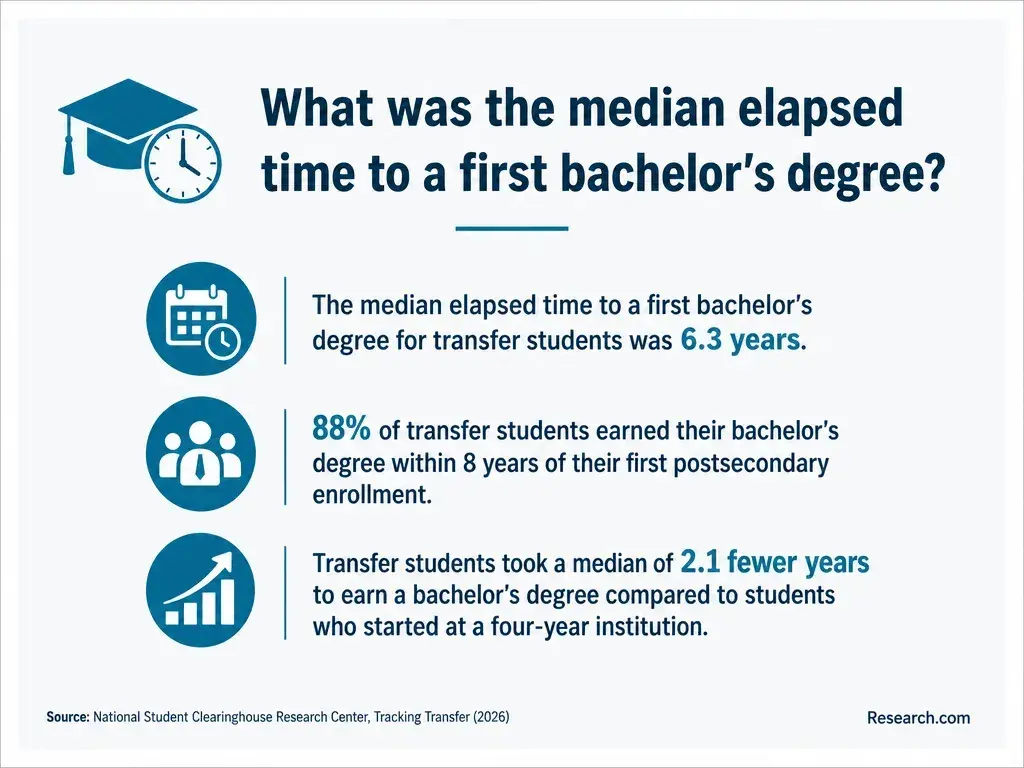
Your remaining requirements - not an advertised fastest-completion timeline - determine how long the degree is likely to take. Transfer-credit applicability, prerequisite chains, required-course availability, and whether you reduce your load during close-heavy terms can all change your finish date.
For a useful cost comparison, request a written degree audit and calculate tuition for the remaining required credits, then add mandatory fees, books, software, proctoring, and any travel. Ask whether tuition is charged per credit or term and whether taking fewer courses changes your aid eligibility or access to employer reimbursement. An accelerated schedule may reduce calendar time without reducing the number of credits or total coursework.
Review FAFSA-accepting colleges for business administration students as possible options, not as proof that a particular student will receive aid. Compare personalized aid offers, borrowing, and the cash you must pay before any employer reimbursement arrives.
Start with the responsibilities you already perform. Someone who prepares reconciliations and supports reporting may be able to demonstrate relevant experience alongside the degree when applying for accounting or finance-support roles. Someone seeking to move into operations can use the same close-cycle knowledge to explain cost, inventory, or process decisions. Neither path follows automatically from graduation.
An accountant or auditor role may require a bachelor's degree and substantial accounting coursework; employers and state boards set additional requirements for particular positions and licenses. Budget analyst, financial analyst, or project coordination roles involve different tools and experience. Management positions generally require a record of responsibility beyond undergraduate study.
If reviewing payroll or staffing costs has sparked an interest in employee-focused work, human resources education and career options provide a more relevant comparison than assuming any business concentration leads to the same jobs. For an accounting-focused applicant, prioritize roles whose posted duties match both your existing work and the courses you plan to complete.
There is no single salary or growth rate for BS in Business Administration graduates: outcomes depend on the occupation, location, employer, and experience. For U.S. accountants and auditors, the Bureau of Labor Statistics reports a May 2025 median annual wage of $83,680 and projects 5% employment growth from 2025 to 2035. These figures describe an occupation, not new graduates or everyone holding a business degree.
If you already work in accounting, assess potential value against the specific jobs you could pursue after completing the degree. Check local postings for required accounting credits, software, experience, and credentials; compare those requirements with your proposed course plan and total education cost.
If the degree would not close a qualification gap, targeted coursework or employer training may be a better immediate investment. Comparing online business education on a smaller budget can help, provided you compare remaining costs rather than advertised tuition alone.
Which certifications and credentials complement a business administration degree?
Choose a credential only after identifying the task or position it would support. CPA licensure is governed by state boards and involves education, examination, and other state-specific requirements; an online business administration degree does not confer it. Other accounting, finance, or business certifications have their own eligibility and experience rules, so verify requirements with the issuing organization before choosing electives or paying for preparation.
For some employees, an approved accounting certificate or individual courses may address a technical gap more directly than a broad second degree. For others, a bachelor's credential is the missing requirement, making online business bachelor's degrees with shorter timelines worth examining. In either case, check whether speed is compatible with quarter-end work and whether the completed coursework supports your intended credential - not merely the degree title.
Other Things You Should Know About Business Administration
Not necessarily. Request the school's academic calendar and map its exam and project dates against your employer's fiscal calendar, including any close periods that extend into the following month.
Check the instructor's syllabus and the school's make-up assessment policy before the course begins. A work emergency does not automatically qualify for an extension; contact the instructor as soon as a conflict becomes likely.
Possibly, with faculty approval and any required employer permission. Use only data you are authorized to share, and confirm whether a de-identified or hypothetical version meets the assignment rules.
Yes. Give the adviser your close calendar and ask for a course sequence that accounts for fixed assessments, prerequisite timing, and terms when a lighter load may be necessary.
- Cost of Attendance (Budget) | 2026-2027 Federal Student Aid Handbook https://fsapartners.ed.gov/knowledge-center/fsa-handbook/2026-2027/vol3/ch2-cost-attendance-budget
- Accreditation in the U.S. | ed.gov https://www.ed.gov/laws-and-policy/higher-education-laws-and-policy/college-accreditation/accreditation-in-the-us
- Online Business Degree Completion | The University of Olivet https://www.uolivet.edu/program/online-business-degree-completion/
- Undergraduate and Graduate Tuition and Fees | Purdue Global https://www.purdueglobal.edu/tuition-financial-aid/undergraduate-graduate-tuition-and-fees/
- Finance Curriculum vs. Accounting Curriculum: How Are They Different? | Freeman News https://freemannews.tulane.edu/2025/06/09/finance-curriculum-vs-accounting-curriculum-how-are-they-different
- Academic Support Resources - Chemeketa Online https://online.chemeketa.edu/elearning-resources/academic-support/
- Business Administration Online Degree (BBA) | University of Kansas https://online.ku.edu/undergraduate-programs/online-bachelors-business-administration-bba
- UMass Global MyPath: Self-Paced Programs https://www.umassglobal.edu/student-experience/why-umassglobal/flexible-ways-to-learn/self-paced
- Online Bachelor's in Business Administration | UNC Greensboro https://www.uncg.edu/degrees/business-administration-b-s-online-business-studies-concentration/
- Cost of Attendance - Financial Aid and Scholarships | The University of Utah https://financialaid.utah.edu/tuition-and-fees/cost-of-attendance.php