2027 Changing From a Biology Major to Healthcare Administration Without Starting Over

Co-Founder and Chief Data Scientist
A biology background can be useful in healthcare administration, but choosing the wrong degree could mean paying to repeat coursework - or pursuing a graduate credential before gaining the experience employers want. If you are finishing a biology degree or considering a career change, this guide explains which coursework may carry forward, when an MHA or MBA makes sense, and when a job move is the better first step.
You will also learn how to compare online programs, estimate the full cost, and identify realistic entry points into healthcare management.
Key Things You Should Know
- You usually do not need a second bachelor's degree: biology can provide a foundation for graduate study or an entry-level move into healthcare operations.
- Undergraduate transfer credit depends on a school's evaluation; graduate programs generally assess admission eligibility rather than converting biology courses into management credits.
- The U.S. Bureau of Labor Statistics reports a $126,520 median annual wage for all management occupations in May 2025, not an expected starting salary for healthcare administration career changers.
Can a Biology Major Switch to Healthcare Administration Without Starting Over?
Yes. Healthcare administration concerns how care organizations operate: staffing, budgets, scheduling, quality improvement, compliance, and service delivery. It does not require a clinical license for many administrative roles, and a biology major does not have to erase their existing education to enter the field.
The least disruptive route depends on where you are now. If you have nearly completed your biology bachelor's degree, finishing it may preserve more value than changing majors late. You can then seek an administrative role or apply to a relevant master's program. If you are earlier in college, a change of major may let your science courses count toward general education requirements or electives, although management requirements may extend your graduation date.
Start dates can affect the transition if you need to leave your current major promptly, but a quick start is useful only if the school accepts enough prior coursework. You can compare rolling-start healthcare administration bachelor's programs while checking each school's transfer evaluation and remaining required courses.
What Healthcare Administration Degree Pathways Accept Biology Coursework?
Biology can support several pathways, but "accepting your background" means different things at the undergraduate and graduate levels. The comparison below shows where previous coursework is most likely to reduce requirements and where it mainly strengthens your application.
| Pathway | How biology coursework may help | Best fit |
| Change to a healthcare administration bachelor's | Completed courses may satisfy general education, science, or elective requirements after evaluation. | Students early enough in college to change majors without substantial extra coursework. |
| Finish biology, then enter healthcare work | The completed degree demonstrates scientific literacy; no new degree is required to begin applying. | Students close to graduation or graduates seeking the lowest-cost transition. |
| Master of healthcare administration (MHA) or healthcare management | Biology may meet the bachelor's-degree admission requirement, but usually does not replace graduate management courses. | Applicants seeking focused healthcare operations and leadership preparation. |
| MBA with relevant healthcare coursework | A nonbusiness bachelor's can qualify; preparation gaps may remain in accounting or finance. | Applicants who want broader business mobility as well as healthcare applications. |
Some healthcare management master's programs are designed for applicants without business degrees, while others expect professional experience. An MBA offers a broad management core; a healthcare concentration, when officially offered, adds focused coursework but is not the same credential as an MHA. If a bachelor's is the right route, begin with institutionally accredited colleges with online healthcare administration degrees and compare their actual transfer policies.
Do You Need a Healthcare Administration Degree to Become a Healthcare Manager?
No single healthcare administration degree is universally required for management jobs. Employers set requirements based on the role, organization, and level of responsibility. A biology graduate might enter through research administration, patient services, quality support, or operations coordination and pursue supervisory responsibilities after learning how a healthcare organization works.
That route differs from applying directly for a department manager position. Managing staff, budgets, compliance, and care workflows generally calls for relevant experience, even when the applicant has a master's degree. A bachelor's in biology plus demonstrated operations work may therefore be more competitive for some roles than a new MHA without practical experience.
An MHA may be worth considering when job postings in your target market repeatedly prefer graduate healthcare-management education or when you need structured training and a professional network. Biology graduates considering this route can examine guidance for nonclinical career changers applying to an MHA. An MBA may make more sense if you also want general finance, strategy, or management options outside healthcare; neither degree confers clinical credentials.
There is no reliable universal number. A receiving college decides which credits it accepts and which accepted credits fulfill its healthcare administration degree requirements. Those are separate decisions: a biology lab might transfer as an elective without replacing a required course in healthcare finance.
General education courses and introductory sciences may be the easiest to apply to a second undergraduate degree. The remaining workload often depends on upper-level healthcare administration requirements, residency rules, course equivalencies, and the age of previous credits. If you already hold a bachelor's degree, ask whether the school waives completed general education requirements rather than assuming you must repeat them.
Request a written, course-by-course degree audit before enrolling. Compare the credits accepted, requirements they satisfy, credits left to complete, and courses offered each term. An accelerated bachelor's study in health services administration option is only faster for you if that audit confirms a shorter remaining path.
Healthcare administration programs apply management methods to healthcare organizations. Common subjects include healthcare finance, organizational behavior, operations, quality improvement, policy, ethics, and the use of data in decisions. Programs vary in depth: an undergraduate course may introduce budgeting, while a graduate course may ask students to assess competing staffing or service-line investments.
A biology major may already understand scientific terminology and how evidence is evaluated. The bigger preparation gaps are often managerial accounting, budgets, reimbursement, communication with nonclinical teams, and leading organizational change. Look for projects that use healthcare scenarios and opportunities to work with an employer, rather than judging a program by course titles alone.
Healthcare administration is also distinct from health information management (HIM). HIM centers more directly on health data, records, information governance, and related systems. If working with clinical information interests you more than running services or teams, start by understanding healthcare administration and HIM degree distinctions.
An online program can be credible, but delivery format alone establishes neither quality nor employer acceptance. Verify the institution's accreditation through the accreditor and confirm that the specific program awards the degree advertised. For an MHA, you can also investigate whether programmatic accreditation relevant to healthcare management education applies; do not confuse it with institutional accreditation or assume every credible program holds the same specialized recognition.
For a career changer, practical access matters as much as the credential's format. Ask whether online students can use career services, complete internships or employer projects, and attend required live sessions or campus visits. An asynchronous lecture schedule does not necessarily mean flexible group work or field-placement hours.
The same checks become important if you later consider online doctoral education for healthcare management professionals. Doctoral study is a possible later specialization, not a prerequisite for entering healthcare administration.
Requirements vary by school and degree level. Undergraduate applicants generally submit prior college transcripts for admission and transfer review. Graduate applicants typically need a completed bachelor's degree and transcripts; programs may also request a résumé, statement of purpose, recommendations, or an interview. Professional-experience expectations, standardized-test policies, and prerequisite courses must be checked program by program.
A biology degree is not, by itself, an admissions obstacle. If your experience is mostly laboratory-based, explain how you have coordinated projects, worked with teams, handled data, or improved a process. Prepare for possible accounting and finance coursework without assuming those subjects are formal prerequisites everywhere.
Choose the degree level that matches your current qualifications. For example, healthcare leadership doctoral study with accelerated timelines may sound efficient, but applicants should check its graduate-degree and professional-experience expectations; it is not a substitute for an entry-level transition plan.
Your remaining courses, enrollment pace, and any required internship determine the timeline. A second bachelor's could require substantially less work than a first one if many credits apply, but that is not certain until you receive a degree audit. A graduate program begins with a completed bachelor's and has its own course sequence; an accelerated calendar may leave less room to work or gain healthcare experience alongside study.
Compare total cost, not advertised tuition alone. Include mandatory fees, books and software, possible placement or travel costs, and interest if you borrow. Ask whether employer education assistance is available and whether reducing work hours would create an additional financial cost.
Review 12-month healthcare administration graduate programs only after confirming their eligibility requirements, full price, and whether the pace fits your circumstances.
Your first role should connect your existing strengths to an organization's operating needs. The table distinguishes plausible entry points from roles that usually call for more management experience; titles and hiring standards vary by employer.
| Role or pathway | How a biology background helps | Likely gap to address |
| Research or clinical-program coordinator | Scientific literacy and experience tracking procedures or data. | Scheduling, budgets, documentation, and stakeholder coordination. |
| Quality improvement or operations assistant | Comfort interpreting evidence and following structured processes. | Healthcare workflows, performance measures, and process improvement. |
| Patient services or practice coordinator | Ability to communicate across scientific and nontechnical settings. | Patient-facing operations, staffing, and service recovery. |
| Department or practice manager | Prior healthcare experience can support later advancement. | Demonstrated responsibility for people, finances, and operations. |
Read local job postings before choosing a degree: identify roles you could apply for now and requirements that repeatedly block advancement. If a master's appears worthwhile, a healthcare management graduate study timeline comparison can help you weigh speed against time available for relevant work experience.
What Are Healthcare Administration Salaries, Certifications, and Job Outlook?
The U.S. Bureau of Labor Statistics reports that the median annual wage across all management occupations was $126,520 in May 2025. This broad figure includes managers outside healthcare and people with substantial experience. It should not be treated as an entry-level healthcare administration salary or an expected return from an MHA or MBA.
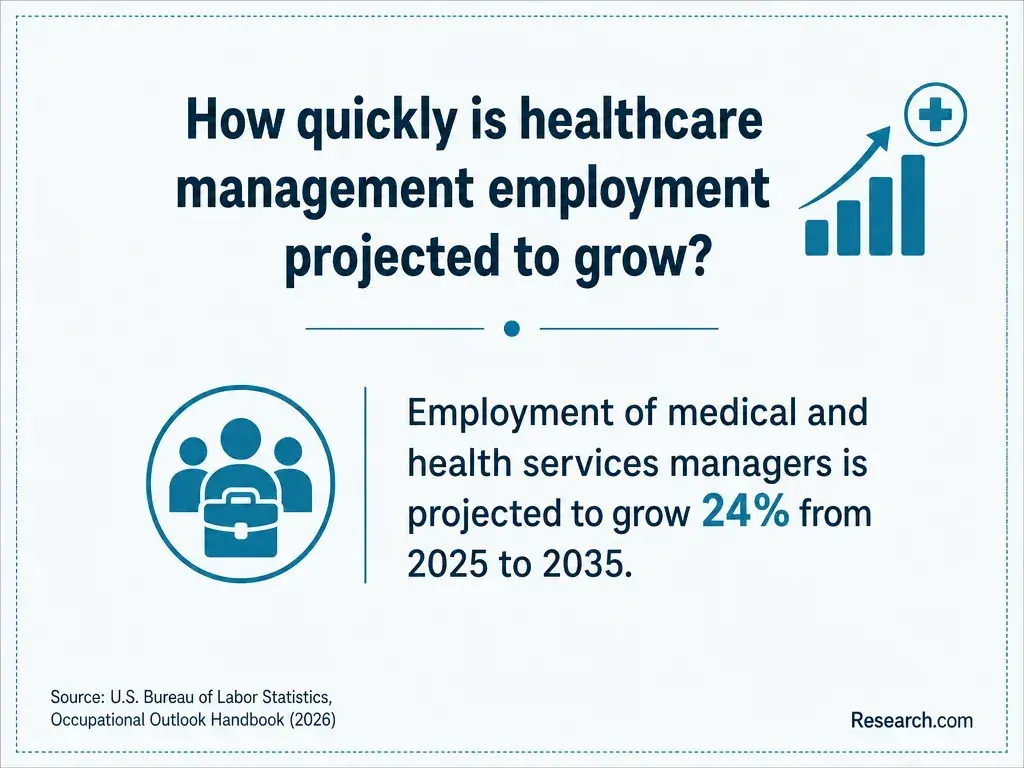
The BLS projects overall management employment to grow faster than the average for all occupations from 2025 to 2035, but prospects for a biology graduate depend on the specific occupation, location, employer, and prior experience. Compare salaries in postings for jobs you could realistically obtain now with those requiring the experience you hope to build.
Professional certifications can demonstrate focused knowledge, but they are not interchangeable with a degree or work experience. Some target experienced healthcare leaders, while others focus on a particular function. Check the issuing organization's eligibility rules and whether employers for your target role actually request the credential before paying for it.
A short graduate program may build broader management knowledge, but reviewing 12-month healthcare administration graduate programs should not replace that role-by-role assessment.
For most biology majors entering the field, a doctorate would add cost and time without addressing the immediate need for healthcare operations experience. If advanced leadership study becomes relevant later, compare healthcare administration doctorate fees and completion costs separately from today's entry-path decision.
Other Things You Should Know About Healthcare Administration
Often, yes. First ask both departments for a degree audit. If changing majors would delay graduation substantially, completing biology and pursuing healthcare experience may be the more efficient path.
Not automatically. It is most relevant when you can show coordination, documentation, data analysis, training, or process improvement. Employers decide whether that experience meets a particular role's requirements.
Yes. Physician practices, insurers, community health organizations, research programs, and other healthcare employers have administrative functions. Responsibilities differ, so compare roles rather than relying on the job title alone.
Speak with administrators, seek a cross-functional project or entry-level operations role, and review local job postings. Those steps can reveal whether you prefer managing services, working with healthcare data, or staying closer to scientific research.
- Pathways for Students and Graduates | Student Internships and Jobs | Working at CDC | Careers at CDC https://jobs.cdc.gov/working-at-cdc/student-intern-jobs/pathways.html
- Essential Skill and Knowledge Required for Health Data Professionals: A Content Analysis of Job Advertisements | nih.gov https://pmc.ncbi.nlm.nih.gov/articles/PMC11605378/
- CAHME-Accredited Online MHA Programs | Online MPH and MHA Degrees From George Washington University https://onlinepublichealth.gwu.edu/mha/cahme-accredited-online-mha/
- How to Get into Healthcare Administration: A Starter Guide | American Military University https://www.amu.apus.edu/area-of-study/health-sciences/resources/how-to-get-into-healthcare-administration/
- How College Transfer Credits Work | Lackawanna College https://www.lackawanna.edu/college-transfer-credits-guide/
- Transferable Skills Career Guide | University of Illinois Chicago https://career.las.uic.edu/transferable-skills/
- Master's Degree in Healthcare Administration (MHA) | National University https://www.nu.edu/degrees/healthcare-leadership/programs/master-healthcare-administration/
- Undergraduate Transfer Credit | University of Arizona Catalog https://catalog.arizona.edu/policy/courses-credit/credit/undergraduate-transfer
- Healthcare Administrator Career Guide & Degree Paths | News & Updates from the Antioch University Community https://commonthread.antioch.edu/healthcare-administrator-career-guide-degree-paths/
- Transfer Credit, Test Awards, Liberal Education (General Education) Requirements | Office of Admissions https://admissions.tc.umn.edu/admissions/transfer-admission/transfer-credit-evaluation/transfer-credit-test-awards-liberal