2027 Can SQL Work Experience Strengthen a Data Science Master's Application?

Co-Founder and Chief Data Scientist
SQL work experience can make a data science master's application more convincing - but it does not automatically satisfy a program's math or programming prerequisites. For analysts, database professionals, and other applicants who use SQL at work, the decision is whether their experience shows enough analytical readiness to apply now or whether they should fill specific gaps first.
This guide explains what admissions committees may learn from SQL work, how to present it, and what to check before choosing a program.
Key Things You Should Know
- SQL experience is strongest evidence when it shows how you turned data into a defensible analysis or decision, not just that you wrote queries.
- Check each program's stated prerequisites: professional SQL work may demonstrate readiness without formally replacing calculus, statistics, or programming coursework.
- The U.S. Bureau of Labor Statistics projects 35% growth in data scientist employment from 2025 to 2035, but that outlook does not predict an individual applicant's admission or career outcome.
Can SQL work experience strengthen a data science master's application?
Yes. SQL work can show that you understand real datasets, can investigate questions with evidence, and have dealt with problems that classroom exercises often simplify: inconsistent records, unclear definitions, and competing stakeholder needs. It is particularly useful if your transcript does not fully convey your analytical work.
The distinction is between using SQL and demonstrating data science readiness. A description such as "created weekly reports" establishes exposure. An account of how you defined a metric, checked its underlying data, tested an explanation, and communicated the limits of your findings gives a committee more to evaluate. Even strong work experience, however, should be presented as evidence of preparation - not as a presumed waiver of published prerequisites.
Apply now if you meet the program's formal requirements and can explain both your SQL contributions and your preparation in statistics and programming. If a required course is missing, ask admissions whether professional work can satisfy that specific requirement before paying an application fee. If the answer is no, complete an accepted course or consider a program with a suitable preparatory pathway.
What SQL skills do data science master's programs value most?
The most persuasive SQL skills support trustworthy analysis. Joining tables accurately, using aggregations and window functions, recognizing duplicate or missing records, and checking whether a query's output matches the intended population all matter more than listing database commands without context.
Graduate-level work also requires judgment beyond querying. An applicant who can explain why a customer cohort changed, whether a time-based comparison is fair, or how source-system limitations affect a result connects SQL experience to statistical reasoning. Experience building reliable datasets or pipelines can be especially relevant when a program includes data engineering; applicants interested in that intersection can examine data engineering coursework in AI master's degrees as a related curriculum comparison.
A useful test is whether you can walk someone through one query-driven investigation: the question, the data grain, the joins and checks, the result, and what the result could not establish. That explanation reveals more about your preparation than a long inventory of SQL features.
How should applicants present SQL experience in a data science application?
Make your individual contribution visible across the résumé, statement of purpose, and, where permitted, a project sample. Describe the analytical question and your method before naming tools. If you report an impact figure, use one you can substantiate and explain what was measured; do not claim that a query caused a business outcome when other factors were involved.
Use the following checks to turn work experience into credible application evidence:
- Résumé: Identify the dataset or business problem, the SQL work you personally performed, and the decision or deliverable it supported.
- Statement: Connect a limitation you encountered at work - such as uncertainty, forecasting, or model evaluation - to what you want to learn in graduate study.
- Project sample: If allowed, provide a reproducible analysis using public or appropriately de-identified data, with assumptions and validation checks documented.
- Recommendation: Ask a supervisor who observed your analytical judgment to describe your contribution, rather than simply confirming that you used SQL.
Never upload employer data or proprietary queries without permission. An original project using public data is preferable to a polished sample that creates a confidentiality problem. Also avoid presenting a team result as solely your own: specifying your role makes the evidence more credible.
What are the admission requirements for a data science master's program?
Requirements vary by institution. Programs may ask for a bachelor's degree, transcripts, recommendations, a statement, and evidence of quantitative and computing preparation. Some specify courses or competency in areas such as calculus, linear algebra, statistics, and programming; others provide ways to prepare before beginning advanced coursework. Do not assume that an application being accepted for review means a prerequisite has been waived.
If your SQL career followed a degree outside computer science, compare programs' actual requirements rather than ruling yourself out by degree title. AI graduate programs for non-computer-science backgrounds offer a related point of comparison, although their admissions policies should not be taken as data science policies. For every prospective program, obtain a written answer about any missing required course and whether work experience, a graded course, or another option can satisfy it.
Which prerequisites help applicants succeed in data science graduate study?
SQL helps you obtain and organize data; it does not by itself establish that you can evaluate a model or reason about uncertainty. The table separates strengths that SQL work may demonstrate from preparation worth checking before enrollment. These are readiness considerations, not a substitute for any school's formal requirements.
| Area | What SQL work may demonstrate | Potential gap to check |
| Data handling | Joins, aggregation, data-quality checks, and metric definitions | Working with less structured data or building reproducible pipelines |
| Programming | Query logic and procedural problem-solving | Writing, testing, and documenting Python or R analyses |
| Mathematics and statistics | Interpreting descriptive results | Calculus, linear algebra, probability, inference, or model evaluation |
Use a target program's prerequisite list to identify the actual gap. A short course or independent project can improve preparation, but it fulfills a formal admissions requirement only if that program says it does. Applicants who already have substantial quantitative coursework should document it rather than repeat introductory material solely because their job title emphasizes SQL.
What does a data science master's program curriculum typically include?
Curricula differ, but applicants commonly encounter statistical methods, programming, machine learning, data management, and applied projects. For an experienced SQL user, the most valuable distinction is whether the program extends familiar data work into inference, predictive modeling, evaluation, and responsible use of results - or concentrates on skills you already practice.
Read course descriptions and project requirements, not just titles. A mention of databases in one course is different from substantial work building and validating datasets. If your goal is to move toward modeling, look for opportunities to apply statistics and programming to real problems; if your goal is data infrastructure, look more closely at engineering and systems work. Neither emphasis is universally better - it depends on the gap between your current role and your intended one.
Are online data science master's programs as valuable as campus programs?
An online program can provide an appropriate graduate education, but delivery mode alone does not establish its quality or employer value. Compare the curriculum, instructors, assessment, project feedback, student support, and credential awarded. For a full-time SQL professional, scheduling may determine whether sustained study is feasible; data science graduate programs for working students provide a useful starting point for examining that fit.
Ask whether classes are live or self-paced, when group work occurs, and whether any campus visits are required. Choose an online format if it lets you keep working while completing rigorous projects. A campus format may suit you better if its in-person collaboration or access to particular resources is central to your plans. Verify each program's arrangements rather than treating either format as uniform.
How much does a data science master's degree cost and how long does it take?
There is no reliable single price or completion time for data science master's degrees: both depend on the institution, required credits, fees, enrollment pace, and any preparatory coursework. Request the current tuition and fee schedule, then calculate the cost of your intended pace rather than comparing advertised tuition figures that cover different things.
For a working applicant, keeping a salary while studying may be important, but a slower schedule can delay completion. Employer tuition assistance can change the calculation; confirm eligibility and any repayment conditions before relying on it. If your interests are shifting from data science toward AI, lower-tuition artificial intelligence degree options may be worth comparing - but compare total required costs and curriculum fit, not price alone.
What careers and salaries can a data science master's degree lead to?
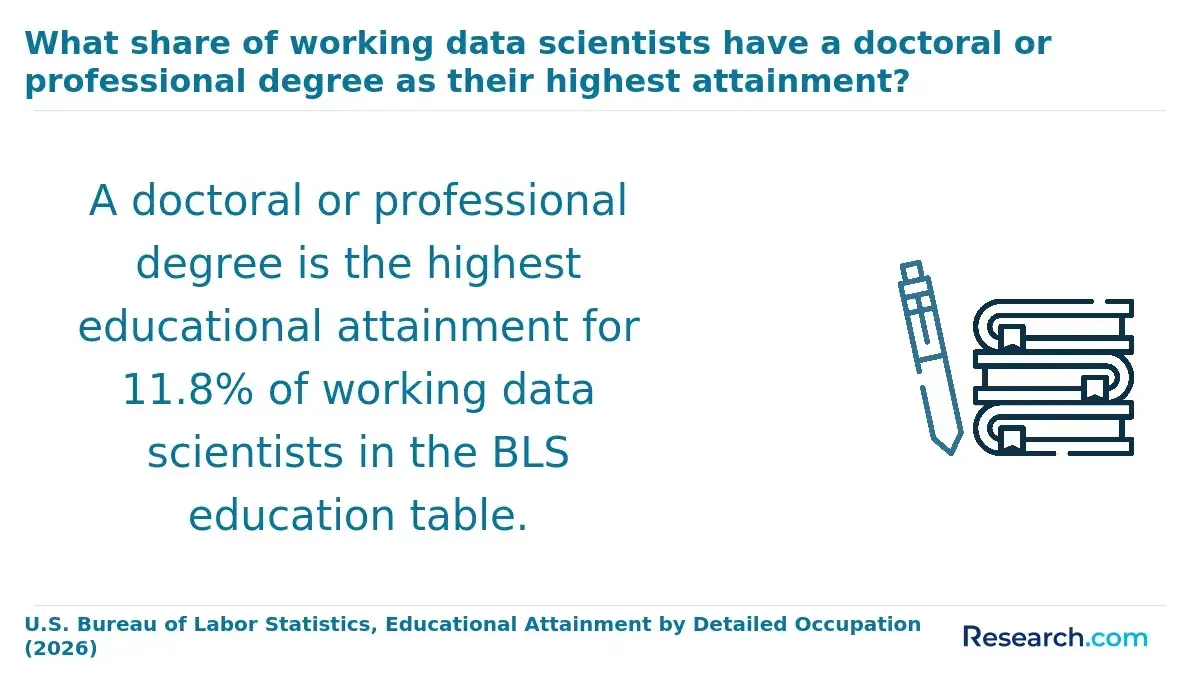
Depending on their existing experience and new skills, SQL professionals may pursue more advanced analytics, data engineering, or data scientist roles. A master's degree can help develop and demonstrate capabilities for those paths, but a job title or promotion does not follow automatically from enrollment.
The U.S. Bureau of Labor Statistics reports a $120,230 median annual wage for data scientists in May 2025. That is an occupation-wide figure, not a starting salary or a measured payoff from a master's degree. Use it to understand the broader occupation, then judge your own prospects against the skills required in target job postings, your prior experience, location, and the roles the program's projects prepare you to pursue.
How can applicants evaluate an accredited data science master's program?
Confirm the institution's current accreditation through the institution and its recognized accreditor, then evaluate the specific program separately. Institutional accreditation is an important check, but it does not show whether the curriculum addresses your gaps or whether graduates achieve your intended outcomes.
Compare programs against the decision you actually face: Can you enter with your present coursework? Will the required classes advance you beyond SQL reporting? Can you complete meaningful projects within your schedule and budget? Ask how project supervision and career support work in practice. If connections are a major reason to enroll, consider what professional connections through an AI graduate program might offer as a comparison, then verify the data science program's own opportunities directly. Treat rankings and promotional career claims as starting points for questions, not substitutes for answers.
Other Things You Should Know About Data Science
Usually, the relevant question is whether a program requires one. A certification may document a skill, but it should not displace stronger evidence such as substantial work, a clear project, or required academic preparation.
Possibly. Ask the admissions office whether the course must be complete before applying or only before enrollment, and whether a conditional offer is possible. Get the policy for your intended entry term.
No. Work in analytics, operations, finance, or another function can be relevant if you can explain the data problem and your own analytical contribution. A title alone says less than the work you performed.
Choose the degree when its required learning, projects, and credential address a gap you cannot reasonably close through your current role or shorter study. If your main goal is one specific tool or technique, a smaller commitment may be more suitable.
References
- Healthcare data scientist qualifications, skills, and job focus | nih.gov https://pmc.ncbi.nlm.nih.gov/articles/PMC7787353/
- What Is Data Science? Definition, Skills, Applications & More | Harvard SEAS https://seas.harvard.edu/news/what-data-science-definition-skills-applications-more
- M.S. admissions | Data Science https://cse.umn.edu/datascience/graduate-admission-requirements
- Data Science vs. Applied Data Science: Main Differences | Syracuse University https://ischool.syracuse.edu/applied-data-science-vs-data-science/
- 12 Essential Skills Required for Data Scientists in 2023 | MDS@Rice https://csweb.rice.edu/academics/graduate-programs/online-mds/blog/data-science-skills
- FAQs | DSI - UChicago Data Science Institute https://datascience.uchicago.edu/education/masters-programs/ms-in-applied-data-science/faqs/
- Admissions Committees Best Practices | wisc.edu https://kb.wisc.edu/grad/131751
- Admissions Application Materials | Northwestern Engineering https://www.mccormick.northwestern.edu/machine-learning-data-science/admissions/application-materials.html
- Admission Requirements https://graduate.appstate.edu/graduate-admissions/apply-graduate-school/application-requirements
- How to Get Into Grad School: What Admissions Committees Really Look For | straighterline.com https://www.straighterline.com/blog/how-to-get-into-grad-school-what-admissions-committees-really-look-for