2027 BS in Business Administration Decision Guide: A Lower Entry GPA Requirement or More Academic Support
Audited and Verified:
Our Editorial and Data Verification Process
Research.com uses government datasets, official education statistics and primary institutional information to support its career and degree guides. Our review process checks factual accuracy, occupational definitions, source dates and the requirements associated with the credentials discussed.
How This Article Was Fact-Checked
Our editorial team verifies salary estimates, employment projections, education requirements and program information against original data providers and official organizations. Salary figures are checked against the relevant occupational definitions and reporting periods. Information about licensure, accreditation and required in-person training is reviewed separately.
Fact-checked and verified on:

Co-Founder and Chief Data Scientist
A lower GPA requirement can make a BS in Business Administration accessible, but admission is only the first step toward graduation. If your grades reflect an earlier setback, a demanding schedule, or gaps in math and writing, the better choice may be the program that helps you complete the degree - not simply the one that admits you first.
This guide explains how to compare admission rules with tutoring, advising, course scheduling, and cost so you can choose a realistic path forward.
Key Things You Should Know
- A lower entry GPA does not necessarily mean admission to the business major; ask whether the institution and major have separate standards.
- Choose stronger academic support when it addresses a specific obstacle - such as accounting, statistics, or course planning - and is available when you can use it.
- Compare admission, support, and completion requirements together. An offer of admission does not establish how prior credits apply or when you can graduate.
What Is a BS in Business Administration?
A BS in Business Administration is an undergraduate degree built around business functions such as accounting, finance, marketing, operations, and management. Depending on the school, it also includes general education, quantitative coursework, electives, and possibly a concentration or capstone. A BBA or BA in Business may cover similar subjects, but its requirements can differ; compare curricula rather than relying on the degree title.
For an applicant concerned about GPA, the most important distinction is between getting into the school and making steady progress through the business curriculum. A faster calendar is not automatically a better solution: fast-track bachelor's degree options still require you to meet course prerequisites and keep up with the workload.
Is a Lower GPA Enough for Admission to a Business Administration Program?
Not always. A school may assess admission to the institution separately from entry into its business major. It may also use different rules for first-year, transfer, and returning students. Ask which GPA is evaluated - overall, recent college work, or specified prerequisite courses - and how repeated or pass-fail courses are treated. A published minimum establishes eligibility, not a promise of admission or success.
The comparison below separates the immediate benefit of each option from the risk you need to investigate. Neither column describes a universal school policy.
| Option | Potential advantage | What to verify |
| Lower GPA entry requirement | May allow you to apply without first raising your GPA. | Business-major admission, prerequisite grades, conditional status, and any academic-standing rules. |
| Stronger academic support | May help you address the coursework or scheduling problem behind past grades. | Who can use each service, appointment availability, subject coverage, and whether access continues online or part-time. |
If you lack a required course, check the school's policy before assuming it must be completed before admission; some programs permit later completion, while others do not. Use its published rules alongside guidance on required credits before entering business administration study, then request a written explanation from admissions or the business department for your circumstances.
How Can Academic Support Help Business Administration Students Succeed?
Useful support is specific to the work ahead. Accounting tutoring may help a student who struggled with financial statements; math or statistics help may matter before analytics courses; an adviser can identify prerequisites that would otherwise delay graduation. None of these services replaces the time needed to study, and a general claim of "student support" says little about access.
Before choosing the more selective program for its services, test how they would work in your actual schedule:
- Ask whether tutoring covers the courses you need and whether appointments are available outside your work or caregiving hours.
- Request a term-by-term plan showing when prerequisites and required business courses are offered.
- Find out how early-alert outreach, academic coaching, and accommodations are requested, and whether part-time or online students can use them.
If employment limits your study time, working-adult business administration program comparisons can help you identify options to investigate. Confirm the services and schedules directly with each school before enrolling.
First, verify the institution's accreditation through the accreditor and the U.S. Department of Education's recognition information. Then check whether the business program has separate AACSB, ACBSP, or IACBE accreditation and whether the specific degree is within its scope. Institutional accreditation and business-specific accreditation answer different questions; neither proves that tutoring is effective or that graduates obtain particular jobs.
For this decision, compare the catalog and written policies that will apply to your enrollment term: major-entry rules, academic standing, course availability, support eligibility, and graduation requirements. Ask for a degree audit if you have prior college work. Credits accepted by the institution may count only as electives rather than satisfy business requirements.
Application expense is worth considering, but it should not control the choice. Fee-free applications for online college may make it easier to compare offers; evaluate accreditation, support, and remaining degree requirements before accepting one.
The degree generally teaches students to interpret business information and make decisions across functions. Introductory accounting and finance develop cost and financial-statement literacy; marketing and management address customers, teams, and organizations; statistics and operations build quantitative and process skills. Check the actual course sequence: a student who needs to rebuild math confidence benefits from knowing when quantitative courses begin and what preparation is available.
A concentration can add depth, but it is not the same as a separate professional credential. If human resources interests you, for example, compare the required HR courses and applied opportunities rather than assuming a general management elective provides the same preparation. Students bringing prior coursework into that pathway can explore human resources bachelor's credit transfer options, then obtain an official evaluation of which credits satisfy the chosen degree.
Choose the format in which you can consistently attend, practice difficult material, and obtain help. Campus study may make face-to-face tutoring easier to use, but commuting and fixed meeting times can strain a working student's schedule. Online study removes that commute, yet classes may still have live sessions, group meetings, timed exams, and weekly deadlines.
Ask for sample course schedules and assessment policies for required accounting, statistics, and capstone classes - not just introductory electives. Business degree options with shorter sessions may fit some schedules, but compressed courses also leave less time to recover after a difficult week. If past grades suffered because too many obligations competed for your attention, a manageable pace matters more than the advertised speed.
Completion time depends on applicable transfer credit, remaining prerequisites, enrollment pace, and when required courses are offered. Tuition is only part of the cost: compare mandatory fees, books or software, travel or technology needs, and the financial effect of an extra term. A lower-GPA-entry program may cost more overall if it requires repeated coursework or offers required classes less often; a support-rich program may cost more upfront but be easier to navigate. Neither outcome should be assumed.
Request an official degree audit and a cost estimate based on your remaining requirements from each school. Then compare the estimates on the same enrollment pace and include available grants, employer assistance, and expected borrowing only when eligibility is confirmed. Online business administration school cost comparisons can help you find candidates, but advertised tuition cannot substitute for a personalized completion estimate.
A BS in Business Administration can support applications for roles in operations coordination, sales support, marketing coordination, procurement, and HR operations. The strongest match depends on your coursework and evidence from employment, internships, or projects. For instance, an operations applicant should be ready to explain a process improvement or spreadsheet analysis - not just list a management course. A degree does not itself qualify a new graduate to manage staff or enter a regulated profession.
If your goal is specifically organizational leadership, compare the business degree's functional breadth with a leadership-focused curriculum and the experience employers request. Three-year organizational leadership bachelor's options may warrant a look, but a shorter program is not a substitute for the accounting, finance, or operations preparation your target role may require.
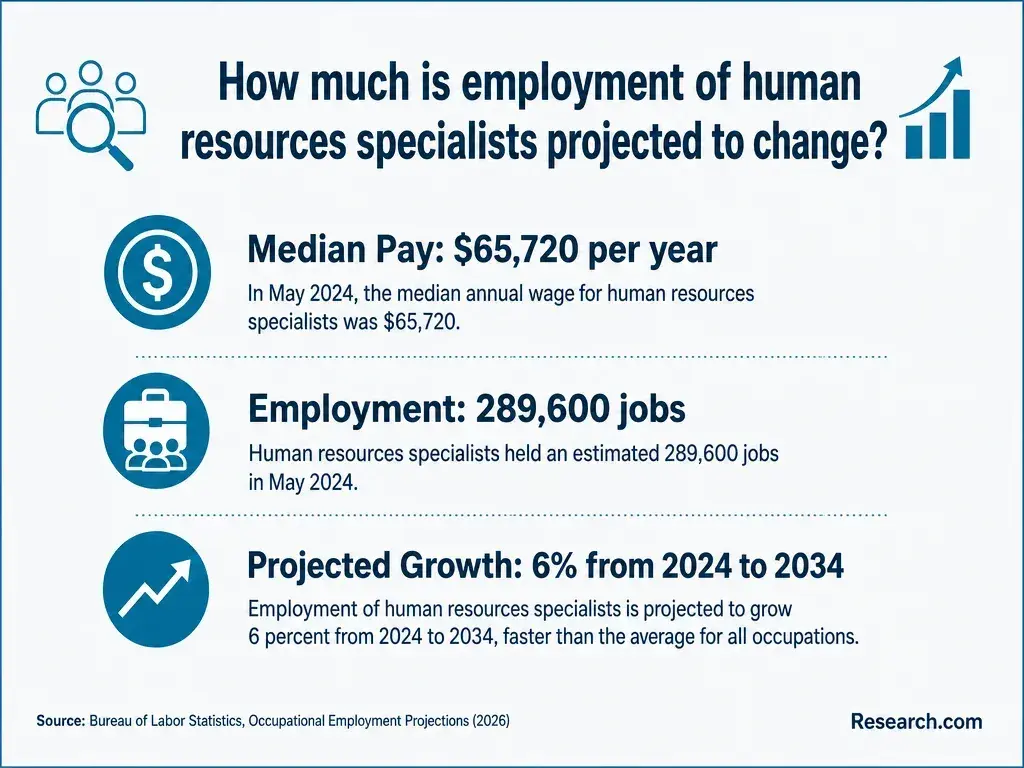
There is no single salary for a business administration graduate: pay varies by occupation, experience, industry, and location. The U.S. Bureau of Labor Statistics reports a May 2025 median annual wage of $75,940 for human resources specialists. That is an occupation-wide median, not a starting salary or an earnings estimate for everyone with this degree. Use a target occupation - not a broad "business" label - when weighing potential pay against education costs.
Because earnings are uncertain, compare borrowing with a realistic completion plan rather than assuming a salary increase will cover it. If federal aid is important to affordability, investigate business administration colleges participating in federal aid programs and confirm your own aid eligibility and net cost with each financial-aid office.
What Is the Job Outlook for Business Administration Graduates?
Outlook belongs to an occupation, not to the degree as a whole. BLS projects 6% U.S. employment growth for human resources specialists from 2025 to 2035. That describes demand across the occupation; it does not predict how readily an individual graduate will be hired. Relevant experience, demonstrated skills, and local openings still matter.
Faster graduation can be valuable if it helps you pursue a suitable opening sooner, but speed alone is a poor reason to risk another academic setback. If timing drives your choice, compare fast-track business bachelor's schools against the support and course access you will need to finish. Favor the program with a credible path from your current academic record to the work you want to do.
Other Things You Should Know About Business Administration
If the application allows it, briefly describe the circumstances, what changed, and evidence of stronger recent work. Follow the school's instructions rather than sending unsolicited materials.
Possibly. Ask whether the school accepts an application with a course in progress and when it requires the final grade. Do not assume the retake will immediately replace the earlier grade in its GPA calculation.
Not necessarily. Obtain the conditions in writing and confirm separately when you become eligible to enter or remain in the major.
Admissions can explain application evaluation; the registrar or transfer office can assess credits; and a business adviser can confirm how approved credits apply to degree requirements.
- Semester Course Load and Student Performance - PMC - NIH https://pmc.ncbi.nlm.nih.gov/articles/PMC7568764/
- Understanding College Costs | studentaid.gov https://studentaid.gov/resources/prepare-for-college/students/choosing-schools/consider-costs
- School-Determined Requirements | 2024-2025 Federal Student Aid Handbook https://fsapartners.ed.gov/knowledge-center/fsa-handbook/2024-2025/vol1/ch1-school-determined-requirements
- Student Support Services Program (84.042A) | ed.gov http://www.ed.gov/grants-and-programs/grants-higher-education/federal-trio-programs/student-support-services-program-84042a
- DAPIP | Homepage - Office of Postsecondary Education (OPE) https://ope.ed.gov/dapip/
- Admission and Certification Requirements | Herbert Wertheim College of Business https://wertheim.fsu.edu/undergraduate/admission-and-certification-requirements
- Academic Support Services | Sacramento State Catalog https://catalog.csus.edu/academic-support-services/
- Business Administration Transfer Pathway - UC Admissions https://admission.universityofcalifornia.edu/admission-requirements/transfer-requirements/uc-transfer-programs/transfer-pathways/business-administration.html
- Search Accredited Schools | AACSB https://www.aacsb.edu/accredited
- Support Programs and Services for Students | Sierra College https://www.sierracollege.edu/student-services/support-programs/