2027 BS in Business Administration and Marketing: Choosing a Focus Without Direct Experience in the Field
Audited and Verified:
Our Editorial and Data Verification Process
Research.com uses government datasets, official education statistics and primary institutional information to support its career and degree guides. Our review process checks factual accuracy, occupational definitions, source dates and the requirements associated with the credentials discussed.
How This Article Was Fact-Checked
Our editorial team verifies salary estimates, employment projections, education requirements and program information against original data providers and official organizations. Salary figures are checked against the relevant occupational definitions and reporting periods. Information about licensure, accreditation and required in-person training is reviewed separately.
Fact-checked and verified on:

Co-Founder and Chief Data Scientist
You do not need a marketing job on your résumé to choose a marketing focus within a business administration bachelor's degree. But without direct experience, it is harder to know whether you enjoy the work - and whether a concentration will help you enter it. This guide is for prospective and returning students weighing marketing against a broader business path. It explains what each option teaches, how to test your interest through practical work, and what to verify about programs before committing time and money.
Key Things You Should Know
- Prior marketing employment is generally not required for a bachelor's degree; check the school's admission and major-entry rules rather than assuming experience is a prerequisite.
- Choose a marketing concentration for deeper study in customer research, campaigns, and measurement; choose general business if your target function remains uncertain or the concentration would delay graduation.
- The U.S. Bureau of Labor Statistics reports a $78,760 median annual wage for market research analysts in May 2025. That occupation-wide figure is not a starting salary or an outcome promised by either degree path.
What is a BS in Business Administration and Marketing?
A BS in Business Administration with a marketing concentration typically combines a business core - such as accounting, finance, management, and quantitative reasoning - with additional marketing courses. Some schools instead award a specialized marketing bachelor's degree. A concentration, a minor, and a few marketing electives are not interchangeable credentials: the school's catalog determines what appears on your academic record.
The distinction matters if you want both broad business preparation and a recognizable marketing focus. Compare the actual required courses, not just the degree title. A BS and a BBA may cover similar subjects but differ in quantitative requirements, electives, and credit applicability. For broader context on degree timelines and occupational pay - not a forecast of your earnings - see business administration program length and salary context.
Can you pursue a marketing degree without direct industry experience?
Yes. Undergraduate marketing courses are designed to teach foundational concepts, though a particular school may require prerequisites before you enter the major or take advanced classes. Customer service, writing, event planning, retail, volunteer outreach, and spreadsheet work can all give you relevant starting skills without being formal marketing jobs.
The more useful question is how you will test and demonstrate your interest. Before committing to a concentration, try an introductory course or a modest, supervised project: define an audience, examine publicly available information, propose a message, and explain how you would assess it. Label proposed results as projections, not outcomes. If application costs are limiting how many schools you can explore, no-application-fee online college choices may offer additional options; still verify that each offers the marketing coursework you want.
What careers can a BS in Business Administration and Marketing lead to?
Relevant starting points may include marketing coordinator, sales support, customer insights assistant, or communications roles. Titles vary by employer. A coordinator might organize campaign materials and report basic results; an insights assistant might clean survey data and summarize patterns. Both require evidence of communication and analytical ability beyond a degree title.
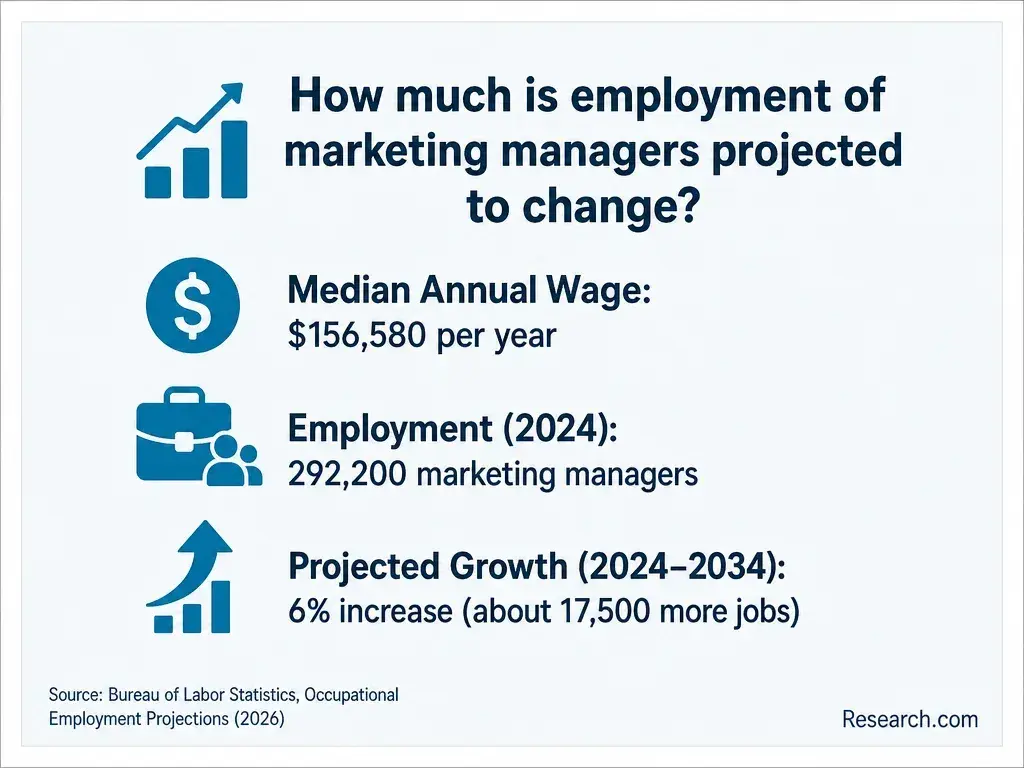
Market research analyst is a useful occupation to investigate if you enjoy interpreting customer and market data. The Bureau of Labor Statistics reports a May 2025 median annual wage of $78,760 for the occupation, across experience levels and industries. Compare local entry-level postings with your skills rather than treating that median as a graduate salary. Marketing manager roles generally require substantial relevant experience; graduation alone does not make someone a manager.
If working with employees interests you more than studying customers, compare the duties and preparation described in human resources qualifications and degree routes before choosing marketing by default.
The business core commonly introduces accounting, economics, management, finance, statistics, and business communication. Marketing coursework may progress from principles of marketing to consumer behavior, research, digital marketing, and campaign analysis. Course names alone do not establish depth: inspect prerequisites, assignments, and the tools students actually use.
For a student without industry experience, an especially useful sequence moves from customer research to a campaign proposal and then to measurement. Look for assignments requiring you to explain a target audience, distinguish observations from assumptions, and interpret results responsibly. A project management course can help with deadlines and team coordination, but it is not a substitute for marketing practice or a project management credential. If you are considering a separate online project management degree instead of a marketing elective, compare its distinct costs and aid options through budgeting for online project management college study.
Choose based on the work you want to try, the additional learning you would receive, and whether the concentration changes your graduation plan. This comparison summarizes the trade-off; neither label replaces relevant experience.
| Option | Likely advantage | Main limitation |
| Marketing concentration | More structured study of customers, campaigns, and marketing measurement | Less room for other electives; required courses may have prerequisites or limited availability |
| General business focus | More flexibility to explore functions or use applicable transfer credits | May provide less depth and fewer marketing-specific work samples |
| Specialized marketing bachelor's degree | Potentially more marketing coursework throughout the major | May offer less flexibility if your interests change |
A marketing concentration makes sense when its advanced courses and applied opportunities match roles you can name. General business is a sound choice when you are still testing several functions, particularly if changing concentrations would add courses or delay completion. If purchasing, logistics, or operations attracts you more than customer research, economical study options for supply chain careers provide a different comparison point. Ask an adviser for a degree audit showing how each choice uses your existing credits.
Requirements depend on the institution and whether you are applying as a first-year, transfer, or returning student. Schools commonly review prior academic records; some business majors also have separate entry standards or require introductory mathematics, statistics, accounting, or economics. Direct marketing experience is generally not an admission requirement, but do not confuse admission to the university with admission to the major.
Request the current catalog and ask admissions which transcripts are needed, then ask the business adviser which prior courses satisfy major requirements. If you are transferring, an accepted course may count only as an elective. Business administration admissions eligibility rules offer context for these questions, while the institution must make the final decision about your record.
A bachelor's degree commonly takes about four years of full-time study from the start, but transfer credit, part-time enrollment, prerequisite sequences, and required course availability can change the timeline. A concentration may fit within existing elective space or require a different sequence; its name alone tells you neither.
Ask for a term-by-term plan showing when advanced marketing courses run and whether they require earlier classes. If speed matters, compare the actual remaining requirements and weekly workload - not only an advertised finish date - when reviewing flexible accelerated bachelor's degrees. Faster terms do not necessarily mean fewer credits or lower total costs.
Both formats can teach marketing concepts, but access to feedback and applied work may differ. The comparison below highlights features worth verifying in the courses you would actually take.
| Feature | Online program | Campus-based program |
| Schedule | May reduce travel, but can still require live meetings and fixed deadlines | Usually has scheduled class meetings and travel time |
| Collaborative work | May use remote teams and presentations | May make in-person team work and events easier to access |
| Applied opportunities | Projects may be completed remotely; internship rules vary | Local employer connections may be available; placements are not guaranteed |
Ask whether marketing courses include live presentations, group campaigns, proctored exams, or an internship that requires an approved site. Online delivery does not by itself determine financial-aid eligibility. If you are also comparing another online business-related major, guidance on FAFSA-based aid for online project management undergraduates can help frame aid questions, but confirm eligibility for the specific marketing program with its financial-aid office.
There is no dependable single price for this degree. Your total depends on the school's tuition basis, fees, remaining required credits, books and software, travel, and how long you remain enrolled. For a transfer student, the important figure is the cost of courses still needed after the school applies accepted credits to the business core and concentration.
Compare written estimates for the general business and marketing paths using the same enrollment pace. Include any added prerequisite or summer course, and distinguish grants and scholarships from loans that must be repaid. For a starting point on comparing accredited online options and federal-aid considerations, see business administration tuition budgets using federal student aid. Your school's financial-aid offer and final degree audit, not a published tuition rate alone, determine the more useful personal estimate.
How do accreditation, certifications, salaries, and job outlook affect program choice?
First verify the institution's recognized accreditation and confirm that the business degree and marketing concentration are actually offered in your intended format. AACSB, ACBSP, and IACBE accreditation have defined scopes; do not assume an entire institution or every program is covered. Then compare required marketing courses, access to projects, advising, and the cost of completion. Compare low-cost online business administration pathways as a shortlist, not as a substitute for checking each school's current catalog and accreditation status.
A degree concentration and a professional certificate are different credentials. A short software or advertising-platform certificate may help you practice a particular tool, but neither it nor the degree proves campaign performance. For labor-market context, the Bureau of Labor Statistics projects 7% growth for market research analysts from 2025 to 2035. That projection describes an occupation nationally, not openings reserved for marketing graduates. Give greater weight to local job descriptions and the work samples you can realistically build.
Other Things You Should Know About Business Administration
Yes. Outreach, event promotion, or audience communication can demonstrate relevant tasks. Describe what you personally did and distinguish actual results from estimates.
Usually, if you identify it as class work and have permission to share its materials. Remove private customer information and avoid presenting a proposal as a campaign that ran.
Not necessarily. Marketing includes research, writing, planning, and analysis as well as creative work. Check whether the roles that interest you require design skills.
No. A concentration, relevant electives, and practical experience may be a better use of time. Compare the double major's additional requirements against the skills demanded by your target roles.
- 4 Things to Consider in Choosing a College or Career School - Federal Student Aid https://studentaid.gov/articles/4-things-consider-choosing-college-career-school/
- Best Business Administration Jobs for New Graduates | Florida National University (FNU) https://www.fnu.edu/business-administration-jobs-for-new-graduates/
- 6 In-Demand Marketing Roles in 2025 | UW Professional & Continuing Education https://www.pce.uw.edu/news-features/articles/in-demand-marketing-roles
- Marketing and Communications Internship Program https://marcom.emas.ncsu.edu/internships/
- How to Pick a College: 7 Things to Consider Before You Decide | western.edu https://western.edu/newsroom/how-to-pick-a-college/
- What Can I Do with a Business Administration Degree? | CTU https://www.coloradotech.edu/degrees/studies/business-and-management/articles/what-can-i-do-with-a-business-administration-degree
- How Marketing Skills Open Doors to Multiple Career Paths | Edison State Community College https://www.edisonohio.edu/blog/how-marketing-skills-open-doors-to-multiple-career-paths
- How Can a Bachelor's Degree in Business Administration Help Me? | University of Wisconsin Flexible Option https://flex.wisconsin.edu/stories-news/how-can-a-bachelors-degree-in-business-administration-help-me/
- BCC Marketing Internship https://www.berkeleycitycollege.edu/marketing/jobs
- Non-Profit Internships - Office of Community Engaged Learning https://cel.missouri.edu/clip-promo/non-profit-internships/