2027 Best Online Associate Degree Completion Programs for Working Adults

Co-Founder and Chief Data Scientist
If you have college credits but no degree, the best online completion program is the one that applies those credits to a credential you can finish around work - not simply the one advertising the shortest timeline. Cost matters, too: the College Board reported average published tuition and fees of $4,050 for full-time students at public two-year colleges in 2024-25, before living expenses and other costs. This guide compares six fields and explains how to check schedules, transfer evaluations, remaining requirements, and career outcomes before you enroll.
Key Things You Should Know
- Start with a written credit evaluation: associate degrees commonly require about 60 semester credits, but accepted credits may not satisfy the courses your major requires.
- Compare the cost of credits you still need, not just published tuition; the College Board's 2024-25 public two-year tuition-and-fees average was $4,050 for a full-time academic year, not a completion-program price.
- "Online" does not guarantee a work-friendly schedule: check live attendance, course availability, proctored exams, and any labs or clinical placements before choosing a program.
Top 10 Best Online Associate Degree Completion Programs for Working Adults
Business Programs
An online business AA or AS can suit adults planning to transfer into a bachelor's program; a business AAS may emphasize immediate workplace skills. Compare accounting, spreadsheet, communication, and management courses against your goals. Asynchronous classes may fit rotating shifts, but group projects can still require meetings. Ask whether previous business courses fulfill major requirements and whether a destination university will apply the credits toward its bachelor's curriculum. An associate degree can support entry-level administrative or sales work; management jobs generally require relevant experience.
Healthcare Programs
Healthcare administration, medical coding, and health information programs can offer more online coursework than hands-on allied-health fields. A healthcare AAS may prepare students for entry-level operations or records work, while an AS may prioritize transfer. Check whether coding courses align with any certification you want; the degree alone does not award certification. If a program includes a practicum, ask whether you must arrange a placement and complete it during business hours. Prior science credits may also face recency rules.
Information Technology Programs
IT associate completion options commonly cover networking, cybersecurity foundations, programming, or support. An AAS may prioritize job skills; an AS may make more room for transferable math and science. Remote labs can reduce commuting, but scheduled team projects or proctored exams may limit flexibility. Ask whether older technical credits still meet current requirements and whether certifications can earn evaluated credit. Entry-level opportunities depend on demonstrable skills and employer expectations, not the degree title alone.
Nursing / Pre-Nursing Programs
Distinguish a pre-nursing AS from an associate degree in nursing. Pre-nursing completes prerequisites but does not qualify a student for RN licensure. An associate nursing program includes supervised clinical education, which generally requires in-person attendance even when lectures are online. Admission to the college may not mean admission to nursing; prerequisites, grades, testing, and available clinical places can matter. Before applying, confirm program approval and whether it meets the licensing requirements of the state where you intend to practice.
Criminal Justice Programs
Criminal justice AA and AS programs may fit adults intending to transfer; an AAS may emphasize applied public-safety coursework. Online study can accommodate shift work, but internships may require set hours. Compare the curriculum with the job you actually want: law-enforcement hiring can involve an academy, background checks, physical standards, and state-specific training beyond college. If a bachelor's degree is your goal, confirm how your existing and future credits will apply at the receiving institution.
Psychology / Counseling Programs
A psychology AA or AS is usually a transfer foundation, not a qualification to practice counseling. Courses often include introductory psychology, research methods, and statistics; check whether previously completed courses meet the intended bachelor's program's requirements. Some graduates pursue entry-level human-services support roles, subject to employer requirements. Licensed counseling generally requires additional education and supervised experience. For a working adult, a clear transfer agreement may be more valuable than an applied program promising an immediate counseling career.
What Are Online Associate Degree Completion Programs for Working Adults?
An online associate degree completion program is a pathway for someone who has already earned college credit but has not finished an associate degree. The school evaluates that credit, identifies remaining general education and major courses, and requires the student to complete them under its rules. "Completion program" does not imply a uniform starting point or a guaranteed finish date.
The credential's purpose matters as much as its delivery format. These common degree types can point toward different next steps, although the actual curriculum and transfer agreements take priority over the abbreviation.
| Degree type | Common emphasis | Best-fit question |
| AA | Broad general education and transfer | Will these courses meet my intended bachelor's requirements? |
| AS | General education plus science, technical, or professional foundations | Do the required prerequisites match my next program? |
| AAS | Applied preparation for a field or occupation | Will the skills serve my job goal, and what will transfer later? |
Some schools evaluate military education, industry credentials, examinations, or documented professional learning for credit. That is a formal assessment, not automatic credit for years worked. A competency based degree may offer another way to demonstrate learning, but its credit and scheduling rules still need to fit your associate-degree goal.
Which Accreditation Should Online Associate Degree Completion Programs Hold?
Look first for institutional accreditation recognized by the U.S. Department of Education or the Council for Higher Education Accreditation. It is a baseline check for institutional oversight, but it does not guarantee that every credit will transfer or that a program meets an occupational licensing rule.
In regulated fields, check the program itself. Nursing applicants should verify state board approval and any relevant nursing accreditation, then confirm eligibility for licensure in the state where they plan to work. Other allied-health occupations may require field-specific program accreditation. Ask the admissions office and the relevant licensing authority about your exact program and location before paying an enrollment deposit.
How Do Online Associate Degree Completion Programs Compare With Campus Options?
Online and campus associate programs can award the same degree, but their weekly demands may differ substantially. For working adults, the deciding factor is often whether required activities fit actual shifts and caregiving hours - not whether classes appear on a screen.
This comparison highlights the scheduling trade-offs to check in a school's current course schedule rather than assuming one format is always more flexible.
| Format | Potential advantage | Constraint to verify |
| Asynchronous online | Access lessons outside scheduled class hours | Fixed deadlines, exams, and limited course offerings |
| Live online | Real-time discussion without commuting | Required attendance at set times |
| Hybrid | Remote coursework with hands-on instruction | Commutes for labs, meetings, or clinical work |
| Campus | On-site equipment and face-to-face support | Travel and scheduled class attendance |
Online coursework can still include local internships or clinical placements. Request a term-by-term schedule for your remaining courses; a required class offered only once a year can delay completion in any format.
What Admission Requirements Apply to Online Associate Degree Completion Programs?
Most applicants need a high school diploma or equivalent, official transcripts from every prior college, and an application. A school may use prior coursework or placement measures to determine readiness. Standardized admissions tests are often unnecessary at community colleges, but policies vary.
Admission to the institution is not always admission to a major. Nursing and some allied-health programs may separately require prerequisites, minimum grades or GPA, testing, background checks, or health documentation. Transfer-credit decisions may also depend on course content, grades, where the credit was earned, and how recently a technical or science course was completed. Ask for an official evaluation before enrollment when possible, including which accepted credits actually fulfill degree requirements.
What Courses Are Included in Online Associate Degree Completion Programs?
The courses left to take depend on your transcript and major. Most associate degrees combine general education - such as writing, mathematics, and communication - with field-specific courses. A student who previously completed general education may still need a sequence of major courses; another may have the opposite gap.
Business students may take accounting and management; IT students may need programming and remote labs; pre-nursing students may need science prerequisites before applying to nursing. Clinical, practicum, or internship requirements can add in-person hours. If you are comparing an easiest associates degree option with a career-specific program, check which required courses support your next step. Fewer difficult prerequisites are not a benefit if the degree misses your transfer or licensing goal.
How Long Do Online Associate Degree Completion Programs Take and Cost?
Associate degrees commonly require about 60 semester credits, but your remaining time depends on how accepted credits apply, enrollment pace, course sequencing, and required experiential work. An advertised short completion timeline may assume substantial transferable credit and full-time attendance. Part-time study can be more sustainable alongside a job, even if it takes longer.
For a cost benchmark, the College Board reported average published tuition and fees of $4,050 for a full-time year at public two-year colleges in 2024-25. That figure is not a quote for finishing your degree: residency rules, online fees, books, technology, travel, and the number of remaining credits can change your bill. Ask each school for a written estimate based on your evaluated credits, then compare aid eligibility, scholarships, and employer tuition assistance. Confirm whether prior-learning assessments carry fees and whether they reduce required coursework.
Which Careers Can Working Adults Pursue After Completing an Associate Degree?
The most useful career comparison starts with the work you want to do, then checks whether an associate degree is an entry credential, a transfer step, or neither. Business and healthcare administration programs may support entry-level office work; IT programs can build skills relevant to support roles; criminal justice programs can provide a foundation for public-safety pathways. Employers may also expect experience, technical credentials, or other screening.
Some goals require a longer route. Registered nursing requires completion of an approved nursing program and licensure, not merely pre-nursing coursework. Counseling typically requires graduate education and supervised experience, so a psychology associate degree is better viewed as an early transfer step. If that is your goal, map the associate degree to a bachelor's program before considering an online masters degree; skipping that transfer check can add time and expense.
What Salaries and Job Outlook Can Associate Degree Graduates Expect?
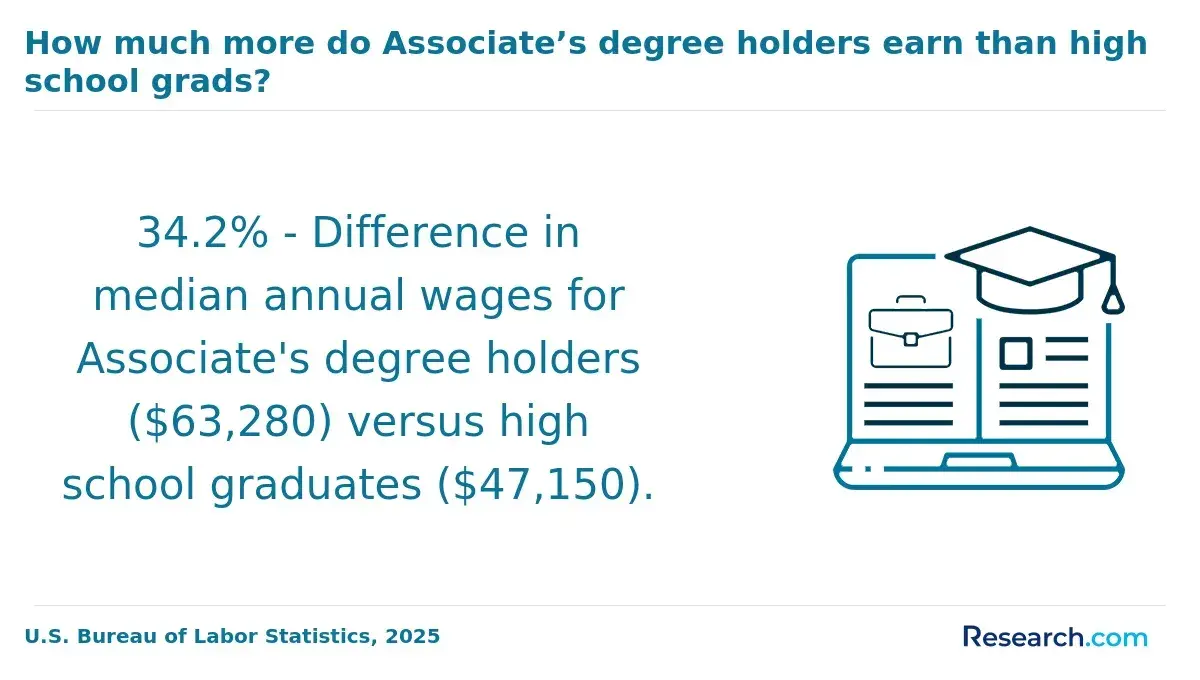
Salary data describe occupations, not what a particular degree's graduates will earn. For example, the U.S. Bureau of Labor Statistics reports a May 2024 median annual wage of $93,600 for registered nurses and projects 5% employment growth from 2024 to 2034. That wage includes RNs with varied education and experience; an approved nursing degree, licensing examination, and state licensure requirements still apply.
Use occupational figures to test whether a career path interests you, then examine entry requirements and local job postings. A psychology associate degree should not be compared with counselor wages as though the two credentials were interchangeable. Likewise, an accelerated online master degree is an advanced option for eligible students, not a shortcut from unfinished associate coursework to a graduate-level occupation.
How Can Students Choose a Reputable Online Associate Degree Completion Program?
The strongest choice is the accredited program that fits your existing credits, weekly availability, budget, and intended next step. A low tuition rate or prominent ranking cannot establish that fit on its own. Use these checks to turn program descriptions into a comparison you can act on:
- Send every prior transcript and request a written evaluation showing accepted credits, remaining general education and major courses, transfer limits, and credits that must be earned at the new school.
- Ask for a term-by-term plan showing start dates, course availability, live sessions, exams, and any campus, lab, internship, or clinical requirements.
- Compare estimated tuition and mandatory fees for the courses you still need, plus books, travel, assessment fees, and available financial aid or employer benefits.
- Verify accreditation, any field-specific approval, and whether credits will satisfy the requirements of your intended bachelor's program or licensing pathway.
Watch for promises of an unusually quick finish without a stated transfer-credit assumption, claims that work experience automatically earns credit, or assurances that "fully online" means no scheduled or in-person obligations. Before committing, ask an advisor to confirm the answers in writing.
Other Things You Should Know About
Some programs allow it, but others require labs, clinical placements, internships, campus visits, or live online sessions. Check the requirements for your specific major and location.
Not necessarily. A school may accept a course as transfer credit without applying it to your remaining major requirements. Request an official degree audit and ask about grade and course-age rules.
Choose based on your destination, not your schedule alone. AA and AS programs often support transfer; AAS programs often emphasize applied skills. Verify the actual curriculum and transfer agreement.
It can. Aid eligibility and award amounts depend on the program, your enrollment level, and applicable aid rules. Ask the financial aid office to estimate your options using your planned course load.
References
- College Credit for Military Training & Experiences | dantes.mil https://www.dantes.mil/credit4training/
- Undergraduate Retention and Graduation Rates - COE https://nces.ed.gov/programs/coe/indicator/ctr/undergrad-retention-graduation
- Cost of Attendance (Budget) | 2025-2026 Federal Student Aid Handbook https://fsapartners.ed.gov/knowledge-center/fsa-handbook/2025-2026/vol3/ch2-cost-attendance-budget
- Point University Catalog https://catalog.point.edu/policy/standinghonors/creditforpriorlearning
- Associate Degree vs. Bachelor's Degree: What's the Difference? | snhu.edu https://www.snhu.edu/about-us/newsroom/education/associate-degree-vs-bachelor-degree
- Online | Coastline College https://www.coastline.edu/locations/online.php
- Transfer College Credits via Prior Learning Assessments | coloradotech.edu https://www.coloradotech.edu/military/credit-transfer/faqs
- What are Asynchronous Classes? | University of Bridgeport https://www.bridgeport.edu/news/what-are-asynchronous-classes/
- 4 Flexible Ways to Earn a College Degree on Your Schedule | stjohns.edu https://www.stjohns.edu/news-media/johnnies-blog/4-flexible-ways-earn-college-degree-your-schedule-0
- Transfer Credit | American Public University (APU) https://www.apu.apus.edu/transfer-credit/