2027 Best Certifications With Evening Classes

Co-Founder and Chief Data Scientist
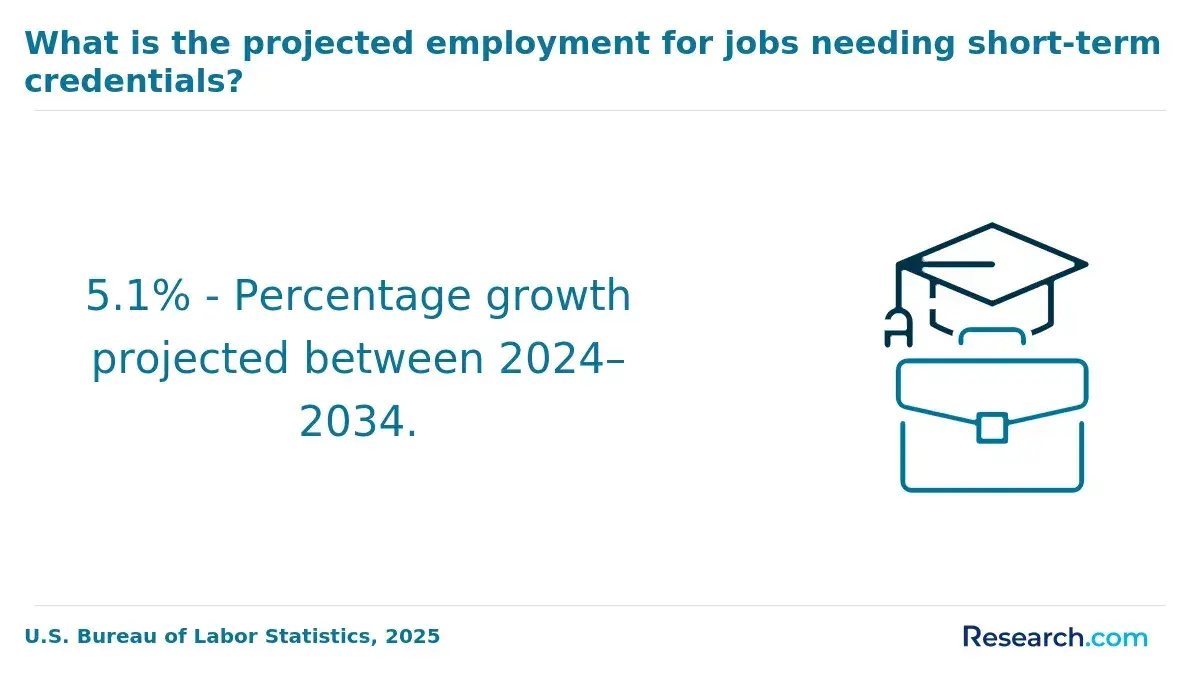
Choosing career training while working means balancing class times, hands-on requirements, cost, and whether the credential actually leads toward your target role. Evening programs can make trade, healthcare, legal, and design training more accessible without leaving a current job. U.S. Bureau of Labor Statistics projections for 2023-33 show faster-than-average growth for several certificate-relevant fields, including healthcare support and skilled trades.
This guide explains which evening credentials fit different goals, what they require, and how to compare schools before committing.
Key Things You Should Know
- Evening classes are most useful when a program includes required labs, clinicals, shop time, or instructor feedback that cannot be fully replicated online; expect some daytime testing, clinical, or licensing obligations in regulated fields.
- A school certificate confirms completion of coursework, while an industry certification usually requires an independent exam and sometimes work experience; verify which credential employers and state boards actually expect.
- BLS 2023-33 projections point to strong demand in practical healthcare, construction, IT support, and legal-support-adjacent work, but salary and hiring outcomes depend on location, licensing, experience, and employer requirements.
Top 10 Best Certifications With Evening Classes
Popular Trade School Programs
Evening trade programs commonly include HVAC/R certificates, electrical technology certificates, welding certificates, plumbing coursework, automotive service certificates, and construction management associate degrees. Certificates usually focus on job-ready technical skills and may take months to about a year part time; associate degrees include broader general education and often take longer. HVAC and electrical students should confirm whether training prepares them for EPA Section 608, local apprenticeship entry, or state licensing requirements. Choose campus-based evening instruction when shop access and supervised practice are central to the work.
Healthcare Programs
Common evening options include medical assisting, pharmacy technician, medical billing and coding, practical nursing prerequisites, dental assisting, and phlebotomy certificates. Clinical credentials are especially state- and employer-dependent: classroom completion may not qualify a student for certification, registration, or practice. Medical billing and coding can be largely classroom-based, while nursing, dental, and phlebotomy programs require supervised clinical experiences that may occur during daytime hours. Ask whether the program is credit-bearing, whether it meets exam eligibility rules, and how clinical placements are scheduled before enrolling.
Criminal Justice / Law Programs
Evening learners may find paralegal certificates, criminal justice certificates, legal studies certificates, court reporting training, and associate degrees in criminal justice. A paralegal certificate can build legal research, writing, and litigation-support skills, but it does not authorize someone to practice law. Police officer, corrections, and security roles may instead require academy training, background checks, physical standards, or state-specific licenses. Choose an American Bar Association-approved paralegal program when that recognition matters to local employers; approval is not available or necessary for every legal studies program.
Arts & Design Programs
Evening arts and design choices include graphic design certificates, UX/UI certificates, photography certificates, web design certificates, digital media production programs, and associate degrees in visual communication. Portfolio quality generally carries more weight than course completion alone in creative hiring. Short noncredit programs can help career changers learn software and create samples quickly, while credit-bearing certificates and associate degrees may provide more critique, studio access, and transferable coursework. Review graduate portfolios, software access, instructor experience, and whether classes teach current workflows such as AI-assisted design tools and accessible design practices.
What are the most in-demand certifications available through evening classes?
The most in-demand evening credentials usually align with occupations that need documented technical competence, recurring licenses, or employer-recognized exams. Demand is not the same as guaranteed placement: local openings, scheduling availability, and prior experience still matter.
This comparison shows where an evening certificate can be a practical first step and where additional licensing, an apprenticeship, or a degree is likely needed.
| Area | Typical evening credential | Important next requirement | Why it can be practical |
| HVAC/R | Career or college certificate | EPA Section 608 certification for refrigerant handling | Hands-on troubleshooting skills fit campus evening labs |
| Healthcare support | Medical assisting, billing, coding, or pharmacy technician certificate | Employer or national-certification requirements vary by role | Many programs serve working adults, though clinicals can be daytime |
| IT support | College certificate or vendor-aligned training | CompTIA or vendor certification may improve job-market signaling | Often available hybrid with evening help sessions |
| Welding | Welding technology certificate | Employer welding tests or code-specific qualifications | Supervised shop practice is valuable for beginners |
| Bookkeeping | Noncredit or credit certificate | Software proficiency and, for some roles, professional certification | Suitable for part-time, classroom, or hybrid learning |
For learners whose priority is remote study and employer-recognized exams rather than campus labs, compare these options with online certifications that pay well. A standalone industry certification is often faster than a college certificate, but it may offer less structured practice and less transferable academic credit.
Current labor-market conditions also favor foundational digital skills. AI tools are changing workflows in IT, bookkeeping, design, and legal support, so prioritize programs that teach verification, privacy, documentation, and responsible use of automated tools rather than only a single software interface.
How do evening certification classes compare to online programs for flexibility and support?
Evening campus, hybrid, and fully online programs each offer flexibility, but they solve different problems. An evening schedule fixes instruction at a predictable time; online asynchronous study lets students choose their study hours; hybrid programs combine both. The best fit depends on whether you need equipment, clinical supervision, accountability, or maximum schedule control.
The comparison below helps separate convenience from the support needed to complete skill-based training.
| Format | Schedule flexibility | Best support feature | Primary limitation |
| In-person evening | Moderate; classes occur on set nights | Immediate instructor feedback and equipment access | Commuting and fixed attendance |
| Hybrid evening | Moderate to high | Online theory plus scheduled practical sessions | Requires independent time management |
| Fully online asynchronous | High | Study around changing work shifts | May not meet hands-on or clinical requirements |
| Live online evening | Moderate | Real-time peer and instructor interaction | Still requires attendance at set times |
Online learning is often a stronger choice for academic subjects, billing and coding theory, bookkeeping, IT concepts, or general education. Students seeking a broader academic route can also explore easy college degrees online, but "easy" should not replace checking accreditation, workload, transferability, and career relevance.
Before choosing online delivery, confirm where exams occur, whether proctoring is required, how quickly instructors respond, and whether required practical experiences are arranged by the school or left to the student. For healthcare and trades, a school that promises a fully online route to a hands-on license without explaining practical training is a major red flag.
What accreditation and licensing requirements should evening certification programs meet?
Accreditation and licensing are not universal requirements for every evening credential, but they are essential when a program leads toward regulated practice, federal student aid eligibility, or a recognized academic award. Institutional accreditation evaluates the college or school; programmatic accreditation evaluates specific professional programs; state approval may be required for career schools and licensure preparation.
Use this distinction to match the program's recognition to the job you want.
| Program type | Recognition to verify | Why it matters |
| College certificate or associate degree | Institutional accreditation and state authorization | Can affect transfer credit, aid eligibility, and employer confidence |
| Healthcare clinical program | Program approval or accreditation required by the relevant board or exam body | May determine clinical eligibility and licensure or certification pathways |
| Trade program | State career-school authorization and alignment with apprenticeship or licensing rules | Training alone may not satisfy local experience requirements |
| Industry certification prep course | Alignment with the certifying organization's current exam objectives | Course completion does not automatically confer certification |
| Paralegal program | Institutional accreditation; ABA approval where relevant to local goals | Employers may prefer particular educational backgrounds |
Start by checking the relevant state licensing board or certifying organization directly, then ask the school for its current approval status in writing. If institutional quality and mission matter to you, compare options such as a non profit university with public community colleges and state-authorized career schools; nonprofit status alone does not establish program-level approval.
A common mistake is trusting a school's statement that it is "accredited" without identifying the accreditor, the exact program, and whether the approval applies in your state. Also verify whether an online or evening cohort is included in the approval, especially when clinical placements are involved.
How long do evening certification programs typically take and what do they cost?
Part-time evening certificates often take roughly six months to two years, depending on clock hours, prerequisites, lab access, and clinical sequencing. Short exam-preparation courses may take weeks, while an associate degree commonly requires about two years of full-time-equivalent study and longer when pursued only at night. A program's advertised duration is meaningful only if its required courses are actually offered every term.
Total cost includes more than tuition. The categories below help compare a lower-priced program with one that may offer better equipment, clinical coordination, or exam preparation.
| Cost category | Common examples | Question to ask |
| Direct tuition and fees | Per-credit tuition, registration, technology, lab fees | What is the total published price for the full sequence? |
| Required materials | Tools, uniforms, textbooks, software, safety gear | Which items must be purchased separately? |
| Credential expenses | Exam, application, background-check, fingerprinting, or licensing fees | Are these included, and is one exam attempt covered? |
| Attendance costs | Transportation, parking, child care, missed work for clinicals | Are daytime requirements likely? |
| Financing | Federal aid for eligible programs, employer benefits, payment plans | Is the program eligible, and what debt would remain? |
Ask for a written net-price estimate before comparing programs. Credit-bearing certificates at eligible institutions may qualify for aid, while short noncredit workforce courses often do not; employer tuition assistance can be valuable but may require continued employment or repayment if you leave.
If your long-term goal is academic advancement rather than entry-level career training, an evening certificate may not be the efficient next credential. For a very different advanced-study path, review easiest PhD without dissertation options carefully and confirm the degree's accreditation, dissertation alternative, and career purpose before applying.
What admission requirements and prerequisites do evening certification programs usually have?
Admission requirements depend on the provider and credential type. A community-college certificate may require an application, placement process, prerequisites, and proof of high school completion or equivalent. A private career school may use a simpler enrollment process. An industry certification training course may only require payment and basic technical readiness, while the certification exam itself can have separate eligibility rules.
Regulated and clinical programs generally have the most extensive screening because students may work with patients or enter supervised practice sites. Common requirements can include:
- Proof of high school completion or equivalent, particularly for college credit or career-school enrollment.
- Prerequisite coursework in math, English, anatomy, computer skills, or technical fundamentals.
- Placement testing or minimum grades in prerequisites when a program has limited seats.
- Background checks, drug screening, immunizations, CPR training, or health records for clinical placements.
- Age, identification, physical-capability, or driving-record requirements for particular trade and public-safety pathways.
Do not assume a low-barrier admission process means the program is easy to complete. Ask whether applicants are admitted directly to the credential, placed on a waiting list, or admitted first to general coursework before competitive clinical or lab placement. Applicants who need a license should check eligibility restrictions, including background-related rules, before spending money on training.
What curriculum and coursework can students expect in evening certification programs?
Evening certificate curricula typically combine job-specific theory with applied practice. The balance matters: an exam-preparation program may emphasize knowledge domains, while a career-training certificate should include demonstrations, simulations, portfolios, labs, clinical experiences, or supervised fieldwork when the occupation requires them.
Students can generally expect coursework in the following areas, adjusted to the field.
- Foundational knowledge, such as anatomy, electrical theory, legal terminology, accounting principles, or design fundamentals.
- Technical procedures, including diagnostics, software workflows, documentation, equipment operation, or client-service processes.
- Safety, ethics, privacy, accessibility, and regulatory standards relevant to the occupation.
- Communication and employability skills, such as reporting, teamwork, customer interaction, and professional writing.
- Career preparation through portfolios, mock exams, résumé support, internships, clinicals, or employer-facing projects where available.
Request the course sequence and syllabi, not just a marketing summary. For stackable college certificates, ask which courses apply to an associate degree and the time limit for using those credits. For noncredit programs, ask whether the curriculum maps to a recognized exam outline or specific employer competencies.
What careers and job roles can evening certification graduates pursue?
Evening-program graduates can pursue entry-level roles when their training, any required exam, and local rules match employer expectations. A certificate is often a launch point rather than a complete career ceiling. In trades, apprenticeships and supervised work hours commonly continue after classroom training; in healthcare, clinical certification or registration may be required; in design, a portfolio remains central.
This table connects common training paths to realistic role categories without implying that every certificate graduate qualifies automatically.
| Training focus | Potential entry-level roles | Important qualification note |
| HVAC/R or electrical | Helper, installer trainee, maintenance technician trainee | Licensing and apprenticeship rules vary by state and locality |
| Welding | Welder trainee, fabrication assistant, production welder | Employers may require process-specific weld tests |
| Medical assisting or pharmacy technology | Medical assistant, pharmacy technician | State rules and employer certification preferences differ |
| Billing, coding, or bookkeeping | Billing specialist, coding support worker, accounts-payable clerk | Experience and software proficiency strongly affect hiring |
| Paralegal studies | Legal assistant, paralegal, litigation-support assistant | Hiring standards vary; a certificate does not permit legal practice |
| Digital design | Production artist, junior designer, content-production assistant | Portfolio and demonstrated technical skills are typically decisive |
Choose an evening credential when it closes a clear skill gap for a specific role. Consider an associate or bachelor's degree instead when job postings consistently require one, when you need broader advancement options, or when a certificate would duplicate skills you already have without adding a recognized credential.
What salary ranges and earning potential are common for certification-related careers?
Salary research should be used as occupational context, not as a promise tied to a certificate. Pay varies substantially by state, shift, union coverage, specialty, employer, and experience. The U.S. Bureau of Labor Statistics reported a 2024 median annual wage of $59,810 for HVAC mechanics and installers, illustrating why technical paths can be attractive, but entry-level wages and local licensing conditions may differ.
The following occupations show the range readers may encounter when evaluating certificate-related fields. These are occupation-level median wage figures, not typical pay for all evening-program completers.
| Occupation | 2024 U.S. median annual wage | Credential context |
| HVAC mechanics and installers | $59,810 | Postsecondary training, apprenticeship, and EPA certification can be relevant |
| Medical assistants | $44,200 | Certificate training is common; employer requirements vary |
| Paralegals and legal assistants | $61,010 | Certificate or associate/bachelor's preparation may be requested |
| Graphic designers | $61,300 | Portfolio and degree expectations vary by employer |
| Computer user support specialists | $60,340 | Certificates and industry certifications can support entry, alongside skills |
Compare local job postings with national wage data before enrolling. Look for the exact credentials, software, licenses, and experience requested in your area, then calculate whether the full program cost and time away from work are reasonable for the roles you can realistically pursue.
How can students choose a reputable school offering quality evening certification classes?
A reputable evening program should make its schedule, total cost, credential type, approval status, and outcomes understandable before you enroll. The strongest choice is not necessarily the fastest or cheapest one; it is the program whose evening format and recognition match your target occupation.
Use these steps to compare schools consistently.
- Identify the exact job title you want and review local postings for required education, licenses, certifications, and shift expectations.
- Confirm whether you need a school certificate, an independent professional certification, a license, an apprenticeship, or a degree.
- Request a written schedule showing evening classes, labs, clinicals, externships, make-up policies, and expected completion sequence.
- Verify institutional accreditation, program approval, and state authorization directly with the relevant accreditor, board, or certifying organization.
- Compare total costs, including tools, exams, transportation, uniforms, and lost work time, rather than tuition alone.
- Ask for current completion, exam-pass, placement, and employer-partnership information, including how the school defines each measure.
- Speak with an instructor or program director about equipment access, clinical placement responsibility, tutoring, and accommodations for working adults.
Be cautious of schools that pressure applicants to sign immediately, promise employment or licensure, conceal extra fees, cannot explain exam eligibility, or advertise "accreditation" without naming it. Keep copies of disclosures and compare at least two programs using the same questions before making a deposit.
Other Things You Should Know About
Sometimes. Exam-preparation, IT, bookkeeping, and some business certificates can often be completed at night. Programs involving clinicals, shop labs, externships, licensing tests, or field placements may require daytime or weekend attendance even when lectures are held in the evening.
They can be worthwhile when they teach skills requested in local job postings and lead to a recognized exam, license pathway, portfolio, or employer-relevant credential. They are less useful when the target job requires a degree, apprenticeship, or experience that the program does not provide.
A certificate is awarded by a school after completing coursework. A certification is usually awarded by an independent professional organization after meeting standards, often including an exam. Some evening certificate programs prepare students for a separate certification exam, but completing class does not automatically grant the certification.
Possibly. Eligible credit-bearing programs at qualifying institutions may offer federal or state aid, while short noncredit programs often rely on employer assistance, workforce grants, payment plans, or private financing. Ask the school's financial-aid office whether your exact program, not just the institution, is eligible.
References
- Short-term programs bring lasting benefits - when student centered https://www.luminafoundation.org/focus-magazine/spring-2023/short-term-programs-bring-long-lasting-benefits-when-designed-with-students-in-mind/
- Short-term credentials and the labor market: Who stands to benefit? https://fedcommunities.org/short-term-credentials-labor-market-who-stands-benefit/
- Why Choosing the Right Certifications Can Help Your Career https://www.managementconcepts.com/resource/why-choosing-the-right-certifications-can-define-and-accelerate-your-career/
- Certificate Programs: Programs, Costs, Duration & Are They Worth It? - University of the Potomac https://potomac.edu/certificates-programs-costs-duration-are-they-worth-it/
- 7 in-demand certifications in 2025 | edX https://www.edx.org/resources/in-demand-professional-certifications
- Comparing Outcomes Across Credentials | HESA https://higheredstrategy.com/comparing-outcomes-across-credentials/
- Are Certified Professionals More Likely to Get Hired? https://www.financialprofessionals.org/training-resources/resources/articles/Details/are-certified-professionals-more-likely-to-get-hired
- CourseCareers https://coursecareers.com/blog-posts/best-certifications-start-a-career
- The Value of Certificates vs. Degrees: What's Right for You? https://www.calmu.edu/the-value-of-certificates-vs.-degrees-whats-right-for-you
- Online Certificate Programs | Certifications Programs https://www.uscareerinstitute.edu/online-certificate-programs