
2027 Best Associate Degrees With Self-Paced Courses

Co-Founder and Chief Data Scientist
Choosing an associate degree is hard enough without discovering that "online" still means attending live classes at fixed times. Self-paced coursework can help working adults and other busy students, but flexibility varies by course and by major. The College Board reported average published tuition and fees of $4,050 at public two-year colleges for the 2024-25 academic year; your total cost may be higher, especially if you need more terms to finish. This guide compares six degree fields and shows what to verify before choosing a program that fits your schedule, budget, and career goal.
Key Things You Should Know
- Best fit for schedule flexibility: Business, IT, criminal justice, and psychology may offer more independently completed coursework than majors requiring labs or clinical placements. Verify the format of every required course.
- Career goals change the answer: The U.S. Bureau of Labor Statistics reported a $93,600 median annual wage for registered nurses in May 2024, but an approved nursing program and state licensure - not flexible coursework alone - are essential to that path.
- Check the whole degree: Many associate programs require about 60 credits; prerequisites, course availability, accepted transfer credit, and enrollment pace determine how long completion actually takes.
Top 10 Best Associate Degrees With Self-Paced Courses - Best Self-Paced Degrees
Business Programs
An AA or AS in business often suits students planning to transfer; an AAS may emphasize immediate workplace skills. Accounting, spreadsheets, communications, and introductory management can lend themselves to independently completed online assignments. For the greatest flexibility, look for asynchronous courses with multiple start dates and clear weekly deadlines - not just a "self-paced" label. Business is a practical choice if you want broad options, but an associate degree alone is unlikely to qualify you for management roles. If a bachelor's degree is your goal, check how each business course applies to the receiving school's major.
Healthcare Programs
Health information, medical billing, and healthcare administration support may offer more online, independently completed coursework than hands-on allied-health fields. Compare the curriculum with the job you actually want: a general healthcare degree may not prepare you for a specific certification exam. Programs involving patient care, imaging, or laboratory work typically have scheduled practical requirements even when lectures are online. Before enrolling, confirm whether an internship is required, who arranges it, and whether any credential you seek has separate eligibility rules. Choose flexibility that still delivers the training your intended role requires.
Information Technology Programs
IT support, networking, cybersecurity, and software-development associate programs often combine online lessons with hands-on virtual labs. They may suit students who can practice independently, provided lab software and instructor help are accessible outside business hours. Compare an AS if you plan to transfer with an AAS built around job-ready skills; either may include certification-aligned courses, but the degree does not automatically award a certification. Ask employers or review relevant job postings for required skills. A short certificate may be a better first step if you need one specific technical skill rather than a full degree.
Nursing / Pre-Nursing Programs
Pre-nursing coursework may include online general education, but science labs can impose set times or in-person attendance. An associate degree in nursing (ADN) has an additional constraint: supervised clinical experiences and skills assessments cannot simply be completed whenever you wish. Admission to the college may also be separate from competitive admission to the nursing program. If becoming a registered nurse is your goal, check state board approval, required accreditation where relevant, clinical placement arrangements, and licensure-exam eligibility. Choose pre-nursing only after confirming which courses the intended ADN or bachelor's program accepts.
Criminal Justice Programs
Criminal justice AA, AS, and AAS programs can cover law, corrections, ethics, and report writing through asynchronous coursework. That flexibility may appeal to shift workers, including those already in public safety. An associate degree does not replace agency hiring standards, academy training, background checks, or state-specific requirements for law-enforcement roles. Compare transfer-focused courses if a bachelor's degree is your next step; compare internships and local employer expectations if you want to enter the workforce sooner. Ask whether any field experience has fixed hours before calling a program self-paced.
Psychology / Counseling Programs
An AA or AS in psychology is generally strongest as a transfer foundation, with coursework in research methods, development, and statistics that may be available asynchronously. Some graduates may pursue entry-level support work, subject to employer requirements. The degree does not qualify someone to practice independently as a counselor or psychologist; those roles generally require substantially more education and state licensure. Before choosing this path, identify your intended bachelor's major and confirm that the associate curriculum transfers into it. If you want quicker workforce entry, compare specific behavioral-health support credentials and their local hiring requirements.
What Are Self-Paced Associate Degree Programs?
A self-paced associate program gives students some control over when or how quickly they complete coursework. The term has no single standard meaning. One school may let you progress after demonstrating mastery; another may use ordinary academic terms with recorded lectures and weekly due dates. A competency based degree is one model to investigate, but not every competency-based course permits unlimited acceleration.
Ask for a sample course schedule. Check start dates, assignment deadlines, minimum and maximum completion periods, exam rules, instructor availability, and whether all required courses use the same format. Flexibility is valuable only if the pace also gives you enough time to learn and finish.
Which Associate Degrees Offer the Best Career and Salary Potential?
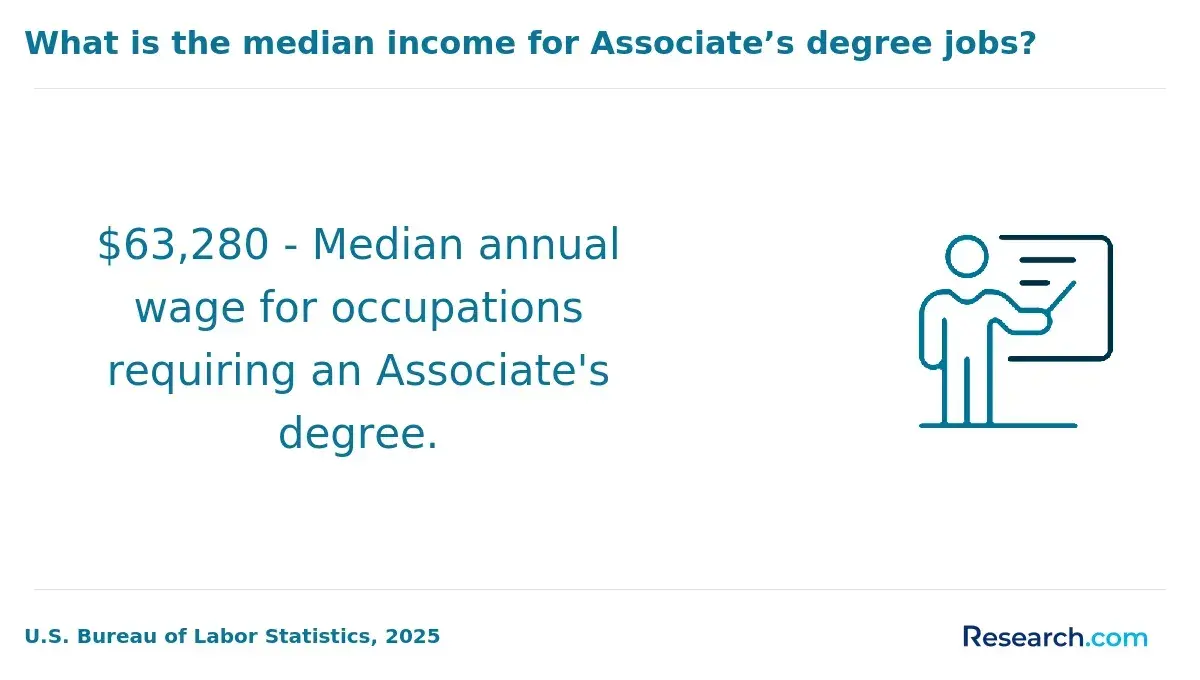
The strongest career choice depends on both the occupation and the steps beyond the degree. An ADN can lead toward registered-nurse licensure, while IT and business degrees can support entry-level applications whose requirements vary by employer. Transfer-oriented psychology programs usually represent an earlier stage of a longer education path. Occupational wage figures describe workers across experience levels; they are not predictions of what new associate graduates will earn.
These distinctions help you compare potential without mistaking a degree title for a job qualification.
| Degree direction | Potential next step | Important limitation |
| Nursing | Apply for registered-nurse licensure after an eligible program | Clinical training and state licensing requirements apply |
| IT | Seek support or junior technical roles | Employers may expect demonstrated skills or certifications |
| Business | Pursue administrative work or transfer | Management positions commonly require experience |
| Psychology | Transfer or investigate support roles | Independent clinical practice requires further education and licensure |
Compare local job postings with each curriculum. If the work you want requires a bachelor's degree or license, judge the associate program partly by how reliably it gets you to that next step.
Are Self-Paced Associate Degrees Accredited and Transferable?
Self-paced associate degrees can be accredited and transferable, but neither outcome follows from the course format. Verify the college's institutional accreditation through the accreditor or the U.S. Department of Education. In nursing and certain allied-health fields, also check program approval or accreditation needed for your intended credential.
Transfer is a separate question: a university may accept a course for credit without applying it to your chosen major. Ask the destination school for a written course-by-course evaluation or an applicable articulation agreement. AA and AS degrees are often designed with transfer in mind, while AAS degrees often prioritize employment, but the receiving institution's rules - not the abbreviation - decide how credits count.
Which Associate Degree Programs Can You Complete Online?
Business, IT, criminal justice, and psychology are often easier to deliver fully online than clinical majors. Availability still depends on the college and on individual course requirements. Online is not synonymous with self-paced: live meetings, proctored exams, group projects, and fixed deadlines may remain. When reviewing easy degrees to get online, weigh the actual workload and delivery format against your strengths rather than assuming "online" means little effort.
Delivery labels offer a starting point, not a guarantee. This comparison shows what each may leave you needing to schedule.
| Format | Typical scheduling consideration | Common fit |
| Asynchronous online | Work independently, often within fixed deadlines | Students with changing work hours |
| Scheduled online | Attend live remote sessions | Students who prefer real-time discussion |
| Hybrid or clinical | Attend labs, campus sessions, or placements | Students pursuing hands-on training |
For any program advertised as fully online, request the complete list of required in-person activities before applying.
What Do You Study in a Self-Paced Associate Degree Program?
Most associate degrees combine general education - such as writing, mathematics, and communication - with courses in the major. A business student might study accounting; an IT student might complete networking labs; a nursing student must complete sciences and supervised clinical work. An AA or AS may emphasize courses intended for transfer, while an AAS may devote more credits to occupational training.
Self-paced delivery changes how some coursework is scheduled, not what the degree requires. Review the entire catalog sequence for prerequisites, labs, internships, and courses offered only in certain terms. A single required course with limited availability can determine your graduation date.
What Are the Admission Requirements for Self-Paced Programs?
Many colleges admit associate-degree applicants with a high school diploma or equivalent, then use transcripts or placement processes to determine course readiness. Requirements vary by institution. Nursing and some allied-health majors can have separate applications, prerequisite grades, health documentation, and limited seats even when the college itself has broad admission.
If you have prior college credit, request an official evaluation before committing. Confirm which courses satisfy major requirements, whether grades or course age matter, and how many credits must be earned at the new school. Ask about evaluated military learning, examinations, or prior-learning credit if relevant; experience alone does not automatically become credit.
How Long Do Self-Paced Associate Degrees Take and Cost?
Many associate degrees require about 60 credits, but "self-paced" does not mean "finish in a few months." Full-time students may finish in roughly two years; part-time enrollment, prerequisites, clinical schedules, and infrequently offered courses can extend that timeline. Accepted transfer credit can shorten it, while an accelerated course changes only that course's length unless the entire degree plan supports faster progress.
Compare costs using the credits you still need, not tuition alone. Add mandatory online and technology fees, books, lab supplies, exam charges, and possible travel or clinical expenses. Publicized tuition may differ by residency, and taking more terms can increase recurring fees. Compare most affordable online colleges for working adults by your estimated total remaining cost, then ask each school about eligible financial aid, scholarships, employer assistance, and payment plans.
Which Careers Require Licensure After an Associate Degree?
Nursing is the clearest licensure-dependent path among these fields. Completing an eligible ADN is an educational step toward registered-nurse licensure, not the license itself; graduates must meet state board requirements and pass the applicable examination. Other patient-care occupations may have their own program, examination, and state rules. Criminal justice graduates seeking sworn law-enforcement work must meet agency and jurisdictional hiring and training requirements.
Psychology illustrates a different gap between an associate major and a licensed occupation. If your goal is to become a psychologist, investigating the educational path - including cheapest online doctoral programs - can clarify the long-term commitment. Price alone is not enough: an online doctorate must meet the applicable licensing board's educational and supervised-training requirements. Check those rules before treating any degree as a qualifying credential.
How Do You Choose a Reputable Self-Paced Associate Program?
Start with your end goal, then test each program's flexibility against its full set of requirements. The best choice is one you can realistically complete and use - not necessarily the fastest-looking or least expensive listing. Use these checks to narrow your options before paying an application fee.
- Match the degree to your next step: employment, a specific certification or license, or transfer into a named bachelor's major.
- Request a term-by-term plan showing course formats, live sessions, labs, placements, deadlines, and how often required classes run.
- Verify institutional accreditation, any relevant program approval, transfer applicability, and eligibility for your state's licensing requirements.
- Get written estimates of accepted credits, remaining credits, total tuition and fees, additional expenses, and realistic completion time at your planned course load.
Be wary of a program that advertises "100% self-paced" but cannot explain required live or clinical activities, or promises a job or transfer outcome without identifying the relevant requirements. Written answers make competing options much easier to compare.
Other Things You Should Know About
Sometimes you can control when you study, but most programs still impose deadlines, course sequences, or term limits. Labs and clinical placements usually require scheduled attendance. Ask how every required course works.
Business, IT, criminal justice, and psychology may offer more asynchronous coursework than clinical fields. The best choice is the one whose required courses fit your schedule and your career or transfer goal.
It can, but transfer depends on the receiving school and how each course applies to the intended major. Obtain an evaluation or review a relevant articulation agreement before enrolling.
Generally not. Some academic courses may be online, but approved nursing education includes scheduled clinical and skills requirements. Confirm program approval and your state's licensure eligibility rules.
References
- College Credit for Military Training & Experiences | dantes.mil https://www.dantes.mil/credit4training/
- DAPIP | Homepage - Office of Postsecondary Education (OPE) https://ope.ed.gov/dapip/
- Fast Facts: Undergraduate graduation rates (40) | ed.gov https://nces.ed.gov/fastfacts/display.asp
- Online Associates Degree - UW Flexible Option https://flex.wisconsin.edu/degrees-programs/associate-degree-online/
- UMass Global MyPath: Self-Paced Programs https://www.umassglobal.edu/why-umassglobal/flexible-ways-to-learn/self-paced
- CCV Academic Support | Tutoring & Student Resources https://ccv.edu/student-support/academic-career-support-services/academic-support/
- What is Cohort vs. Self-Paced Learning? - Wharton | Wharton Executive Education https://executiveeducation.wharton.upenn.edu/thought-leadership/wharton-online-insights/cohort-vs-self-paced-learning/
- The Role of Student Support Services in College | snhu.edu https://www.snhu.edu/about-us/newsroom/education/the-role-of-student-support-services
- Academic Advising & Support Services - South Piedmont Community College https://spcc.edu/student-life-resources/academic-advising-support-services/
- What Is an Accredited University? Understanding Accreditation | National University https://www.nu.edu/blog/what-is-an-accredited-university/


