2027 Best Associate Degrees for Transfer Students

Co-Founder and Chief Data Scientist
The best associate degree for transfer is the one whose courses count toward the bachelor's degree you actually want, not simply the one with the lowest tuition. Cost still matters: the College Board reported average published tuition and fees of $4,050 for in-district students at public two-year colleges in 2024-25.
But a low-cost course can become expensive if you must repeat it after transferring. This guide compares six degree fields and shows prospective transfer students how to check credit applicability, accreditation, costs, and career requirements before enrolling.
Key Things You Should Know
- An Associate of Arts (AA) or Associate of Science (AS) often requires about 60 credits, but a transfer agreement - not the degree name - determines how those credits apply to a bachelor's program.
- A "2+2" pathway can lead from a two-year college to a four-year college; confirm the destination school's major requirements and remaining credits before relying on that timeline.
- Choose the field around your intended bachelor's major: business and psychology offer broad pathways, while nursing and some healthcare programs require particularly careful checks of selective admission and licensure rules.
Top 10 Best Associate Degrees for Transfer Students
Business Programs
A transfer-oriented AA or AS in business typically combines accounting, economics, mathematics, and general education. It suits students considering bachelor's majors such as accounting, finance, or management, but those majors may require different introductory courses. Check the destination school's required calculus or statistics sequence before registering. An Associate of Applied Science (AAS) in business administration may emphasize immediate employment and offer fewer courses that satisfy upper-division prerequisites. Ask for a course-by-course transfer plan rather than assuming every business credit will advance your chosen major.
Healthcare Programs
Healthcare transfer pathways can lead toward public health, health administration, biology, or a specific clinical profession. An AS in health sciences may provide flexible prerequisites, but its courses must match the destination program's anatomy, chemistry, and laboratory requirements. Career-oriented allied-health AAS degrees may prepare students for particular occupations while transferring less cleanly into unrelated bachelor's majors. If the goal is a licensed profession, verify the required program accreditation, clinical placements, examinations, and state rules separately; a general healthcare associate degree does not itself confer a clinical license.
Information Technology Programs
An AS in computer science is often the stronger transfer choice for a computer science bachelor's degree because it may include programming, calculus, and science sequences. An IT or cybersecurity AAS may instead prioritize networking, systems, and workforce skills. Neither is universally better: compare the receiving university's math and major prerequisites against the associate curriculum. Ask whether technical credits count toward the bachelor's major, only as electives, or not at all. Certifications can complement coursework, but they do not replace required college credits unless the receiving institution explicitly awards credit for them.
Nursing / Pre-Nursing Programs
Pre-nursing AA or AS programs can cover prerequisites for a bachelor of science in nursing (BSN), but completing them does not guarantee admission to a selective nursing major. An accredited associate degree in nursing (ADN) follows a different route: eligible graduates generally must pass the NCLEX-RN and meet state licensing requirements to practice, then may pursue an RN-to-BSN pathway. Compare these routes using prerequisite lists, clinical availability, admissions standards, and the receiving school's credit policy. Confirm that a proposed online pathway still accommodates required in-person clinical work.
Criminal Justice Programs
A transfer-oriented AA or AS in criminal justice can support a bachelor's degree in criminal justice, criminology, or a related social science. Prioritize transferable writing, statistics, and social science courses alongside major classes. Some AAS programs emphasize practical public-safety training, which may not satisfy bachelor's major requirements. A degree alone does not qualify someone for every law-enforcement or federal role; hiring standards, academy training, background checks, and education requirements vary by employer. Compare the associate curriculum with both your intended university and occupational goal.
Psychology / Counseling Programs
An AA or AS in psychology is a useful starting point for a psychology bachelor's degree when it includes the receiving school's required statistics, research, and general education courses. A counseling-labeled associate program may focus more on human services or entry-level support work, so check how its specialized credits transfer. Students aiming to become licensed mental health counselors or psychologists should plan for substantial education beyond the associate degree, typically including graduate study and state-specific supervised experience and licensing requirements. Choose the pathway based on that longer-term plan.
What Are the Best Associate Degrees for Transfer Students?
The best associate degree for a transfer student is the AA or AS pathway that fulfills the most requirements for a specific bachelor's major at a specific destination college. There is no universal winner: a technically focused AAS can also be a good choice when a university has a documented pathway for it. Compare the fields below by how well their coursework matches your next degree, not by the associate title alone.
This comparison highlights the most important transfer question in each field. Use it to narrow your options before requesting a formal course evaluation.
| Field | Strong fit for | Transfer issue to verify |
| Business | Accounting, finance, or management majors | Required math and introductory business courses |
| Healthcare | Public health or defined clinical pathways | Science labs and program-specific prerequisites |
| Information technology | Computer science or IT majors | Whether technical credits meet major requirements |
| Nursing / pre-nursing | BSN entry or RN-to-BSN study | Selective admission, clinical rules, and pathway type |
| Criminal justice | Criminology or related social sciences | Major credit versus elective credit |
| Psychology / counseling | Psychology or human-services study | Statistics, research, and graduate-study preparation |
If your main goal is immediate employment rather than a bachelor's degree, compare career-focused credentials on their own terms; guides to online degrees that pay well address a different decision. For transfer, the decisive question remains how many accepted credits fulfill the intended bachelor's program.
How Do Associate Degrees Transfer to Four-Year Colleges?
Four-year colleges evaluate transfer courses under their own policies and any applicable articulation agreements. An agreement may establish course equivalencies, general education fulfillment, or a defined route into a major, but admission to the college does not necessarily mean admission to a selective program. Likewise, a college can accept a course as elective credit without applying it to the bachelor's requirements you still need to complete.
Before enrolling in an associate program, request answers to these questions from the receiving college and keep the responses with your degree plan:
- Which associate courses satisfy general education, major prerequisites, and electives in my intended bachelor's program?
- Does a current articulation agreement cover my college, major, and planned transfer term?
- What grades, GPA, application steps, and residency credits will the receiving college require?
- How many credits will remain after transfer, and are the required courses offered when I need them?
Repeat the check if you change majors or destinations. A pathway that works well for one university may leave substantially different requirements at another.
Which Associate Degrees Offer the Best Career and Salary Potential?
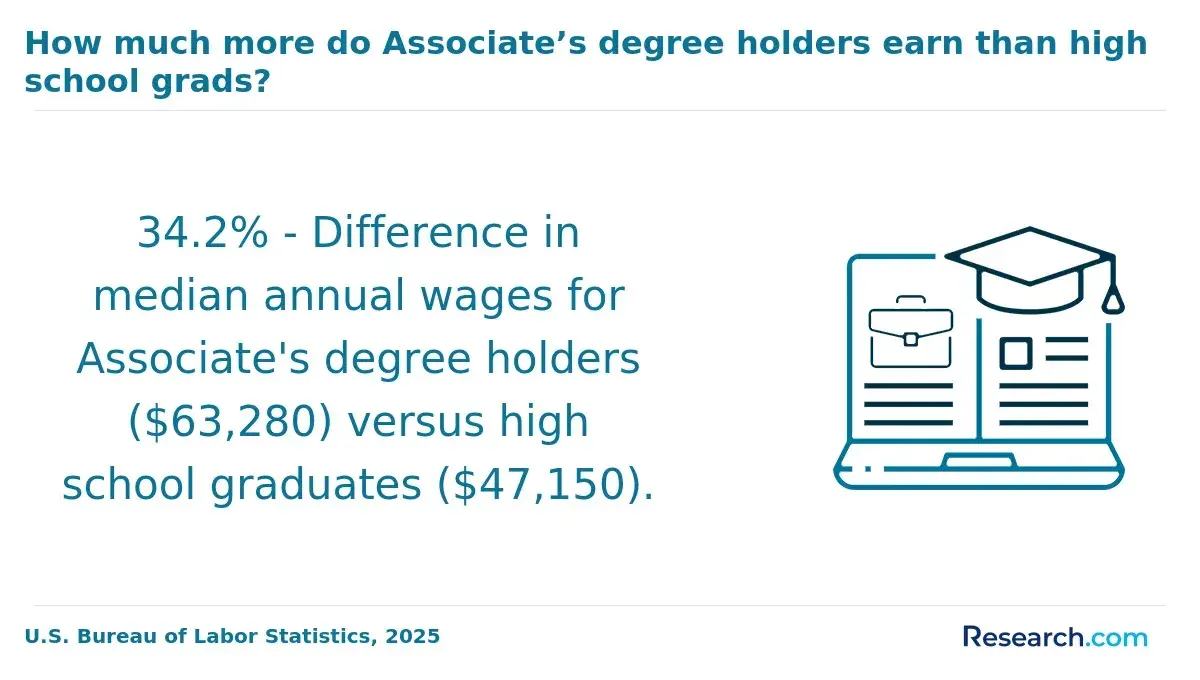
Career and salary potential depend more on the eventual occupation and qualifications than on the associate major alone. For example, the U.S. Bureau of Labor Statistics reported a May 2024 median annual wage of $93,600 for registered nurses. That is an occupational median, not the expected salary of an ADN graduate: registered nurses must meet licensing requirements, and pay varies with role, location, and experience.
Nursing can offer a defined occupational route for students who want clinical work, provided they understand selective admission, clinical training, and licensure. IT and business offer a wider mix of occupations, but a bachelor's degree or experience may be needed for roles such as software developer or accountant. Psychology and counseling often make more sense as foundations for further education than as direct routes to licensed professional practice. When comparing degrees that make the most money, separate the wage of a target occupation from what you can realistically do with an associate degree alone.
What Accreditation Should Transfer Students Look For in Associate Degree Programs?
Start with institutional accreditation for both the associate-degree college and the intended transfer institution. Check each school's current status through its recognized accreditor and confirm the receiving college's credit-acceptance policy. Accreditation supports a credible review, but it does not guarantee that a particular course will transfer or satisfy your major.
Programmatic accreditation matters when a specific nursing or allied-health program and its associated licensure or certification pathway require it. Ask the relevant program and state licensing board what recognition is needed before enrolling. For other transfer majors, a course-by-course match and a current articulation agreement are generally more useful than assuming a field-specific credential is necessary.
Which Courses Should Students Complete Before Transferring?
Complete the courses the receiving bachelor's program actually requires, especially transferable writing, mathematics, general education, and sequenced major prerequisites. The right math course differs by major: statistics may fit one pathway, while calculus is essential to another. Science-bound students should verify laboratory formats and whether courses intended for nonmajors will satisfy the destination program.
Build your schedule backward from the transfer college's degree map. Take prerequisites early enough to unlock later courses, and save course descriptions and syllabi in case an equivalency needs review. One common mistake is finishing the associate degree with credits that transfer only as electives while required introductory major courses remain unfinished.
What Are the Admission Requirements for Associate Degree Programs?
Associate-degree admission commonly involves an application, proof of high school completion or an accepted equivalent, and placement or advising steps. Colleges set their own rules for prior transcripts and course readiness; do not assume that being admitted to the institution makes you eligible for every major course.
Nursing and some allied-health programs can have separate applications, prerequisite grades, clinical eligibility conditions, and limited seats. Transfer admission later may also require a minimum GPA or specific course grades. Check both sets of requirements early so you do not complete an associate pathway that leaves you ineligible for your intended bachelor's major.
How Long Do Associate Degrees Take and What Do They Cost?
Many AA and AS pathways are built around approximately 60 semester credits and can take about two academic years of full-time study. Part-time enrollment, prerequisite sequencing, unavailable courses, developmental coursework, or clinical scheduling can extend that timeline. Accepted prior credits may shorten it, but only after the college evaluates how those credits meet degree requirements.
Published tuition is only a starting point. Estimate mandatory fees, books, transportation or technology, lab and clinical expenses, and the cost of the remaining bachelor's degree. Compare in-district and other residency rates, then ask each college for an aid estimate based on your circumstances.
Federal aid eligibility depends on factors including the institution, program, enrollment, and your aid application; scholarships, employer assistance, and payment plans may also change what you pay. The lowest-priced associate option is not the cheapest overall if its credits delay transfer or graduation.
Are Online or Campus-Based Associate Degrees Better for Transfer Students?
Neither format is inherently better for transfer. Online study can reduce commuting and help students balance work or family responsibilities, but "online" does not necessarily mean self-paced: courses may have scheduled meetings, fixed deadlines, proctored exams, or in-person labs. Campus study can make laboratories and face-to-face support easier to access, but commuting and course schedules may limit flexibility.
Check transfer equivalencies for the specific online or campus courses you plan to take, particularly sciences with labs. Students considering online self paced degrees should also check term deadlines and course availability rather than assuming they can finish prerequisites whenever they choose. Nursing and other clinical pathways may require local placements regardless of how lectures are delivered.
How Can Students Choose a Reputable Associate Degree Program?
Begin with a destination bachelor's major, then compare associate programs against that destination's published requirements. Request a written course-by-course transfer plan, confirm accreditation and any articulation agreement, and calculate the credits and costs likely to remain after transfer. Ask an advisor how often required courses run and what happens if you cannot enter a selective major on your first attempt.
Be wary of guarantees that "all credits transfer," unsupported salary claims, or a low tuition figure that excludes substantial fees. A directory of best online schools can help you identify options, but it cannot replace confirmation from your intended receiving college. The most useful next step is to send that college your proposed associate degree map and ask which courses will fulfill your bachelor's requirements.
Other Things You Should Know About
Neither is automatically better. Choose the degree whose individual courses meet your intended bachelor's major and general education requirements.
Yes, some AAS credits or entire pathways can transfer. Check whether the receiving college applies them to major requirements or counts them only as electives.
No. A college may award a standing classification while you still have lower-division prerequisites to complete. Ask for an evaluation of remaining degree requirements.
Before choosing first-semester courses. Recheck its requirements each term and whenever you change your major or transfer destination.
References
- Fast Facts: Undergraduate graduation rates (40) | ed.gov https://nces.ed.gov/fastfacts/display.asp
- .03 General Education Requirements for Public Institutions. | Library of Maryland Regulations https://regs.maryland.gov/us/md/exec/comar/13B.06.01.03
- How Many Credits Is a Bachelor's Degree After an Associate Degree? | Franklin University https://www.franklin.edu/blog/how-many-credits-is-a-bachelors-degree-after-an-associate-degree
- General Education and Course Requirements | Valencia College https://catalog.valenciacollege.edu/degrees/associateinarts/courserequirements/
- Transfer Information | butlercc.edu https://www.butlercc.edu/academics/support-advising/transfer-information
- Institutions - Associate Degree Types https://adhe.edu/institutions/associate-degree-types
- Does an AAS Degree Transfer to a Bachelor's? | Marshall University https://www.marshall.edu/blog/aas-to-bachelors-transfer/
- AAS Pathways - Transfer Admissions & Engagement https://transfer.appstate.edu/future-students/transferring-credits/aas-pathways
- Frequently Asked Questions about Transfer | ccsf.edu https://www.ccsf.edu/student-services/counseling/transfer-center/frequently-asked-questions-about-transfer
- Frequently Asked Questions Regarding Transfer (FAQ) | SKCTC https://southeast.kctcs.edu/current-students/student-services/transfer-faq.aspx