2027 Best Online Two-Year Degrees With 5-Week Courses

Co-Founder and Chief Data Scientist
A five-week course can make college easier to fit around work, but it does not make an entire associate degree five weeks long. If you are comparing accelerated online programs, the questions are whether your required courses actually run in short terms and how quickly you can complete them. The College Board reports average published tuition and fees of $4,050 for in-district students at public two-year colleges in 2024-25 - a useful cost benchmark, not an online price quote. This guide compares degree fields, explains the scheduling and career trade-offs, and shows what to verify before enrolling.
Key Things You Should Know
- Most associate degrees require about 60 credits; five-week classes shorten individual terms, not the degree's credit requirement.
- At one three-credit class per five-week block, 20 classes would take 100 instructional weeks before breaks, prerequisites, or unavailable courses.
- Prioritize a verified five-week schedule for required classes, then compare total cost, accreditation, transfer plans, and any in-person requirements.
Top 10 Best Online Two-Year Degrees With 5-Week Courses
Business Programs
An Associate of Arts (AA) or Associate of Science (AS) in business often suits students planning to transfer; an Associate of Applied Science (AAS) may emphasize immediate workplace skills. Compare accounting, marketing, and management requirements - not just the program name. Five-week classes can work well for theory-based subjects, but a required spreadsheet, accounting, or capstone course may follow a different calendar. Business is a flexible choice if you have not settled on one occupation. It is less direct than a specialized credential when an employer requires particular technical skills.
Healthcare Programs
Healthcare administration or health information associate programs may offer online coursework and prepare students for entry-level office or records-related work. Check whether coding practice, an internship, or a certification-aligned course is required and whether it runs in a five-week block. Administrative programs generally do not qualify graduates for clinical practice. If your goal is a licensed patient-care role, choose a program designed for that occupation and confirm its clinical and state requirements before prioritizing speed.
Information Technology Programs
IT support, networking, and software-development associate degrees can combine online lessons with hands-on projects or remote labs. An AAS may focus on employment skills; an AS may better support transfer, depending on the school's agreements. Short classes reward students who can practice consistently each week, but tightly sequenced programming courses can delay progress if a prerequisite is offered infrequently. Compare the required software, equipment, lab access, and whether the curriculum prepares you for relevant industry certification exams; a degree alone does not award certification.
Nursing / Pre-Nursing Programs
Pre-nursing AA or AS degrees may offer online general education and science coursework, but check for in-person labs and whether courses meet the target nursing program's prerequisites. An associate degree in nursing (ADN) normally includes supervised clinical training and must meet applicable approval requirements; online lectures do not eliminate those obligations. Admission to the college may also be separate from competitive admission to the nursing major. Choose pre-nursing for a transfer or application pathway, not as a substitute for an approved nursing program or licensure.
Criminal Justice Programs
Criminal justice AA, AS, and AAS programs commonly cover law, courts, corrections, and public safety. Online five-week theory courses may suit working adults, particularly when the degree supports promotion or transfer. Check whether your intended agency accepts the credential and whether it requires an academy, background screening, physical standards, or additional training. An associate degree by itself does not make someone a police officer or guarantee advancement. A transfer-oriented program is the stronger fit if your target role calls for a bachelor's degree.
Psychology / Counseling Programs
An AA or AS in psychology is typically a foundation for bachelor's study, not a qualification to practice as a psychologist or licensed counselor. Some graduates seek entry-level human-services work, but employers may require additional training or supervised experience. Ask whether five-week statistics and laboratory-science courses transfer into your intended bachelor's program. If your goal is counseling licensure, map the full education and supervised-practice pathway before choosing an associate degree; the shortest initial course schedule may not produce the fastest overall route.
What Are Online Two-Year Degrees With Five-Week Courses?
Online two-year degrees with five-week courses are associate programs in which at least some classes run for five weeks rather than a longer academic term. Students still complete the program's required credits, general education, major courses, and any experiential work. A school may offer consecutive five-week blocks, overlapping classes, or a mixture of term lengths; those structures produce different workloads and completion times.
Ask for a term-by-term plan showing every required class and its next available start date. A claim such as associate degree in 6 months online warrants particular scrutiny: find out how many previously earned credits the timeline assumes. Transfer credit can shorten your remaining work, but it does not change the length of the degree itself.
Which Accredited Colleges Offer Online Two-Year Degrees With Five-Week Courses?
There is no responsible universal list of accredited colleges offering entire online associate programs in five-week courses: schools can use short blocks for some classes while scheduling prerequisites, labs, or capstones differently. A college's general advertisement for five-week courses is not proof that a particular associate major meets that description. Without a current, program-specific course schedule, naming a school as a verified match would be misleading.
For each college you consider, request its current catalog, required-course sequence, and schedule for the next several terms. Confirm institutional accreditation through the U.S. Department of Education or the Council for Higher Education Accreditation, then ask which required courses are online, which last five weeks, and whether you can take them consecutively. For regulated healthcare programs, verify any additional program approval and state eligibility.
Are Five-Week Online Courses Legitimate for Earning a Two-Year Degree?
Yes. A five-week online course can count toward a legitimate associate degree when it meets the college's academic requirements; course length alone does not determine legitimacy. The important distinction is between instructional format and credential quality. Check the institution's accreditation, required learning activities, assessment methods, and credit-hour policies rather than judging a course only by its calendar.
Short terms compress the work. A class that feels manageable over a longer semester may demand frequent assignments and fixed weekly deadlines in five weeks. "Online" may also include scheduled meetings, proctored exams, labs, or local placements. If those conflict with your availability, a longer course could be the faster route to graduation because you are more likely to complete it successfully.
What Online Two-Year Degree Programs Can You Complete in Five-Week Courses?
Business, healthcare administration, IT, criminal justice, and psychology are plausible fields for short online courses because substantial portions of their curricula can be taught remotely. Nursing and some allied-health pathways are different: even when classroom subjects use five-week blocks, clinical or laboratory components may not. Availability depends on the specific school and degree plan, not simply the major.
The comparison below identifies each field's main scheduling question. Use it to narrow your search, then obtain the school's actual course sequence.
| Degree field | Likely scheduling consideration | Best-fit goal |
| Business | Confirm accounting and capstone term lengths | Broad workplace preparation or transfer |
| Healthcare administration | Check internships and coding-related requirements | Nonclinical healthcare roles |
| Information technology | Check remote labs and prerequisite sequences | Technical skill development |
| Nursing or pre-nursing | Confirm labs, clinicals, and separate admission | A documented nursing pathway |
| Criminal justice | Check agency requirements beyond the degree | Public-safety preparation or transfer |
| Psychology | Check transfer of statistics and science courses | Further study |
If you need one job-specific skill rather than an entire degree, compare the required coursework with easy certifications to get. A shorter credential can be more targeted, but verify that employers actually recognize it for your intended role.
What Are the Admission Requirements for Fast Online Associate Degrees?
Admission to many associate programs begins with an application and proof of high school completion or an accepted equivalent. Schools may use transcripts or placement measures to determine course readiness. Transfer applicants should request an evaluation showing which credits satisfy specific degree requirements, not merely how many credits the college accepts.
Program admission can be more restrictive than college admission. Nursing and other clinical fields may require prerequisite courses, minimum grades, health documentation, background checks, or a separate application. Ask whether prerequisite work fits the five-week schedule and whether a missed admission cycle would delay graduation. If you have prior credits, also confirm grade and course-age rules, maximum transferable credits, and the number of credits you must complete at the awarding college.
How Much Do Online Two-Year Degrees With Five-Week Courses Cost?
Published tuition is a starting point, not the total price of an online degree. The College Board's public two-year benchmark in the introduction covers in-district tuition and fees; your bill may differ because of residency, institution type, online charges, and enrollment pattern. Add books or software, technology and lab fees, proctoring, travel for required activities, and any extra terms caused by course availability.
Ask each school for an estimate based on your remaining required credits after a preliminary transfer evaluation. Compare financial aid eligibility, scholarships, employer assistance, and payment plans alongside that estimate. Articles about online colleges that pay you to attend can help you explore aid possibilities, but aid or a potential refund is not guaranteed and does not replace a program-specific cost comparison.
What Careers Can You Pursue With an Online Two-Year Degree?
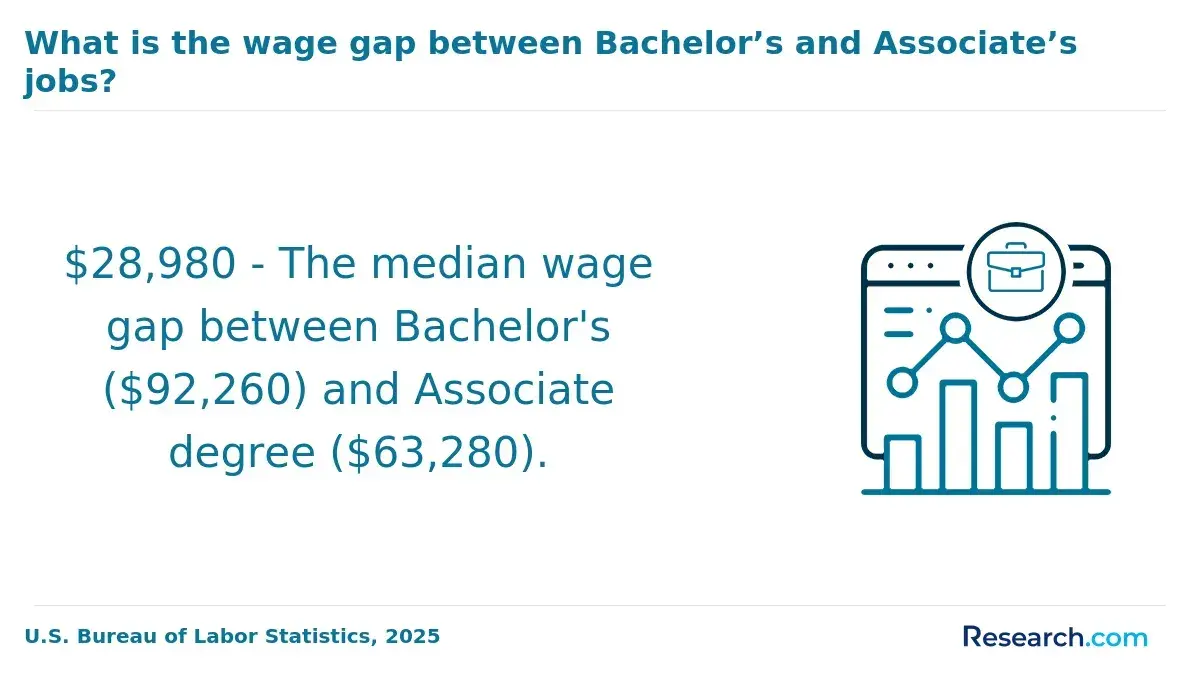
An associate degree may support applications for office administration, IT support, medical records, or certain public-safety and human-services roles, depending on the major and employer. An ADN can form part of the pathway to registered nursing, but graduates must also satisfy applicable licensing requirements and pass the required examination. Psychology and pre-nursing associate degrees are often stepping stones rather than credentials for licensed practice.
Match the job you want to actual postings in your area: note required degrees, certifications, experience, and whether work is on-site. If location flexibility matters, explore what degrees allow you to work from home, but do not assume an online degree leads to a remote job. Employers decide where roles can be performed.
What Salaries and Job Outlook Can Graduates Expect?
Career outcomes differ too much across these fields to assign one salary to a "five-week-course graduate." For context, the U.S. Bureau of Labor Statistics reports a 2024 median annual wage of $93,600 for registered nurses. That is the occupation's median - not an ADN graduate's expected starting pay - and registered nurses must meet state licensure requirements. Use occupational wage and employment projections for your specific target role, then check its usual entry qualifications.
Short course blocks do not, by themselves, raise pay or improve job prospects. Their potential value is helping you complete a suitable credential sooner if you can sustain the workload and the school offers required courses when you need them. Weigh that possible time savings against tuition, missed work, transfer plans, and any further training the occupation requires.
How Can You Choose a Reputable Accelerated Online Degree Program?
The best accelerated program is the one whose verified schedule, cost, and outcomes fit your goal - not necessarily the one with the shortest advertised class. Before paying an enrollment deposit, use these checks to turn marketing claims into a realistic graduation plan:
- Request a degree audit and term-by-term map identifying the length, format, prerequisites, and next start date of every remaining course.
- Verify institutional accreditation and, for a regulated occupation, the program approval and state requirements that apply to you.
- Get a written transfer evaluation and ask whether accepted credits fulfill general education and major requirements.
- Compare estimated total charges after aid, including fees and any required travel, rather than comparing tuition alone.
- Ask how advising, tutoring, and course scheduling work if you study part time or need to repeat a short-block class.
Watch for claims that every course lasts five weeks without a complete schedule, promises of automatic licensure or employment, and unusually fast completion estimates that omit required transfer credits. If a school cannot explain those claims for your degree plan, keep looking.
Other Things You Should Know About
No. Five weeks describes an individual course, not the full degree. Your completion time depends on required credits, accepted prior credit, course load, and scheduling.
It depends on the program. Online lectures may still be paired with in-person labs, clinical placements, internships, or proctored activities. Request the requirements for your specific major.
They cover required material on a compressed schedule, so weekly deadlines can be demanding. Whether they are a good fit depends on your preparation and available study time.
Course length alone does not decide transferability. Ask the destination institution whether each course will be accepted and, importantly, whether it will fulfill requirements in your intended bachelor's major.
References
- DAPIP | Homepage - Office of Postsecondary Education (OPE) https://ope.ed.gov/dapip/
- Recognition of Accrediting Agencies | Texas Higher Education Coordinating Board https://www.highered.texas.gov/recognition-of-accrediting-agencies/
- Understanding Transfer Credit | American Military University (AMU) https://www.amu.apus.edu/transfer-credit/getting-started/understanding-transfer-credit/
- Undergraduate Transfer Credit | University of Arizona Catalog https://catalog.arizona.edu/policy/courses-credit/credit/undergraduate-transfer
- Explanation of Fees | University of North Texas - Student Accounting https://studentaccounting.unt.edu/explanation-fees.html
- Specialized Program Accreditation - Utah Tech University https://accreditation.utahtech.edu/specialized-program-accreditation/
- How Internships, Practicums, and Clinicals Actually Work | Florida National University (FNU) https://www.fnu.edu/internships-practicums-clinicals-explained/
- Undergraduate and Graduate Tuition and Fees - Purdue Global https://www.purdueglobal.edu/tuition-financial-aid/undergraduate-graduate-tuition-and-fees/
- What Is an Accredited University? Understanding Accreditation | National University https://www.nu.edu/blog/what-is-an-accredited-university/
- What is the time commitment for different degree options? | Penn State World Campus https://www.worldcampus.psu.edu/about-us/news-and-features/what-is-the-time-commitment-for-different-degree-options