
2027 Best Associate Degree Programs for Low Student Debt

Co-Founder and Chief Data Scientist
Choosing an associate degree means weighing more than tuition: required supplies, time away from work, and credits that will not transfer can all increase what you borrow. College Board reports average published tuition and fees of $4,050 at public two-year colleges in 2024-25, but that figure does not include living expenses.
This guide is for students comparing career and transfer pathways on a budget. It identifies promising fields, explains their trade-offs, and shows what to verify before enrolling so a low-cost option does not become an expensive detour.
Key Things You Should Know
- Start with an in-district public college and compare the total cost to finish, not just its per-credit price; program fees and extra semesters can change the result.
- Choose a career-focused AAS when it leads toward a specific occupation, or a transfer-oriented AA or AS when a bachelor's degree is essential to your goal.
- Nursing and allied health can offer strong occupational pay, but selective admission, clinical schedules, and licensing steps make them riskier choices if you cannot complete the full pathway.
Top 10 Best Associate Degree Programs for Low Student Debt
Business Programs
An associate degree in accounting or business administration can support entry-level bookkeeping, payroll, or administrative work. An AAS generally emphasizes job skills; an AA or AS may be better if you plan to transfer into a bachelor's program. Compare software training, internships, and local employer requirements before borrowing. Business is often less expensive to deliver than a lab-heavy major, but an associate degree alone rarely qualifies someone for management. If a bachelor's degree is your goal, confirm that required business courses - not just general education credits - will apply after transfer.
Healthcare Programs
Dental hygiene, diagnostic medical sonography, and radiologic technology may lead toward well-paid occupations, but they are not automatically low-debt choices. Clinical placements, equipment, exams, and selective admissions can add expense or delay. Check whether a program meets the relevant accreditation and state credential requirements before paying for prerequisites. Compare the complete path from application through certification or licensure, including what happens if you are not admitted to the clinical cohort. A lower-cost prerequisite program is useful only if those courses count toward an attainable credential.
Information Technology Programs
IT support, networking, and cybersecurity associate programs can provide a relatively low-cost route to technical skills, particularly when an in-district college offers the required software and equipment. Look for hands-on labs, work-based learning, and preparation for certifications employers actually request. Entry-level support roles are more realistic immediate targets than advanced cybersecurity positions, which often require experience. Because tools change quickly, compare a degree's total price with shorter certificate options and ask employers whether the associate credential adds value for your intended role.
Nursing / Pre-Nursing Programs
An associate degree in nursing can prepare eligible graduates to pursue registered nurse licensure after meeting state requirements and passing the NCLEX-RN. Pre-nursing is different: it usually covers prerequisites and does not itself qualify someone for RN licensure. Nursing admission may be competitive even at a college with open general admission. Price the prerequisites, clinical travel, immunizations, testing, and possible waiting time. Also check whether employers in your target area prefer a bachelor's degree and whether an affordable RN-to-BSN transfer agreement is available.
Criminal Justice Programs
Criminal justice associate programs may fit students exploring policing, corrections, or transfer into a bachelor's degree. They do not replace academy training, background checks, physical standards, or agency-specific hiring requirements. Because some entry-level roles accept applicants without an associate degree, ask a target employer whether the credential affects eligibility or advancement before taking on debt. If you expect to transfer, favor a documented articulation agreement over a workforce-focused curriculum whose credits may apply only as electives.
Psychology / Counseling Programs
An AA or AS in psychology is usually a transfer foundation, not a credential for independent counseling practice. Licensed counseling and psychology occupations generally require substantially more education and state-specific supervised experience. This path can limit initial borrowing if credits transfer cleanly to an affordable bachelor's program, but its total education cost may be high. Ask the destination institution which courses satisfy major requirements and map the full sequence before enrolling. Students seeking faster workforce entry should compare relevant human-services support roles and their actual hiring requirements.
What Are the Best Associate Degrees for Avoiding Student Debt?
The best low-debt choice is the least expensive completable pathway to your specific goal - not a universally "best" major. For direct workforce entry, compare accredited nursing and allied-health programs with IT and accounting options. For a bachelor's-bound student, an in-district AA or AS with a documented transfer agreement may reduce borrowing more reliably than an attractive AAS whose credits transfer poorly.
This comparison highlights where debt risk arises in each field. It is a guide to questions worth investigating, not a ranking of individual colleges or a promise of employment.
| Field or pathway | Potential low-debt advantage | Main cost or outcome risk |
| Business or accounting | Often fewer specialized equipment costs | Target jobs may prefer experience or a bachelor's degree |
| Allied health or nursing | Defined occupational and credential pathways | Selective admission, clinical costs, and licensing steps |
| Information technology | Can combine college coursework with practical skills | Certifications and experience may still matter |
| Criminal justice | Can provide a transfer foundation | Agency hiring standards may matter more than the degree |
| Psychology | Can lower the cost of initial transfer credits | Professional practice usually requires graduate education |
Before committing to a degree, compare it with shorter high paying certificate jobs pathways. A certificate may cost less when it meets your target employer's requirements, but it is a poor substitute for a degree required for licensure or transfer.
How Much Do Associate Degree Programs Cost, and How Long Do They Take?
Associate degrees commonly require about 60 semester credits, although program requirements vary. Full-time students may finish in roughly two academic years; part-time study, prerequisites, course sequencing, and clinical placements can extend that timeline. College Board's 2024-25 average of $4,050 in published tuition and fees at public two-year colleges is a useful benchmark, not a quote for an entire degree. Residency rates, books, transportation, housing, and lost work hours can matter more to your borrowing decision.
Distinguish published tuition from net price after grants and from the total amount you expect to pay through graduation. Request a term-by-term cost estimate that includes mandatory program charges. File the FAFSA to assess eligibility for federal, state, and institutional aid, then ask about scholarships, payment plans, employer assistance, and whether transferred credits reduce required coursework. Borrow only after comparing aid offers and confirming that the remaining classes will be available when you need them.
Which Associate Degrees Lead to High-Paying Careers Without Extensive Borrowing?
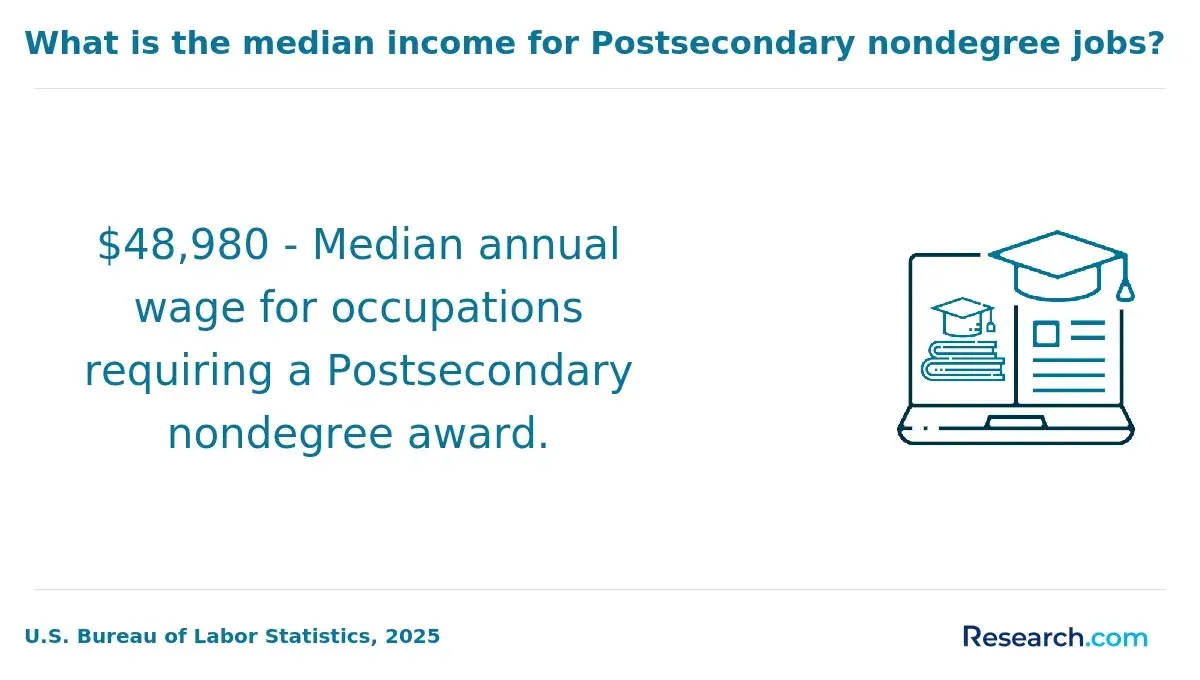
Registered nursing and some allied-health fields offer clearer routes toward relatively high-paying occupations than broad associate majors, provided students gain admission and satisfy credential requirements. The U.S. Bureau of Labor Statistics reports a 2024 median annual wage of $93,600 for registered nurses. That is the median for employed RNs across experience levels and education backgrounds - not an expected starting salary for associate degree graduates.
Dental hygiene and diagnostic medical sonography are other fields worth investigating, but local program capacity and clinical availability can affect whether the pathway is financially practical. Compare each occupation's licensing rules and nearby openings with the cost of completing its specific program. By contrast, an associate degree in psychology is generally an initial transfer step: counseling careers often require graduate study. If that is your goal, research bachelor's transfer costs before comparing affordable master degree programs; a low-debt associate degree alone does not make the full pathway inexpensive.
Are Online Associate Degree Programs More Affordable Than Campus Programs?
Sometimes, but not automatically. Online study may eliminate commuting or relocation costs while adding technology or remote-proctoring charges. At a local public college, online and campus courses may have similar tuition. An out-of-district online program can cost more even if its advertised per-credit rate looks competitive.
Verify whether classes are asynchronous, require live attendance, or include campus labs, clinical work, internships, or in-person exams. A student who cannot attend required sessions risks paying for courses they cannot finish. For adults over 60 who want to explore a subject before enrolling, open university free courses for over 60s may offer a noncredit starting point; confirm whether any course would count toward a degree before relying on it to reduce tuition.
What Accreditation Should You Look for in an Associate Degree Program?
Check that the college holds recognized institutional accreditation, which matters for federal aid eligibility and can affect credit transfer. Then check whether your intended occupation calls for programmatic accreditation or approval. In nursing, confirm state board approval and the program's eligibility pathway for the NCLEX-RN. In allied health, verify the specific accreditation or credential eligibility expected by the certifying body and employers.
Do not assume that institutional accreditation makes every course transferable or every graduate license-eligible. Ask the destination university to evaluate how credits apply to your intended major, and ask the relevant state board or certifying organization whether the program meets current requirements. These checks are especially important before paying nonrefundable deposits or completing prerequisites.
What Admission Requirements Apply to Associate Degree Programs?
Most associate programs require a high school diploma or equivalent, an application, and placement information or prior transcripts. A college may admit students broadly while admitting a particular nursing, dental hygiene, or imaging cohort selectively. Those majors can have separate science prerequisites, grades, background checks, health documentation, or application deadlines. Testing and GPA policies vary by institution and program.
Ask admissions for two distinct answers: whether you can enter the college and whether you can enter your intended major. If the latter is competitive, find out when selection occurs, how applicants are evaluated, and whether completed prerequisites have another use if you are not selected. That distinction can prevent spending on courses that do not advance your backup plan.
What Courses and Skills Do Low-Debt Associate Programs Typically Include?
Most programs combine general education - often writing, mathematics, and communication - with major coursework. An AA or AS may emphasize courses intended for transfer, while an AAS often emphasizes occupation-specific skills; the actual curriculum and transfer agreement matter more than the abbreviation.
Accounting students might practice bookkeeping and spreadsheet analysis; IT students may complete networking labs; nursing and allied-health students typically need supervised clinical learning. Those requirements affect both employability and scheduling. Request the complete degree map and identify prerequisites, courses offered only once a year, and any placement you must arrange. A low tuition rate offers little protection from debt if an unavailable course forces another term of living expenses.
What Careers, Salaries, and Job Outlook Follow These Associate Degrees?
Match the occupation to the credential rather than assuming the degree title defines a job. Nursing graduates who obtain RN licensure may pursue registered nurse positions; qualified allied-health graduates may pursue roles in their trained specialty. Business and IT graduates may seek entry-level office, accounting-support, or technical-support work, where employer expectations and experience vary. Psychology graduates typically need additional education for licensed clinical roles.
Labor-market outlook should be considered alongside local demand. The Bureau of Labor Statistics projects registered nurse employment to grow 5% from 2024 to 2034, but a national projection cannot tell you whether a nearby employer is hiring new graduates or which credential it prefers. Review local postings for required licenses, certifications, experience, and schedules before selecting a program. If your long-term goal requires a graduate credential, price the whole sequence rather than treating an inexpensive associate degree as evidence that later study will be affordable.
Which Certifications or Licenses Can Associate Degree Graduates Need?
Requirements depend on the occupation and state. Associate nursing graduates generally must meet their state board's eligibility rules and pass the NCLEX-RN to become licensed registered nurses. Dental hygiene and imaging careers can involve separate state licenses or professional certification. IT certifications are often optional but may help demonstrate specific skills; earning an IT degree does not award them automatically.
Confirm credential eligibility directly before enrolling, especially if you plan to study across state lines. Also distinguish a professional license from an academic credential: even advertised 1 year PhD programs online should not be treated as shortcuts to psychology or counseling licensure. Those professions have their own education, examination, and supervised-practice rules.
Other Things You Should Know About
Possibly. Grants, scholarships, employer assistance, savings, and part-time enrollment may cover costs for some students. Compare your aid offer with the full cost of completion before deciding how much to borrow.
Choose based on your destination. An AA or AS with a verified transfer agreement may reduce bachelor's costs; an AAS may be more efficient for a specific job. Neither label guarantees low total cost.
Not necessarily. A university may accept a course as elective credit without applying it to your major. Get a program-specific transfer evaluation or use an established articulation agreement.
No. First confirm admission prospects, clinical scheduling, total expenses, licensing eligibility, and whether the work suits you. Occupational median wages are not a promise of your starting pay.
References
- Price of Attending an Undergraduate Institution - COE https://nces.ed.gov/programs/coe/indicator/cua/price-of-attending-an-undergraduate-institution
- Delayed Time-to-Degree and Post-college Earnings - PMC https://pmc.ncbi.nlm.nih.gov/articles/PMC7875953/
- Data Home - College Scorecard - Department of Education https://collegescorecard.ed.gov/data/
- Making Student Debt Manageable - THECB Data https://databridge.highered.texas.gov/making-student-debt-manageable/
- Board of Governors of the Federal Reserve System https://www.federalreserve.gov/publications/2025-economic-well-being-of-us-households-in-2024-higher-education-and-student-loans.htm
- A Snapshot of Federal Student Loan Debt - Congress.gov https://www.congress.gov/crs-product/IF10158
- What are the earnings advantages to education? | oecd.org https://www.oecd.org/en/publications/2025/09/education-at-a-glance-2025_c58fc9ae/full-report/what-are-the-earnings-advantages-to-education_7a7e64e0.html
- Average Cost of College [2025]: Yearly Tuition + Expenses | Education Data Initiative https://educationdata.org/average-cost-of-college


