2027 Best Online Associate Degrees for Adults Returning to College

Co-Founder and Chief Data Scientist
Returning to college means choosing a degree you can finish around work, family, and existing commitments - not simply finding one advertised as online. The College Board reports average published tuition and fees of $4,050 for in-district students at public two-year colleges in 2024-25; your actual cost may be higher once fees, books, and residency rules are included.
This guide compares six associate degree fields by scheduling flexibility, career relevance, and transfer potential. It also explains what to verify before enrolling, so you can choose a path that fits both your goal and your calendar.
Key Things You Should Know
- For broad career flexibility, compare business and information technology; for a bachelor's pathway, prioritize an AA or AS with a confirmed transfer agreement.
- Many associate degrees require around 60 credits, but part-time enrollment, prerequisite sequences, and accepted prior credits can change your finish date substantially.
- Healthcare and nursing can lead toward regulated roles, but an online course schedule does not eliminate required labs, clinical placements, exams, or state licensing rules.
Top 10 Best Online Associate Degrees for Adults Returning to College
Business Programs
Business administration and accounting associate degrees suit adults seeking office roles, advancement within a current employer, or a route to a bachelor's degree. An AA or AS may emphasize transferable coursework; an AAS may emphasize bookkeeping, operations, or applied software skills.
Ask whether classes are asynchronous and whether required courses run every term. Business is versatile, but a general degree alone is unlikely to qualify someone for a management role without relevant experience. Compare the curriculum with the jobs you actually want.
Healthcare Programs
Health information and medical coding programs may suit adults who want healthcare work without direct patient care. Some coursework can be online, but employers may value field-specific certification, and program requirements can include supervised experience.
Allied-health degrees involving patient care may require in-person labs and clinical placements. Check the precise credential, any programmatic accreditation relevant to your goal, certification eligibility, and whether local placements are available. "Healthcare" is too broad a label to establish job readiness.
Information Technology Programs
IT support, networking, and cybersecurity associate degrees can combine online coursework with hands-on virtual labs. They fit adults who can practice troubleshooting regularly and want an entry point into technical work. Compare an AAS aimed at employment with an AS intended for transfer.
Ask whether lab software works on your computer and whether courses prepare you for relevant industry certifications. A cybersecurity degree does not, by itself, qualify a newcomer for every cybersecurity position; experience and demonstrated skills matter.
Nursing / Pre-Nursing Programs
An associate degree in nursing can be a route toward registered nurse licensure, but required clinical training and skills labs make a completely remote experience unrealistic. Admission to the college may also be separate from competitive admission to its nursing program.
Pre-nursing coursework can prepare you to apply, yet it does not confer nursing eligibility on its own. Confirm nursing-program accreditation where relevant, state board approval, clinical schedules, and exam eligibility before committing - especially if you live outside the college's state.
Criminal Justice Programs
Criminal justice associate degrees introduce law, courts, corrections, and public safety. They may suit adults exploring agency support positions or planning to transfer, but requirements for sworn roles vary by employer and jurisdiction and commonly include separate academy training or other screening.
If you hope to become a police officer, verify local hiring standards rather than assuming the degree is required or sufficient. An online AA may be preferable to an AAS when a bachelor's degree is your next step.
Psychology / Counseling Programs
Psychology associate degrees are usually strongest as transfer pathways or preparation for entry-level human-services support work. An associate degree does not qualify someone to practice independently as a licensed counselor or psychologist; those careers require substantially more education and state-specific credentials.
Adults interested in immediate employment should compare human-services programs with supervised fieldwork requirements, which may be difficult to schedule around a job. Verify that intended bachelor's programs accept the courses toward the major, not merely as electives.
What Are the Best Online Associate Degrees for Adult Learners?
The best field depends on whether you need near-term job skills, a reliable bachelor's transfer route, or both. Business and IT often offer the widest scope for online academic work; health information offers a more specific occupation to investigate. Nursing can be a strong choice for someone committed to licensure who can accommodate in-person training. Psychology and criminal justice require especially careful career-goal checks.
This comparison shows the main trade-off in each field. It compares degree paths, not individual colleges or guaranteed job outcomes.
| Field | Potential fit for a returning adult | Main constraint to check |
| Business | Broad office skills or transfer | Whether the curriculum targets a specific role |
| Healthcare | Defined administrative or technical healthcare work | Certification and experiential requirements |
| Information technology | Technical skills and portfolio-building | Lab access and employer skill expectations |
| Nursing / pre-nursing | A planned route toward nursing | Selective admission, clinical schedules, and licensure |
| Criminal justice | Public-service exploration or transfer | Separate agency hiring requirements |
| Psychology / counseling | Transfer or human-services foundations | Further education for licensed practice |
If you are still weighing majors, start with the job or bachelor's program you want, then work backward to its requirements. A flexible online associate's degree is valuable only if its courses move you toward that destination.
How Do You Choose an Accredited Online Associate Degree Program?
First, check the college's institutional accreditation through the accreditor and the U.S. Department of Education's accreditation records. Then check programmatic approval or accreditation when your intended license, certification, or employer requires it. Accreditation matters, but it does not guarantee that credits will satisfy another college's major or that a program meets your state's licensing rules.
Before applying, use the same checks for every college on your shortlist. Request written answers where your decision depends on a specific policy:
- Ask for a degree audit or sample plan showing remaining general education, major, prerequisite, and residency-credit requirements.
- Request a preliminary evaluation of previous college work, military education, exams, or prior learning; ask how credits are awarded and whether they apply to the major.
- Confirm asynchronous versus scheduled meetings, course frequency, exam arrangements, and every required campus, lab, internship, or clinical activity.
- If transfer or licensure is the goal, verify requirements with the receiving university or relevant state board - not only with an admissions representative.
A red flag is a promise of an unusually quick finish without an evaluation of your credits and remaining courses. Another is a claim of "fully online" that leaves required in-person activities unexplained.
How Much Do Online Associate Degrees Cost and How Long Do They Take?
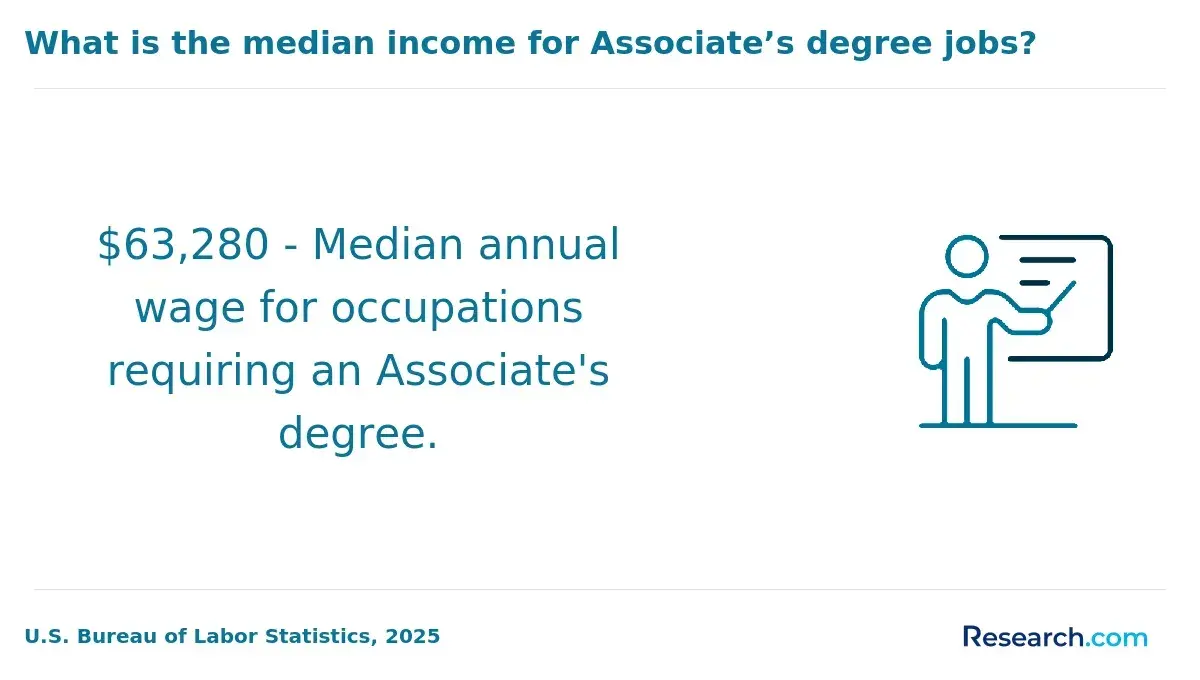
Many programs require roughly 60 semester credits. A full-time student may finish in about two years, while a working adult taking fewer courses often needs longer. Accepted transfer credit can shorten that timeline, but prerequisites, courses offered only in certain terms, and clinical sequencing can offset the time saved. Short class sessions are not the same thing as a short degree.
The College Board's 2024-25 in-district public two-year tuition-and-fee average is a useful benchmark, not a total-program quote. Compare the cost of your remaining credits at each school, including mandatory online and technology fees, books, software, equipment, and travel for required in-person work. Out-of-district or out-of-state rates can change the comparison. Ask each financial aid office about federal aid eligibility, scholarships, and payment plans; also check whether your employer offers tuition assistance.
If speed is your main concern, use a fastest degree to get online comparison as a starting point, then request a personalized completion plan. A faster schedule is useful only if you can sustain its weekly workload and obtain the courses you need.
What Admission Requirements Apply to Online Associate Degree Programs?
Colleges commonly ask for an application and high school or equivalency records; students with previous college study should expect to submit transcripts. Placement, prerequisite, or English-language requirements may also apply. Testing policies and minimum grades differ by school, so check current requirements rather than assuming that online admission is easier than campus admission.
Admission to a college is not always admission to a major. Nursing and some allied-health programs may have separate applications, prerequisite grades, background checks, and limited clinical capacity. If you are returning with older credits, ask whether they satisfy current prerequisites and whether a course must have been completed recently. Get those answers before paying for courses you may have to repeat.
What Coursework Do Online Associate Degree Programs Typically Include?
Most combine general education - such as writing, math, and communication - with major courses. Business students might study accounting and operations; IT students may complete networking and troubleshooting labs; healthcare students may encounter terminology, records systems, or anatomy. An AA or AS often emphasizes coursework intended for transfer, while an AAS commonly emphasizes applied skills, although the actual curriculum matters more than the abbreviation.
Course titles do not reveal workload or delivery rules. If you are looking at easy online college courses, check instead how assignments, labs, group projects, and exams fit your available study hours. A course with recorded lectures can still have fixed weekly deadlines. Regulated programs may also require placements or practical assessments that cannot be completed from home.
Are Online Associate Degrees Better Than Campus-Based Programs for Adults?
Online study can remove a commute and make recorded instruction easier to fit around shifts or caregiving. It is not inherently self-paced. Campus study may offer easier access to equipment, face-to-face help, and local placements; hybrid study can provide some of each. The better format is the one whose required attendance and support match your life.
The distinctions below can help you compare advertised delivery formats. Always confirm the schedule for required courses, not just the program's general description.
| Format | Potential advantage | Trade-off for a working adult |
| Asynchronous online | Choice of when to view course materials | Fixed deadlines and independent study still apply |
| Scheduled online | Live interaction without a commute | Meeting times may conflict with shifts |
| Hybrid | Remote theory plus in-person practice | Travel and placement hours need planning |
| Campus-based | Direct access to facilities and staff | Commute and class times may reduce flexibility |
What Careers Can You Start With an Online Associate Degree?
Possibilities depend on the major and the employer. Business graduates may pursue administrative or bookkeeping roles; IT graduates may seek help-desk or support positions; health information graduates may investigate records-related work. Some criminal justice or human-services support jobs may be accessible with an associate degree, though qualifications vary. Relevant experience, software proficiency, and local hiring standards still matter.
Nursing is different: an approved associate degree in nursing can form part of a route to registered nurse licensure, but graduation alone is not a license. If you want a narrower job skill and do not need degree credit or a transfer pathway, compare the time and cost of 6-month certificate programs with an associate degree. Confirm that a shorter credential is actually accepted for your target role before choosing it.
What Salaries and Job Outlook Can Associate Degree Graduates Expect?
There is no single salary for associate degree graduates: occupations differ, and pay varies by location, experience, employer, and credentials. As one point of context, the U.S. Bureau of Labor Statistics reports a May 2024 median annual wage of $93,600 for registered nurses. That is an occupational median across registered nurses - not the starting pay of newly licensed associate degree graduates - and the role requires state licensure.
Job outlook also depends on the occupation, not the degree title. For example, BLS projects employment of medical assistants to grow 12% from 2024 to 2034, but medical assistant training requirements vary and an associate degree is not necessarily required. Use occupation-specific wage and projection figures only after confirming that your proposed program can realistically help you meet that occupation's entry requirements. Treat projections as estimates of labor demand, not a promise of an individual job offer.
Which Licenses and Certifications Require an Associate Degree?
Requirements vary by credential and state. Registered nurse licensure can be pursued through an approved associate degree in nursing, followed by the required licensing exam and other state conditions. Other healthcare credentials may require graduation from a specifically accredited program, an exam, or supervised training; the words "associate degree" on a program page are not enough to establish eligibility.
Many IT certifications do not require an associate degree, although college coursework may help with preparation. Criminal justice agency credentials and hiring processes differ by jurisdiction. Licensed counseling and psychologist roles generally require education beyond an associate degree. Before enrolling for any regulated career, check the licensing board or credentialing body for the state where you intend to work, then ask the college to show how its program meets those requirements.
Other Things You Should Know About
Some programs can be completed through online academic coursework, but delivery varies by school and major. Nursing and other hands-on fields generally require in-person clinical training or labs. Confirm every attendance requirement before applying.
An AA or AS is often designed with transfer in mind, but no degree label guarantees that courses will apply to your intended major. Ask the receiving university for a course-by-course transfer plan; an AAS may transfer differently.
They may. The new college decides which credits it accepts and how they apply to degree requirements. Request a transcript evaluation and check grade, course-age, major, and residency-credit rules.
Many programs allow it, but course schedules and prerequisites may limit your pace. Ask for a term-by-term plan based on the number of courses you can realistically complete alongside work.
References
- Key Standards in the Regulations | New York State Education Department https://www.nysed.gov/college-university-evaluation/key-standards-regulations
- Tuition and College Costs | WSAC https://wsac.wa.gov/tuition-and-college-costs
- Cost of Attendance - University of Portland https://www.up.edu/admissions-aid/office-of-financial-aid/costs/index.html
- What Career Paths Can I Pursue With an Associate Degree? | mwcc.edu https://mwcc.edu/blog/career-paths-to-pursue-with-an-associate-degree/
- Transfer credit policies - Office of Admissions https://admit.washington.edu/apply/transfer/policies/
- Online Student Placement Process | Office of Clinical Partnerships https://clinicalpartnerships.asu.edu/online-student-placement-process
- Transfer Credit Policy - SUNY Empire https://sunyempire.edu/policies/transfer-credit-policy.html
- Asynchronous Classes | Online Courses | SNHU https://www.snhu.edu/online-degrees/classes/asynchronous
- How long does it really take to finish an online degree if you work full time? - Boise State Online https://www.boisestate.edu/online/2026/06/19/how-long-does-it-really-take-to-finish-an-online-degree-if-you-work-full-time/
- Online | Coastline College https://www.coastline.edu/locations/online.php