
2027 Best Associate Degree Completion Programs With No Campus Visits Required

Co-Founder and Chief Data Scientist
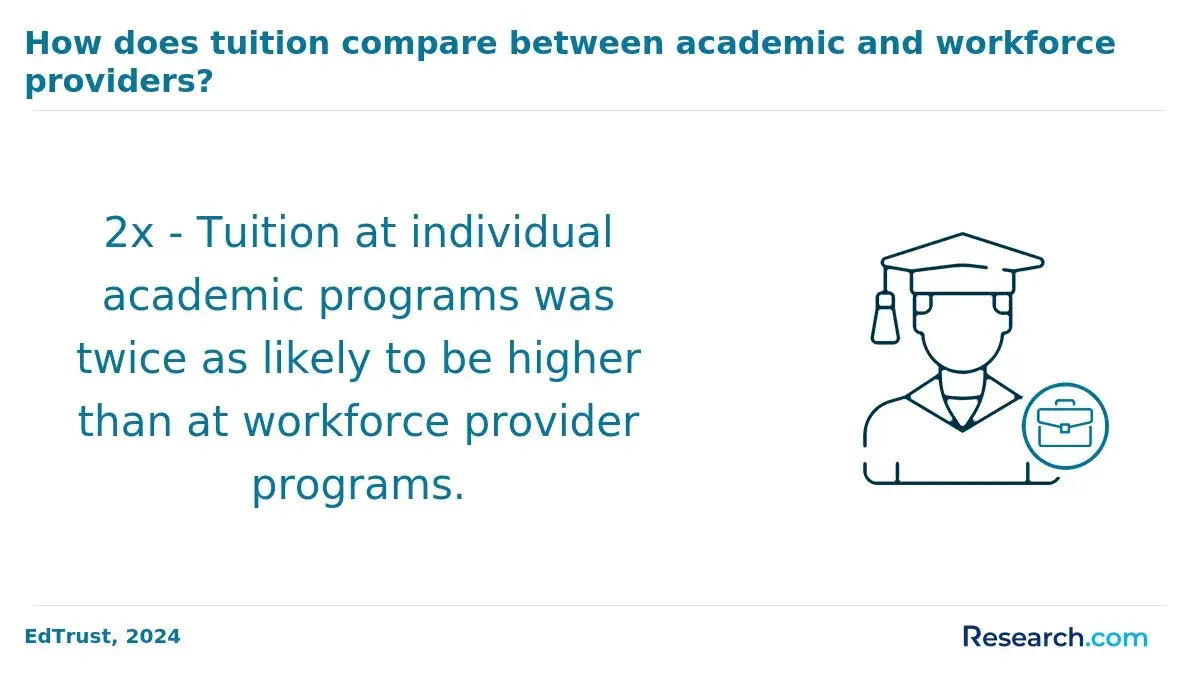
If you have college credits but no degree, the right online program could help you finish without traveling to campus. The challenge is finding one that accepts enough of your credits and has no hidden in-person requirements. College Board reported average published tuition and fees of $4,050 for in-district students at public two-year colleges in 2024-25 - a useful benchmark, but not the price you will necessarily pay to finish. This guide compares degree fields and school options, then shows you how to check delivery, remaining credits, total cost, and career fit before enrolling.
Key Things You Should Know
- Start with an official transfer evaluation: a program requiring about 60 credits may leave two students with very different amounts of coursework to complete.
- For a no-campus-visit goal, distinguish online classes from required labs, clinicals, placements, orientations, or proctored exams; confirm the rules for your exact program.
- Use the $4,050 public two-year tuition-and-fees benchmark for context, not as a completion quote. Compare the price of your remaining credits and all mandatory fees.
Top 10 Best Associate Degree Completion Programs With No Campus Visits Required
Business Programs
An online business associate degree can suit someone seeking office, customer operations, bookkeeping, or sales support roles - or a transfer route into a bachelor's program. An AA or AS may emphasize transferable general education; an AAS may emphasize workplace skills.
Compare accounting and spreadsheet coursework, accepted business credits, and whether a capstone requires scheduled online meetings. Management positions usually require experience beyond the degree. Choose this field if its broad applicability fits your goal; choose a more specialized credential if you need training for a specific occupation.
Healthcare Programs
Healthcare administration, medical billing, and health information pathways may offer online coursework without campus visits, but their career targets differ. An administrative degree does not qualify you to provide clinical care. Check for required internships, local placements, and whether courses prepare you for - but do not automatically award - an industry certification.
If your goal is a licensed patient-care role, do not substitute a nonclinical online degree for an approved clinical program. Prioritize programs that apply your existing science or general education credits to the actual degree requirements.
Information Technology Programs
Online IT associate programs commonly cover networking, operating systems, programming, or cybersecurity fundamentals. They can fit students seeking technical support or a later bachelor's degree, but employers may also value projects and relevant certifications.
Ask whether hardware activities use remote simulations or require physical equipment or a testing site. Compare how older technology courses transfer: a school may accept them as electives without applying them to current major requirements. Choose a curriculum aligned with the role you want, not simply the one accepting the most credits.
Nursing / Pre-Nursing Programs
Pre-nursing or health sciences associate coursework may be available online, but it is not the same as an associate degree in nursing that prepares students for registered nurse licensure. Nursing programs generally require supervised, in-person clinical education, even when lectures are online.
If you cannot attend any in-person activity, a pre-nursing transfer pathway may fit, but a licensure-qualifying nursing program likely will not. Before transferring credits, confirm prerequisite age limits and whether your intended nursing program will accept each lab science course.
Criminal Justice Programs
An online criminal justice associate degree can introduce law, courts, corrections, and public safety systems without necessarily requiring campus visits. It may support entry-level applications or transfer into a bachelor's program, but police and corrections hiring can involve separate academy training, physical standards, and background checks.
Compare transfer agreements if further study is your goal. If you already work in public safety, ask whether documented academy or military training can earn evaluated credit; experience alone does not automatically reduce your remaining coursework.
Psychology / Counseling Programs
An online psychology associate degree is usually a foundation for transfer, not a license to practice counseling or psychotherapy. Look for courses in research methods, statistics, and human development that satisfy the requirements of a prospective bachelor's program.
Human services programs may instead emphasize direct-service skills and could include a local field placement, even when classes are online. Choose psychology for a planned education pathway; consider a targeted support-role certificate if you need a shorter route into a particular job.
What Are Associate Degree Completion Programs Without Campus Visits?
An associate degree completion program is a route to finishing an AA, AS, AAS, or other associate credential using previously earned college credit. It does not necessarily have separate classes or a separate admissions track: often, you enter a standard degree program and receive an evaluation showing what remains.
AA and AS degrees often support transfer, while AAS degrees often emphasize workforce preparation, but the curriculum and receiving school - not the abbreviation alone - determine the best fit.
"No campus visits" should mean you can satisfy the school's academic requirements without going to its campus. It does not automatically mean self-paced study or no in-person obligations elsewhere.
Scheduled online meetings, remote proctoring, shipped lab kits, and local experiential work are different requirements; ask the school to identify each one. If you are comparing an associate's degree online with a completion pathway, remember that an advertised short timeline may assume substantial accepted prior credit.
Which Accredited Schools Offer Fully Online Associate Degree Completion Programs?
Southern New Hampshire University and Excelsior University are examples of institutionally accredited schools with online associate offerings worth checking if you already hold college credit. SNHU lists online associate study in business administration and information technologies; Excelsior offers an online liberal arts associate pathway.
These are options to investigate, not a verified ranking or a promise that every course or requirement in your individual plan is visit-free. Request written confirmation for the current catalog, your program, and your location before deciding.
The comparison below focuses on the decision each option presents, rather than assuming one school is best for every transfer student.
| Option to investigate | Potential fit | Most important completion check |
| SNHU online business administration associate | Business-focused study or a possible bachelor's pathway | Which prior business courses meet major requirements, and whether any assigned activity requires travel |
| SNHU online information technologies associate | Foundational IT study | How older technical credits apply and how hands-on coursework is completed |
| Excelsior online liberal arts associate | Students with transferable general education and elective credit | Remaining degree and residency requirements, plus the intended bachelor's school's transfer rules |
For any school, check its current institutional accreditation status, request a degree audit, and ask the program - not only general admissions - to confirm that your complete plan requires no campus visits. Online availability can differ by degree, course, and term.
How Do You Choose a Reputable Online Associate Degree Completion Program?
The most reputable choice is the accredited program that applies your existing credits to a suitable degree, fits your schedule, and gives you a clear written account of what remains. A low price per credit or a broad transfer-credit policy means little if many accepted courses count only as electives. The same caution applies to "fully online" labels that do not address placements or exams.
Before paying an enrollment deposit, use the following sequence to test a program against your no-campus-visit requirement and your longer-term goal.
- Confirm institutional accreditation and, where your career requires it, relevant programmatic approval or accreditation.
- Send transcripts for an official evaluation and request a degree audit identifying applied credits, remaining courses, and credits that must be earned at that school.
- Ask in writing about campus visits, local placements, scheduled sessions, labs, orientations, and exam-proctoring arrangements.
- Compare the full remaining tuition and mandatory fees, then check course availability and how those courses fit your work schedule.
- If you plan to continue to a bachelor's degree, verify with the destination school which completed courses will satisfy its specific requirements.
A common mistake is treating admission to a college as proof that a particular major is accessible or career-qualifying. Another is choosing the school that accepts the most credits without checking whether they shorten the path to graduation.
If scheduling is your main constraint, compare online colleges with flexible start dates alongside actual course availability and deadlines; frequent starts alone do not make every required class flexible.
What Admission Requirements Apply to Online Associate Degree Completion Programs?
Admission commonly calls for an application and transcripts from previous colleges; schools may also require proof of high school completion or its equivalent. Placement or prerequisite rules can apply to particular courses. A college's general admission policy does not override selective admission requirements for fields such as nursing, and acceptance of a transcript does not mean every course will count toward your major.
Ask whether there is a minimum number of previous credits to enter a designated completion pathway, a maximum that may be transferred, and a minimum that must be earned at the awarding school.
Also check minimum transfer grades, course-age restrictions, and whether credits from previously attended institutions meet the school's policies. Some schools evaluate military education, exams, credentials, or documented prior learning, but award credit only after their own review. Request an evaluation before committing whenever possible.
How Long Do Online Associate Degree Completion Programs Take and Cost?
Many associate degrees require roughly 60 semester credits, but your time and cost depend on how many accepted credits fulfill required courses. A student with remaining prerequisites or courses offered infrequently may take longer than another student with the same total number of transferred credits. Short terms describe individual classes, not the time needed to earn the entire degree.
College Board's 2024-25 in-district public two-year tuition-and-fees average of $4,050 provides a broad price reference, not an online completion price. Residency, institutional fees, books, technology, and the number of credits left can change your bill substantially.
Compare each school's written estimate for your remaining plan, including mandatory charges, rather than multiplying a headline tuition rate by an assumed number of credits. For a wider price comparison, a cheapest online college list can be a starting point, not a substitute for your transfer evaluation.
Ask the financial aid office about eligibility for federal aid, scholarships, employer tuition assistance, or payment plans. Aid depends on the institution, program, enrollment, and your circumstances; a lower sticker price does not always mean a lower amount paid out of pocket.
What Courses Are Included in Associate Degree Completion Programs?
Your remaining courses depend on the degree audit, not simply your intended major. Associate programs generally combine general education - such as writing, mathematics, and social or natural sciences - with major courses and electives.
A business student might still need accounting; an IT student might need networking; a transfer-focused psychology student might need statistics. A prior course can be accepted for credit yet fail to satisfy a specific requirement.
Lab, capstone, practicum, or internship requirements deserve particular attention in a no-campus-visit search. A remote lab may use software or a home kit, while a placement may require attendance at a local site.
If you eventually plan advanced study, work backward from the entry requirements of your intended bachelor's or later program rather than assuming this associate curriculum will cover them. Exploring easiest graduate degrees is premature until you know which bachelor's prerequisites and professional requirements apply to your goal.
What Careers Can You Pursue After Completing an Associate Degree Online?
Career possibilities depend more on your courses, skills, experience, and local hiring requirements than on the associate credential's title alone. Business study may support applications for administrative or operations support; IT study may help with technical support roles; and healthcare administration coursework may be relevant to nonclinical office work.
Psychology and liberal arts associate degrees more often serve as steps toward further education than direct routes into licensed professions.
For each target job, read current local postings before selecting a program. Note required software, certifications, experience, or a bachelor's degree, then compare those expectations with the curriculum.
A certificate or apprenticeship may be more direct for a narrowly defined skill; a transfer-oriented associate degree may be more useful if a bachelor's is already part of your plan.
What Salaries and Job Outlook Apply to Associate Degree Careers?
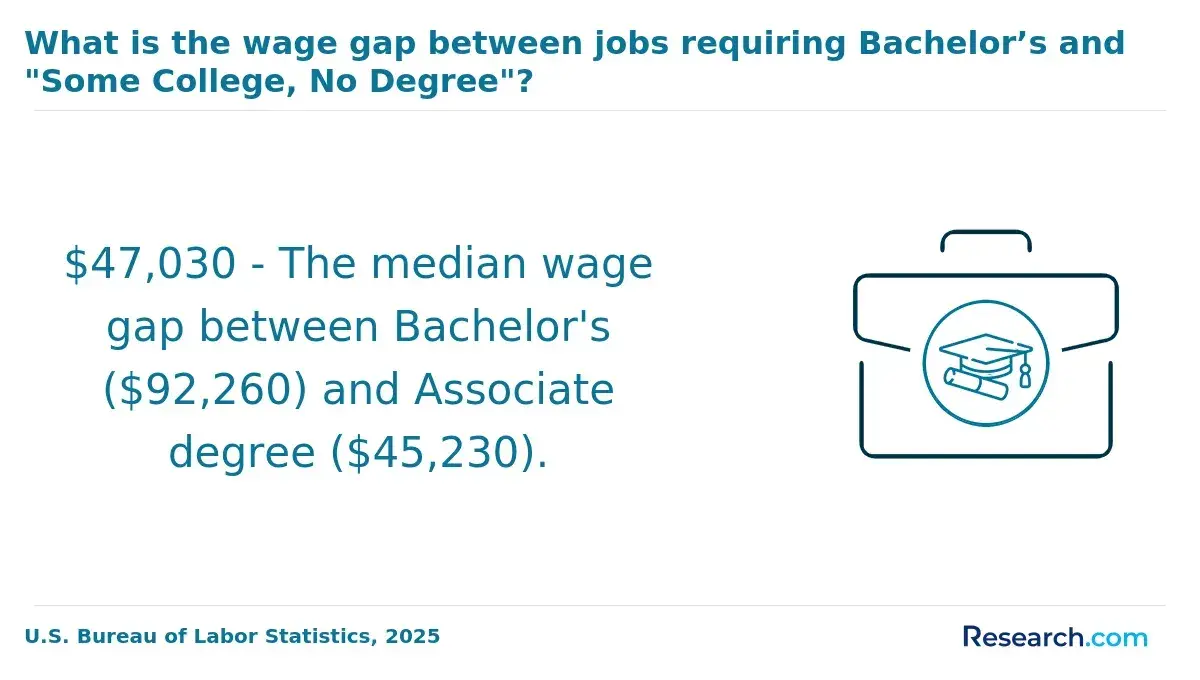
Occupational pay is a reference point for a career decision, not a forecast of what an associate graduate will earn. For example, the U.S. Bureau of Labor Statistics reports a May 2024 median annual wage of $93,600 for registered nurses. That figure covers workers across the occupation; it does not describe the earnings of pre-nursing students, and pre-nursing coursework alone does not qualify someone for RN licensure.
Job outlook also varies sharply among roles that sound related. Before relying on a growth projection, match it to a specific occupation, check its usual entry requirements, and consider local openings.
For a completion student, the practical return-on-investment question is whether the remaining cost and time move you toward that occupation or a planned next degree - not whether a national median wage looks attractive.
Which Certifications or Licenses Require an Associate Degree?
An associate degree may form part of the eligibility route for some professional licenses, but the credential itself does not grant one. An approved associate degree in nursing, for example, can be an educational pathway toward RN licensure; graduates must also meet state board requirements and pass the required licensing examination.
That route typically includes in-person clinical training, making it a poor fit for someone who cannot attend any physical site.
In less regulated fields, certifications may be optional or may have requirements independent of the degree. IT credentials can require exams; healthcare billing or information credentials have their own eligibility rules.
Check the relevant state board or certifying body before enrolling, especially if a school's marketing says its courses "prepare" students for a credential. Preparation is not the same as eligibility, certification, or licensure.
Other Things You Should Know About
Possibly, particularly in nonclinical fields. Get written confirmation that your exact degree plan has no campus attendance, and ask separately about local placements, labs, and proctored exams.
Not necessarily. A school may accept a course as elective credit without applying it to general education or major requirements. An official degree audit is the clearest way to see what remains.
No. Online courses may have fixed deadlines or required live meetings. Check the schedule for every remaining course, including how often it is offered.
Choose your career or transfer goal, gather transcripts, and ask prospective schools for transfer evaluations, complete remaining-cost estimates, and written confirmation of all in-person requirements.
References
- Recognition of Accrediting Agencies | Texas Higher Education Coordinating Board https://www.highered.texas.gov/recognition-of-accrediting-agencies/
- Cost of Attendance (Budget) | 2025-2026 Federal Student Aid Handbook https://fsapartners.ed.gov/knowledge-center/fsa-handbook/2025-2026/vol3/ch2-cost-attendance-budget
- Fully Online Programs - Blue Ridge Community College https://www.blueridge.edu/programs-courses/online-learning/online-programs/
- Tuition & cost of attendance | universityofcalifornia.edu https://admission.universityofcalifornia.edu/tuition-financial-aid/tuition-cost-of-attendance/
- How Long Does It Take to Finish an Online Degree? | NMSU Global Campus https://global.nmsu.edu/blog/general/how-long-does-it-take-to-finish-an-online-degree/
- Transfer Credit, Test Awards, Liberal Education... - UMN Admissions https://admissions.tc.umn.edu/admissions/transfer-admission/transfer-credit-evaluation/transfer-credit-test-awards-liberal
- Transfer Principles | Berkshire Community College https://www.berkshirecc.edu/academics/transfer-planning/transferprinciples.php
- Ways to Study Online - SUNY Empire State University https://sunyempire.edu/student-experience/studying-at-suny-empire/study-online.html
- Online | Coastline College https://www.coastline.edu/locations/online.php
- Academics: Section 3: Student Expectations and Responsibilities: Student Guidelines for the Classroom https://academics.waldenu.edu/handbook/student-expectations/classroom-guidelines


