Synup Review 2027: Pricing, Features, Pros & Cons, Ratings & More

Co-Founder and Chief Data Scientist
Synup: Top Reputation Management Software
4.3 / 5
Featured Reputation Management Software Alternatives for Synup

Custom
30 days
Automated review requests, sentiment analysis, analytics
Editor's Take
Birdeye is a comprehensive reputation management and customer experience platform that helps businesses manage online reviews, improve customer engagement, and drive growth. Designed for businesses of all sizes, Birdeye consolidates online reviews from major platforms like Google, Facebook, and Yelp into a single dashboard, allowing businesses to monitor and respond to customer feedback efficiently. This streamlined approach helps companies build a positive online reputation, enhance customer loyalty, and attract new customers.
Key features of Birdeye include automated review requests, sentiment analysis, and detailed analytics, giving businesses insights into customer satisfaction and areas for improvement. The platform also offers tools for managing social media, messaging, and surveys, enabling businesses to engage with customers across multiple channels. Additionally, Birdeye’s messaging functionality provides real-time chat and text messaging, improving communication and providing timely responses to customer inquiries.
Birdeye integrates with over 3,000 business applications, including CRM and POS systems, making it easy to sync customer data and automate feedback collection. For multi-location businesses, Birdeye offers location-based insights, allowing centralized management with the flexibility to tailor strategies for individual locations.
With a range of pricing plans and scalable features, Birdeye is a powerful tool for businesses looking to improve their online presence, foster customer trust, and enhance the overall customer experience.
Expert Score
In evaluating SaaS software, a comprehensive and structured methodology ensures a fair and accurate comparison across key metrics. This approach focuses on the most critical aspects that affect user experience, functionality, and business value. The following metrics—general features, cost, customer service, integrations, and mobile support—are evaluated to provide a holistic view of each software solution’s strengths and weaknesses. These metrics are selected based on their direct impact on software usability, scalability, and long-term effectiveness for businesses.
1. General Features - scoring weight 40%
This metric evaluates the core functionalities and tools the software offers. It involves assessing the comprehensiveness of the features, their relevance to the target users, and the ease of use. This is important because robust and well-designed features determine the software’s overall utility and efficiency in solving user problems.
2. Cost - scoring weight 15%
Cost analysis focuses on pricing models, value for money, and scalability. It’s crucial to evaluate whether the software’s features justify its price, considering different plans for small and large organizations. This is vital for businesses to ensure they invest in cost-effective solutions that fit their budget.
3. Customer Service - scoring weight 15%
This evaluates the responsiveness, quality, and availability of customer support, including channels like chat, email, or phone. Good customer service is essential for troubleshooting and ensuring smooth software usage, which reduces downtime and frustration for users.
4. Integrations - scoring weight 15%
This examines how well the software integrates with third-party tools (e.g., CRM, payment systems, collaboration apps). Seamless integrations are key for creating a unified workflow and enhancing productivity by connecting multiple systems, which is crucial for operational efficiency.
5. Mobile Support - scoring weight 15%
Mobile support assesses the software’s functionality and performance on mobile devices, including apps and mobile web versions. With increasing remote work and on-the-go usage, strong mobile support is critical to ensure users can access and utilize the software effectively, regardless of location.
Synup Review
What is Synup
Synup is an AI-powered local marketing and online reputation management platform designed for digital marketing agencies, multi-location businesses, franchises, resellers, and small businesses. It combines business listings management, local search engine optimization (SEO), review management, social media publishing, and answer engine optimization (AEO) within a centralized workspace.
The platform enables businesses to distribute location information across supported directories, monitor customer feedback, track geographically specific search rankings, and maintain a consistent digital presence. Agencies subscribed to Premium or higher plans can also deliver branded reports and provide clients with access to white-labeled marketing portals.
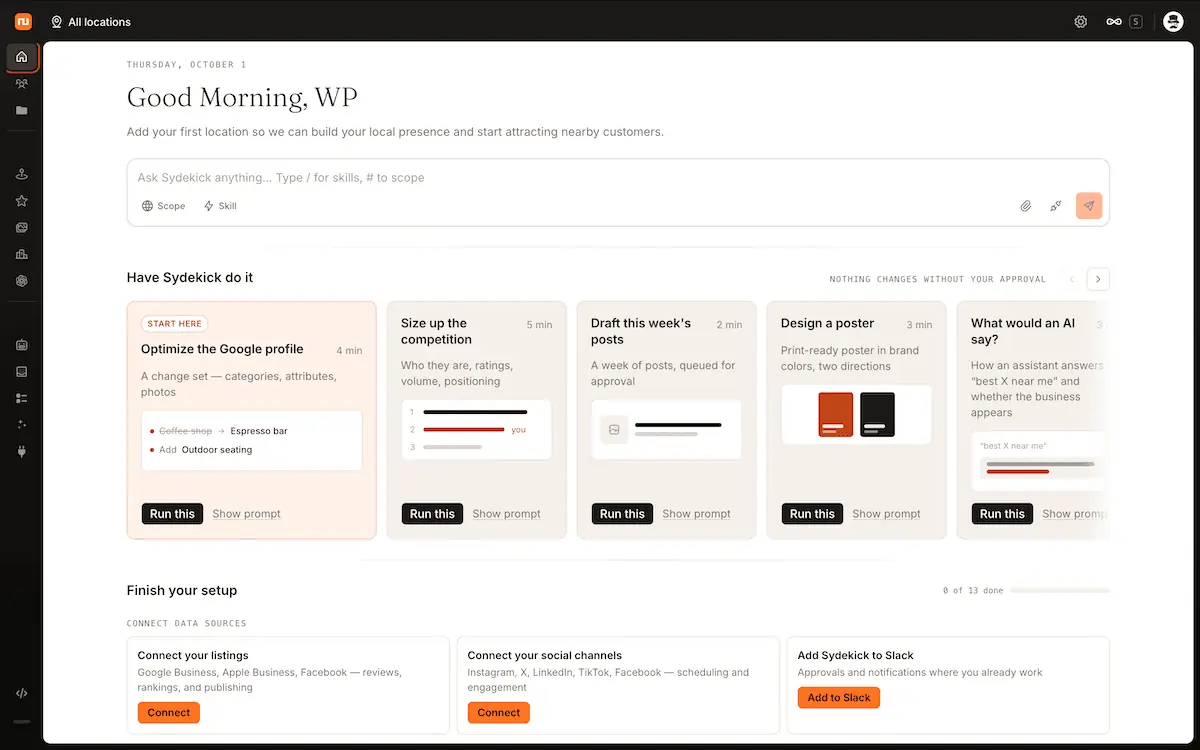
Synup's central selling point is Sydekick, its conversational AI marketing agent, which assists users in performing tasks such as updating business listings, drafting review responses, preparing social media content, and generating performance reports. Combined with its multi-location management infrastructure and white-label capabilities, Sydekick can consolidate recurring local marketing activities, although automation is subject to usage credits, permissions, publisher integrations, and approval requirements.
For those exploring comprehensive digital solutions, it may be useful to review the cloud based learning management system rankings, which provide comparative insights into cloud platforms that support diverse business needs.
What's New in Synup?
Synup introduced several updates in 2026, expanding its AI automation, social media management, listings protection, and external AI integrations.
Sydekick AI Marketing Agent
Introduced in August 2026, Sydekick enables users to manage listings, draft review responses, create social media content, and generate reports through natural-language instructions. Its customizable workflows and approval controls help agencies streamline recurring tasks while maintaining human oversight. However, approving content does not automatically publish it.
Centralized Social Inbox
Launched on September 28, 2026, Social Inbox centralizes direct messages from Facebook Messenger, Instagram, and X, allowing teams to manage customer conversations across multiple accounts. November updates added expanded notifications and LinkedIn message forwarding via email, although these capabilities remain in early access.
Multi-Client Publishing and Smart Scheduling
Synup's October 2026 updates introduced multi-client publishing, Smart Scheduling, and an expanded media library. These features help agencies distribute content across client accounts and coordinate publishing schedules using predefined rules and account-specific time zones rather than predicted engagement times.
Automated Monitoring and Google Edit Protection
Introduced in November 2026, Sweeps enables scheduled monitoring through natural-language instructions, while Google Edit Protection attempts to restore approved business information following unauthorized changes. Sweeps operates as a read-only monitoring tool, while Google Edit Protection excludes business addresses and remains subject to Google's approval processes.
Integration With Claude and ChatGPT
On November 23, 2026, Synup documented its integration with Claude and ChatGPT through the Model Context Protocol (MCP). Users can retrieve marketing data and prepare changes through conversational interfaces, simplifying information retrieval and account management. Access requires a Developer API plan or trial, with manual configuration required for ChatGPT.
Featured Reputation Management Software Products
Custom
30 days
Automated review requests, sentiment analysis, analytics
Editor's Take
Birdeye is a comprehensive reputation management and customer experience platform that helps businesses manage online reviews, improve customer engagement, and drive growth. Designed for businesses of all sizes, Birdeye consolidates online reviews from major platforms like Google, Facebook, and Yelp into a single dashboard, allowing businesses to monitor and respond to customer feedback efficiently. This streamlined approach helps companies build a positive online reputation, enhance customer loyalty, and attract new customers.
Key features of Birdeye include automated review requests, sentiment analysis, and detailed analytics, giving businesses insights into customer satisfaction and areas for improvement. The platform also offers tools for managing social media, messaging, and surveys, enabling businesses to engage with customers across multiple channels. Additionally, Birdeye’s messaging functionality provides real-time chat and text messaging, improving communication and providing timely responses to customer inquiries.
Birdeye integrates with over 3,000 business applications, including CRM and POS systems, making it easy to sync customer data and automate feedback collection. For multi-location businesses, Birdeye offers location-based insights, allowing centralized management with the flexibility to tailor strategies for individual locations.
With a range of pricing plans and scalable features, Birdeye is a powerful tool for businesses looking to improve their online presence, foster customer trust, and enhance the overall customer experience.
Expert Score
In evaluating SaaS software, a comprehensive and structured methodology ensures a fair and accurate comparison across key metrics. This approach focuses on the most critical aspects that affect user experience, functionality, and business value. The following metrics—general features, cost, customer service, integrations, and mobile support—are evaluated to provide a holistic view of each software solution’s strengths and weaknesses. These metrics are selected based on their direct impact on software usability, scalability, and long-term effectiveness for businesses.
1. General Features - scoring weight 40%
This metric evaluates the core functionalities and tools the software offers. It involves assessing the comprehensiveness of the features, their relevance to the target users, and the ease of use. This is important because robust and well-designed features determine the software’s overall utility and efficiency in solving user problems.
2. Cost - scoring weight 15%
Cost analysis focuses on pricing models, value for money, and scalability. It’s crucial to evaluate whether the software’s features justify its price, considering different plans for small and large organizations. This is vital for businesses to ensure they invest in cost-effective solutions that fit their budget.
3. Customer Service - scoring weight 15%
This evaluates the responsiveness, quality, and availability of customer support, including channels like chat, email, or phone. Good customer service is essential for troubleshooting and ensuring smooth software usage, which reduces downtime and frustration for users.
4. Integrations - scoring weight 15%
This examines how well the software integrates with third-party tools (e.g., CRM, payment systems, collaboration apps). Seamless integrations are key for creating a unified workflow and enhancing productivity by connecting multiple systems, which is crucial for operational efficiency.
5. Mobile Support - scoring weight 15%
Mobile support assesses the software’s functionality and performance on mobile devices, including apps and mobile web versions. With increasing remote work and on-the-go usage, strong mobile support is critical to ensure users can access and utilize the software effectively, regardless of location.
How much does Synup cost
Synup: Top Reputation Management Software
4.3 / 5
Synup offers four publicly priced subscription plans and a custom Enterprise option. Its pricing structure is based on the number of business locations managed, available usage credits, simultaneous AI conversations, and agent infrastructure requirements.
Synup includes its principal marketing modules across its paid subscription plans. However, white-label functionality requires Premium or above, while certain developer integrations, early-access features, and custom Enterprise capabilities are subject to additional eligibility or configuration requirements.
Solo — $49 per Month
The Solo plan is designed for independent businesses, individual professionals, and marketers managing one business location.
Key inclusions:
- Management of one business location
- Business listings distribution and synchronization
- Review monitoring and review generation
- Social media publishing
- Local SEO and AI visibility tracking
- Sydekick AI marketing agent
- 20,000 advertised promotional monthly credits, subject to eligibility
- One simultaneous AI agent conversation
- Custom-domain location landing pages
Crucial limitations: Solo does not include white-label functionality and uses shared agent infrastructure. Businesses managing more than one location must upgrade to a higher subscription tier. Shared infrastructure does not mean that customers share workspace data or account access; Synup states that these remain isolated.
Premium — $299 per Month
Premium is suitable for boutique digital marketing agencies, growing local businesses, and small franchise networks managing up to 10 locations.
Key inclusions:
- Management of up to 10 locations
- Core local marketing and reputation management tools
- White-label capabilities and branded client portals
- 200,000 advertised promotional monthly credits, subject to eligibility
- Three simultaneous AI agent conversations
- Shared agent infrastructure
Crucial limitations: Premium is capped at 10 locations and three concurrent agent conversations. Businesses requiring dedicated agent infrastructure must upgrade to Pro or above.
At full capacity, Premium costs $29.90 per location per month. For a business managing only two locations, the effective monthly subscription cost increases to $149.50 per active location.
Pro — $499 per Month
The Pro plan is intended for established marketing agencies and regional businesses managing larger portfolios of business locations.
Key inclusions:
- Management of up to 25 locations
- Core marketing and agency management features
- White-label client experiences
- 600,000 advertised promotional monthly credits, subject to eligibility
- Five simultaneous AI agent conversations
- Dedicated agent infrastructure
Crucial limitations: Pro is limited to 25 locations and five concurrent agent conversations. Additional credit purchases may be required when automation usage exceeds the included allocation. Dedicated infrastructure changes the account's agent environment rather than unlocking a separate set of core AI features.
At full capacity, Pro costs $19.96 per location per month.
Scale — $899 per Month
Scale is designed for larger digital marketing agencies, regional franchise networks, and multi-location brands requiring greater operational capacity.
Key inclusions:
- Management of up to 50 locations
- Dedicated agent infrastructure
- White-label marketing and reporting capabilities
- 1,200,000 advertised promotional monthly credits, subject to eligibility
- Ten simultaneous AI agent conversations
Crucial limitations: Scale has a maximum capacity of 50 locations. Organizations exceeding this limit must discuss a custom Enterprise arrangement with Synup.
At full capacity, Scale costs $17.98 per location per month.
Enterprise — Custom Pricing
Enterprise is designed for large agencies, national franchises, software resellers, and businesses requiring customized capacity for portfolios of 50 or more locations.
Key inclusions:
- Customized location capacity
- Custom usage credit allocation
- Configurable simultaneous agent conversations
- Dedicated agent infrastructure with customized computing and storage resources
- Bring Your Own Key (BYOK) support
- Bring Your Own Model (BYOM) support
- Customized end-client experiences
Crucial limitations: Enterprise pricing is not publicly disclosed and requires a negotiated contract. Buyers should confirm implementation costs, service-level agreements, support response times, and additional usage charges during procurement.
What Sets Synup Apart?
Synup differentiates itself through its combination of conversational AI automation, multi-location marketing infrastructure, white-label agency tools, and AI search visibility monitoring.
Conversational AI Task Execution
Synup's Sydekick agent extends beyond conventional AI writing assistance by supporting operational marketing workflows.
Users can request location updates, review responses, social media content, and performance reports through conversational instructions. Repeatable tasks can be configured through skills and playbooks, while approval settings provide oversight for applicable actions.
This approach is particularly useful for agencies that need to coordinate recurring marketing activities across numerous independent client accounts. Although competing platforms also offer AI-assisted execution, Synup includes Sydekick in its entry-level Solo subscription rather than restricting its core agent to higher-priced plans.
Integrated White-Label Agency Infrastructure
Synup provides white-label capabilities that allow agencies to present marketing services under their own branding.
Supported functionality includes branded client portals, reports, custom domains, outbound email branding, and agency-branded AI assistance. Agencies can customize Sydekick's client-facing name and avatar, allowing them to deliver local marketing services through a branded interface without developing their own software platform.
White labeling is available on Premium and higher subscriptions.
Combined Traditional and AI Search Optimization
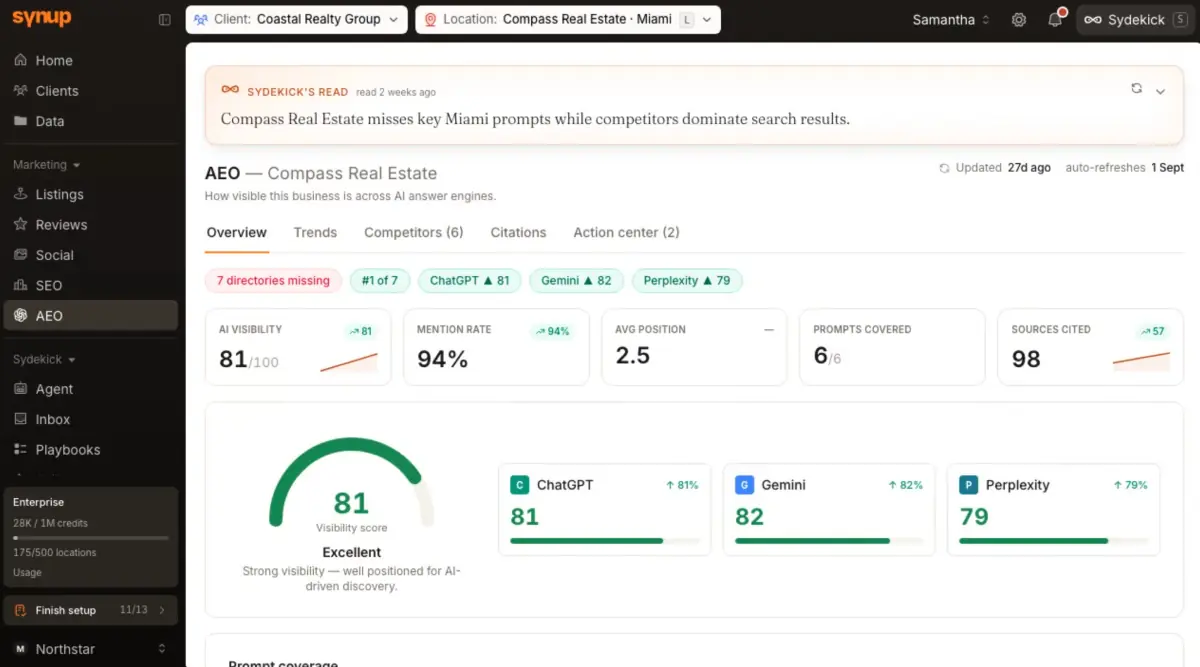
Synup combines conventional local SEO tools with beta answer engine optimization capabilities that evaluate how businesses appear in AI-generated search results.
Its location-level AEO documentation confirms monitoring across ChatGPT, Gemini, and Perplexity. Synup's broader product documentation also identifies Microsoft Copilot, although availability for newer AI services is being introduced progressively. Agencies can examine tracked AI visibility alongside conventional local rankings and business listings information.
This gives marketers an additional way to evaluate business discoverability as customers increasingly use conversational search tools. However, AI visibility scores do not guarantee recommendations or higher rankings.
Unified Location-Based Subscription Model
Synup includes its principal local marketing capabilities across its subscription tiers, with pricing primarily determined by location capacity and automation resources.
This bundled approach allows agencies to estimate base subscription expenses according to portfolio size rather than purchasing separate listings, reputation management, SEO, and social publishing modules from Synup. However, white-label eligibility, additional credit consumption, and unused location capacity affect the total cost of ownership.
What are the pros of Synup
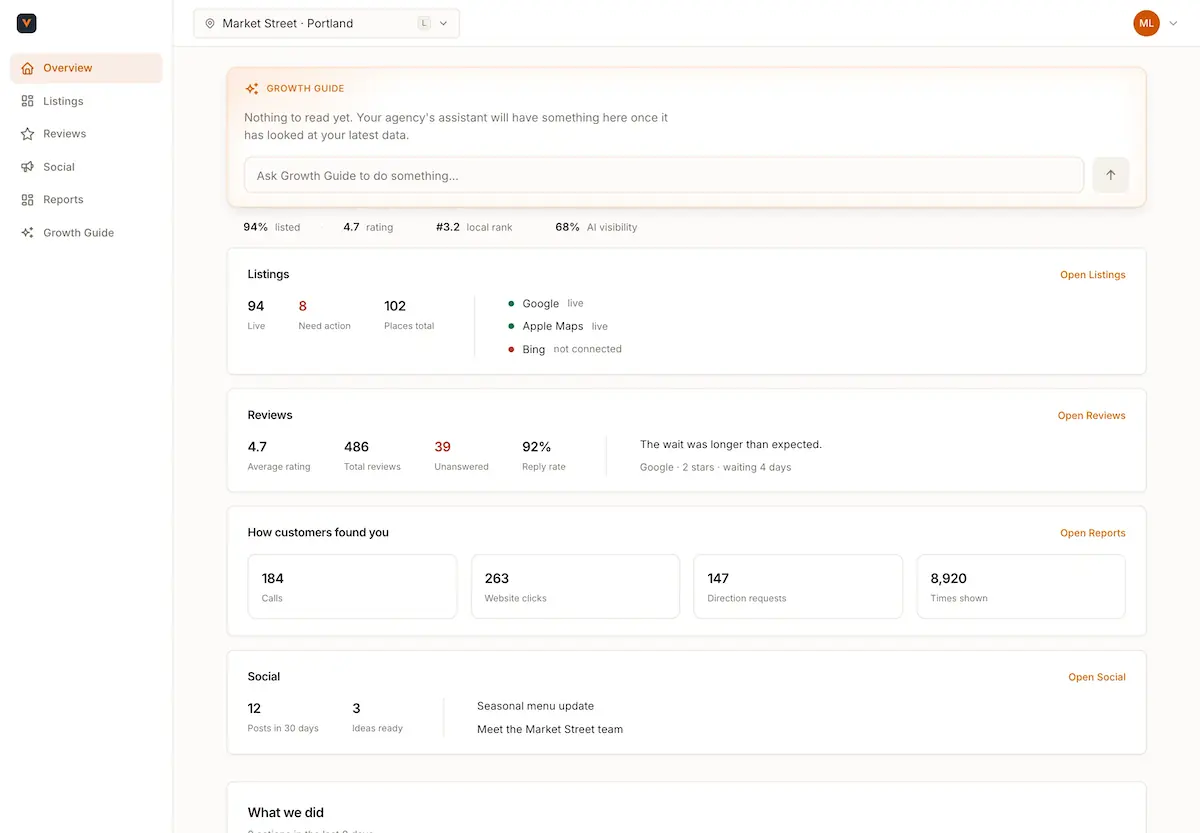
- AI-Assisted Marketing Execution: Sydekick can prepare content, coordinate listing updates, and generate reports through conversational instructions, potentially reducing repetitive administrative work across client accounts. A September 2026 G2 reviewer reported that Sydekick helped prepare social content drafts while the agency managed other marketing activities.
- Centralized Multi-Location Listings Management: Businesses can maintain names, addresses, telephone numbers, opening hours, and other profile information from a single workspace instead of updating each supported directory independently.
- Integrated White-Label Agency Tools: Branded portals, reporting, and AI assistance allow agencies to deliver local marketing services under their own identity without investing in proprietary software development.
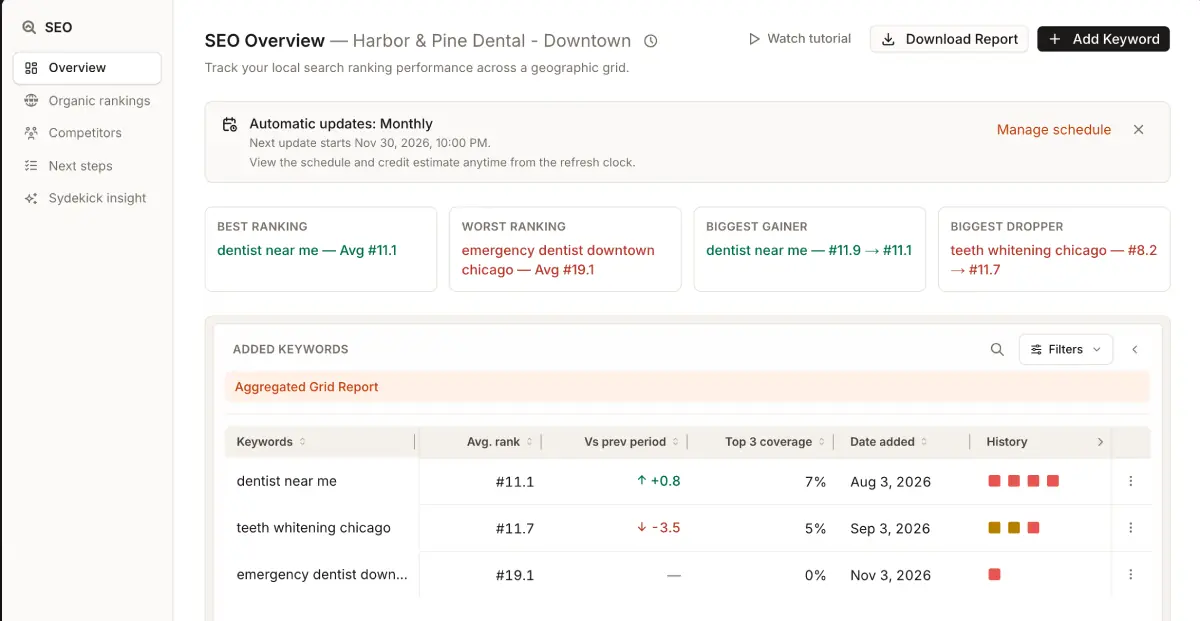
- Geographically Granular SEO Tracking: Local rank grids allow marketers to examine search visibility across different geographic points rather than relying solely on a citywide ranking average.
- AI Search Visibility Monitoring: Synup's beta AEO functionality helps agencies assess how frequently businesses appear in tracked AI-generated answers, examine their relative placement, and investigate citation gaps. These findings provide additional discovery metrics beyond traditional search rankings.
- Positive Customer Support Feedback: Some G2 reviewers report favorable experiences with Synup's technical assistance and responsiveness to feature requests. Capterra also displays a customer service rating of 4.2/5 based on its available review data, although negative experiences are reported and support quality may vary.
What are the cons of Synup
- Usage-Based AI Credit Restrictions: AI conversations, scheduled workflows, content generation, and other resource-intensive tasks consume credits. Agencies running frequent automation across many clients may incur additional expenses or experience paused agent workflows when their allocation is exhausted. The advertised promotional credit allocations are also subject to account eligibility.
- Substantial Pricing Increase for Small Portfolios: Businesses moving beyond one location must upgrade from the $49 Solo plan to the $299 Premium plan. This increases the monthly base subscription cost by $250, which may be difficult to justify for businesses managing only two or three locations.
- Restricted Direct Review Responses: Synup supports direct review publishing and integrated AI reply drafting for connected Google Maps and Facebook profiles. Reviews collected from platforms such as Yelp and TripAdvisor require users to visit the original review website to respond, limiting the convenience of centralized reputation management.
- Dependence on Third-Party Publisher Processing: Listing updates and corrections remain subject to external publisher requirements, verification processes, and approval delays. Businesses cannot assume that every submitted change will appear immediately across all directories. Even when Google Edit Protection is enabled, Google may review or reject a proposed correction.
- White-Label Functionality Excluded From Solo: Independent consultants and small agencies must subscribe to Premium or above to access white-label capabilities, even when they manage only one client location.
What are the core features of Synup
Synup: Top Reputation Management Software
4.3 / 5
Sydekick AI Marketing Agent
Sydekick is a conversational AI agent that assists with listings management, review responses, social media content, SEO, and reporting through natural-language instructions. Customizable workflows and approval controls help agencies automate recurring tasks while maintaining human oversight, subject to available usage credits.
Business Listings and Location Data Management
Synup centralizes and distributes business information across more than 100 publishers, according to the vendor, including Google, Apple, Bing, Facebook, and Waze. This helps multi-location businesses maintain consistent contact details, operating hours, and business information, although publisher availability varies by geographic market.
Reputation Management and Review Generation
Synup centralizes customer review monitoring, review generation, and AI-assisted response drafting to help businesses manage their online reputation. Direct review responses are supported for connected Google Maps and Facebook profiles, while other review sources require users to respond through the original platform.
Local SEO and Geographic Rank Tracking
Synup provides geographic rank grids, keyword tracking, visibility scores, and competitor analysis to measure local search performance. These tools help marketing agencies identify location-specific visibility gaps and prioritize SEO strategies across different neighborhoods and service areas.
Answer Engine Optimization and AI Visibility
Synup's beta AEO tools monitor business visibility, relative rankings, sentiment, and citations across supported AI search platforms. Its AI Visibility Score measures the frequency and prominence of business mentions in sampled responses, helping marketers assess discoverability beyond traditional search engines. AEO reports consume usage credits.
Social Media Management and Publishing
Synup combines social media content creation, scheduling, multi-client publishing, media management, and centralized messaging within one platform. Its AI-assisted drafting and scheduling tools help agencies coordinate campaigns across client accounts, although supported capabilities vary by social network.
Agency Management, Client Portals, and Reporting
Synup provides multi-client management, role-based permissions, client portals, performance reporting, and developer API capabilities. White-label customization is available on Premium and higher plans, enabling agencies to deliver branded marketing services, manage client access, and communicate performance through a centralized platform.
Benefits of using Synup
Increased Marketing Operational Efficiency
Synup combines listings management, reputation monitoring, social publishing, and local SEO reporting within one platform. Its AI-assisted workflows can reduce repetitive administrative tasks, allowing agencies to dedicate more time to client-specific marketing strategies.
Improved Business Information Accuracy
Centralized listings management helps businesses maintain consistent contact details, opening hours, and business descriptions across supported directories. Its monitoring and correction tools help identify discrepancies, reducing the risk of customers encountering outdated information.
More Consistent Customer Review Management
Synup centralizes customer feedback and provides AI-assisted review responses for connected Google Maps and Facebook profiles. Approval workflows help businesses maintain consistent brand communication while identifying location-specific customer service concerns.
Better Understanding of Local Search Performance
Geographic rank tracking, competitor analysis, and AI visibility monitoring help businesses identify local search performance gaps. These insights enable marketing teams to prioritize optimization efforts and allocate resources based on location-specific requirements.
Potential Reduction in Software Expenditure
Synup's integrated marketing tools may reduce the need for separate software subscriptions. At full location capacity, monthly costs decrease from $49 per location on Solo to $17.98 on Scale, excluding additional credit expenses.
Expanded Agency Service Offerings
Synup's white-label capabilities, available on Premium and higher plans, enable agencies to deliver branded local SEO, reputation management, and social media services. This supports recurring service offerings without requiring proprietary software development.
Improved Client Reporting and Accountability
Synup consolidates listings activity, customer feedback, and search visibility metrics into client-facing reports and portals. These tools help agencies communicate marketing performance, demonstrate completed activities, and identify optimization opportunities without equating profile interactions with confirmed sales.
Our expert take on Synup
What stands out about Synup is its evolution from a local SEO and listings management solution into a comprehensive AI-powered local marketing platform. Its ability to synchronize business information across more than 100 supported publishers, according to the vendor, remains a core strength. However, the introduction of Sydekick, its conversational AI marketing agent, adds another dimension by enabling businesses to delegate recurring marketing tasks, prepare content, and generate performance reports through natural-language instructions.
Another noteworthy aspect is Synup's combination of geographic rank tracking, reputation management, and answer engine optimization (AEO). These capabilities help businesses evaluate their visibility across traditional search engines and emerging AI search platforms. Its centralized Social Inbox and multi-client publishing tools also provide practical advantages for agencies managing several accounts. However, direct review responses remain limited to connected Google Maps and Facebook profiles, restricting the convenience of centralized reputation management.
From a technical standpoint, features such as Sweeps and Google Edit Protection strengthen Synup's monitoring and listings management capabilities. Nevertheless, its credit-based automation model introduces an important cost consideration, particularly for agencies running frequent AI-assisted workflows. Businesses must also account for third-party publisher processing times, beta feature limitations, and the need for human oversight of AI-generated content.
Considering Synup's pricing, feature coverage, and white-label capabilities, I consider it particularly suitable for digital marketing agencies, franchises, and multi-location businesses. While the $49-per-month Solo plan provides an accessible entry point for single-location businesses, the jump to $299 per month for Premium may be difficult to justify for smaller portfolios. Overall, Synup offers a compelling combination of local marketing automation and agency management tools, provided that businesses can sufficiently utilize their subscription capacity and manage their AI credit consumption.
While exploring various digital solutions, I also came across an insightful article on what are the best CMS software, which could be useful for those looking to complement their local SEO efforts with a strong content management system. It’s worth checking out to understand how different software tools can work together harmoniously in digital marketing.
What business types use Synup
Digital Marketing and Local SEO Agencies
Digital marketing agencies can use Synup to manage listings, monitor reviews, track rankings, and schedule content across multiple clients. Its white-label infrastructure supports recurring local marketing services and branded client reporting.
Franchise and Multi-Location Retail Businesses
Franchises and retail chains can use Synup to maintain consistent brand information while managing location-specific contact details, operating hours, and promotions. Centralized monitoring helps headquarters identify branches with declining search visibility or unresolved customer feedback.
Healthcare Clinics and Dental Practices
Healthcare providers can use Synup to maintain accurate practice listings, monitor public reviews, and track local search visibility. Organizations must verify applicable privacy requirements and ensure public review responses do not disclose protected patient information.
Restaurants and Hospitality Businesses
Restaurants, hotels, and hospitality chains can use Synup to update business information, coordinate promotions, and monitor guest feedback across locations. However, responding to reviews from platforms such as Tripadvisor requires visiting the original review website.
Home Service and Professional Service Businesses
Contractors, law firms, and real estate businesses can use Synup to maintain accurate listings, monitor geographically specific search rankings, and manage customer feedback. Businesses publishing multiple service areas should account for Synup's location-based billing requirements.
For businesses exploring comprehensive management solutions, consulting resources like what is the best cmms software can provide valuable insights into optimizing operational tools alongside platforms like Synup.
Top 5 Alternatives to Synup
While Synup combines AI-powered local marketing automation with agency management tools, competing platforms offer specialized capabilities in local SEO, enterprise data management, customer experience, and franchise marketing.
1. BrightLocal
BrightLocal specializes in local SEO audits, citation building, geographic rank tracking, and reputation management. Unlike Synup's broader marketing automation approach, BrightLocal emphasizes detailed search diagnostics and separately purchased citation-building services. Its MCP integration with Claude also supports conversational SEO tasks for eligible Grow subscribers.
2. Yext
Yext is a digital presence management platform specializing in enterprise-level business data governance. Its Knowledge Graph distributes structured information across a reported network of more than 200 publishers and service providers. Compared with Synup's agency-oriented workflows, Yext emphasizes centralized control of complex business information.
3. Birdeye
Birdeye combines reputation management, listings, customer messaging, surveys, and AI-powered automation. Unlike Synup's emphasis on local marketing and agency service delivery, Birdeye extends into appointment management, front-desk operations, and support ticketing, making it suitable for businesses requiring broader customer experience management.
4. Uberall
Uberall provides multi-location listings management, reputation monitoring, local social publishing, and AI search optimization. Compared with Synup, Uberall emphasizes enterprise store discovery through customizable locators, local landing pages, and a reported network of more than 200 directories, making it suitable for international retailers and franchises.
5. SOCi
SOCi is an AI-powered multi-location marketing platform specializing in distributed brand management. Unlike Synup's emphasis on independent agency clients, SOCi supports centralized, decentralized, and hybrid franchise marketing models through its Genius AI agents, location-specific automation, and corporate brand governance controls.
Best 1 alternatives to Synup
Birdeye
4.9 / 5
Birdeye is presented as a solution in the online reputation management software space, positioned to serve businesses that prioritize maintaining a strong digital image. Although the source overview provided is incomplete, the product’s categorization hints at capabilities designed to support the management of online brand presence. The brief description suggests that Birdeye is intended to help companies navigate the challenges of digital reputation, offering a potential asset for those seeking to refine their online interactions. For prospective customers evaluating reputation management platforms, Birdeye emerges as a candidate warranting further investigation to determine its fit with their strategic objectives.
Frequently Asked Questions about Synup
Synup is used to manage business listings, customer reviews, social media publishing, local SEO, and AI search visibility. Its Sydekick AI agent also assists businesses and agencies with recurring local marketing tasks.
Synup starts at $49 per month for one location, with Premium priced at $299, Pro at $499, and Scale at $899 per month. Annual billing carries an advertised 20% discount, while Enterprise subscriptions and additional usage credits may incur separately determined charges.
Synup offers a 14-day free trial of its Solo plan but does not advertise a permanent free subscription. White-label functionality requires a paid Premium subscription or higher.
Synup supports local SEO through business listings management, geographic rank tracking, review management, and competitive analysis. These features help businesses identify and address local visibility issues, but they do not guarantee higher search rankings.
Synup is worth considering for agencies that manage multiple business locations and require integrated local marketing automation, white-label client portals, and reputation management. Its suitability depends on the number of locations managed, automation credit consumption, reporting requirements, and overall service delivery costs.
Yes, Synup is appropriate for small businesses. It offers scalable solutions suitable for varying business sizes, allowing small enterprises to manage their online presence efficiently. Its user-friendly interface and comprehensive features, such as listing management and performance analytics, make it an ideal choice for businesses seeking to enhance their digital footprint without overwhelming resources.
Synup has mobile apps that let users manage listings, monitor reviews, and view analytics while on the move.
Data security is maintained through industry-standard practices such as encryption and secure access protocols to safeguard business information.
Yes, Synup includes tools for monitoring local SEO success, including keyword rankings and visibility measurements.